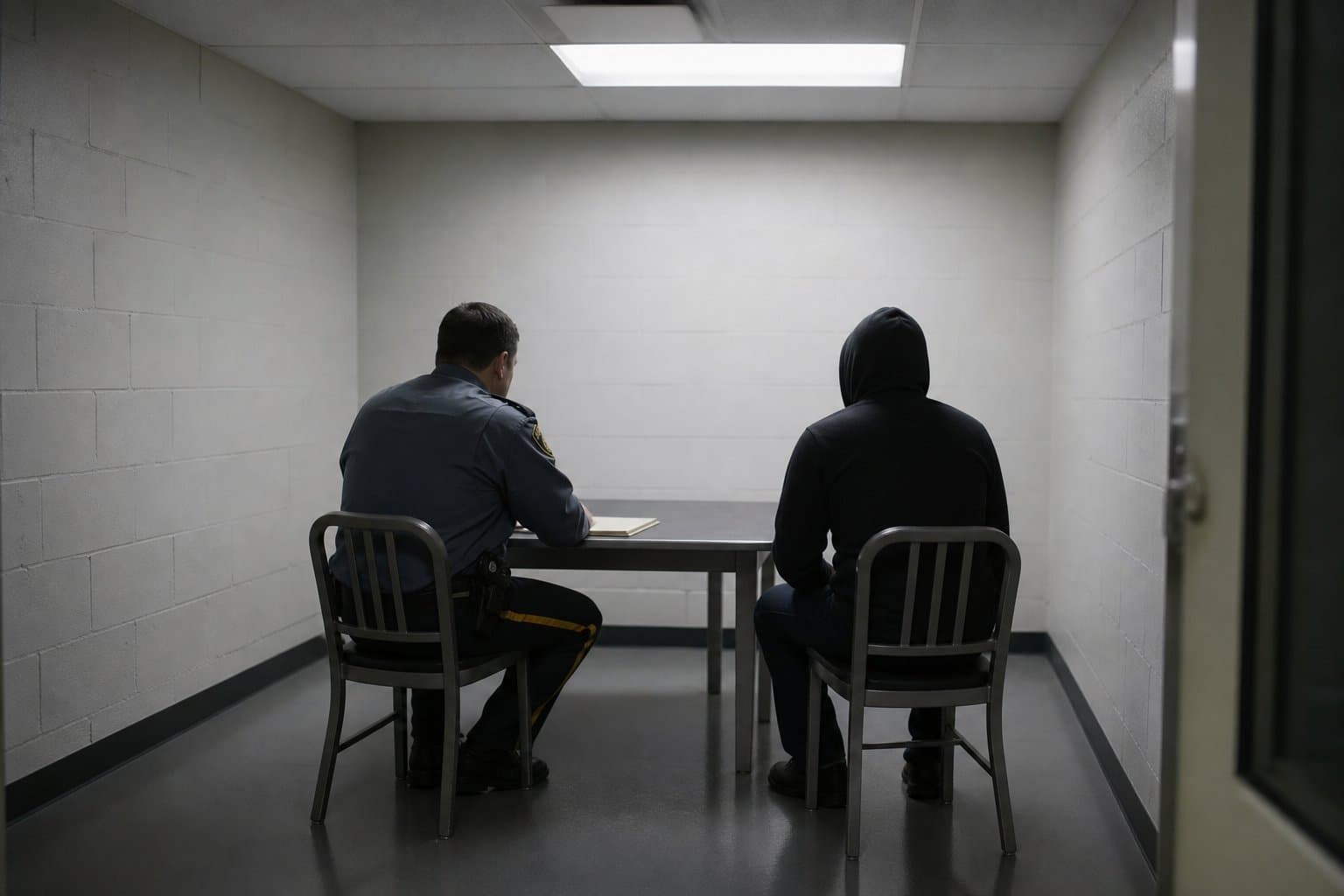
AI image
Alaska Supreme Court rules: Officers Must Stop at Unclear Lawyer Requests
A Stricter Standard for Police Interrogations
Police across Alaska must stop questioning a suspect who makes an unclear request for a lawyer, the Alaska Supreme Court ruled Friday, even if the suspect already waived Miranda rights. The standard is stricter than federal law, and it leaves a first-degree murder conviction from Kodiak reversed.
Under the "stop and clarify" rule, officers must halt the interrogation and find out whether the suspect wants an attorney, asking only "ministerial and non-adversarial questions that do not seek to persuade the suspect to forgo counsel." It governs every custodial interrogation in the state: Alaska State Troopers, municipal police, village police officers and any other agency.
Justice Oravec wrote for a unanimous court that included Chief Justice Carney and Justices Borghesan, Henderson and Pate, grounding the rule in article I, sections 9 and 11 of the Alaska Constitution. Under Davis v. United States, decided by the U.S. Supreme Court in 1994, officers may keep questioning unless a suspect asks for a lawyer clearly and unambiguously. The State of Alaska asked the court to adopt that federal standard. The court declined.
The Kodiak Interrogation
In November 2015, Steven Ridenour waived his Miranda rights and began describing the shooting of his coworker, Steven McCaulley, at a remote Kodiak work site. He stopped and said, "So . . . (sighs) . . . should I do this without an attorney?" A trooper asked what that meant. Ridenour repeated the question and added, "Am I hanging myself here?"
The troopers continued. One said they could not advise him "one way or the other what you can or should or shouldn't do legally," reminded him he could stop at any time, then explained why his account mattered: "if we don't get from you what happened we won't know where to look for what. You know, if you tell us you use the shotgun over here we need to know that so we can go over here and look for shotgun shells."
Ridenour kept talking, describing shooting McCaulley while he was face down and saying he "went overboard" and was "[t]rying to put [him] out of his misery." Those statements went to the jury. He was convicted of first-degree murder, attempted first-degree murder, first-degree assault and evidence tampering, the middle two merging into the murder count, and sentenced to 75 years with 15 suspended plus a consecutive two years.
The court found the troopers tried to clarify whether Ridenour wanted to stay silent, but not whether he wanted a lawyer. Their statements "implied conditional willingness to develop exculpatory evidence" and "did not reasonably and responsively clarify Ridenour's intent."
At the suppression hearing, officers said "lawyer" is a buzz word during interrogations and that "it's our obligation to clarify the nature of the comment." The superior court denied suppression anyway, finding the initial waiver sufficient.
Roots in a 1981 Ruling
In Giacomazzi v. State, decided in 1981, the court held that an officer facing an equivocal statement about counsel may seek clarification but may not use "the guise of clarification as a subterfuge for coercion or intimidation." That decision rested on the federal constitution and stopped being federal law after Davis. The Court of Appeals held in 2023 that it remained correct under the state constitution and reversed Ridenour's convictions. Friday's decision affirms that ruling. The opinion also draws on Justice Jay Rabinowitz's dissent in the 1981 case, which argued that "the individual who remains passive loses his rights."
The court settled two further points. The right may be invoked "in any manner and at any stage of the process," so it makes no difference whether a suspect speaks up before or after waiving. And the State's burden does not shift after a waiver: "the burden remains on the State to demonstrate waiver of a constitutional right."
The State argued the federal rule was more workable, that officers' judgment would otherwise be second-guessed and voluntary statements suppressed, and that restricting questioning of suspects who do not actually want a lawyer is "detrimental to public safety." The court was not persuaded. Assistant Attorney General Diane L. Wendlandt of the Office of Criminal Appeals argued for the State under then-Attorney General Treg Taylor, whose name appeared on the filings before he stepped down in August 2025. The Innocence Project filed a brief supporting Ridenour. The opinion cites Connecticut, which reached a comparable result in 2019, and Maine, which adopted a stop and clarify rule in 2025.
What Remains Unresolved
The opinion does not use the word retroactive and does not address convictions already final. It says nothing about whether Ridenour will be retried, a decision for prosecutors in Kodiak. No record reached counts how many pending or closed Alaska cases involve statements taken after an ambiguous request for a lawyer.
This account draws on the written opinion and the Alaska Court System's weekly slip opinion notice, which contain no comment from the Department of Law, the Department of Public Safety, the Public Defender Agency, Ridenour's counsel, or the family of McCaulley, shot at the work site in 2015. Whether trooper training has changed since 2023 is not in the record.
Source: Alaska Court System, A Kodiak murder suspect asked "should I do this without an attorney?" The troopers kept going, and the Alaska Supreme Court has now made that unlawful in every interrogation in the state.
Made by our human newsroom with AI. How humans and AI work here · Grow with our newsroom
Stay informed. Support what matters.
Free, permanent access to local news you can verify. Subscribe to support Walter AlaskaNews and go ad-free.
Related Coverage
A murder conviction is reversed because a suspect's question about a lawyer wasn't enough for police to stop
Alaska News · 2mo ago
Alaska must appoint lawyers for people jailed on other states' warrants, appeals court rules
Alaska News · 3w ago
The state must bridge the language gap before ending parental rights, court says
Alaska News · 3mo ago
Alaska Supreme Court upholds ICWA termination, clarifies standards
Alaska News · 4mo ago
Alaska appeals court identifies DUI jury instruction tension in Homer case
Alaska News · 3mo ago
Comments
Sign in to leave a comment.
No comments yet. Be the first to share your thoughts.