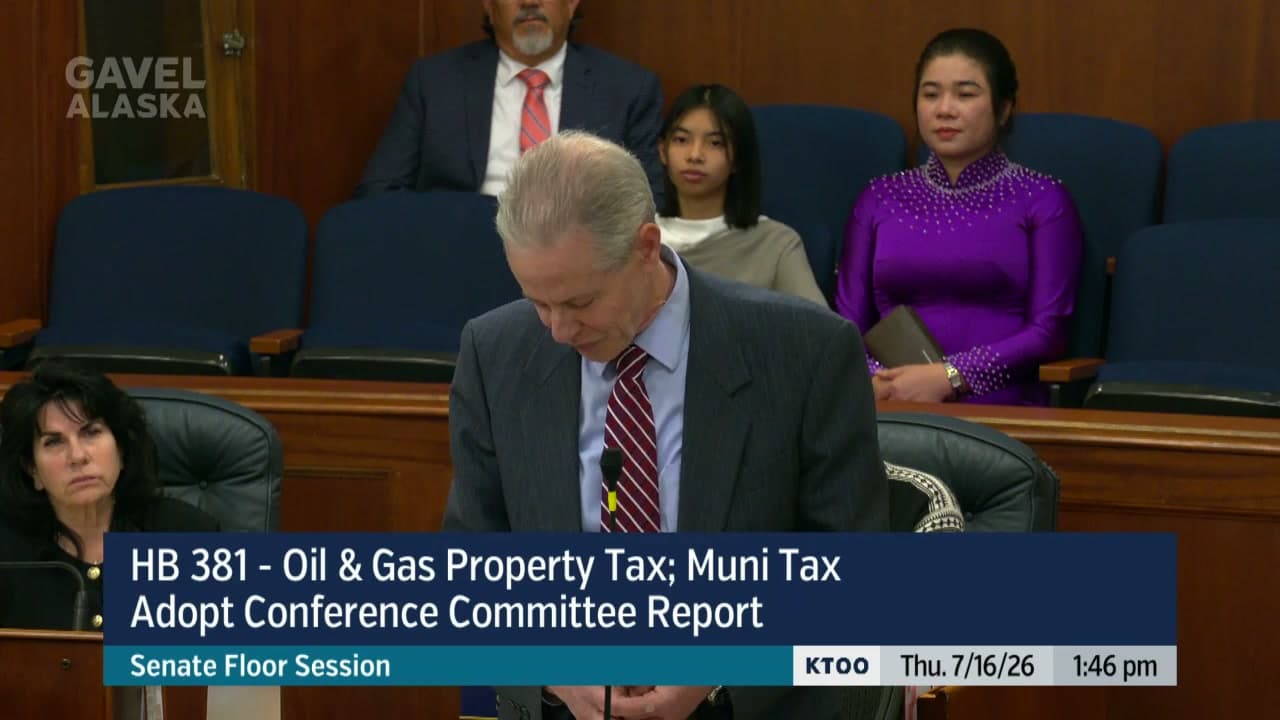
Alaska Senate passes HB 381 oil and gas tax bill 11-8, with dissenters signaling more work ahead
The Alaska State Senate passed the conference committee substitute for House Bill 381 on an 11-8 vote Thursday, advancing legislation that dissenters said still carries unresolved questions about a new income tax on pass-through oil and gas entities that could affect the economics of the Alaska LNG project. The effective date clause passed unanimously, 19-0.
HB 381 is the primary enabling legislation for the AK LNG gasline project, covering oil and gas property taxes, municipal tax structures, and the Alaska Gasline Development Corporation. The bill's most contested element is a provision that would impose a new income tax on oil and gas companies structured as pass-through entities, such as S corporations and limited liability companies. Supporters, including Sen. Bill Wielechowski, argued Alaska could be forgoing roughly $100 million to $150 million a year by leaving those entities untaxed. The Department of Revenue estimated the provision could generate between zero and $100 million per year under existing production, with its fiscal impact listed as indeterminate because detailed tax liability data for the affected companies is unavailable. Under a full AK LNG buildout, the department projected the pass-through tax would generate about $102 million in added revenue in 2033, averaging a little over $90 million annually after that.
Critics argued the provision singles out one or two North Slope operators while leaving more than 11,000 similarly structured Alaska businesses untouched. Sen. Matt Claman, who initially indicated he would vote no but changed his vote to yes before the final tally, pushed back on the loophole framing. "it's not a Hillcorp loophole, it's almost every business in Alaska loophole," he said. "The only real exception is marijuana businesses." Claman also said he was concerned that the Department of Revenue did not testify during the conference committee meeting that morning, and described the bill as far less than perfect and one that raises more questions than answers in some respects.
Sen. James Kaufman argued the S corporation question should have been handled separately. The measure, Kaufman said, "became instead a bit of an attack on the ongoing situation that we have. If we want to try and resolve our tax structure broadly with respect to the S corp, that's a worthy issue. Do it separately."
Sen. Robert Yundt called the bill "arguably the fourth most consequential piece of legislation in the history of the state behind statehood, TAPs, and the PFD," but said it was not ready and voted no. "We need to change its diaper. Does that mean another special session? Does that mean the powers of free conference? I'm not quite sure, but I know everyone here is willing and ready to get back after it," Yundt said. Both Yundt and Kaufman said they hoped further work on the bill remained possible.
This article is based on a public meeting — Alaska Legislature: Senate Floor Session - July 16, 2026 11:00am ().
Made by our human newsroom with AI. How humans and AI work here · Grow with our newsroom Transcript byLucas Brown
Watch key moments from the source meeting. Click to expand.
Stay informed. Support what matters.
Free, permanent access to local news you can verify. Subscribe to support Walter AlaskaNews and go ad-free.
Related Coverage
Alaska Senate passes S-corp LNG tax with 2028 effective date
Alaska News · 3mo ago
Conference draft keeps oil-and-gas pass-through tax, delays it to 2029
Alaska News · 3mo ago
Alaska's gas-pipeline bill now carries a tax on Hilcorp and others
Alaska News · 3mo ago
Alaska LNG tax bill advances to floor on split conference committee votes
Alaska News · 3mo ago
Senate passes gas-line bill; Dunleavy immediately calls lawmakers back to rewrite it
Alaska News · 3mo ago
Comments
Sign in to leave a comment.
No comments yet. Be the first to share your thoughts.