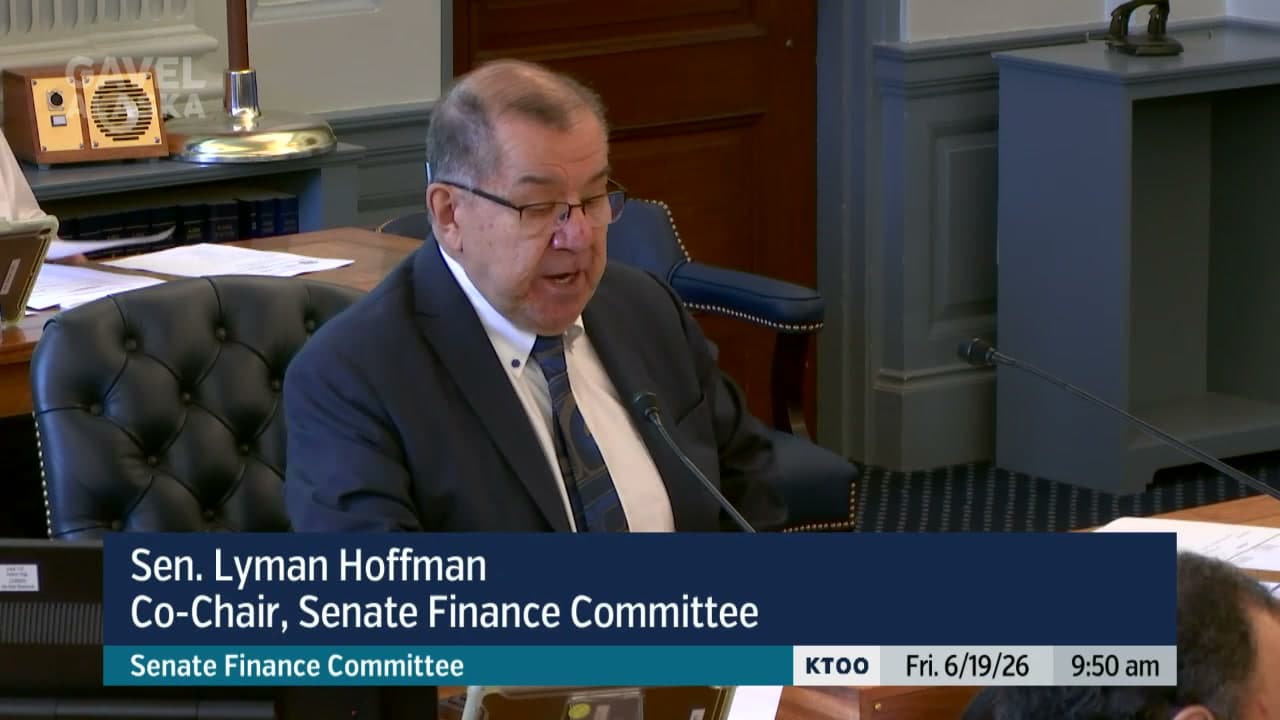
Frame from "Alaska Legislature: Senate Finance - June 19, 2026 9:01am" · Source
Alaska Senate Finance advances LNG tax bill on final day of session
The Alaska Senate Finance Committee voted 7-0 Friday to advance a rewritten tax bill for the Alaska LNG project, replacing a capital-expenditure formula with fixed per-unit rates and adding termination conditions for the tax abatement and alternative volumetric tax tied to hard project deadlines.
The committee first adopted a committee substitute before voting to move the bill to the full Senate floor, where amendments are expected.
Fixed Rates Replace Capital-Expenditure Formula
The committee substitute sets Phase 1 at 6.2 cents per thousand cubic feet, covering the pipeline to the Mat-Su Borough, and Phase 2 at 10.6 cents, adding the Cook Inlet crossing, the Nikiski terminal, and an expanded North Slope gas treatment facility. Pete Eklund, staff to Chair Lyman Hoffman, called the rate change the most significant in the bill.
"The most significant change is that the committee substitute in front of you does not use capital expenditures as a component of the tax rate or the collection of the tax. Instead, it returns to a single tax rate at each stage of the project," Eklund said.
The bill sets a final investment decision deadline of January 1, 2028, and requires pipeline construction to be complete by December 31, 2032. Missing either deadline voids the tax relief.
Senator James Kaufman raised concern about the construction timeline. "We've got a big question on page 27 with respect to the construction timeline of it possibly being a deal killer with respect to finance," he said.
Chair Lyman Hoffman said the committee moved the bill Friday to give members time to prepare amendments before the full Senate takes it up. "The reason that we're proceeding today with passing the committee bill out is so that we have ample time for members to draft any amendments that that they may see fit to improve the legislation for consideration of the full body," Hoffman said.
Senator Bert Stedman said the legislature could revisit the deadlines if unforeseen circumstances slowed construction, as long as the project met the investment decision date. "I think if they meet the previous date of final investment decision by January 1st of '28 and start construction, I think there'd be probably be some flexibility by the legislature in the event that there was some unforeseen black swan events or something that messed up the construction, slowed it down intentionally, or whatever to, you know, we can change these and modify these going forward. This is not in the Constitution," Stedman said.
AI-assisted, reviewed by editors. Spot an error?
Watch key moments from the source meeting. Click to expand.
Comments
Sign in to leave a comment.
No comments yet. Be the first to share your thoughts.