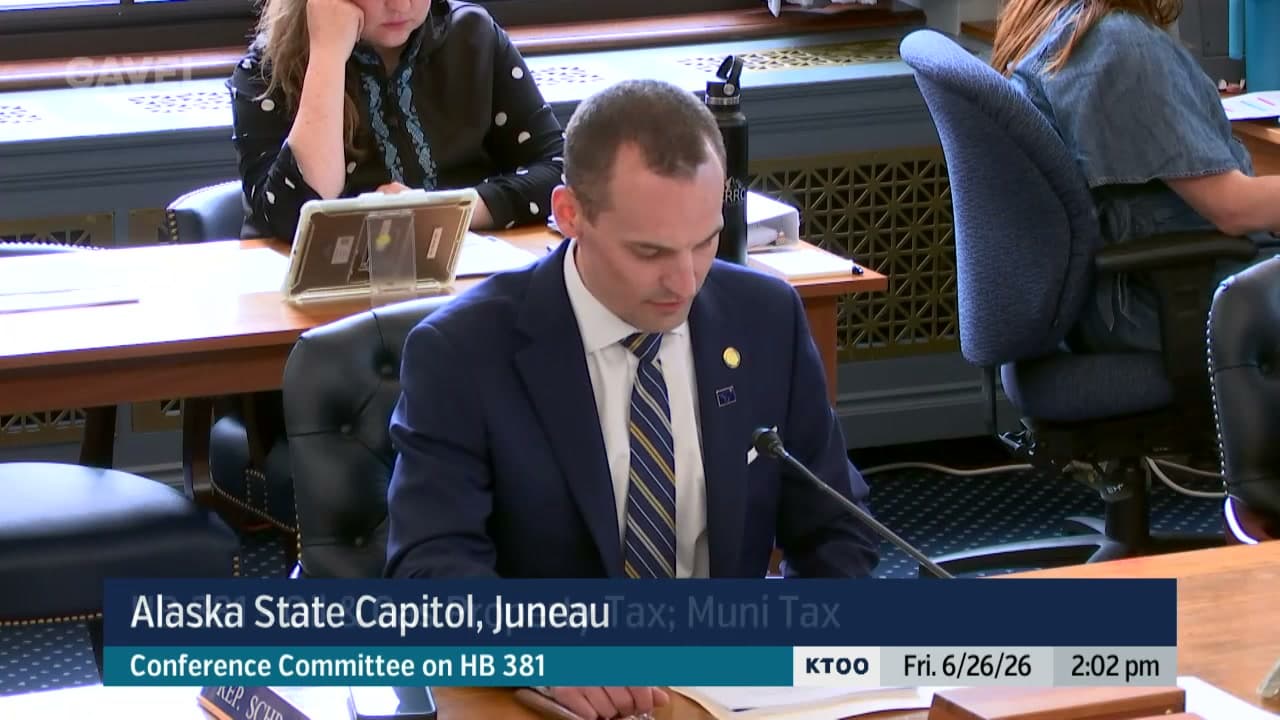
Frame from "Alaska Legislature: JHB381-260626-1400" · Source
Alaska LNG conference committee deadlocks, seeks free conference powers
The Alaska LNG tax bill conference committee deadlocked Friday, with House and Senate members each voting down the other body's version of the legislation, forcing the panel to seek expanded negotiating authority to write a compromise using limited powers of free conference.
Representative Calvin Schrage, the committee chair, announced the path forward after both votes failed. "Having not adopted either the House or Senate versions of HB 381, and after consultation with the presiding officers, the committee will proceed with its work under the expectation that limited powers of free conference will formally be granted later in the process when the bodies reconvene and before the adoption of the final committee reports by both bodies," Schrage said. Under those powers, the committee can adopt any language, dates, or effective dates subject to conference.
The votes did not split cleanly along body lines. When Speaker Bryce Edgmon moved to adopt the House version, all three Senate members voted no, and two of the three House members also voted no, with only one House yes vote recorded. The motion failed. When a senator moved to adopt the Senate version, all three House members voted no, while the Senate delegation voted 3-0 in favor. Because each body required a majority, the Senate version also failed to be adopted.
Following the failed votes, the committee formally requested limited powers of free conference on language that is not identical in the House and Senate versions of HB 381.
The six-member committee includes Senators Lyman Hoffman, Bert Stedman, and Mike Cronk on the Senate side, and Edgmon, Schrage, and Representative Justin Ruffridge on the House side.
Schrage outlined a working plan after the votes. The committee will start from the Senate Finance Committee version of the bill, which he said largely mirrors and builds on what the House passed. "From there, we will move on to amendments adopted on the Senate floor, which I expect will form the basis of most of our decision-making," Schrage said.
What the Tax Framework Requires
Under the bill's own terms, the alternative volumetric tax and property tax abatement take effect only if the project developer reaches a final investment decision before January 1, 2028, completes pipeline construction by the end of 2032, and has at least one component in operations by 2037. If any of those deadlines are missed, the tax framework lapses, reverting the project to current property tax law.
The $44 billion Alaska LNG project would move North Slope natural gas through a pipeline to Southcentral Alaska and an export terminal on the Kenai Peninsula. The Alaska Gasline Development Corporation and developer Glenfarne briefed the committee Friday on the Senate Finance version of the bill, followed by a Department of Revenue fiscal modeling presentation.
AI-assisted, reviewed by editors. Spot an error?
Watch key moments from the source meeting. Click to expand.
Comments
Sign in to leave a comment.
No comments yet. Be the first to share your thoughts.