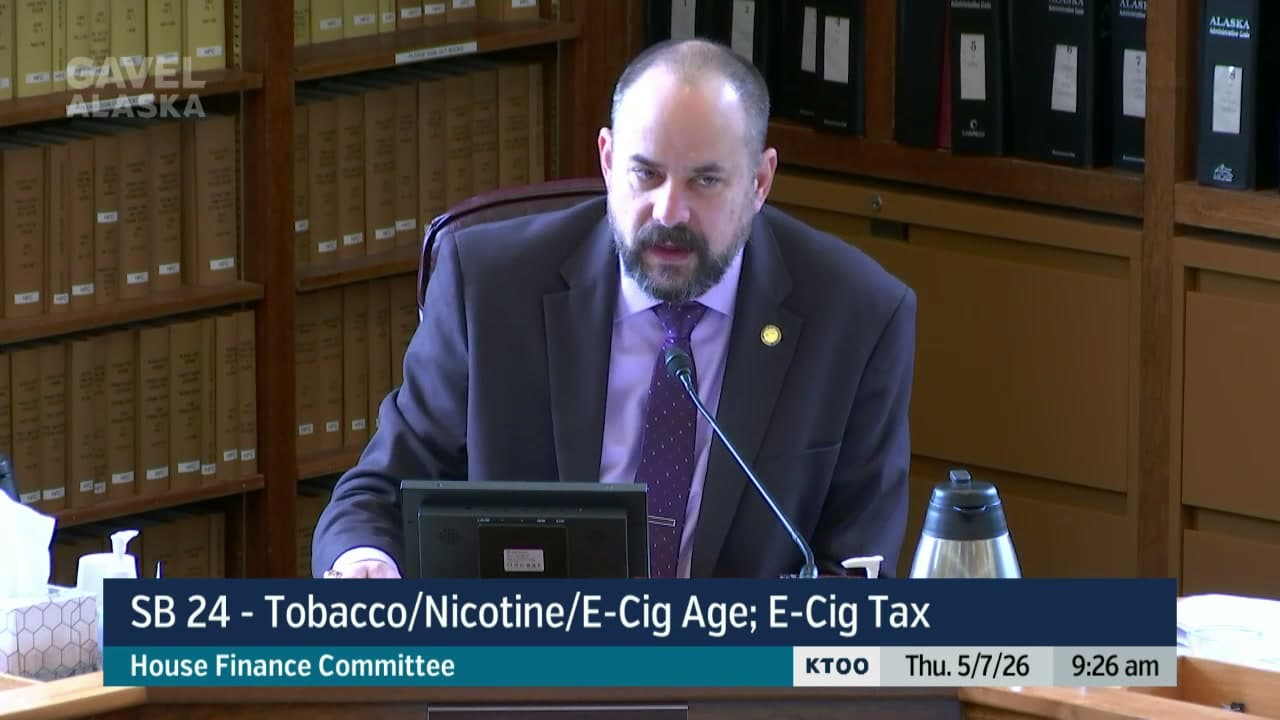
Alaska House Panel Hears Push to Raise Tobacco Age to 21
The Alaska House Finance Committee heard testimony Thursday on Senate Bill 24, which would raise the legal age to buy, sell, use and possess cigarettes, nicotine products and e-cigarette products from 19 to 21.
Alaska currently sets the minimum age at 19, creating a gap with federal law enacted in 2019 that blocks access to millions of dollars in federal prevention funding. The bill would establish a sales tax on e-cigarettes to fund prevention programs. Senator Gary Stevens is making his sixth attempt to align state law with the federal standard. Similar statewide bills have been introduced before, including Senate Bill 89 in 2023, while Anchorage already raised its local tobacco purchase age to 21 in July 2019. Schools across the state confiscated 239 vaping violations this school year, up from 95 in 2022.
Senator Gary Stevens, who sponsored the bill, told the committee the tobacco industry has responded to declining cigarette sales by targeting young people with vaping devices. The bill is also complementary to a federal program that will provide the state with millions of dollars to publicize the dangers of addiction, Stevens said.
Dixie St. John, a school nurse, told the committee she has confiscated 77 vapes from students in just over two years. She described a device confiscated Wednesday that delivers up to 50,000 puffs and contains about 2,000 milligrams of nicotine, the equivalent of roughly 30 packs of cigarettes. Students reported paying $30 for the device.
Students cannot make it through a single class period without asking to leave to go and vape, St. John said. They are not just experimenting, they are dependent.
Jamie Burgess, a school superintendent, said vape detectors installed with federal pandemic funding have become nearly useless as alerts increase in frequency. School administrators struggle with whether punitive discipline is worth their limited time when many students are significantly addicted. Burgess said schools are also struggling with vapes that contain marijuana. The addiction that we see is fast and significant, Burgess said.
Billy Strickland, an executive director with a school activities association, said reported violations increased from 95 in 2022 to 162 in 2023, 203 in 2024, and 239 this school year. When students are removed from athletics and activities for vaping violations, they lose access to coaches, teammates, structure and accountability.
Teresa Roble, director for policy and advocacy at the Alaska Children's Trust, said raising the minimum purchase age from 19 to 21 would close a gap that allows legal purchasers still in high school to have daily access to younger peers. The bill would also establish consistent taxation of all tobacco products, including vaping devices. Research from other states shows increased prices on e-cigarette products through taxation result in measurable reductions in youth use, Roble said.
Kari Nissen, representing the American Lung Association in Alaska, said the total amount of nicotine sold in disposable e-cigarettes skyrocketed 249 percent over a 3.5-year period while the number of products sold increased only 35 percent, a sign that nicotine products are becoming far more potent and addictive. Some devices now feature digital screens, Bluetooth connectivity and built-in games. Nissen said 34 other states have implemented taxation on these devices.
Alaska's current law creates confusion for retailers and consumers because federal law raised the legal age to 21 in 2019 while state law still says 19. Updating state law would support compliance, strengthen enforcement and reduce youth access, Nissen said.
Committee members asked multiple testifiers whether banning flavored vaping products would reduce youth use. Testifiers said flavor bans could help but expressed concern that outright bans might drive products to the black market.
The committee did not vote on the bill Thursday. Committee Co-Chair Foster said he intended to take up questions again at the next meeting and set an amendment deadline. The bill has eight fiscal notes attached.
This article is based on a public meeting — HFIN-260507-0900 ().
AI-assisted. How we use AI Transcript byLucas Brown
Stay informed. Support what matters.
Free, permanent access to local news you can verify. Subscribe to support Alaska News and go ad-free.
Related Coverage
Alaska House panel hears push to raise tobacco age to 21, tax vapes at 25%
Alaska News · 4mo ago
House Finance advances tobacco age increase, e-cigarette tax on 7-4 vote
Alaska News · 4mo ago
House panel cuts youth tobacco fines, advances Tobacco 21 bill
Alaska News · 4mo ago
Alaska House passes tobacco age increase, vape tax, cigar lounge exemption
Alaska News · 4mo ago
Alaska House debates youth vaping penalties amid justice concerns
Alaska News · 4mo ago
Comments
Sign in to leave a comment.
No comments yet. Be the first to share your thoughts.