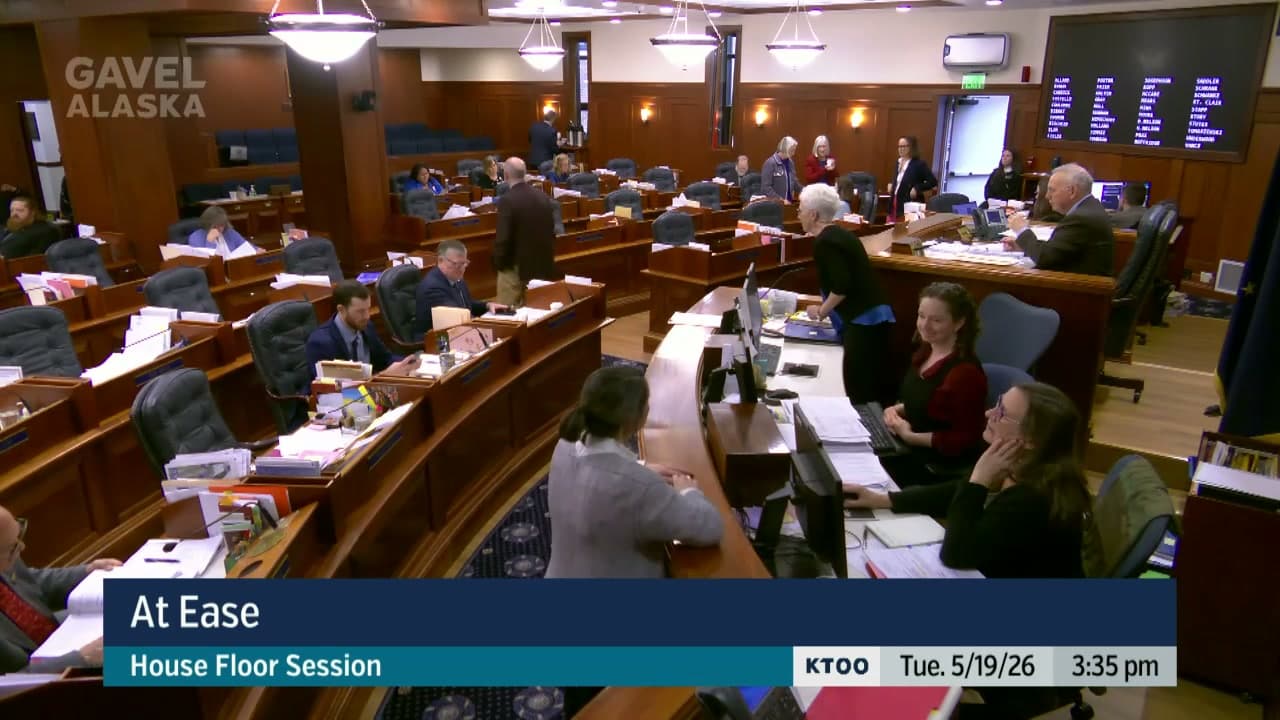
Alaska House passes tobacco age increase, vape tax, cigar lounge exemption
The Alaska House of Representatives passed legislation Tuesday that raises the minimum age to purchase tobacco and vaping products from 19 to 21 and imposes the state's first statewide tax on electronic smoking products. The bill also creates an exemption for premium cigar retail stores.
Senate Bill 24 passed 24-16 after extended floor debate and consideration of multiple amendments. The House also passed a title change resolution, HCR 32, by a vote of 36-4.
Representative Sara Hannan carried the bill on the House floor. She said the legislation addresses two central policies. The first raises the minimum age to purchase tobacco products and electronic smoking products to align Alaska with federal law passed in December 2019. The second establishes a retail tax on electronic smoking products for the first time statewide in Alaska. Hannan said annual proceeds from the tax will continue to go into the Tobacco Use Education and Cessation Fund, which is already used for smoking education and prevention programs. Anchorage adopted a citywide e-cigarette excise tax in 2020, effective March 2021, but no statewide vape tax has existed until now.
Hannan said nicotine and tobacco cause preventable health diseases, including cancer, heart disease, and stroke.
The bill establishes a retail point-of-sale tax on electronic smoking products. Hannan defended the structure as necessary because vaping products vary widely in nicotine content and packaging, unlike traditional tobacco products. An amendment by Representative Jeremy Bynum to replace the retail tax with a 75 percent wholesale excise tax failed 19-21.
Amendment 4, introduced by Representative Kevin McCabe, passed 21-19. The amendment creates an exemption allowing premium cigar retail stores to operate smoking lounges if they meet strict requirements. According to McCabe, qualifying stores must derive at least 60 percent of revenue from cigars and humidor rentals, prohibit cigarettes and cigarette tobacco entirely, maintain a built-in or walk-in humidor, allow cigar smoking only within the business itself, and be freestanding or physically separated so smoke cannot travel between neighboring businesses. The amendment also bars these establishments from operating inside pull-tab facilities or general public retail spaces such as malls.
McCabe said the amendment is brought to you by laundry soap, air freshener, mouthwash, and breath mint industries, as well as wives and girlfriends who would rather their significant others not smoke cigars in the shop, in the garage, on the patio, or in the driveway.
Hannan opposed the cigar lounge exemption. She cited Alaska's 2018 smoke-free workplace law. In 2018, when the Alaska Legislature passed the law, there was a carve-out for private cigar clubs to exist, she said. The issue is employees. Secondhand smoke is always carcinogenic.
Representative Andrew Gray echoed those concerns. He noted that cigar smoke contains the same carcinogenic compounds as cigarettes. In 2018, this body said that we were going to have smoke-free workplaces in Alaska, Gray said.
Supporters of the exemption argued that employees at cigar lounges choose to work in those environments and that the businesses serve a niche adult market. Representative Will Stapp argued the bill was inconsistent with on-site cannabis consumption, which he said is permitted at some cannabis retail facilities in Fairbanks.
Bynum offered two separate amendments aimed at removing penalties for 19-year-olds and 20-year-olds possessing tobacco products. Bynum withdrew Amendment 2 after he said legal drafters had introduced errors that pulled in unintended statutory language. He later offered a revised version, Amendment 6, but withdrew that as well after the bill sponsor asked that the bill stay intact; the House voted 27-13 to allow the withdrawal.
During debate on the penalty issue, Stapp argued that the bill unfairly targets young military members. He said he represents the second largest military base in the state, Fort Wainwright. He said he has an entire brigade there, an air assault brigade, 1st Brigade, 11th Airborne Division. You have three infantry battalions in that brigade, and a ton of those 19-year-old and 20-year-old kids actively vape, Stapp said. The fundamental difference between the T21 federal law and this bill is the state, if you pass this, is now actively going to punish people who are 20 and 19 years old.
Representative Andy Josephson defended the bill's penalty structure. He said that under current law tobacco fines for minors can run up to $500 and include a mandatory court appearance, and that the bill lowers fines to $100 and removes the court appearance requirement. This would be the adoption of T21, a congressional act that says effectively you cannot distribute to people under 21, Josephson said. Compliance with it brings the state roughly $3 million per year in grants, he said.
Josephson also noted that rejecting the bill would maintain higher penalties. If you vote against the bill, we lapse back to the current law, and that means cigarette fines for kiddos can be up to $500 instead of $100 with a mandatory court appearance, he said.
The effective date clause passed 39-1.
This article is based on a public meeting — House Floor Session, 5/19/26, 3:30pm ().
AI-assisted. How we use AI Transcript byLucas Brown
Stay informed. Support what matters.
Free, permanent access to local news you can verify. Subscribe to support Walter AlaskaNews and go ad-free.
Related Coverage
House Finance advances tobacco age increase, e-cigarette tax on 7-4 vote
Alaska News · 4mo ago
Alaska House panel hears push to raise tobacco age to 21, tax vapes at 25%
Alaska News · 4mo ago
Alaska House Panel Hears Push to Raise Tobacco Age to 21
Alaska News · 4mo ago
House panel cuts youth tobacco fines, advances Tobacco 21 bill
Alaska News · 4mo ago
Alaska House debates youth vaping penalties amid justice concerns
Alaska News · 4mo ago
Comments
Sign in to leave a comment.
No comments yet. Be the first to share your thoughts.