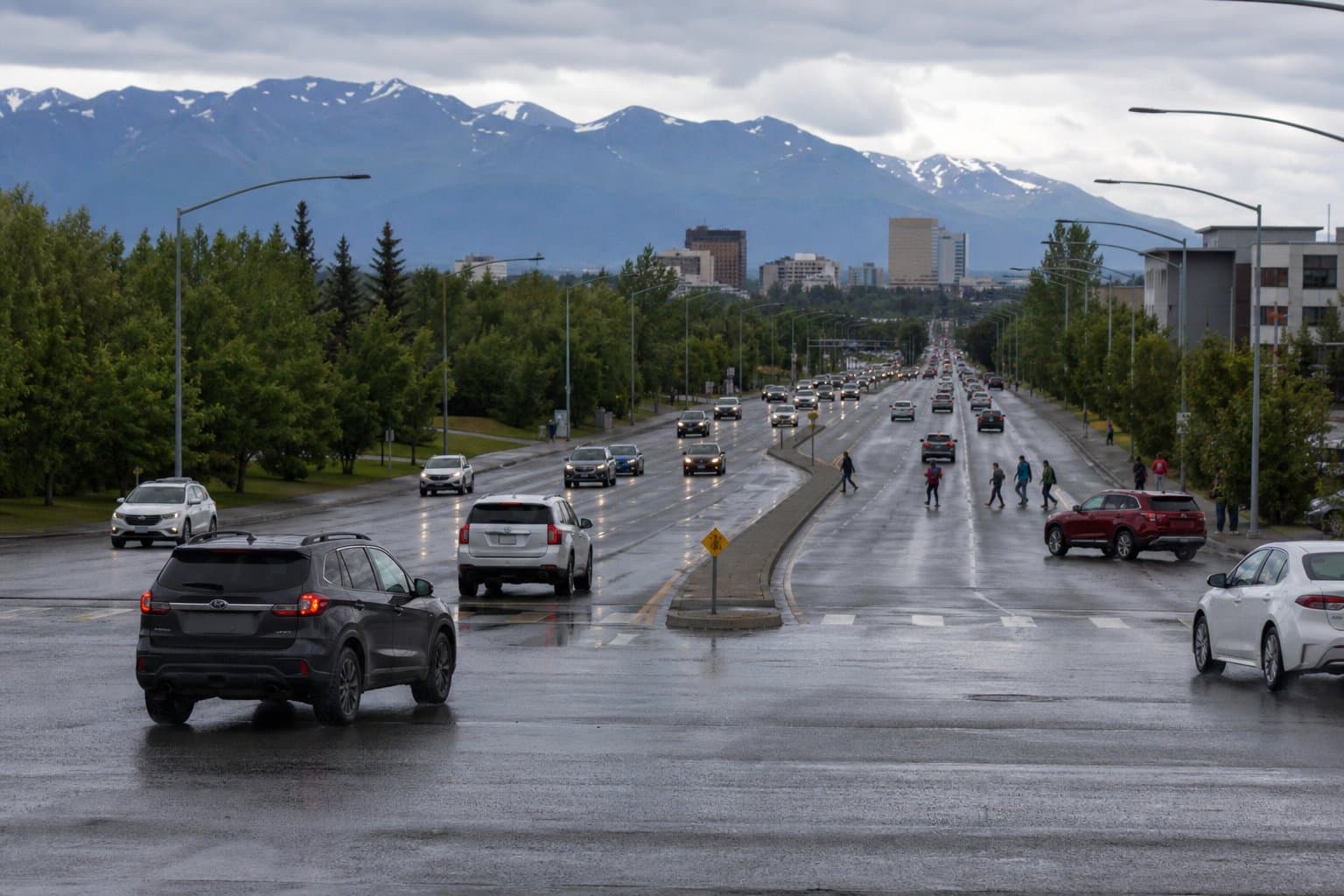
A routine Anchorage roads vote this week would also quietly funds cameras at 82 more intersections
The Anchorage-area transportation committee meets Thursday to move some money around, the kind of vote that usually draws no attention. The largest item is another increase for a road project: about $2 million more for the Tudor Road median between Baxter Road and Patterson Street, its second bump this year, bringing the project to roughly $7.8 million. There is design money for crosswalk and signal work on Mountain View Drive. Ordinary transportation housekeeping.
Tucked into the same agenda is a different kind of item: about $842,000 to install cameras at 82 signalized intersections. On paper it is one more safety line. It also arrives as the city is substantially completing its traffic-signal camera network at the same time Anchorage is debating how far police surveillance should go and who gets to write the rules for it.
The cameras are funded as pedestrian and bicycle safety. The state, which is administering the project with federal highway-safety money and a state match, says they are meant to reduce the severity of crashes involving people walking and biking, on the theory that a driver is more likely to stop and help if a camera is watching. Anchorage has a documented history of hit-and-run crashes, and the project is aimed at that. The $842,000 up for a vote is the federal construction share; with the match and earlier design money, the programmed total is about $989,000.
It would substantially complete a rollout begun in 2017. Traffic Engineering says it maintains more than 283 signalized intersections; roughly 200 were already camera-equipped earlier in the rollout, and the state identifies these 82 as intersections where recording cameras do not yet exist.
The cameras themselves are ordinary traffic cameras. By the city's own policy, they are wide-view cameras on signal poles that record on a loop, holding three to seven days of footage before it is written over. The project documents do not describe them as automated ticketing cameras or license-plate readers. The traffic department's own written policy bars its staff from using them for "any type of surveillance."
But that rule binds the traffic department, not the police, and police access to these cameras has quietly grown. Before February 2025, an officer who wanted footage had to ask the traffic department to pull it for a specific case. Now, under an agreement the two sides formalized in October, the police department has direct access to the traffic-camera feeds, an arrangement the agreement itself calls "a very useful law enforcement tool." The agreement notes the change was made in part because police requests for footage had grown enough to strain the traffic department's staff.
That access is one piece of a larger buildout. The city has stood up a Real-Time Crime Center, a police hub built to pull many camera feeds into one place, with room for as many as 750. APD already has direct access to the traffic-signal cameras, and the mayor’s office says the crime center uses them. The hub runs on Axon's Fusus platform, which the municipality's contract with the company defines as part of its cloud services; the same contract, in its own appendices, separately covers automated license-plate readers and says Axon cloud services may include predictive analytics. Whether any of that is applied to the traffic cameras is a separate question. What the contract establishes is that those capabilities exist within the broader Axon system the city is buying into.
The draft policy for the crime center does set out limits. Separately, the mayor's office says license-plate scans are automatically deleted after 14 days, searches must be tied to an active police case number, only 12 people are authorized to run them and access is audited. Those would be real commitments. They are also, at this point, non binding: the rules the city has posted publicly are marked draft, with the effective-date fields left blank. And a policy, unlike a law, can be changed by the department at any time, without a vote. Apart from a ban on facial-recognition technology, city code says nothing about what the cameras may collect, who may view the footage, or how long it is kept. Those limits live in internal police policy, which the department can rewrite on its own.
The signed traffic-camera agreement shows the same gap in miniature. It gives police direct access to the feeds, but as for what happens to footage once an officer downloads it, the agreement says only that it is kept "per APD policy." It writes no retention period into the public document, names no auditor, and does not say that an officer's viewing of a live feed is logged the way the traffic department logs its own staff.
Alaska is unusual ground for those questions. The state constitution contains an explicit right to privacy, and the Alaska Supreme Court held in 2024 that police could not treat something as fair game for warrantless surveillance just because new technology made it easier to see. The courts have not ruled on a system like Anchorage's, and the law here is unsettled.
None of that is on Thursday's agenda. What is on the agenda is a road median and 82 cameras, filed together under routine transportation spending.
AI-assisted, reviewed by editors. Spot an error?
Stay informed. Support what matters.
Free, permanent access to local news you can verify. Subscribe to support Walter AlaskaNews and go ad-free.
Related Coverage
Anchorage Assembly to vote July 21 on $351K for pedestrian and bike count program
Alaska News · 1mo ago · 83% match
Anchorage Assembly will vote June 23 on $214,684 for a pedestrian safety campaign
Alaska News · 2mo ago · 82% match
Anchorage is considering expanding its surveillance network. The privacy rules are still a draft.
Alaska News · 2w ago · 81% match
The state wants $293M to rebuild 5th and 6th, but the funding isn't settled
Alaska News · 2d ago · 80% match
Sitka Street crossing costs $91,200 more; overhead is 41 percent
Alaska News · 11h ago · 79% match
Comments
Sign in to leave a comment.
No comments yet. Be the first to share your thoughts.