RDC: Alaska Airlines Update.mp4
Alaska News • • 21 min
Articles from this transcript
Alaska Airlines is counting on connecting travelers to help fill its Tokyo flight
About 15 people a day fly between Anchorage and Tokyo. Alaska Airlines bets Japanese tourists, Filipinos and Lower 48 connections can fill 161 seats.

No audio detected at 0:00
Ladies and gentlemen, welcome back. If you're still in the trade show area, please make your way to the main ballroom here. We are about to start. You know, we at Alaska Airlines have made a lot of changes over the last year, and they're good changes, but we're here to talk a little bit about that. And right now, I'd like to announce Alaska Airlines has continued to expand its reach and partnerships, and those decisions matter to communities and businesses we serve across Alaska.
No audio detected at 0:20
No audio detected at 0:30
I'm excited to have Brett Catlin, Senior Vice President of Network and Partnership and Loyalty, to share some of the new developments and some of the exciting new destinations we're going to. Please welcome Brett.
Thank you, Scott. Good morning, everyone. It doesn't take much of an invitation from Scott to get me to Alaska, and it's a privilege to be here for a few minutes, have a chance to speak with you all. I also appreciate you all dialing up what I'd consider to be a Chamber of Commerce day. It's beautiful outside.
Definitely representing the best of Anchorage here in November. So as Scott mentioned, I've got a few slides and I want to share where we're at as Alaska Air Group in continuing to serve the state of Alaska and communities like Anchorage. There's a couple of topics that I'll hit on. The first is network connectivity and the network that we're building and continuing to build out of Anchorage and other communities throughout the state of Alaska. And then I want to spend a few minutes towards the end sharing with you all some of the investments we've made in Atmos Rewards over the past year.
Including enhancements of the Club 49 program, which I see represented as a table topper on many of the tables here in the room. So with that, I suspect you all know that Alaska, we're going on 95 years of history, given our roots here in the state of Alaska. As we've grown over time, our commitment to Alaska is really unwavering. And I wanted to share a little bit about our growth. Many of you may not know today, Alaska Air Group, we're about 30,000 employees.
No audio detected at 2:00
We cover the Alaska, Hawaiian, and Atmos Rewards brand. And as you see on the slide, we're also the largest airline now on the West Coast, number one on the West Coast, including markets like California, Oregon, Alaska, of course, Hawaii, Washington, Idaho, Montana. And so the business has just— thank you.
The business has just changed dramatically. I've been at Air Group for about 10 years, and I know as our business has changed, there's always the question for where our home is in the state of Alaska on How are we continuing to show up for you all and to make sure that it's Alaska that you've come to know over 95 years and that many of you rely on, your teams rely on, your families rely on every day? And so I wanted to spend a little bit of time just walking through what that looks like and how Air Group's growth is directly benefiting the state of Alaska. This chart shows how Air Group has grown across the West Coast, and I put a couple of interesting kind of waypoints for Air Group over the past 20 years. The first is, some of you may recall, we started flying to Hawaii almost 20 years ago in 2007.
No audio detected at 2:50
That was kind of a watershed moment for Air Group. And of course, now the state of Alaska benefits from nonstop service to Honolulu, Maui, Kona, and there's a much clearer direct link into the Hawaiian Islands given how Alaska grew into that market 20 years ago, starting with Seattle. You also see a bit of a call-out there for new East Coast cities. We, of course, have served Seattle for many decades, but it's fun to look now just how expansive Air Group's nonstop network is here from the state of Alaska, specifically from Anchorage. We just announced new markets like Dallas, Nashville, Austin.
Nashville and Austin being completely unserved markets from state of Alaska. They've never had service. And so it's exciting to see as Air Group has grown into the West Coast, we've also invested a lot of that growth in the state of Alaska and into Anchorage. And then one of the most exciting developments is the last box here on the right-hand side, this global expansion. I can't quite see the picture, but I suspect it's somewhere fantastic like London or Tokyo or Seoul or Sydney or many of the global destinations that we can now take you to.
That service traditionally has been from Honolulu. As part of our combination with Hawaiian, we now brought that service to Seattle. And most importantly for you all, as I'm sure you're aware, we're going to start nonstop service to Tokyo next May. And so I'll spend a second on that service specifically only because it's unique and very exciting. This is one where in my role, network planning, where we fly schedules fleet, it's a science.
There's phenomenal data that can tell you where there's demand and the fares that consumers will pay, but there's also an element of art. And so when you think about Anchorage Narita, if you were to look just at the data, there's about 15 people a day that fly between Anchorage and Tokyo, even in the summer. It's not a very big market. Our MAX 8s that will fly in this particular route, they have 161 seats. So 15 people a day is what the data would tell you exists between Anchorage and Tokyo.
No audio detected at 5:00
That's obviously not enough to fill up a 161-seat aircraft. But I think given our commitment to the state of Alaska, this is a market that on the network planning side of things we've been dreaming about for 10 years. We didn't know how we were going to serve it, but we've always seen Anchorage as this unique link between the mainland U.S. and Asia and creating that bridge while also serving the communities of Alaska. And so the fact we already had a station in Tokyo, we fly that market from Seattle and from Honolulu. It gave us the confidence to go and try something really unique, like flying a service from Anchorage to Narita.
And so the question is, okay, if there's only 15 people, how do you actually intend on filling 161 seats, because of course we want this not to be a one-season service. We want this to grow over time and potentially allow us to add other markets in Japan if this first market is successful. And so the strategy here— and I won't spend this much time on every slide, but I, I do want to invest in giving you a bit of the context here— is really fourfold. You have, of course, that local market of Japanese travelers visiting the state of Alaska. Hopefully many of you will also be taking this flight to get to Asia and points beyond Tokyo.
I was just chatting with an individual from the Alaska seafood arena who is in Seoul. And so for him, instead of going down to Seattle, he can now go right to Tokyo, which is just amazing connectivity. So we, of course, need the support of all of you in the state of Alaska and your businesses and your communities. We also are going to work closely with the Japanese tourism industry to bring Japanese travelers from Japan to the state of Alaska. This service, as you see, will operate not only in summer, but then also in winter.
That winter service is really geared towards Japanese-originating travelers. Then you have this— yes, I'm very excited about that. Then you have the second group, and this is where I think the data of network planning and the science of how you build an airline is quite interesting. There's a huge diaspora of Filipinos and travel between the Philippines and state of Alaska. And so we intend on winning that business to help fill these flights.
It's much quicker to connect over Narita than it is to go Manila to Seattle or Manila to LA and then up to Anchorage. And so actually our first booking, just kind of an aside, a fun fact, was from Cebu to Anchorage. Cebu being the second largest city in the Philippines. And so we're really gonna pull from across Asia to make this market successful. And then the third is exciting as well, which is pulling from the lower 48.
So we've retimed flights, we've added frequency to markets like Portland and Chicago. And so historically, we've always flown Chicago as two red eyes, so two late night departures out of Anchorage. Next summer, one of those flights will leave Anchorage at 2:00 PM. Similarly, we're going to add a sixth frequency to Portland, and that sixth frequency will leave Anchorage at 2:00 PM. And the reason for that, of course, is the Anchorage Narita flight lands at Anchorage at noon.
And so now we'll be able to connect people from Tokyo via Anchorage to markets like Portland, Chicago, Seattle, and others as well. So across those three demand pools, both kind of the local traffic between demand in Alaska, traffic from throughout Asia, and then connecting people into the mainland US, we think this service can be a success. And as I noted, we're very thankful for your support. I know the community has stepped up in a really big way to help make this happen, and I'm excited to see it come to life next May. So thank you again for that.
And then so what does this do for the access you get beyond Asia? I mean, beyond Tokyo. So there's just a huge number of places you can go. The flight is timed perfectly for connections. And so perhaps you normally go down to Cabo or Puerto Vallarta, you're taking our service into Oahu.
Maybe next summer, next winter, you'd consider a trip to Bangkok. It'll probably take you about the same amount of time to get Anchorage, Bangkok as it would to get down to Cabo or Puerto Vallarta. So that would be a pretty fun way to diversify your summer travels when winter rolls around in 2027. So perhaps something to look forward to, something to use your Atmos Rewards points on. And of course, when you're traveling on JAL, those OneWorld benefits that you've earned as Atmos status holders, they'll travel with you.
Better seats, lounge access, all the accoutrements that make traveling just a little bit more comfortable. So zooming out a bit and thinking about Alaska's network into the mainland US and how we've grown really over the past, I would say, 6 or 7 years since 2020, since the pandemic, our network has ballooned from Anchorage in terms of the non-stops offered. You can see a representation up there. I mentioned that we just announced service to Dallas, Nashville, and Austin. I was talking to some folks out in the breezeway.
No audio detected at 9:30
There's actually a bunch more dots that aren't represented on this map that we would love to fly. We're kind of taking baby steps, right? Many of these new services, they'll operate once or twice a week. The goal is to get them to daily and then ultimately to add more service. So you could imagine markets like Houston or Washington, D.C. that many of you frequent for business or leisure travel.
And so this map represents significant growth over the past 5 or 6 years, but we think there's a lot more to come. And it's really a reflection of, one, the loyalty that you all give to Alaska, the business that we've earned and that we don't take for granted, um, that allows us to make this possible. So what does that look like? Just thinking about Alaska's growth in the state of Alaska over the past 10 years versus some of the competitors that are out there. This is a fun slide.
Somebody on my team put it together, and to be honest, I was surprised by the amount of growth in the past 10 years that we've invested in the state of Alaska. So this is seats. You can kind of see what that looks like. And other carriers have come and gone in state of Alaska. As you know, there's carriers that aren't represented that maybe flew 10 years ago that aren't here today.
Alaska, of course, is committed to this market like no other carrier. So that bar that you see, it's effectively 18 737s worth of capacity. And so I'll just maybe put a round number on what a 737 costs. Like, I know a lot of you in the resources space, like, capital is near and dear to you. And so let's say a 737 costs $50 million.
No audio detected at 11:00
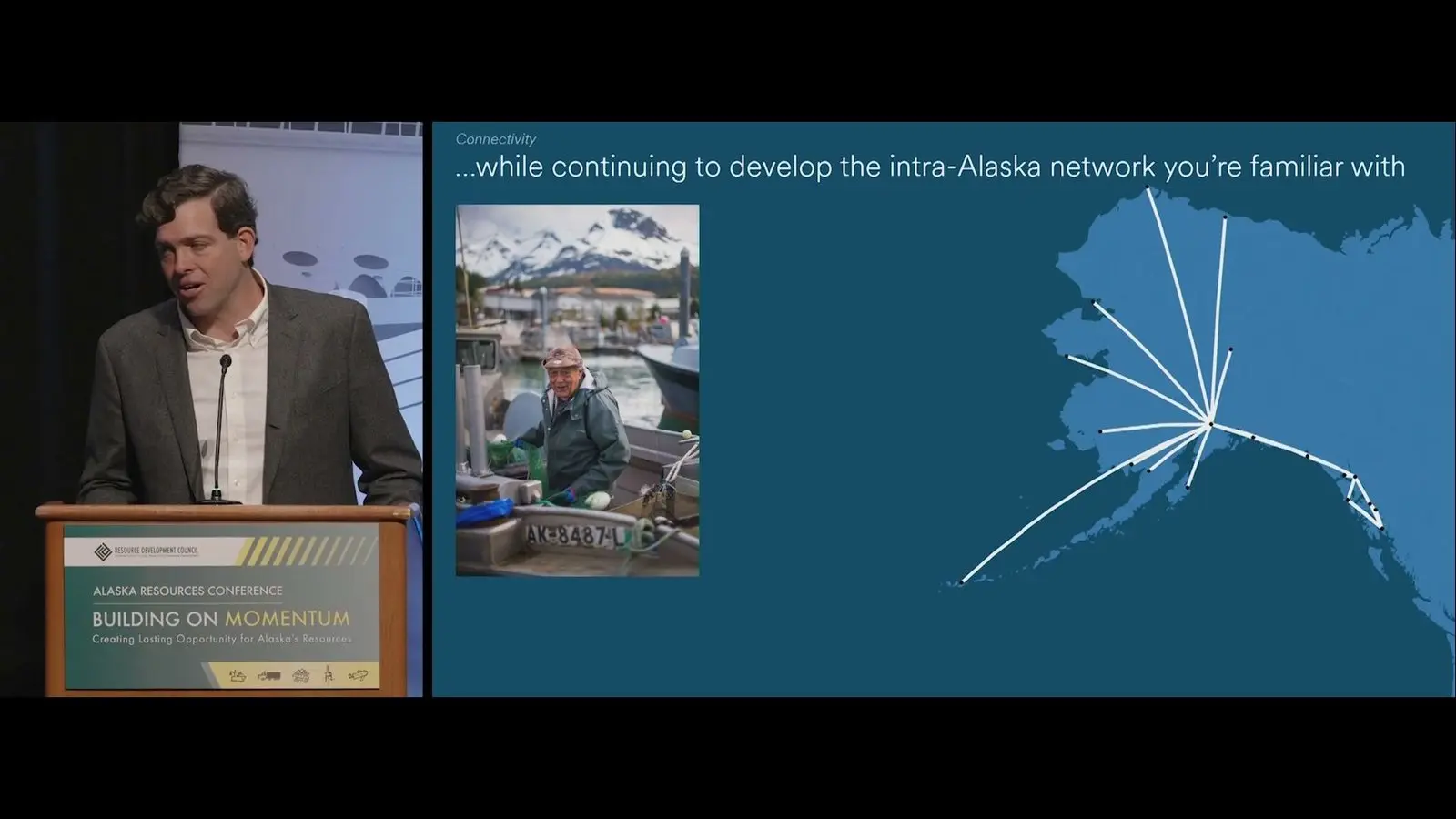
We have invested 18 of them in the state of Alaska. That is an enormous capital investment in this community, in this market. And it is reflective, again, of how we see the growth and the potential in the state of Alaska in terms of how we, we serve each of you and your communities and your businesses. So that growth, that investment, it extends beyond just the narrowbody flying down into the lower 48 or into Tokyo. We also have a robust intra-Alaska network that we're continuing to invest in, bringing the E175s up to Alaska.
No audio detected at 11:30
The Combis, if you go back in time, which many of you remember, the Combis, phenomenal aircraft for the state of Alaska. We don't have an aircraft like that in our fleet today. It doesn't really exist anymore. And so we're augmenting now with, of course, a great dedicated cargo fleet that we're building. But then also the E175, which I recognize is a somewhat imperfect aircraft and there are challenges, but it allows us to serve communities in Alaska with frequency that we otherwise couldn't.
And so we've worked hard to diversify how we serve the communities, including with the E175 and with those cargo freighters. And then kind of pivoting for a second to Atmos Rewards. So of course, if we can get you on our aircraft, we can earn your business. We want to deliver when you're on board our aircraft and then we want to reward you. So you keep coming back to Alaska Air Group and that we earn your loyalty for years to come.
And so Atmos Rewards, I'll kind of give you a bit of the context here and I'll go off script. You all have been part of Mileage Plan going back to the '80s, I suspect. You have deep love for Mileage Plan, just like Hawaiian travelers had deep love for Hawaiian miles. I totally get that. Mileage Plan was a fantastic award-winning program.
No audio detected at 12:40
Hawaiian miles had many aficionados as well. The reality for Air Group, as we scaled globally, we saw an opportunity to invest in loyalty in a way that other carriers weren't. And part of that was we needed to bring a new brand to market that reflected the scale of Air Group and what we can now offer consumers, not only in Anchorage, Alaska, but also in Seattle, Washington, or Honolulu, Hawaii, or San Diego, California, or say markets on the East Coast like New York, New Jersey, or D.C. And so Atmos is a reflection of that. And so how we've invested in Atmos, and I think kind of what's written on the tag here matters, we want to build a program for all types of travelers. Now, if you have flown on some of our competitors, they built their loyalty programs really for one type of traveler.
No audio detected at 13:20
That's the traveler that spends $1,000 or $2,000 to fly in first class, probably other people's money, and they're spending $100,000 a year on their premium credit card, and that's how you get rewarded now. Those programs are tuned to reward the top 1% of flyers. And we want to win those travelers' business as well, don't get me wrong. That is how we continue to invest and grow the airline. But we also want to make sure that we don't build a program that is only for that small tier of travelers.
We want something that allows everybody to see themselves, to be rewarded, and to ultimately feel like their loyalty is valued. And so how we ultimately deliver that, there's 3 aspects to it. The first is choice accrual. So we have given guests the ability now, you can pick on the Atmos Rewards website and it will go into effect January 1st. To choose how you want to earn your points— by how much you pay for a ticket, by how far you fly, or by the frequency in which you take flights.
No audio detected at 14:10
And so as you think about the use case for each of those, our competitors, by the way, they only reward you now based on how much you spend. There isn't a single carrier left in the United States that rewards you based on how far you fly. And so it was really important to us to keep that. Many of you fly very long distances to get to where you're going, and perhaps you're doing them on fares that aren't $1,000 or $2,000. And so earning by distance, that allows us to reward you in a way that is reflective of how you've been rewarded for the past 30 years.
At the same time, there are people that are spending significant money on their flights. Maybe they're taking us long haul to London and they're spending $5,000 or $6,000 for a lie-flat seat. We can now reward them the way our competitors do such that we don't lose their business. And then we have this unique part of Air Group, which is intra-Hawaii, so neighbor island flying. And those travelers, they often want to be rewarded on frequency.
And so the program is designed to reward those travelers as well. And so that was the intent of Choice, was to make sure that, again, we aren't building a program just for one type of traveler. The other investment we made was actually building on the success of Club 49, which I see Marilyn and Scott here and Tim somewhere around. Club 49 is celebrating 15 years in the state of Alaska. It was a really innovative way to show up for the community in the state of Alaska.
And so we thought it was such a good idea, we actually wanted to extend it to Atmos Rewards more broadly. And so we rolled out 5 additional communities. One is specific to the state of Hawaii, Hua Kai, and then there's 4 that are more lifestyle communities. So think about families on the go that rewards travelers that are bringing their families with them. At the same time, we wanted to continue to invest in Club 49.
And so I put on the slide here a couple of the ways that we've invested in this program. It's not just this sexy new brand that you see on the screen. But there's also some things that we've done. We improved the enrollment flow. So historically, you had to fill out a form on the internet, and then it went to a human, probably in Seattle or Boise or Phoenix, and the human put into the system that you were in Club 49.
And that would often take 2 or 3 days. It didn't work very well. And so we've modernized all of that as part of this investment in the community's architecture. Now you instantly get status, and you instantly get to participate in the Club 49 program if you're an Alaska resident. And you opt in.
The second thing we've done is we've added badging across all the touchpoints. So if you log into the app or the website, you'll now see Club 49 represented in your account. So it's this reinforcement of the value you're getting with the program. We also added this interesting new program called the Bonus Points Challenge. So if you visit one of 10 destinations that are curated each year for the state of Alaska, I think it's this theme of sunruns.
And so taking you to warm places in winter, you're going to get bonus points and status points. For each destination you visit up to 10,000 points. So again, another investment in the Club 49 offering. Then the fourth one up here is we have this new program called Atmos Unlocked, which gives you access to experiences. And there's a number of curated experiences in that portal that are solely for Club 49 members, and you get a discount on those of 20%.
And so again, I think Club 49, fantastic idea. It's allowed us to invest in the community in ways that we We don't necessarily want to invest people that are just visiting the state of Alaska, but we do want to invest for state of Alaska residents. And we liked it so much that we extended it to the program more broadly. And so there's a couple other things that we're doing to improve the experience of Atmos. And I will tell you, these are things that people have been asking about for 10, 15 years, and we're finally going to get to them later this year and into 2027.
The first is those upgrade certificates that you're earning or selecting as part of your status. You'll now be able to waitlist. And so oftentimes space won't be available, and so you can add your name to a waitlist, and then you'll be at the top of the upgrade list if space opens up all the way up through departure. And so if you're perhaps an Atmos Gold member and you're not particularly used to getting upgraded to first class, because there's a number of status holders here in the state of Alaska, you could use one of those certificates to essentially jump the line by waitlisting for that flight. It's a really exciting benefit and something that I'm quite keen to get into market next year.
The second is a new activities page. We hear from members quite frequently, they want to better understand how they're earning points and status points, whether it's by flying on Alaska, spending on our portfolio of credit cards, perhaps it's with GCI or Car Safeway here in the state of Alaska, um, maybe it's taking a Lyft, uh, down when you're visiting the lower 48 or Hawaii. All of those earn at most points and status points, and we want to make sure it's super clear how that's contributing to your status in the program. And so there's a ton of investment that's gone into ATMOS. But again, I know there's been a lot of questions in the state of Alaska on why change Mileage Plan.
No audio detected at 18:30
It was a great program. We kept a lot of the wonderful things about Mileage Plan, but we also want to have a program that can scale with the business for the next 35 years. And then finally, and in closing, we're always looking for new ways to serve the state of Alaska. What's on the slide here kind of represents how we've done it over the past 10 years. But the 737s bringing the MAX 8s to this market, which, by the way, is a phenomenal aircraft.
If you have been on an Alaska flight with Starlink, it's amazing. I spend a lot of time on aircraft. I like to use my laptop on those aircraft and it's extremely frustrating today. But when you have Starlink, it is— it's like sitting at home. There's no latency.
It's a phenomenal product. And so I hope many of you will get a chance to experience that on our flights. The entire fleet will be completed by the end of 2027. Anchorage, Alaska. So that's super exciting.
The second, of course, is those E175s, which we continue to bring to State of Alaska. And they're really, again, just to kind of hammer home the point about augmenting frequency, allowing us to serve communities better. Then the freight story— I didn't spend much time on cargo, but that's a growing part of Air Group's business that again is inspired by the State of Alaska. We, when the combis retired, we brought on 3 737 freighters specifically to serve the State of Alaska. We're now going up to 5, and we'll have even more than that in a couple of years.
No audio detected at 20:00
And that gives us even more ways to serve the state of Alaska, but then also the state of Hawaii and the lower 48. So really, a lot of our best ideas have come out of the state of Alaska, whether it's Club 49 or cargo or the areas that we're growing and investing in today. And so in closing, I want to thank you all. You— I know the combination with Hawaiian has created friction. HAB and Marilyn and a lot of the folks in Alaska Air team here in the state of Alaska do a great job.
Representing our brand in this community. But I wanted to come here and just reinforce our commitment to the state of Alaska and all the ways that we intend on continuing to invest in how we serve not only Anchorage, but all the communities across Alaska. So with that, thank you for having me. Thank you, Scott, for inviting me, more importantly. And we look forward to serving you for many years to come.
No audio detected at 21:10
No audio detected at 21:20