Fairbanks Borough: Special Economic Development Commission Meeting, 2026-11-20
Alaska News • • 104 min
Articles from this transcript
Fairbanks borough commissioners ask what UAF's minerals project gives back
Fairbanks commissioners pressed UAF on what locals get from a minerals project that could draw up to $160 million in federal funds.

Fairbanks borough short-term rental registration would require city license, mayor says
Fairbanks borough's short-term rental registration will require a city business license to finish signing up. The ordinance heads to the Planning Commission Dec. 15.
No audio detected at 0:00
No audio detected at 2:00
No audio detected at 4:00
No audio detected at 6:00
No audio detected at 7:40
No audio detected at 8:00
No audio detected at 9:40
We are live in the Truesmart. All right. Hey, Paul's on too, right on. Hello everybody. Um, so with that, we're going to go ahead and call the Special Committee— sorry, Special Economic Development Commission to order at 11:00— sorry, 2:31 in the PM on November 20th.
There we go. All right, Clerk, please give me a roll call. Yes, thank you. Mr. Talbot. Present.
Ms. Sprinkle. Here. Ms. Weideman. Present.
Mr. Rasmussen.
Here. Mr. Roach? Here. Ms. McGinnis? Present.
And Mayor Hopkins? I am also here. You have a quorum. All right, good news. Thanks, everybody.
Appreciate you being here. Let's see, a reminder that this meeting is being livestreamed and recorded. The microphones are sensitive and capture sound throughout the room, so please keep side conversations and unnecessary noise to allow wrappers and snacks to a minimum, and give the recognized speaker your attention. Are there any citizens online or here for any comments? No, signups for C1A.
All. Right, any for C1B? No. All right, we're going to go ahead and close public testimony on those two items. Any disclosure statements or conflict of interest?
Seeing none, we're going to go ahead and move on forward.
Approval of the agenda and consent agenda. Commissioners, are there any items from the consent agenda that you would like removed? The things with the little asterisks? All right, seeing none. Could we read the consent agenda?
Economic Development Commission meeting minutes from July 28, 2026. That concludes your consent agenda. All right. Can I get a motion to approve the agenda and consent agenda? I move.
Second. All right, moved by Talvey, seconded by Sprinkle. Thank you both. And Kirk, can I get a roll call vote for that? Yes.
Mr. Talvey? Yes. Ms. Wagoner? Yes. Mr. Roach?
Yes. Mr. Rasmussen? Yes. Ms. Sprinkle?
Yes. Ms. McGinnis? Yes. Mr. Grier Hopkins?
Yes.
Unanimous. All right, the agenda is approved.
Do I need to do the minutes from last week? No, that was in the consent agenda. Yep, we're good to that. All right, on to reports. I don't have a lot of reports to give, so—.
Would it be possible to maybe have Kristi's presentation first and then Yeah, move the reports after since she's been patiently waiting. For sure. Yeah, I'll go ahead and do that. I'm gonna go ahead and rearrange the agenda without any objection. And we'll go ahead and move to F3, a presentation from a representative of the UAF College of Business and Security Management regarding the university's efforts to identify and address local workforce needs, support talent management, and contribute to economic development within the community.
Presentation will be followed by commission discussion and opportunity. Since we have people online, I have to do a roll call real quick. Just—. Okay, that's fair. Someone can make a motion to reorder the agenda.
I move to reorder the agenda and move to item F3 and then start again at F1. Second. All right, moved by McGinnis, seconded by Talvey. Let's do a roll call vote on that. Ms. Wageman?
Yes. Mr. Talvey? Yes. Mr. Rasmussen?
Yes. Ms. Sprinkle? Yes. Mr. Roach? Yes.
Ms. McGinnis? Yes. And Mayor Hopkins? Yes. 7-0.
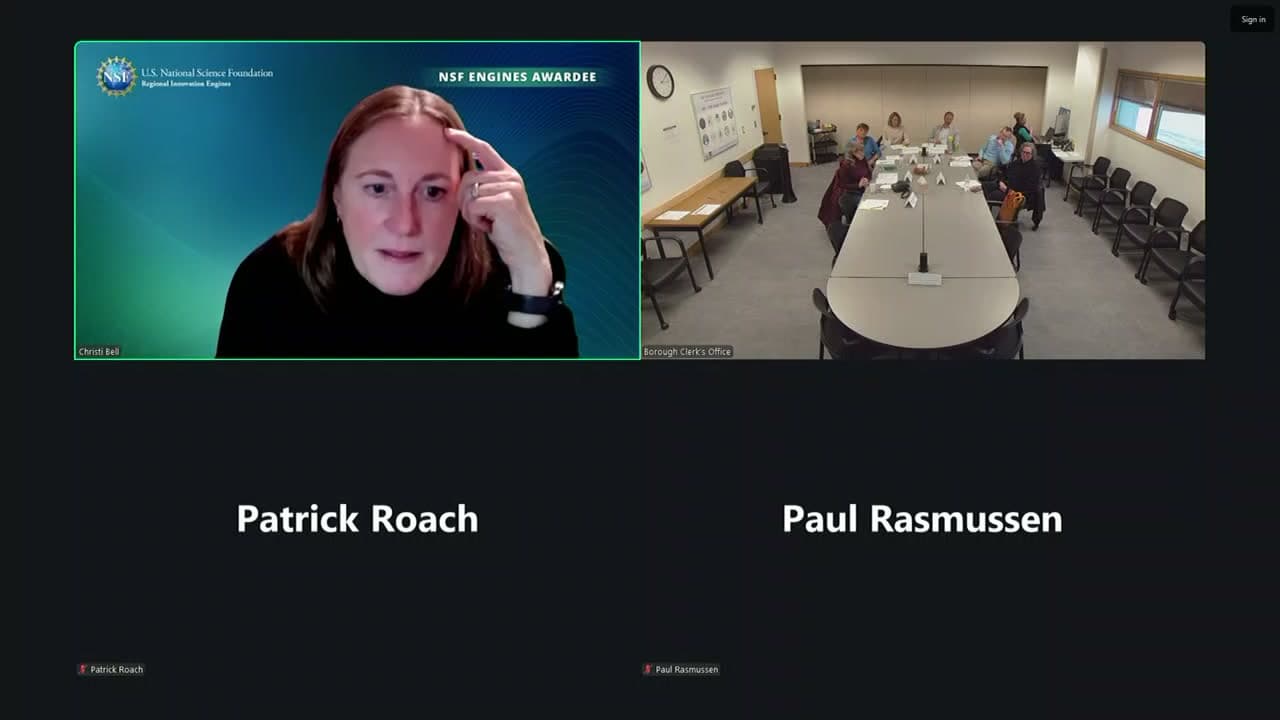
All right, unanimous on moving it around. Okay, Kristi, uh, Ms. Bell, thank you very much for your flexibility on scheduling, and please take it away. Uh, do you have the presentation up there? You want me to go ahead and just share? And do I have sharing screen?
If you can share your screen, are we able to make her the full screen? Yes, you should, you should be able to go ahead and share your screen. All right, and you are on the full screen now, so thank you very much. Um, do you want us to— we'll just— do you want us to hold questions until the end, or do you want us to jump in with them? I don't mind either way.
I can't clearly see everyone, so just interrupt me if you want me to Okay. A. Drug thing. Yeah, I'm hearing you. I can do that.
All right, take it away and we'll either hold on or let you know, but we are listening and watching, so thank you. All right, thank you all for having me here today. I'm Kristi Bell, for those that don't know me. I am the COO of the newly launched critical mineral NSF-funded critical mineral accelerator here in Alaska, and I have a 30-ish year background in economic development working across our state, 20 of those working within the University of Alaska. I was last at UAA leading the Business Enterprise Institute and was associate vice chancellor down on that campus.
I now am at UAF through the Geophysical Institute, and they're the entity that provided us some runway in order to bring the NSF engine to Alaska. A little bit about who I am and why I'm here today. So a little bit about what's this engine and why should you care. And if I, I just move my notes over, does that block what you see? Do you see my notes?
Nope, still looks good. Fabulous. All right, so the NSF Critical Manual Engine, or an engine, or the Alaska engine, as you'll hear us say from time to time. It's a pretty big deal. We were told that we had a 1% chance going into this of landing one of these for Alaska, and there's 20 of them across the nation.
Ours focuses, as it sounds, on critical minerals. We will not be doing any new mines. It's working with the community, the mining sector, on pulling critical minerals predominantly from their waste streams, so using some new technology. So just to address that upfront, our initial award is $7.5 million a year for the first 2 years. These are structured very much like a venture capital deal in that we have certain things that we have to accomplish within a very discrete amount of time.
If we don't accomplish those, then they end the award. They did end a couple of the original engines, so we're taking this very seriously. If we're successful to get past the first 2 years, then years 3 through 5 are $15 million a year, and then years 5 through 10 are $20 million a year. So over the course of the award, if we're successful with all 10 years, it's $160 million award that requires zero match. So it's a big deal for Alaska to have those types of resources helping advance a, a sector.
So why critical minerals matter? And I imagine everyone in this room just has to look around your space right there. Critical minerals are in everything, and it's increasingly become a national concern because very little of our critical minerals actually are secured here in the US. We in Alaska have 56 of the 60 critical minerals, and we have things like bismuth and tellurium from gold mine waste. We have things like germanium from the zinc— the largest Red Dog mine, the largest zinc mine in the U.S.
So we have critical minerals already in our ongoing mine waste streams, so it's a huge opportunity to be able to help contribute nationally. For Alaska, we are seeking to really drive value as it relates to new business starts and to— towards advancing a stronger workforce development across the mining sector. As it relates to business starts, we're helping move technologies through the university and some of those will help advance recovery, help advance processing challenges, help address environmental performance. So the types of careers and types of business opportunities really span far more than just, you know, I'm not interested in launching a mine. It's really all the support services that are related to a mine.
And so the local economic development question and the question I imagine all of you are kind of thinking about is how do you position the Interior to be the entity that launches some of those businesses and/or participates through some of the job opportunities that will result?
So, on that note, Business retention and expansion is always the place, at least in my opinion, that you can get the most bang for your buck with as it relates to economic development. Helping the businesses that have already chosen a place to either expand or be able to continue to be profitable is always a better risk or a better way to invest than trying to attract new firms to a place. So we're looking at working with entities like the Small Business Development Center and other technical assistance providers, as well as the mines, to figure out how some of these new technologies might be adopted both by the mines, but how we might be able to advance some technology providers to help advance some of the new, the new work. There's also a huge opportunity for specialized local services. For the Fairbanks community, this could be local firms that are winning work that is associated with engineering, environmental, even equipment that mines might need.
And all of that really stems from us being able to help the mines move more through their processing and create new revenue streams. So they're going to have new, new needs as they go through those processes. And then it's always in our best interest to retain as much of that locally. So capturing that value and better connecting industry demand with local suppliers and residents who can either do that work or suppliers that can help advance their businesses to address some of those work needs. So, I think that there's a significant opportunity for Alaska.
Our region of service is all of Alaska, but particularly, I think, from Fairbanks and the Interior's perspective, knowing about this and starting to position businesses and even the workforce for the opportunity is going to be significant.
So then, as it relates to that and the work of the NGINN, we really have 3 primary pillars with an overarching umbrella of working with stakeholders across the state. So the 3 pillars are research and development, technology commercialization, and workforce development. And it's not standard whenever people see that research and development, they're like, oh, the university is going to do more research? Yes, and we're only allowed to work on research that's moving rapidly towards commercialization. So when we're having conversations with researchers at the university, one of the first questions we're asking is, what's the TRL, or the technology readiness level, of what you're proposing?
And if it's not moving rapidly you know, towards the latter end or towards the 6 through 9 portion of a TRL. It's probably something that we might give it some initial because we have to have a whole pipeline of projects. We might give it some small investment, but we're really focused on those technologies or those opportunities coming out of the lab that are like, hey, we're ready to move into a testbed, prove out this technology. And then get it commercialized. And we have 6 technologies, 6 different things that are already out in the field.
We were one of the engines that we had a little bit of runway to work on having a launch with a number of catalyst projects. So we have launched with that. And so we were able to move right out into the field with some tests. On different technologies. So all of these elements then work together.
We also— workforce development isn't just a latent thing. As we're moving these new technologies out, we're thinking about what is the workforce and how is it going to change as a result of moving this technology into the mine. So all of that's happening, kind of looking at it One more, you know, another way of kind of putting all this together. We don't do anything without industry demand first, so industry is at the table for saying these are the things we, you know, the problems we have and the solutions that we're looking for. We don't only serve through UAF.
No audio detected at 25:20
We're working closely with Colorado School of Mines as well as a number of the national labs to ensure that We're bringing solutions from a number of places and/or teams that are testing solutions collaboratively. We then are working with the mine sites to pilot and to test and to create what's the adoption for this. So, it's not just spinning ideas out and around. Those first three happen rapidly. And like I mentioned during the last slide, we're then working with the mines to think about what's that workforce pathway?
What is it that we need to be ensuring is happening as it relates to workforce? And then we're simultaneously thinking about how to not only have the engine be sustainable beyond year 10, but how we can bring other levels of investment in, because even though the $160 million is a lot of money when you start mapping it out year by year, it's not an end-all be-all. So we're working with a number of entities to think about what's the financial stack that needs to come in to help advance the critical mineral sector for Alaska so that Alaska leads our nation in this space and that the rest of the nation is thinking about us as the leader.
So how does that all relate to economic development. And a really quick example is the Red Dog Mine illustration. And Red Dog has been a partner from the beginning. I think— I would guess many of you know, but maybe not— that much of the what they can mine and get out is— has been done in many ways, and they either need to create new mine sites and/or figure out how to get— recover more value from their stockpiles, which their waste streams. And so we've been working with them on that, and they have a fair amount of germanium in their waste streams.
And so we'll be able to get more germanium into the marketplace. And so we're there with a couple tests to, to test these new technologies. And to work with both the borough and think about what are the firms that might need to be developed to actually commercialize this. You know, there's one option where the mine just picks up the technologies. There's a whole nother where a technology firm, perhaps even from outside of Alaska, helps commercialize this at the mine site.
So, we're working through those aspects. And the other opportunity is, as they're thinking through all of this, is there's increased engineering work, increased equipment, increased training of their staff and other staff that they might need in the future. So, all of it has been exciting for Red Dog and particularly that project, just because they were really seriously looking at how do we ramp down. And now they're engaged in conversations regularly with how do we maybe think about how this will advance the mine site, retain more of our current workforce, and be able to advance different aspects of new business that we hadn't even been considering before.
All right. And then alignment with the borough's economic development strategy. I, I took a quick look at your SEDS and It provides a wonderful foundation and alignment with some of this work. It already identifies a connection with research and private sector applications and growth in new business starts. So that was exciting for me to see and to be thinking about as I was prepping for this presentation, like how might the NGINN help advance some of those priorities and how might we work together on some of those directly or indirectly.
And I think knowing that the engine is here and doing this work, and, you know, happy to make other presentations with any of your stakeholders. The mining priority is really where we're focused, and that's to advance recovery processing and to ensure environmental performance is addressed. But there's still a fair amount of opportunities as it relates to entrepreneurial priorities. And how we might be able to connect investors with the innovators to launch new firms and/or to commercialize some of the work, as I was mentioning earlier. So there's, there's those aspects that we're really interested in working with stakeholders and partners across the state on, particularly through like entities like yourself, the economic development drivers.
And it— all of this gives us more opportunity, more glimmer at future workforce opportunities. So I will— so it is an economic development award. It's not a research award.
No audio detected at 31:00
When it relates to business outcomes, we're— we are tracking, you know, how many firms are we helping launch, how many existing firms might be advanced because of the work of the Engine. As it relates to residents, we're looking at how many of them might be retained in jobs that they were working in and/or wage progression. And/or opportunities for them to advance in their careers. A few— a pretty significant portion of our workforce development strategy is focused on changing the narrative as it relates to mining and that there's pretty exciting career pathways depending on where people want to come in and where they see themselves over the long term. So, we'll be working to bring that together.
We're working with some national mapping partners so that we can help bring some of that technology here to Alaska. When it comes to investment, we are working with a number of partners across the nation, both from angel investor, but more predominantly with technology-type investors, funders that are looking at this type of space and how to Help places advance. And, um, we'd love to work with you to, to see how the borough data can help us establish both, um, kind of foundations where we are, but also, um, to be able to share the story over the course of the 10-year award in regards to, um, there's evidence that we are all making progress and moving forward. And happy to explore ways that we can work on that together.
And then just thinking about this conversation, I see it as a starting point, as a way of, you know, really starting to pull the string on what it might look like to work on a project of this scale.
Throughout the state, but from a borough's perspective. I'm curious what else you might want to know and how you think that we could all work together with other entities like FEDC and the Small Business Development Center. So I will stop there with this because that was a lot to take in, and I'd love to know what questions you might have and/or— gosh. Well, uh, thank you so much, Ms. Ball. I really appreciate that, um, presentation, and I think the whole commission does, you know.
Uh, yeah, um, I guess, do you have a time limit when you have to get off? No. Okay. Um, I, I— you have me for at least another 30 minutes, and I will let someone know if I need to be someplace. Okay, that sounds good.
So we got some time for some questions. Excellent. Um, who's got questions for Ms. Bell? I have some, but I'll— all right, go ahead. You go ahead.
Mr. Talvey. Hi, Kristy, how are you? Okay, that helps. Uh, what criteria do you have to meet to get to that third year of funding through those first two years? Yeah, some of it sounds super simple.
We have to stand up our team. It's harder standing up a team inside of a university for a startup than one might think. So we're working as hard as we can. The challenge is, is that about a third of the other engines are in a nonprofit, and so they're able to just move at the pace of industry. And the other university-based ones report like right to their president, and so they can be like, hey, things aren't moving as fast.
So we're trying to move at as best of a pace as we can, unless, you know, I've been in the university a bit and I'm usually pretty nimble at working away. So that's the first. The second is proving out that we can do this commercialization, which should also give everyone in the room a little pause since we haven't really done anything as it relates to commercialization in our state. I'm someone passionate about it. I think we can do it, and we have a half dozen projects that are very matured.
Lee Ann Munk, the geologist that's our CEO, has been working with industry for the last 20 years here in Alaska to help move some of these things along. And we were in a unique position where NSF pulled us aside and said, launch with some catalysts. We launched with some catalysts and now we have to like move them through the field and show that we can actually either make rapid decisions and be like, no, this isn't a technology that we're going to move forward for. So it's fine to fail. But it's also— we need to show like, okay, and this is good and everyone is signed off and we're going to do a translation in this way.
It doesn't have to be like a fancy commercialization where everyone makes hundreds of millions of dollars. It just has to be where we're showing it's put to use. So there, on one hand, really low bars. On the other hand, It's really more of the subjective decision by NSF that they want to keep working with us, and it's more of this cultural mindset that we behave like a startup, not a university-based research entity. Great.
Thank you. Yeah. Sue Sprinkle from the City Council. I'll try to be more succinct. Sorry.
No, that's good. And Kristi, you said something about working only with existing minds. Did I hear that right? So when you, when you talk about that, are we talking about, you know, places like Manchow that are on private land? We're talking about, you know, Kinross.
They're internationally owned. I mean, so where— what is beneficial to the borough or the state when you're dealing with people who aren't really sharing the wealth in those ways. But I just— that's where I'm coming from with this. Yeah. Is it just the jobs you guys hope to make, or is it just the technology you hope to come out of it?
There's a part of me that wonders how the little guy here in town gets to win on this. Yeah. And I will— I'll address this, and then I'll share the slide deck that has all of our partners. I kind of stopped. Before I got there, just in case I felt like I was throwing off.
So, all of it matters, and we're not fixated on any one mine. So, one of the other aspects of success is that we're not just pouring the federal resources into a mine, that there's a private sector partner, i.e., a mine, that's sharing in some of the costs and that is helping advance a technology that might not have been advanced otherwise to bring more critical minerals to the marketplace. And so all of it has to have a benefit for Alaska as well as our nation. And so all of those are criteria as we're thinking about who are our partners, what might they— you know, it's not like they're writing a check, but they may be like, we will make certain that this, this testbed is made available to you. We'll make certain you get core samples.
We'll make certain when your team needs a helicopter into the site, we're, we're covering all those costs. So it's a lot of shared cost in those regards. Um, and it's an exceptional question that we're— we and the NSF are paying close attention to And let me—.
And I ask that because if we're going to use tax dollars, you know, it just, it makes me itch when I think that some other international company is going to benefit from that. Yeah, without ROI on our part. Okay. Yeah. Okay.
No, I hear you. Let me see if it'll share the slide with you real quick and I'll show I'll have to get onto this slide.
So here are the entities that we're working with right now: Tekken Red Dog, Northern Star Resources, they have antimony as well as Nova Minerals, and I may be mixing. Graphite One will be a future mine that we're working with. So, it gives you a sense of the mines that raised their hands immediately and said, "We have a project and we want to be able to help see this be successful." And these folks have been working with us over the last 2 years to bring forward this engine, and one of the things that NSF told us at the site visit was, wow, you have really engaged partners. So it's, it's a concern. And I think that as you look at our partner list, while there are some internationals, they're all, at least the ones that we've been working with more directly, are very committed to building wealth here in Alaska.
Um, Christy, on, on this one, um, oh, now you got more partners, so maybe I have to look again. Yeah, so here's, here's the— those were just the mining sector partners, and here are the broader partners. So looking at the last one, um, I saw MDF on there. That's going to be your Treasure Creek, which is the antimony gold mine off of Old Murphy Dome. So that answers one of my questions about like size of mine you're looking at.
No audio detected at 41:40
Uh, is there a reason you can share why Kinross is not on there? Because they haven't expressed an interest in working with us yet. We've had conversations. Okay. But those, those were the partners that came forward and said, we're willing to, within the constraints of what you have, because we can't just like cut mines a check, right?
It has to be a share. It has to be a project. So they have to have said, we have this challenge. We think that the university and/or your broader network of partners might be able to address that challenge. And we're willing to commit some resources resources to help address.
It. One last question, um, and, and Christy, it doesn't sound like I'm hearing you say you're going to chase anything on Ambler Road or out—. Ambler was on that list. It was? Okay, I thought you said those were existing mines.
Are we mining there already? No, but there were some that also were not developed. Yet. There's a couple that are near to the Ambler District. Um, we're not chasing any mines.
So we've, we've worked with mining partners so that they know that this resource is available. So I guess if you're saying that, but really it's about the mines coming forward and saying, we have this challenge and we want to work together to have it addressed. Does that make sense? Sure. We're not bringing out a technology and being like, who wants to pick this up?
It really from the mine saying we have this challenge. Okay, thank you. I'm kind of curious, when you think about job creation and workforce development, obviously there's probably a lot in the actual, the engineering, engineering support services, but earlier in that kind of supply chain creating those technologies, how many of those are coming from researchers at UAF that are here in the interior? Do you think there's going to be more jobs created at the kind of beginning of that, that chain?
I don't have a good answer for you there yet. One of the— back to Russ's original question— one of the metrics that we're measured on is how we're working across our whole region of service. So as an example, Arizona State had one of the original engines. They were unfunded because they were moving their money just around Arizona State and a couple of— it was a partnership with University of Utah and University of Reno. And what they said was, you know, buying a percentage of all your faculty time to do this work isn't what we envisioned.
So our workforce development element is a wonderful example where we're partnered with the Alaska Workforce Alliance, and they're helping develop in conjunction with industry. So we've had a number of strategy sessions where they're helping us really work through what is it that we need to advance this industry in Alaska, and how can we be thinking about not only the jobs of the future, but the jobs today, that there's more Alaskans in those jobs. And what is it— like, the main thing that industry came to us and asked us to help address first and foremost is that there's a bad rap as it relates to working in the mining sector. And so really helping them reshape that narrative that it's not a pickaxe underground, that there's environmental jobs, that there's other jobs related to it, and that there's entry-level jobs as well as one of the concerns across the mining sector right now is that there's not folks that are training to come into their executive jobs in their business. Side jobs.
Uh, go ahead. So, uh, you said it was 1 to 5 years is $15 million, and then 5 to 20 years was $20 million a year. Is that— did I have those numbers right? For the first 2 years, we get $7.5 million a year, or a total of $15 million for the first 2 years. If we make it to year 3, then we start getting $15 million a year for years $3 through $5 million.
And then the final 5 years, it's $20 million a year. Oh, so it's 10 years. Okay. Um, during that time, and then if this works and is put into place, let's say at local mines, what sort of infrastructure would be needed to get developed? Like, at the mine, what sort of infrastructure is needed for something like the, the critical mineral extraction from the waste streams?
Yeah, one of the conversations that's been happening is how do we, particularly for antimony, that it's one of the— so I'm the non-geologist and the business side. So if I get things screwed up, we'll have Leanne come in and clean it all up. So. That's why we invited you.
So yes, thank you. Um, so for like antimony, one of the concerns I've been told is that our ammunition stockpile in the US is going to be largely depleted within a year. That's pretty scary for me, particularly a country that's at war. So, um, antimony is one of the ways to address that, and we don't have a current domestic supply of antimony.
There's some really high-grade antimony that we could just ship into the marketplace, but as it relates to infrastructure, one of the questions right now is, can we come up with a way to refine it and add some value to it before it leaves Alaska? And what might that look like? And how do we do it without having a smelter? How do we do just a very small-scale scale processing facility that then might be able to be matured to address other critical minerals as they need to come to the marketplace. And so, we've been in conversations with the Port McKenzie that has land and interest in that.
The spur will come from Fairbanks down— actually, it comes from, I think, a little bit lower, but there's opportunity there in my mind to create that, you know, borough-to-borough relationship and figure out how to build some of that infrastructure collectively.
But that's me just sitting around thinking about like, how might this all come together? And one of my questions, I guess I missed— I misspoke. The infrastructure on the mine, actually. So will there need to be another processing plant? Does it run through something like that, or is it just go through and pick out the critical minerals with the tweezers?
What sort of infrastructure would be needed? Those technologies are all being figured out. I just went to the Squinna mine. I think it's Nova Minerals. Mine, and it's shocking to me.
Like, they, they have a room about the size of what it looks like your boardroom here, and they've created a small crusher, and they're just like working through because the antimony, they're going to ship it out in bags on a plane. It's not like big equipment that they're rolling to a smelter. It's a really small scale. And so they've created just this infrastructure there they brought in on ice roads over the winters just to start working on what might it look like there. They'll probably build an additional facility that's down by the port, Port McKenzie, but at the mine sites, at least what I've been told so far, so it's probably a question more for Leanne, that it's pretty insignificant right now.
It's just testing technologies, trying to see what we can bring, and then whether they can pivot some of their existing infrastructure to address.
Thank you. It was shocking to me, the scale is much different than like we're trying to get all the gold out of. Yeah, the Treasure Creek Antimony mine, they're looking at doing a processing plant out in Fox. And if you've been out there recently, there's a lime factory to get lime from a quarry, and they said it'd be about that size, and that's pretty small out there actually. So did you have a question?
Yes, I guess I'm— Kristi, I'm just wondering, is there any ROI for UAF? Does it— do we have any money coming back if you're pumping it all into new technologies, you're developing new whatchamacallits? Does that money come back when you've sold these ideas or trained— I mean, what happens to us on the other end? Yeah, so UAF is benefiting from the F&A structure. So this was, even though it's not research and it kills me, They— it's a 55% facilities and administrative rate that's put on this.
So nearly— now, every subaward only, and this gets into our complicated math. So there's a certain amount that's going out as subawards, and there's a certain amount like this year we'll spend between year 1 and 2 almost $3 million at the university. To advance our abilities and capacities, both in training researchers, faculty, and bringing in postdocs, undergrads, or not— graduate students, so the master's level, to run new lab facilities. And we're bringing in new lab equipment. So one of the things that the mining sector said is, we're sending everything out of state, it's costing us this much, if you were to build those capabilities here in-state where we could bring you our core samples and you could tell us exactly what's in the core, we could get it done faster and probably cheaper, and UAF would still be able to have a cost center return.
No audio detected at 52:00
So that's one example. Um, the other example is, uh, off of each year, it's about $1 million to $1.7 million return that the university gets off of So that $7.5 million, about that much just goes into the university coffers. And then long term, one of the things that we're tasked with is having a 10x return on the NSF funds. So that's through business creation, it's through mines, you know, expanding their investment in our state. It's through us, we've already been contacted by a number of entities like Lockheed Martin that are like, huh, could we come and invest and help you do this?
So there's going to be another, a whole nother level of investment that happens. And ultimately we have to 10x and ensure that this engine is sustainable beyond just the 10-year initial award period. So those are some big things. I'm hearing money comes in, they can stay in, and that helps us locally. I think that's great.
Yeah, that's part of that 7-to-1 ratio of federal dollars that come into the university, into our communities, all those positions, jobs, and work. Yeah. All right, thank you. Sorry, Kristi, I interrupted you. No, you're fine.
You, you were right on. Uh, so one, one question I wanted to ask is, uh, what can the borough do to help move it along and partner with this specific grant. Are there policies that you can think of as a second-class borough with decent economic development powers? Is there support? Just cheer it on with letters or with helping get the word out about it.
Is there land we can support with? If we have vacant land that we can, you know, transfer to the university or lease to the university, or if there's lease funds to— for these specific ones? Are there connections we can help make, whether it's through Lockheed or the ANCs or anything else?
Yes to all of that, and simultaneously, I don't know specifics. So I think that's why I think it's an ongoing conversation.
You know, I think at the most basic level, I'm assuming the borough's tracking, you know, workforce and business starts. That's one of the things that we want to make certain that—. Trends Magazine. Sorry, I was just thinking we do not track those things at the borough. The best— there you go.
You know, we do track a lot of things, but it's looking in our research quarterly. I don't think we do business startups here for us. I think somebody else might collect that, whether it's the State Department of Labor, Small Business Development Fund, or office or something. Maybe Fedco. Yeah, well, they don't.
Kristi, actually, I'm also going to draw on your— I know you have like decades of knowledge about economic development in general. Um, like, we transferred ARDER status over to, like, um, the economic development— Fairbanks Economic Development Corporation. And then, like, a couple of us in this room are also actively involved in helping them figure out how to be an ARDER. And one of the things we're going after initially are some of these planning and technical assistance grants, in part to improve that data collection capability. So if you had your druthers and there were numbers we could start tracking what would be the most important set of metrics?
You know, all of it depends. So I'm gonna wear two hats here. I'm gonna wear the federal funder hat for a second. You know, they have to— whatever you're gonna do needs to track with whatever your ultimate goals are. So I would hope that one of your goals might be we want to help advance the mining sector, and in order to know that we've made any progress over this 10-year window, we need to be tracking the number of starts or the number of ways, the number of jobs that are related in mining within our borough, the number of, you know, it would require probably a survey, but it's something that Fed Coach should be able to do and I'm happy to coach them.
But like how many environmental firms in town and Fairbanks are also doing support to the mining sector? Like there's, And have— and/or over the next 10 years, what I'd be curious about is like, oh, we weren't doing any of that work beforehand, but now that this started being more of a push for our state, now we've created this whole other business line as our consulting shop has expanded. And so those are the types of things that I would be really excited to be able to report out on and that I'm incredibly anxious as an economic development practitioner knowing that there's not really clean data out there for me to be like, and it's not a piece that we're really funded to do. So it might be something that us in the College work with, like, you know, could we hire some students to help model something or to do some survey work and we could work it into the academic curriculum somehow. So there's things like that that I think we can all put our heads together on, on dressing.
No audio detected at 57:20
It's new, and I, you know, we have a couple-year run-up as we're getting everything structurally in place, but that'll be over in the blink of an eye. Our first 3-month quarterly was already due, so I mean, that's the piece that has me anxious, is we're all so busy.
Certainly, but if there's things we can help track and add to our community research quarterly, that would be important things for our community, for Knowing what we should do, that would be a good idea. Do you look at our research, our community research quarterly ever, and see what we're missing in there? I used to. I haven't looked at it in a while. I don't think the things we collect have changed, so it'd be the same.
The numbers would be updated, but I don't think we collect much new things. I'll look at it. Um, and I think the other— and I think that you're already like with Fedco— I've been thinking about, um They've kind of swooped in and out and trying to figure out like, how do we— is it the borough that we work with closer? Is it FedCO that we work with closer? How does that like— so that there's clean information going back and forth, but we're not hitting you all up.
It's not like we're going to hit you up for resources, but for information and tracking these things. The other is, and the rest is kind of grown. The SBDC is another, like, how closely are you working with the SBDC? I clearly have relationships there, but I think that it's a piece that the borough could be like, how do we leverage the SBDC to maybe track some of this? Yeah, so we— I just had a meeting with them maybe 3 weeks ago, um, and doing a presentation to this commission was one of the things that we talked to them about, about how we can do better work at the borough with them, how we can support small businesses through funding and through collection and through innovate— just different innovative ideas.
And that's certainly something we should ask them about, what we can provide them for better data to understand what's out there. When they present, it might be in the spring and second quarter of '27, but we're— that's one of the things we're looking at. But we don't work very closely with them at all at this point besides having Russ, who's retired, on here, and a meeting that I had with them. So, you know, that's a collaboration we can certainly build, and if there's recommendations, I'm happy to run with them. Yeah, I just think they're well positioned to maybe help track some of this, um, and it helps their metrics, and it's not— at least I could be completely wrong, so Russ, you can help coach me here, but it seems like just another variable they can add into their tracking system.
Metrics. As you're looking at the economic, or I guess the commercialization of it, how much sort of— how much ore or how much of the minerals, the critical minerals, are we talking about? Is that going to be a— is it going to be enough to be economic to move it out of here? Or is it just going to be, you know, we get 10 bags of the ore that the mine's coming from, we got a little Ziploc bag that just kind of goes along with the on the train or the plane out of here. How can we— is it going to be economic to move as much as you'll be able to get out of it?
Or is that the question you're researching or not researching but looking into? That's some of what the mines are. So that's, that's not our side of the equation. The mines are determining. But I'll give you one example.
Donlin was initially like, we don't really have anything. And, you know, we want to be at the table, but we don't really think we have a project. So just kind of keep us informed. And Lee Ann knew that they had bismuth and tellurium in their waste streams. So we did just an initial low-grade test with them.
It pulled out 10% more gold, and we think can address about 10% of the nation's need for bismuth and tellurium. They were like, the gold alone pays for this, we're in. So probably not something that I should just be out But it's an example of where I think as the mines bring us challenges and we have an opportunity to work through a solution and bring some technologies from other places as well, that we'll figure out what makes economic sense, and it may mean that there's 10% more gold going and that it pays for business than Telerium getting out of here into the marketplace. That's great news that you should make sure Fort Knox or Kinross knows so we can keep them open 10% longer. Yeah, no, those are the ones that like, if you want to— I'm certain Leanne's already working with them, but teeing up those types of like, hey, the engine's not bad.
I mean, I think everyone's just trying to be like, is this a flash in the pan? It's really going to be something.
Excellent. What sort of job training and skills are included in the NSF grant? Do you— does this grant support any actual job training that we could help make sure there's people looking at? So in the first 2 years, most of it is about identifying the jobs and identifying the career pathways. It's about creating a new communications narrative, and then it's about one of the, the CEOs of the mines, when they met with us, they said one of the challenges they have is teachers are telling students that mining is dirty and not a career and not something that they could work in.
And so we've been working with an entity, Alaska Resource Education, And getting more students, that's some of the work this first 2 years is we'll get more teachers out in the field and have like a deep dive over the course of the week through several mines so that they understand the industry, they understand the jobs because the jobs are everything from heavy equipment operators and drillers to the C-suite and everything in between there. So one of the other, as I mentioned earlier, is we're trying to map all these jobs and work with industry to make certain that we understand the layers of jobs as well as where the entry levels are, where folks can work without any formal college-type education, and where they really want to build a career, what they're going to need over the long term. Thank you. Yeah, so in later years we'll have more money to do more specific training, but it's always going to be driven— back to your original question— it's always going to be driven by what the mines say will help advance the sector. Great.
Have you had any communication with the mining training school in Delta? Yeah,. Good. Okay, they were one of the first people we went to, and they definitely are a partner and involved And the mine said— the mines collectively, when we brought them all into a room, said, "We have a lot of heavy equipment operators already. We have other areas that we have gaps." And so, we worked over the course of several day-long facilitated sessions to identify where the low-hanging fruit was, and what I just listed for you is where they all agreed.
Let's focus there first, but we'll definitely be doing more with maps over the long term of the award. Great, thank you. Who else has questions?
Got mine done, thanks. This is really great, Kristi. Thank you so much for joining us. Thank you for having me, and I think the other— as I'm thinking about like ways— I know mining isn't like— it's actually surprised me how many people have reached out to me and been like, oh, how did you sell yourself out and why are you doing this?
What I've learned is that there's really dedicated professionals working across the mining sector and trying to do it right by Alaska. And so I think as you're having those folks and I think I volunteer myself, like, as there's folks that really want to dive in and wrap their head around mining in Alaska, happy to be part of that conversation because we want to understand where folks are seeing that it's not doing right or it's creating problems. I know even in the borough there's a group that are really opposed to mining to, you know, have an opportunity to have a conversation because we want to have this be something that Alaskans are proud of. Definitely. I know it gets a different rap in many different rooms, but like you said, you're not opening up new mines.
You're definitely trying to make them more efficient. And if we can find critical minerals from the mines that are opening or open currently, that certainly helps reduce the need for other large-scale ones. That's Russ. Yeah, that, that business expansion and retention component is intriguing. For that reason, another area of emphasis in our SEDS is being a transportation and supply hub.
So if we can extend the useful life of some of our mining businesses and, and expand their product lines, that's like— we may not see it, We do track freight in and out of the airport, but, uh, you know, hard to keep ahead of what— how that— that retaining those kinds of jobs, how many jobs it keeps. But. Can I be the turd in the punch bowl? Yeah, please. Um, I think the problem I know we have is the use of the roads that they are using at no expense to themselves.
So we've got that with the threat of a 300-mile radius that they're going to try to do more of it. So I mean, yeah, it could extend the life of the mine, but at expense to what? So I, I think there's a little part of that's, that's the public. We have to make sure we're getting paid for the use of wear and tear. And maybe throw in there, like, when we're talking about critical minerals in particular, we're talking about small-size smelters on site.
We're not talking about—. Would be great. We're not talking about gold being trucked in 200+ miles. Sure. But it's that, it's that knee-jerk you hear about, like, oh, great, more, more mines, you know, and you think, okay, as long as they pay their way.
Yeah. Well, I guess. That's why— that's a wonderful example of you guys could bring that challenge to us and we could explore, like, what are they doing across the globe to address that? Because that's it's not just an Alaska problem, and maybe work together on what's a solution that the mines would live with and that helps the borough to address this challenge. I can't promise anything, but it's something interesting.
Go ahead, sorry. Sorry, I guess that was my question. You mentioned a communications plan as part of this, and is that sort of community. Listening education activities what you're talking about within that?
A lot of that will unfortunately probably come more years 3 through 5. The communication plan initially is really focused just on workforce development and helping reshape the narrative that mining isn't just underground and dirty pickaxe jobs.
Yeah. All right. Thank you. Thank you so much. Absolutely.
And, you know, as you work through this over the next 5 to 10 years, what things the borough can do, you know, we'll keep our eyes and thoughts open. But if you run into something, where do we put this? You know, how can we get, you know, letters of support for it, or cheer squad, or who can we go to to find connections to keep driving it? You know, use us as a resource and think of us at the front of your mind as a resource that can help in many different ways. So, but our door will always be open here to help build that expansion.
I can think of things, but if you can think of them to help us, I'm here for saying yes. Yeah, yeah, yeah. And as you guys are working on SEDS or you have other things that come up related to like the roads, um, bring them to us and bring them to us sooner than later. We might not be able to like pivot because everything gets mapped out years in advance, but you know, like if that's something serious that you want to try and work on in years 3 through 5, let's start having a conversation and put a little work group together about what that might look like. That's good advice, doing it sooner rather than later.
Let's do it. It takes a long time. Between the university and the borough, we're not the most nimble. No, we're not, but we're trying. Yes, we are, every day.
Thank you so much. Appreciate it, Kristi. Thank you so much for the work you do for our community and for the university. So thank you. I appreciate it all the time.
All right. Um, okay, well, thank you, commission members. That completes F3. We're going to go back to F1. Which is reports from me.
So I'll keep it short. We're starting our budget process here in about 2 weeks and we won't really know what our tax cap or tax revenue cap is looking like until some preliminary numbers come in in January about new construction and estimated rate of inflation here in Alaska, which are the 2 biggest drivers for our— for our tax cap.
We are having the short-term rental ordinance move forward. It's going to go to the Planning Commission on December 15th. So we'll have our first big presentation there. We met with the city administration and said, how can we partner with the city? And we'll be— I will be presenting to the North Pole Chamber— sorry, not North Pole Chamber, North Pole City Council, I think January 3rd.
To talk about the same things. At the city one, the request was, you know, if we're going to be doing all the registration for all the short-term rentals, to help police the, the business license for the city. So when somebody puts in their address of where they're going to do a short-term rental, a field will pop up where they have to have the state business license and the city business license. And if they don't have the city business license, they won't be able to progress through that. So they'll have to go get that.
Um, the city currently has its own registration process for it. If they want to keep that, that will be up to them. We could manage it for them, or manage ours, but if they want an additional one, um, that'd be up to the city. Um, North Pole, we'll see how that goes when— on— in early January. We are still working through, um, the online registration system for that to try to make it easier for people to register.
We're on our 20— we just passed— of working on this ordinance in internal meetings. So we also will be moving forward our commission updates ordinance in January for that. And the biggest changes is going to be we're going to be able to have more online participation. We can make a quorum online with that, and you'll be able to make as many meetings really online as you want. We'll be making it easier to add topics by making sure Assembly or Commission members know that they just need to make sure we get it onto the agenda.
And then, um, we're also going to be switching to every other month instead of every third month. So we'll be able to move these through a little quicker and do work together a little quicker. There's other changes in there, but that's the main part of it. Right? Did I miss any on the Commission updates?
Okay. I mean, there's a lot of other things, but those are the biggest changes to our day-to-day stuff here.
So we do have— oh, I've got some more reports. Let's see, do you have a report you'd like to give? Yes, actually. All right. The mayor mentioned that boards and commissions ordinance.
We've got a little bit of that later, just in regard to a decision about responsibilities of the commission. But beyond that, one thing actually that I just remembered that is something that's going to be standard across the board is having 9 members on each commission, which most of them are at right now anyway. But we've got a few like the Trails Commission that has 13 people on it and we never have enough people to have quorum. Yeah. But what we generally heard from everybody, including on this commission, were that, you know, people needed to— felt like they needed to meet a little bit more frequently in order to to kind of be effective and give effective feedback to the Assembly or to the administration about what we should be doing.
So that's the major impetus for that Boards and Commissions Ordinance. In terms of other just kind of economic development related activity, we're also moving forward hand in hand with the planning for Arctic Winter Games in 2028. And I've been the kind of the borough liaison to the board for the host society. That planning is active. Actively underway.
We had a visit from the Arctic Winter Games International Committee, um, in early November. Several folks from Canada came up and visited, and we toured facilities and schools where the student athletes will be staying. And, um, by and large seemed like, uh, folks there were very impressed with kind of the quality and state of our facilities and more than one of them remarked that just like we in Alaska here, and especially in Fairbanks, um, you know, do this bigger and better than a lot of their own communities in Canada, um, which was, you know, heartening to hear. Um, so that was, that, that was good. Um, trying to think of anything else that we've got going on.
Do they have any comment about, oh, we'd like to see more of a blank fill in the blank? Is there any lacking, um,. No. Infrastructure, not services, not in terms. Of interest?
I mean, I think everybody would like us to have better bus service. I think this is a— because like that, they use, um, public transit as a— like, they also have like actual buses that are dedicated for their use that take athletes around. But like, in terms of spectators and stuff, um, you know, many of them use the the borough buses. And so it would make everybody's lives easier. Is it just one week?
Yes. Can you guys add a week of service and make that change? When you say add a week of service, what do you mean? I don't know what it means that you mean, but I'm just saying—. We can't like double our number of drivers for one week.
Okay, that's where I was headed. Folks won't want to— I mean, although I guess it's possible given that that is not a school week that there may be school bus drivers available, um, during that period. So. That's something we've just fixed it. I mean, if, yeah, if Durham wants to help run stuff around, um, there'd be additional cost we could put on there, but that's just a cost.
Um, where there's a dollar, there's a way. Well, it's in their hours that they need the public transportation is probably a little different than our regular hours, so it might be— yeah,. Anyway, it's just a thought. And it might not be— I mean, like, in, in that hypothetical scenario, it probably actually wouldn't be borough buses because, um I would guess that our, um, labor contracts are not flexible enough to allow for the expansion using non-unionized labor. Uh, okay, well, let's sweat it down the road.
Yeah, okay, that was the one thing. Conceptually, it's possible. Um, so, uh, but yeah, so that's, that's kind of, um, that they haven't said yet that there's anything that kind of they feel like we're not up snuff on. Um, yeah, they're excited about the facilities. Um, in fact, just, you know, kind of in terms of the greater future of the organization for Arctic Winter Games, because I don't know how actually how familiar all you, all of you are with Arctic Winter Games, but it's, it's an every 2 years thing.
It rotates between different sites around kind of the north, uh, countries in the north, um, hosted mostly us in Canada, but also occasionally Greenland. Um, there are Finnish athletes who, uh, participate, but I don't think it's ever been hosted in Finland. Um, and, uh, Russia used to participate, but obviously they're not participating right now because that's kind of a pan-sport thing. Um, that they don't participate, uh, in stuff we host. Um, but, uh, they are looking kind of toward a future where it's economically difficult for a lot of because we are one of the larger communities.
Um, like, Alaska has all of the biggest communities among places that host the Arctic Winter Games. Um, and so it's an economic challenge for, uh, places not in Alaska to host it, uh, just because of the amount of resources that it takes, even if there is a return from it. Um, and so they're looking to kind of potentially have different versions of it depending on where it's held. Like, if a host site can only have— right now there's like 20, um, sporting events that take place there, but if maybe there are places who want to host it who can only do 10 of those, and so, you know, for one season of it, then it'll just be like a smaller scaled-down version. Um, and so they're, they're looking at that as a potential option to expand the potential for folks to host it.
That's actually why we have it, is that it was supposed to be in Yellowknife Um, for its, the next version of the games. And, um, they were essentially economically not able to, uh, to host. And so they said, we can't do it. And then we put our hand up, well, Team Alaska put their hands up and then they came to us and asked if we could help them. And we said, yes.
Um, but yeah, so that's, that's Arctic Winter Games. Um, in terms of other, um,. And that would— is 2028? Yes, 2028. Spring break.
So like second, third week— second week of March. And the school district changed their calendar, didn't they? They did. Uh, there will be— I think it's 2 days, uh, beforehand. So the Thursday, Friday before spring break and the Monday after will be— will create an extended spring break where the kids have that off so that there is time to set up things like cots in schools.
Get everything ready for people to arrive because last time we hosted in 2014, that did not happen. And although everything got done, it was a real scramble to kind of get everything in place by the time athletes were showing up. Cuz it was like. Lessons learned,. Putting stuff up on the same day that the flights were coming in.
Oh gosh. So, all right. There's a lot logistically to do there. If any of you would like to volunteer or know people who would like to volunteer, uh, Karen Lane is is an email or a phone call away and would love to hear from you. Um, yeah, and I can, you know, also just shuttle any volunteer info her way too if you'd rather just make it easy and talk to me.
Um, yeah, I think that's, that's it for my report. At this point in 2026, planning for 2028. What kind of volunteer efforts are needed? Um, there's a lot of like what they're organizing right now is they've got kind of sport chairs. So who are leading the charge for each of their sports and almost all of them are together.
I think they're the one place that as of last month, I had heard that there wasn't a sport chair was, well, there wasn't one yet for snowboard, but I think they had somebody kind of targeted for that. Dene Games was actually one that was in need of a sport chair or multiple sport chairs. Some sports have multiple chairs. Curling's got a couple, hockey's got a couple. So, but those are the ones who basically are the head, the lead volunteers and organizers for their sport.
And so it all kind of all, you know, waterfalls down, but they're, You know, there are folks who are volunteering for marketing, there are folks who are, you know, volunteering for communications, all kinds of different opportunities. When the Games actually arrive, there's a lot of kind of on-the-ground work for greeters at the airport and, you know, for instance, people who take, you know, skis and snowboards off-site to go get waxed and then bring them back, that sort of thing. Just a lot of kind of logistical tasks that need doing. And, uh, but, but in the run-up, I think, you know, a lot of kind of getting the word out about, you know, how much help we're going to need. Folks who are doing graphic design, folks who are, you know, um, helping spread the word in their community organizations, that sort of thing.
Is there a website dedicated to this yet? It is, and I believe that as of right now it has been moved over to, uh, the, the 2028 host society. So you just Google Archiveware Games, uh, that site should now be beginning to be updated for our games. I don't know how much they've got there in terms of content and assets. Oh, it would have contact names like Karen and all that stuff.
Yes. All right, great. Exciting stuff. Yeah. Um, thank you very much.
Next up, we do have some consideration and a recommendation for me. Oh wait, uh, yeah, Sister City, awesome. Um, so in your minutes from— oh no, it's actually in your agenda packet, good. Uh, you've got on page— well, it says 6 of 7, but, um, page 3. You've got the actual code we have in our ordinances now for Sister City Commission.
In the past, there's been a separate commission for creating Sister Cities with a lot of— oh, a lot of extra work for them, and then subcommittees for each different Sister City we actually have. One of the things we wanted to ask was, should we absorb this sister city commission that's in on the books, should we absorb it into this one so we can have something, um, or a set commission that can continuously work on these? Um, we can do subcommittee structure however we want, but— or should we create our sister city commission again and reestablish this one separately as another commission on our books that we need to staff? Um, would we like to do it under this umbrella or would we like to buy a new umbrella and, or I guess take an old umbrella out of the closet and re-up the Sister City Commission itself? Is that decent report?
Do you have anything to add to that? I would just say that, you know, it's effectively a question of whether this is a responsibility you want, like you're comfortable taking on and you feel like fits enough under the umbrella of economic development, or whether you think this would be, you know, that it'd be better in terms of focus on the specific job of maintaining relations with sister cities for it to be its own thing. This section of code exists in borough code, it's just been deactivated. So, you know, it's easy either way. Either we could fold this code into the duties and powers of this commission, or we could just reactivate this section of code and all of a sudden we have a new sister city commission again.
So it's really up to the members of this commission what you— we want to kind of respect your wishes in terms of what we do with it. We don't have a strong feeling of whether we would rather have it be one. Way or the other. Miss Pringle. I think the last time we were supposed to meet, I had asked for samples or examples of what sister city duties, what has been done.
I mean, to say yes to this is It doesn't sound horrible, but, you know, what does it look like on paper? What does it look like on, you know, in what we've done in the past? I guess that would be my request. If you look at the code here under sister city committees, these are different a little bit than committees as they exist under some other commissions.
It says, you know, it talks about there being citizen committees, and those are actually outside of the membership of the Sister City Commission itself. And those basically are, you know, they essentially meet on their own, you know, privately. You know, that they, you know, they go off, do their thing. You know, they can even correspond outside of the purview of the borough, and they just make reports to the Sister City Commission about how things are going, any kind of exchanges they have planned. They coordinate with the Commission to, um, you know, to do things like that.
But it doesn't require, you know, that the, uh, the Commission itself take lead on that. But generally speaking, in terms of what sisters— like, the Sister City Commission does in terms of managing those relationships, um, it's, it's stuff, you know, they've got them all over. There are sister city relationships all over the state. Palmer actually has some of the most active sister city relationships. They've got a regular yearly exchange, bidirectional with their sister city in Japan.
They actually will send a teacher over there who will teach English to Japanese students. And there's like a house that is at least partially owned or leased by their sister city group. In Japan. Uh, and then, um, you know, one year Palmer sends a delegation of students and teachers and parents, community members over, and then the next year, uh, their sister city in Japan sends a delegation back for cultural exchange. They do things like, um, you know, sister classrooms where they'll, uh, have video presentations or like shared lessons where they, you know, zoom into each other's classrooms and different, you know, at schools.
There's in some places language work that gets done. You know, there'll be, you know, folks will learn Japanese so that they can have, you know, conversations class to class, that sort of thing. You know, one thing that we have brainstormed in terms of our relationship with our Japanese sister city is they also have a carving comp— like an ice carving competition. Competition. Uh, and so having some kind of like a carver exchange for, uh, Ice Alaska and their, um, carving competition, send some people over from here, get some people from there.
So we already have that sister relationship? We have 3 sister cities. I think we actually have one in Italy as well. The city of Fairbanks has, uh,. Has.
Fennano, Italy. Okay. And they're actually looking now— I just saw it— one in They're entertaining the idea. Your mayor just met with Kenya. Um, we are trying to create one with Guri City in Korea.
Um, I went over, I met the mayor, uh, then that mayor lost reelection and we're trying to reestablish that relationship. Um, we're trying to get the, um, a student exchange or at least even a virtual classroom exchange with, um, Monbetsu, Japan, our sister city with them. The Korean one, you know, those interests in tourism exchanges and university exchanges and things like that. So there's opportunities for it. Um, so I guess then my question is, how does that work with economic development?
I mean, I could get it, I can make the trail the crumbs, but. I mean, I'd look here under purposes, a development of international trade and tourism. Like right now it sounds like your program has really been focused on cultural change, but like we could consider looking at new sister cities. Like UAF tries to bill itself as the Arctic University and like, um, do a lot of things around the Arctic. So you could consider, you know, does it make sense to facilitate economic cooperation through a sister city program?
I don't know. I think there is potential there, um, if we're active, pick it up and run with it. Um, but. I get it, I get it on paper. That is something that has been done to a limited extent with our Japanese sister city.
They also have a university there, and, uh, hajou aiken, uh, of the university would semi-frequently go over, uh, to Japan for conferences and things like that and visit the college there, and they would have a kind of an informal, um, exchange, uh, be because, you know, that relationship exists. And, you know, if we had messages to send to them, then he would kind of be courier for that when he went. Um,. But. Yeah,.
You know, as I think about things we can do with this commission, we've talked about presentations, that's always great. Um, you know, uh, but if there are things to add to our agendas weekly or monthly or every other month rather, I think it'd be a benefit, and I think doing it into this committee as opposed to starting to start a new one, then make subcommittees and staff all those, I think would be a lot easier and more productive to do it here, especially because we can take an economic development aspect, look at it, and even culture builds tourism. And so I think I, I would appreciate it if somebody wanted to recommend to me to absorb it into this commission, and then we can, if you would give us the flexibility to pick and choose what we would take out of this this because I think that we don't need to make it this specific of reports and things back to the assembly. Or maybe we do. And we want it to, but maybe not as frequent, but we can— I think it'd be decent to keep it under this commission and then allow us to absorb it and come up with the flexibility on the code.
Well, if you need a motion, I would motion that we take a upon this commission to fold sister city underneath our commission. Second this motion. All right. In discussing— is there discussion on that debate or on that motion? I guess the next question is then, we already got one.
You said the Japan—. We got two. Our second is Yakutsk, and it's dormant right now. We actually just had a visit from a private citizen who semi-regularly travels back and forth between here and Yakutsk. And so we had some communication from the mayor of Yakutsk and a professor at an institute there that originally was started by Wally Hickel, um, back when kind of things were thawing between Russia and the United States.
Um, but, and that, like, Yakutsk has been in times of peace our, uh, probably our strongest and most active sister city relationship. Um, but yeah,. The art in our office, all the wall hangings are all from Yakutsk. Oh, fun. Um, so if you come up there, we've got a whole half of a display cabinet, one from Monbetsu and one from Yakutsk.
And it was Mimi Chapin that organized the conversations, if anybody knows her, and Terry Chapin. Um, anyway, it was a good conversation, just last week. So you mentioned Palmer's having a healthy— yeah, program. How many sister cities does Palmer have? Um, I don't know if they have more sister cities than just the Japan one.
They just have a very active relationship. Quality of. Japan, that's, that's the key, right? Yeah, I think that's good. And I think that, uh, one thing I do want to underscore here is that it wouldn't necessarily be, uh, like you're not taking on necessarily a lot of responsibility by accepting the sister city.
Mostly you are just the being the conduit through which information flows. And, you know, they— this enables basically the, the kind of the restarting of citizen committees, uh, that can kind of help do that correspondence. Um, you know, the mayor mentioned Mimi Chapin, and she for a long time was the chair of this citizen committee, uh, that helped manage our relationship with Yakutsk, and I'm sure she would be interested in doing that again, you know, if we're able to kind of thaw that relationship. Um,. Would it make— would it make sense to put it in an agenda item that we always check in on?
Yes, that would be like— that, that's what I would envision is that, you know, there would become a standing agenda item that would be reports from sister city committees. Um,. And if we push it, we can do more with it. Yeah, and it would be, you know, it would be something that we could do as the mayor's office to put out communications saying, would you like to be on a citizen sister city commission, committee? These are the ones that are available.
And generally speaking, those are not super formal. So it can be, you know, there can be 15 members of a sister city committee if there are 15 people who kind of want to participate in that. And fortunately, like historically, those have been really active because they are usually members of the community with ties to those places. So the mayor was mentioning our kind of fledgling relationship with Gray City in Korea. There are some members of the Korean community here in Fairbanks who are really excited to see that get going.
So I think there would be a lot of people who'd be interested in serving on a committee for that. So is it— does it serve us to talk to Mimi? Is that her name? Mimi Shapa. Just so she can give us like, here's what happens, or?
Don't you just go with it? It might. I think, you know, recommendations of how we might be able to do it better might be a good avenue for us to the mayor's office to talk to her as we pick and choose from these, the code of how we want to move forward with it. This is just so new to me. I just—.
For sure, me too. Not— yeah, I'm no expert in it myself. So, so with that, are there any more discussions or comments. Regarding to this? Yeah.
Okay. So with that, we're gonna really take a vote on that recommendation. And it was moved by Sprinkle, seconded by McGinnis. The motion was to recommend to the borough mayor to go ahead to absorb the Sister City Committee into the Economic Development Commission. Can we have a call for a vote?
Yes.
Mr. Roach.
I forgot these guys were hanging out. Mr. Roach, you're up. So what does—. Muted. Um, Mr. T—.
Oh yeah, sorry about that. Oh, Mr. Roach, how do you ask? Can you hear me okay? Yes,. Yep.
Yes, yes, I'm in support of merging. Yeah, Mr. Rasmussen, just delayed a little bit.
You there, Paul? Yes, I am. Sorry, I, I didn't hear the call. Um, yes, in support. Miss Sprinkle?
Uh, yes. Grier Hopkins? Yes.
Miss Wageman? Yes. Miss McGinnis? Yes. And Mayor Hopkins?
Yes. 7-0. All right, 7-0. We are unanimous there. Thank you, everybody.
Um, look forward to putting more work on our table in the future. All right, um, with that, we have concluded our regular business, or our new business, old business. Uh, so are there any future absences for the next meeting being January 26th, 2027? Anybody know if they'll be gone at that point? I'm, I'm not sure I'll be sitting in this chair.
That's fair. Okay, so I can't. We'll make sure the next city rep is here. I'll be out of town, but I could promote. Okay, or I could participate remotely.
Okay, thank. You. Sounds good. There you go.
That sounds good. Thank you much. And Mr. Roach, if it is still you on the commission when we meet next, that'd be great. Otherwise, we'll make sure it's the next assembly member on there. Commissioners, comments, communications, anybody want to add anything for the good of the order?
I'm going to ask again, I get— you can tell me if I'm off-road here. I've just sat through a meeting, a couple of meetings actually, for the discretionary bed tax that we disperse, having received them from the— Short-term rental. Sure. Or all of it, all bed tax. Anyway, we distribute to our community $400,000.
And it's— there's no limit to it. But my question is, Does the borough ever think about doing something like that? It's really, really, it's great, it's great, great money to share out. And I just wonder if we'd ever thought about standing one of those up, or is that something this commission could look at and say, hey, what would that look. Like?
You know, they get, so our funding for, no, in the long, I don't know if we've, the borough has previously under previous administrations looked at those grants and put them out. The city redid its ordinance a number of years ago. I don't know if the borough at that time also looked at it. The way it works for us is 65% of our hotel bed tax goes to destination marketing, and then 35% goes to the borough. We don't have a set amount, you know, of the $2.2 million that the city has, and then above that, we don't look at it that way.
It's just a percentage. That fortunately continues to grow as tourism does. So we haven't talked about it otherwise, but it'd be a conversation with Explore Fairbanks and the assembly. I wanted to go—. Yes, because basically we're reinvesting into the very things that people come to see.
So I just throw that out as, again, I don't know if that's topics that we talk about here, but, uh, so intriguing. We can always add things to the agenda by Commissioner requests. And so if it is you on this one or somebody else for the next meeting, if that's something that— or we can just say, hey, can we make sure that's on the agenda? And that's good enough. We don't need a motion or something like that to make it happen.
I've never been successful in getting anything on an agenda. That's one of the things we're working on because we run into that is—. Yeah. So that's— I'll leave it at that. So anyway, that was the one thing I was going to bring here.
Okay. Maybe that'd be something. Again, I don't know if it says to me that that should be something to look at. Is that a request to put that discussion on the agenda? Sure, if you find it.
All right, we'll tack it to the wall so we remember. That's me, but thank you. And I hope this, you know, the more often we meet, the better this gains traction because it felt really like we were slipping. And I'm really thrilled to think that we're starting to move forward. And I appreciate you bring in Kristi in to discuss.
Thank you. Thank you. She's— I think she has a really good mind to pick on like general economic development issues. I think of anyone in state, she's the person that comes top of mind when I think of economic development. So I was just excited to get her here.
Yeah. Whether you like mining or you don't like mining, it doesn't matter. She was a smarty pants. That's good. Yeah, yeah.
Another commissioner communication, maybe I'll just— not to go ad nauseam about the ARDER and FedCo, but quick update, which Sue's certainly aware of. Our committee, one of the ARDER committee responsibilities is to set objectives for FedCo for next year as an ARDER. So we wrote my— it was my magnum opus, beautiful, uh, like, I don't know, it was shining, shining pages long of very dense single-spaced text, but it explicitly states everything I would like to see JOMO do next year. Um, so that has been— I think we have to vote on it over the weekend virtually, but I think we're at final text at this point. So I'm very excited about having measurable goals because I think it's going to push push the ball forward for action.
I'm excited about that. It was glorious work done. I got a copy. Agreed. Yeah.
Any. Other Commissioner comments? All right, thank you, everybody. With that, we're going to go ahead and adjourn the Economic Development Commission at 4:03 in the PM.