Senate Veterans' Affairs: Hearings to examine VA accountability and transparency
Alaska News • • 110 min
Articles from this transcript
Watchdog doubts VA's $56.5 billion health record estimate weeks after Alaska's switch
Alaska's VA just switched to a new health record system. A federal watchdog told senators it can't vouch for the $56.5 billion price and expects it to rise.

No audio detected at 0:00
No audio detected at 2:00
No audio detected at 4:00
No audio detected at 6:00
No audio detected at 8:00
No audio detected at 10:00
No audio detected at 12:00
No audio detected at 12:40
No audio detected at 14:40
No audio detected at 15:00
Good afternoon. Thank you all for being here. We're here to discuss a topic of conversation that has been discussed more than once in this committee. Or discuss the current and future path of the VA's electronic health records modernization program. Several years ago, the VA set out to deliver a unified health record that improves care for service members and veterans.
That is a worthy and important goal. This is the department's fourth continuation effort in modernizing its electronic health record system. After the first three efforts, the VA paused the program to make the system more reliable, improve clinical workflows, and make it easier for employees to use. Coming out of EHRM's program reset, the VA improved the system's reliability, addressed some of the patient safety issues, improved the employee experience at existing facilities, and set up stronger process for future developments. The EHRM program now runs at 19 VA facilities, 13 of them employed this year.
No audio detected at 19:20
VA says lessons learned and greater standardization will speed up future deployments. And I'm encouraged that the VA leadership has taken steps needed to address these issues. Next year, the VA plans to double the number of deployments launched that they launched this year, with sites in including my home state of Kansas scheduled for 2028. Senator Murray, who we've heard from on the deployment in her home state, she has— can talk about where we are today. And I can worry and be concerned about where we will be in the future.
VA and Oracle must make certain that the system works for veterans and for employees and be transparent about the program's cost. Despite repeated requests, this committee has no answers on what this program will cost over its full life. Veterans, VA staff members, taxpayers, lawmakers deserve to know that total cost. Congress's duty in providing oversight is to understand the cost of the program, and the committee continues to await the detailed cost assessment. That is why I'm calling on the VA again to provide a complete, updated, and independent life cycle cost estimate for the program.
I hate these— this phrase— as soon as possible. Without it, there's no basis for overseeing costs or identifying expenses that have been pushed into future years. This afternoon, I look forward to hearing more about how the clinical experience and data sharing under this new system, uh, are demonstrably better from the current medical records system. I also look forward to hearing how the new health records is— are supporting not just the VA's clinical work, but also the VA's disability claim work, and reducing practical burdens on veterans moving between care settings. The implementation of modern electronic health records carries tremendous opportunity for improving the delivery of care and benefits to veterans, creating a more seamless transition for service members separating from the military, and better supporting clinicians and support staff.
While concerns remain, we acknowledge— the committee acknowledges progress has been made in modernizing and improving the VA's electronic health record system. I thank you. I thank you for that. I look forward to today's discussion, and I yield to the ranking member, Senator Blumenthal, for any statement he would like to make. Thanks, Chairman Moran.
Thank you to the witnesses for being here today. Veterans have waited almost 10 years. I think it may be longer because I have a distinct recollection on the Armed Services Committee of hearing about the issues 15 years ago. And the electronic health record system is still not fully deployed. Not even maybe halfway deployed.
No audio detected at 22:00
We don't know. The estimated costs have nearly tripled. In 2022, Oracle CEO told this committee that Oracle was committed to delivering the VA system without exceeding the contracted cost of $10 billion and would address subsequent issues at Oracle's— Oracle's expense. 4 Years later, after deploying only 10% of VA facilities. Oracle has pocketed $9.2 billion and is asking for $17 billion more.
And I'm troubled that Congress learned of the new $27 billion contract sealing through news reports, not from the VA, not from Oracle. Oracle says this contract is about veterans, but we know the company's chairman, Larry Ellison, is reportedly a $10 million— I'm sorry, a $45 million backer of the president's political network. We also know this administration just tripled his company's no-bid contract, told no one in Congress beforehand, and still can't explain or justify that number. If there is an innocent explanation, Oracle and VA should be eager to provide it today and share the documents to prove it. VA will say it shared overall cost estimates last year, but an estimate is not a decision to raise the contract ceiling by $17 billion to a new contract of $27 billion.
And Congress has every right In fact, every obligation to be concerned. This program began with a Trump administration no-bid, sole-source contract. It was announced before the government and Cerner had negotiated a price, a price that would ultimately be paid by taxpayers. In May 2018, a contract was signed with a $10 billion ceiling. At that time, VA justified the Trump no-bid contract by saying it was the same system used by DOD, though it was a system that was paused because it was unfit for use.
Trump administration signed it anyway, and VA's new health record deployment was hastily launched without adequate planning, testing, or training. The results are well documented. Patient safety events, repeated outages, and a program that has cost veterans and taxpayers very, very extravagantly. Veterans deserve one seamless health record that follows them from military service through a lifetime of VA care. In the 15 years I've been in United States Senate.
It has been promised again and again and again and never delivered. A modern electronic health record can only deliver on that promise if clinicians can use it, the data is reliable, the patients are safe. So my questions today are about accountability, whether the current contract protects the government, and whether the system works for veterans. Future deployments must be contingent on VA demonstrating the program's readiness and VA medical professionals having the tools and support they need to deliver quality healthcare. They should never be driven by an arbitrary schedule from the department's political leadership or pressure from Oracle, though VA has reportedly generally positive feedback from clinicians about the latest deployments.
The committee is starting to hear from dissatisfied users of Oracle systems, and we need to hear about all of it today. I look forward to your testimony. Thank you, Mr. Chairman. Senator Blumenthal, thank you.
We are joined today by Dr. Neil Evans, the Program Executive Director for VA's Electronic Health Record Modernization Integration Office, Mike Cecilia, Chief Executive Officer of the Oracle Corporation, He is accompanied by the Honorable Seema Verma, Executive Vice President and General Manager for Oracle Health and Life Sciences. And we are also joined by Ms. Carol Harris, Director of Information Technology and Cybersecurity for the Office of Government Accountability. Um, Dr. Evans, we'll begin with you, and you are recognized for your time. Chairman Moran, Ranking Member Blumenthal, members of the committee, thank you for holding this hearing today on what is a critical VA transformation effort, modernization of our electronic health record system. As you are aware and just shared, VA is deploying the federal EHR across the enterprise at a rapid pace now, having completed 13 medical center deployments in 2026 alone, with a plan for 26 deployments in 2027.
No audio detected at 27:00
No audio detected at 27:20
Now, before I talk about the successes that we've seen this year and address the questions you posed in your request for this hearing, let me start with a reminder about what the federal electronic health record is. Because the name undersells it. A modern electronic health record is far more than just a digital collection of health information. Electronic health records instead are the engine behind all operations of the modern healthcare system, from the emergency room to the clinic to the lab to the intensive care unit to the hospital ward to pharmacies and more. Every request for consultation, order for an X-ray, lab order, lab result, prescriptions for fulfillment, fulfillment by mail or at the window, it is all processed and managed by the electronic health record.
No audio detected at 28:00
How work gets done in the modern healthcare system and in the VA is in large part driven by how the electronic health record organizes and supports that work. This project is an opportunity, therefore, to standardize and refine how work is done in VA and how care is rendered consistently to veterans regardless of where they seek care in VA. Not only that, this system is shared with the Department of War, as was mentioned earlier. When VA finishes deployment, every service member and veteran will be cared for by clinicians who are using a single, accurate, standardized lifetime health record, one that begins on a service member's first day in uniform and follows them through the entirety of their care in VA. VA's electronic health record modernization effort began in 2018. Between 2020 and 2025, the department deployed at 6 VA medical centers. In 2026 alone, as promised, VA deployed the federal EHR at 13 additional medical centers, which I will note is more than double the previous total.
The federal EHR is now live at 19 medical centers, 107 clinics, and 165 remote sites such as telehealth hubs and clinical call centers. And more than 780,000 veterans are benefiting, and more than 42,000 VA clinicians and staff use it today. Each deployment wave has been better than the last as we've applied our new adoption and change management methodologies empowered local leadership and end users, and applied lessons learned from one deployment to the next. We are also deploying a system that has been better optimized. The system is stable from a technical standpoint.
We've gone more than 12 months without a complete outage. We've made more than 13,000 improvements to the system based on user feedback and our lessons learned. We've standardized workflows to support improved care quality and support, and we've now pressure tested nearly every clinical service the federal EHR needs to support, with the final one, solid organ transplant, coming online in January of 2027, in just 2 months. Which brings me to a key point. This program is back on track.
We have a schedule and we are executing as we've promised. On that schedule. Before I wrap up, I want to make a few comments in response to your questions about cost. In September of 2025, just over a year ago, we shared with the committee a revised cost estimate for completing the deployment of the federal EHR by 2031 and operating and optimizing the system over that same time period. That estimate was informed by predictable and now validated real-world costs, and VA has high confidence it can complete the deployments within the $37.2 billion estimate.
The estimate has also been compared to an independent lifecycle cost estimate that was completed in 2022, and it aligns with that. VA recently raised the ceiling of our contract with Oracle Health, as was mentioned, from $10 billion to $27 billion. An adjustment that was expected and necessary to support the overall program cost estimate. It was driven by changes in the timeline, by work that VA completed early in the pro— that VA— by work that VA early in the program thought that it might take over, but has since realized that it is better for Oracle to continue managing, and by new requirements identified as a result of VA's lessons learned. VA is committed to continued tight management of the costs of this program and welcomes this committee's ongoing oversight.
In summary, VA is proud of the success that we have had implementing the federal EHR. There's a palpable sense of momentum in VA, driven in part by our deployment successes and driven in even larger part by the realization of the value of this investment. An enterprise electronic health record that is poised to support the veteran wherever they seek care in the VA healthcare system. Thank you, and I look forward to your questions.
Thank you, Mr. Cecilia.
Chairman Moran, Ranking Member Blumenthal, and members of the committee, thank you for the opportunity to speak with you today. As mentioned, I'm joined by the Honorable Seema Verma, Executive Vice President and General Manager of Oracle Health. Congressional oversight continues to be indispensable in making this program stronger, stronger, and holding all stakeholders accountable We welcome the opportunity to discuss the VA EHRM project with you. This is a highly complex and worthy effort to provide our veterans with their longitudinal medical record from enlistment in the armed services through lifelong care at the VA. The underlying rationale for this program that made sense 8 years ago continues to be highly relevant today.
The good news is that unlike many other government systems implemented in the 1970s, we do have a line-of-sight visibility into the most modern, secure national healthcare infrastructure in the world, and we believe that is a worthwhile outcome for our nation's veterans. As I've testified before, there were many early challenges with this program, including the unforeseen COVID pandemic, which created the initial delays, the decentralized and custom nature of VA's current EHR implementations, early design decisions that made the EHR configuration too complex for end users, and inadequate infrastructure from Cerner that impacted system stability. When I testified in 2022 for the first time, approximately 1 month after Oracle acquired Cerner, my desire was to be the best partner that we could be for the United— to the United States government, to our veterans, and to those who care for them. That was a sincere commitment, and that commitment remains today. I did promise that Oracle would absorb costs and commit to improving the system.
Oracle has kept the commitment, stabilizing the system, moving it to our cloud, improving system performance and workflows, and making many other no-cost commitments. The sheer amount of scope increases and the 2-year pause could not have been anticipated at that time. The reset accomplished the standardization and planning that objectively should have been done in 2017, but it also resulted in a substantial expansion of the program scope, as I have detailed in my written testimony. The expanded scope and delays have been the significant contributors to the increased cost. We are now in a drastically more positive situation.
As Dr. Evans said, having successfully completed the new EHR to 13 medical centers this year alone for a total of 19, the VA has established a strong program governance and partnered with Oracle to create a standard repeatable deployment process. And we have invested enormous resources to get and keep this program on a positive trajectory. We are confident that we can move forward with double the number of deployments next year. Perhaps the best test as to whether or not the program is on the right track is to ask the veterans themselves. We are grateful that so many veteran services organizations took the time and effort to write statements in support of the program and the benefits that it's bringing to veteran healthcare.
We thank them for their effort and their service to the nation. I know that despite our progress, there is still frustration in Congress. What I want to assure you is that we are here to be a partner. We believe the program is delivering for veteran healthcare. We are building on our progress with every deployment, and we are bringing more innovative tools to the system.
We are committed to continuing to deliver modern, scalable, secure national healthcare infrastructure for our veterans. We remain convinced that Oracle is uniquely positioned to deliver this capability across the infrastructure and the electronic health record itself. But our view of value ultimately is not what matters. We understand Congress has to decide the value and whether to continue investing taxpayer dollars. For Oracle, healthcare is a mission, and we believe that we are doing the right thing for veterans, and we are committed to continuing to do everything we can to keep the program moving forward.
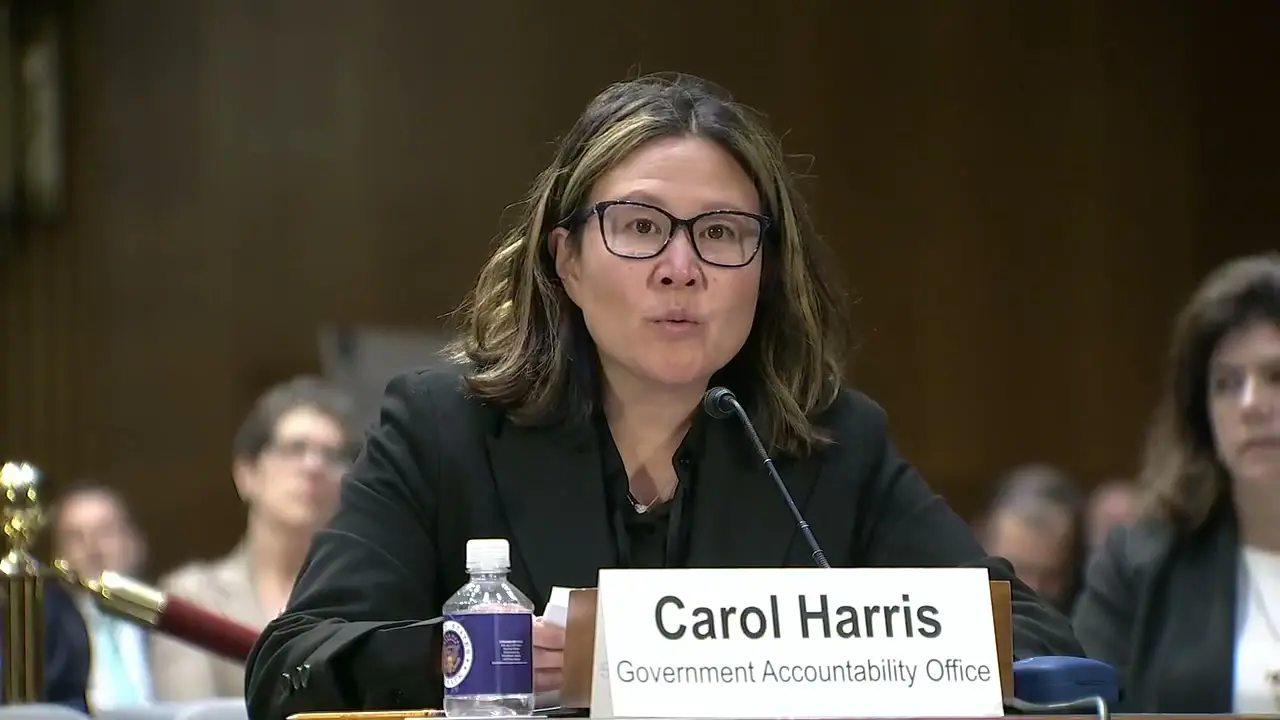
Thank you again, and we look forward to your questions. Thank you for your testimony. Uh, Ms. Harris. Chairman Moran, Ranking Member Blumenthal, and members of the committee, thank you for inviting us to share our observations about VA's recent work on the EHRM program. As you know, the department initiated this program in June of 2017 to replace the legacy VistA system, and to date it has deployed the new EHR to 19 medical centers.
In particular, VA set out to deploy to 13 sites this year, and they achieved this goal. The rollout was much smoother than the initial 5 sites, which occurred roughly 4 to 6 years ago. However, it is too early to declare success as we continue to see fundamental program management gaps and mixed reviews about the system. Additionally, VA will hit the $10 billion ceiling of the current Oracle Health contract before the end of the year, with 17 months left on the initial contract. In light of this situation, VA modified the contract adding 3 more years, moving the end date from 2028 to May 2031, and increasing the ceiling to $27 billion.
Over the past 5 years, we've issued 5 reports on VA's efforts to deploy its new EHR system. These reports describe the challenges in VA's implementation and include 18 recommendations, 12 of which we have marked as priority because of the critical impact they have on strengthening successful deployments. While VA has taken actions to address our recommendations, it has not fully implemented 11 of them. And I'll highlight 3 points from our work this afternoon. The first is that VA needs to produce a reliable cost estimate and schedule.
Last September, the department shared an updated total lifecycle cost estimate that included $37.2 billion to go live at all 170 sites by 2031 and another $19.3 billion to operate and sustain the system for another 10 years. Bringing the total cost to $56.5 billion. We have been waiting over a year for VA to provide the underlying analysis supporting this figure. VA has also described key assumptions about this estimate that are concerning, such as the use of unrealistic inflation rates. A credible estimate is imperative to understanding the full magnitude of VA's investment.
We have also yet to see an updated integrated master schedule. And while I applied— applaud the program for deploying to the 13 sites as planned this year, doubling of sites next year will introduce significantly greater complexity and execution risk. Without a comprehensive schedule, it will become increasingly difficult to effectively monitor progress and anticipate potential delays. We also can't know whether 2031 is a realistic end date. Consequently, as a department increases its deployment momentum, More information critical to controlling risks and informing congressional oversight is needed.
And now to my second point, which is that more work is needed to address user concerns and system issues. In May 2023, we reported on gaps in VA's organizational change management activities for EHRM. We also reported that users expressed great dissatisfaction with the new system and that VA did not adequately identify and address system issues. We made 10 priority recommendations to address change management, user satisfaction, and system trouble ticket deficiencies. As of today, VA has closed 2 of the 10 priority recommendations and continues to work towards implementing the remaining 8.
So for example, the department now has a VA-specific change management strategy to formalize its approach to drive user adoption. VA has also implemented the use of innovative learning labs and increased the number of super users at each site. And during my time in Michigan, in the lead-up to the go-live there, I did hear positive feedback from users on these specific actions. However, more work is needed, and among other things, VA has yet to establish user satisfaction goals and ensure the program demonstrates improvement towards meeting those goals. And finally, my last point is that VA ought to be making plans for turning off the legacy VistA system.
As we talk about EHR, we shouldn't lose sight of this part of the equation. The legacy environment is costly to maintain and difficult to secure. V— VistA's annual cost is not well tracked within the department, but it is in the hundreds of millions of dollars. It will be difficult to turn off as VistA provides numerous functions beyond what the Oracle Health System is intended to do, such as the handling of prosthetics and dental care. Accordingly, I would urge you to press VA on their detailed plans and timeframes for decommissioning VistA.
Moving forward, it will be critical for VA to address the 10 open priority recommendations as soon as possible. Doing so will position VA to more effectively deliver a modern health record system our veterans deserve. And that concludes my statement. I look forward to addressing your questions. Miss Harris, thank you.
Let me use this moment to turn to— right back to Dr. Neil— I'm sorry, Dr. Neil Evans, and ask him to respond to what the Government Accounting Office— what Ms. Harris just said, particularly related to are you going to provide the total independent life cycle cost estimate? And secondly, are you going to complete the outstanding recommendations that have been made by the GAO? And perhaps an issue that I am only more now becoming aware of, the costs associated with legacy of VISTA? Sure, I'd be happy to answer each of those in turn. So let's start with the cost estimate.
No audio detected at 42:00
No audio detected at 42:20
We've been having very productive discussions with GAO with regard to the open recommendation regarding an independent cost estimate. As I mentioned in my opening remarks, in 2022 we completed an independent cost estimate that was done by an organization at FFRDC, the Institute for Defense Analyses. We have looked at that cost estimate for the program and compared it with our program cost estimate, the one that I mentioned that we delivered here to the committee in September of 2025, and they are within 5% of each other. GAO has graciously offered to review our homework there, to look over the, the analysis between the two, and we are looking forward to taking GAO up on that offer, sharing with them are the cost— the independent cost estimate that we have done, as well as our program cost estimate, the details within, as we then work towards our decision-making on a new independent. Dr. Evans, before you go to the next two, two parts of my question, Ms. Harris, your response to what was just said?
Sure. I mean, we're— we absolutely will be happy to take a look at the reconciliation between the current $56.5 billion estimate and the ICE of record, which is from 2022. My concern about the ICE of that comparison is that that ICE is old, and given his remarks as well as Mr. Cecilia's remarks about the changes in scope and, and everything else, um, my, you know, my concern is that that ICE is no longer current, and so perhaps an updated independent cost estimate is still a worthwhile effort. Thank you. Dr. Evans?
I, in follow-up to that, we agree that this would be the beginning of that conversation to move forward with regard to whether there should be an independent cost estimate, a new one pursued. The second question that you had asked was around the priority recommendations that GAO has provided. We meet monthly at least with GAO to work through the details about those recommendations. But more importantly, we're working every day to address the recommendations. Of the 18 recommendations from GAO, 7 are closed.
No audio detected at 44:40
That leaves 11 open. VA has submitted a request for closure on 5 of the 11. We believe we've made significant material progress, in fact, to the point where we believe that 5 of the 11 that are still open are at the point that they're ready to be closed. GAO has rightly said that they wanted to see evidence of how we performed over the course of this past year in deploying at 13 sites, and as we move into deploying at 26 sites next year, to see the evidence, um, of essentially success in order to close some of those findings. So we are making good progress on each of the findings.
On the third topic of VistA, there's active work happening in VA right now to look at what a deprecation plan should look like for VistA. As was mentioned, VistA supported more than just the electronic health record capabilities. So it's probably 70 to 80% of VistA was what supported electronic health record. There were other modules, other capabilities VistA used to support used to support, for example, the police force. It used to support our time and attendance in VA. Those functions have been pulled out of VISTA.
We are doing an analysis of each of the remaining capabilities. One that was mentioned by Ms. Harris was prosthetics. That's one that's under active evaluation right now. So the short answer is we understand that completing deployment of the federal EHR in 2031 should also mean that we are looking to deprecate VistA and remove those costs from the VA ledger at the same time that we no longer need VistA for its electronic health record. Where does the function of those 30% of what VistA does, where does it go?
Would you say pulled out? It would, it would move to different— for example, time and attendance, time and leave used to be part of VistA. We now have a separate modern time and leave system that's used across the enterprise. So it is a separate IT system that replaced doing that in Vista. We would be looking at any other remaining capabilities in a similar fashion.
How can we use our existing IT infrastructure to support those capabilities? And when we can't, how would we replace that functionality, usually with a commercial capability? Doctor, thank you. Senator Blumenthal.
Mr. Cecilia, how long have you been employed at Oracle?
18 Years. I'm sorry, 18 years. And I believe in July of 2022, you testified that Oracle was committed to delivering the system quote, without exceeding the contracted cost, end quote, and would fix performance or workflow issues, quote, at our expense. 4 Years later, the ceiling is just under $27 billion. The VA Secretary told the House he wasn't involved in the negotiations, couldn't say what drove the increase.
I assume you do— did the due diligence when You made that statement. Uh, to what do you attribute the need for an additional $17 billion? The primary driver for the increase in the IDIQ is that the scope has drastically changed. At the time that I made that statement, which was one month after we acquired Cerner, the system was contemplated to support 85,000 concurrent users. The new number is 195,000.
At the time, there were just north of 60 interfaces that needed to be written. Now it's about 190, to my knowledge, interfaces that need to be written. There were things that were supposed to transfer to VA, like sustaining training and things that were supposed to transfer after year 3 and year 9. They still remain in Oracle's, in Oracle's court. So as I said, my statement at the time was very sincere, Senator.
This is, you know, this is a very complex program. I think we've made measurable progress in this. I'm not here to declare victory. I'm also not here to say that everything is perfect with the system. But the system has, the scope of the system, the scale of the system has changed dramatically.
We have included many no-cost services to the VA, including moving to a modern, secure cloud. Including rewriting—. And I apologize for interrupting, but my time is limited. So let me just say, so far, I haven't heard anything to dissuade me from thinking that Oracle assumed the risk when it acquired Cerner, when it knew what it was getting into. And justifying this additional $17 billion seems very difficult from the estimate that the explanation or non-explanation we've been provided so far, especially since the program is in a state that could hardly be called satisfactory.
Um, let me show you a poster.
If I may.
You recognize the people in that photograph? I do.
President Trump's on the— on your left. And that's Larry Ellison on the right, correct? That's correct. And Larry Ellison is Oracle's co-founder and executive chairman. Correct?
That's correct. Do you know what the occasion was for that photograph? I believe that that was the announcement of the Stargate Data Center. Correct. Oracle was announced as a partner in a $500 billion Stargate project for AI infrastructure.
That picture was taken in January 2025. Are you aware that ahead of the 2024 elections, Larry Ellison gave about $45 million to a nonprofit backing President Trump's campaign, as well as other funds connected to Trump's legacy initiatives, as they're called, Freedom 250, reported to be about $1 million? Are you aware of those facts? I've been made aware of that. I was not aware of that at the time.
No audio detected at 51:40
You weren't involved in—. I was not involved. I did not discuss Mr. Ellison's political donations with him.
Are you aware of other business involvements between Larry Ellison and the Trump family? I am not. I do not discuss Mr. Ellison's conversations if they've happened with the, with the president. You're aware that Oracle was awarded a 10-year, $395.8 million contract by OPM to establish a single HR system for the federal government? I am aware of that.
I've also been informed that we were the low bidder on that. Are you aware of stock in Oracle owned by President Trump? I've been made aware of that, but I was not aware—. I do not track the president's The, the estimates are that his stock ownership is in the millions of dollars. We don't know precisely how much.
No audio detected at 52:40
It may be at least $1 to $5 million, but very likely higher because of when and how he purchased that stock earlier in this year.
Would you say that those kinds of links between Larry Ellison and President Trump create a reason for this committee and also the Permanent Subcommittee on Investigation, where I'm the ranking member now, hopefully chairman, to do further factual inquiry. Well, that's ultimately the purview of Congress, Senator. That would be, you know, more suited for your department than mine. But I've had no involvement with the president in terms of this. You're not able to answer these questions.
You're not directly involved. I am not. Mr. Ellison is. He's not here. I think he should be here.
And I'm going to ask the chairman to invite him to be here, even between now and the end of this year, when Senator Moran will still be chairman, I think we should hear from him. Thank you. Senator Murray. Senator Sheehy. Sorry, didn't know you were here.
Sneaking up on you. Yeah.
The DAW's rolled out an electronic health record system roughly the same time through Genesis. Obviously they've got a different command structure, acquisition structure, and for the most part their rollout has happened faster and it would appear more seamless. The VA's got a more challenging landscape, no question. You've got a larger population to deal with, you've got a wider age group to deal with, and geography that arguably is more challenging, but the reality is our veterans need a 21st century healthcare record system. It's been decades, it's been billions of dollars, they're still not getting it, getting it.
No audio detected at 54:40
We still don't really have a good finish line in sight, and I think it's high time that, as we've seen over the last several days, whether it's banking or Gmail or ATC, our infrastructure is challenged right now, and the health of our veterans shouldn't be mixed in with that. So I don't really have a question. I simply could tell you, please dig in, get this problem solved. It's been far too long. We spent far too much money.
It's frankly been a disgrace how long this has taken, how much money we've wasted on it. If we can send people to the moon and bring them back, we can get electronic health records done. So let's get it done. Thank you.
Sir, Senator Sheehy, thank you, and Senator Murray, thank you for reminding me that there are others in the room. Yes. Thank you, Mr. Chairman. Thank you to our witnesses today. It has been over 6 years since the VA launched its first EHR deployment at the Mann-Grandstaff VA in my home state of Washington, and it was a complete disaster.
It literally put veterans' lives in danger, so it won't surprise you to hear that I am very skeptical about deploying the system to other VAs in my state. Um, Dr. Evans, Puget Sound is the largest VA in Washington and the specialty care hub for Alaska, Idaho, and Montana. VA is scheduled to roll out EHR there next year, and ahead of this next Washington deployment, have you spoken directly with providers at Mann-Grandstaff about the lessons learned?
Yes. Do you want to tell us what they told you? Sure. I, first of all, I've spoken, I've been to Mann-Grandstaff several times in person. In fact, when we started, you know, we was frankly in partnership with you and prior hearing, which is a hearing when I had been on the job for a month where you encouraged us to—.
I just want to know what they told you. They shared with us some of the challenges, but they also, I will argue, have been incredibly helpful in providing feedback that has led to some of the 13,000 changes that we have made to the system, in part because we have learned from what they shared. So I would argue that the staff at Van Grandstaff and the staff in Walla Walla And frankly, all of our original sites in the Pacific Northwest are staff that we have a significant debt of gratitude to for their willingness to—. I appreciate that, but I think, you know, there are still concerns, and I'm hoping you're talking to them before you roll this out. Let me just say that one of the failures in the past EHR rollouts was that the VA systems couldn't work with research universities and partners.
The Puget Sound VA works with outside partners, including the University of Washington, to reach groundbreaking new treatments for our veterans. Can you assure me today that VA has resolved those issues coordinating with its research partners so this EHR rollout won't mean disruptions in clinical research and in patient care? Yes, absolutely. You may recall that one of the reasons why we were, we were on track to go live in Ann Arbor numerous years ago, and we stopped that go-live because of concerns about our ability to adequately the research mission in Ann Arbor. Ann Arbor has partnerships with the University of Michigan and others.
Have those been resolved? And those have all been resolved. So we've gone live in Ann Arbor. We went live with over 100 clinical trials in Ann Arbor and have been very successful in doing so. So you can assure me today that there won't be any disruptions when you go live with any of their partners, including, as I said, research and patient care?
That's correct. There will not be none? You're testifying to that today? We, we, the, the, we work closely with Oracle. We, we actually send a team.
There is a dedicated team from Oracle that supports working with our principal investigators to make sure that we are getting the build right for each of the clinical research trials. We've, this has been a proven model over the, all of the medical centers over this past year where we do support research, and we will of course be doing the same when we go to Seattle. Well, let me just say that after the missteps we have seen, I want to put you on notice today that I am watching like a hawk to make sure that quality service and veteran safety are being prioritized every step of the way. Um, now Oracle told my staff that its EHR contract increased a whopping $17 billion because there were changes in the scope of the project between 2018 and '26. The number of veteran records increased from 8 million to over 26 million.
Apparently VA got this estimate dead wrong under the first Trump administration. So Dr. Evans, when did VA realize the project was more than 3 times larger than originally negotiated?
Um, the— so I'll first say there, um, we shared that a year ago, as I've mentioned, the cost estimate. So we have certainly been aware of what the costs are going to be, in part because of the realization that the estimate— so I'll just take us back to 2017 and 2018. That estimate of $9.996 billion, that was the original ceiling estimate, was an estimate based on an assumption of what it would take to successfully deploy the federal EHR. We together have learned a lot. We have increased, for example, you heard mention of learning labs.
We added learning labs. That was not—. Okay, my question was, and I will run out of time here, and I have more questions because Um, the estimate was way off. Oracle also said that in addition to record increases, there was 129% increase in end users. How do you explain that?
I'm really confused about how this number is cre— is increasing when the Trump administration is simultaneously putting a hiring freeze on the VA clinical staff. These miscalculations are a big red flag to all of us, and, and we need more information on how VA comes up with these estimates that apparently were really wrong. That's what I'm very concerned about.
Mr. Sicilia, and I'm— if I can just have another minute here. In July 2022, you told this committee that Oracle would provide VA with an EHR system that exceeds expectations without exceeding the contracted cost. Was that a promise that you kept? Yes or no?
I believe that what was contemplated at that time is very different than what's been delivered today. And I believe that we have delivered after the reset on the redesign program. Well, let me just say that more than tripling the cost of the project kind of feels like a no to me. And you also said the number of interfaces Oracle has to build to connect to the other systems has increased by 187% since 2018. So let me just ask you, does the new contract account for future work to connect to those other systems?
The new contract, the contemplated IDIQ takes into account all of the scope changes that have been made, all of the additional interfaces, and the continued rollout to complete the VAMC rollout. That is all in the new IDIQ. IDIQ. If the question is about value versus cost, I want to go back to what I said about a sincere commitment. If Congress believes that the system doesn't have value, that is something that only Congress and the VA can ultimately decide.
We made every effort to deploy this system as efficiently, as cost-effectively as we can. If Congress believes that the cost is simply too high but the value is still there, well, I would encourage you to challenge us. Look, what I'm just saying is you told this committee that, um, the system would exceed expectations without exceeding the contracted cost. We're here not much later, and it's done that considerably. So, Mr. Chairman, let me just say, I want to make sure that you are not going to walk away after the end of this contract and leave Veterans with a system that still doesn't work.
We all know veterans deserve access to the best healthcare technology, and you're responsible for holding up that promise to them. Thank you, Mr. Chairman. Sir Banks. Sir Banks. Thank you, Mr. Chairman.
Dr. Evans, the Oracle EHR has been live in Indiana since August. We are hearing some concerns, which is to be expected, but nothing like the earlier sites. You have clearly made a lot of improvements along the way, but when do you expect the Indiana medical centers, when they will be able to return to 100% of normal appointment and procedure volumes? Yeah, we have been— first of all, I will say that in Michigan and Ohio, we saw return to normal operations, to greater than 90% of normal operations across. We measure We measure operations with 15 metrics, and we saw greater than 90% recovery, typically within 12 to 15 weeks, which is comparable to what a best practice would be at a commercial healthcare system.
No audio detected at 1:04:00
We're seeing the same in Indiana. So you think we're close? Yes. Okay, good. Um, the— our medical centers in Indiana got dozens of temporary staff to help manage the transition, but just a few or a small handful of new permanent staff.
When you're spending hundreds of millions of dollars every month on this program, why not increase staffing levels all across the medical centers? Uh, I think, you know, we have— first of all, there, there has been an increase in staff, um, where it is necessary at all of the medical centers that have gone live. That is when there is a need for staff. There is an authorization to hire that staff. I work with the medical center directors of every medical center and have not run into trouble making sure that we're getting the right medical support associates, clerks at the front desk, pharmacists, or other staff on board.
I will say the other advantage we have— we do have temporary staff who support the medical center Because we, you know, we're training, you know, in Indianapolis, for example, we're training over 5,000 end users. We need to pull them out of the clinics, off the wards to do their training. We are using interim staff to allow patient care to continue while employees are training, but those are temporary staff that we can then support future medical centers and go-lives. Can you quantify the permanent staff increase in Indianapolis? I would have to take that for the record to get you the—.
On the record for that—. The numbers. The VA recently increased Oracle's contract ceiling from $10 billion to $27 billion. How many more contract ceiling increases do you anticipate? None.
And you increased Oracle's contract ceiling, but have you actually negotiated the cost to finish the project? The costs are negotiated at the task order level of the contract. So the ceiling is what— there is an authorization to spend. Of course, those dollars need to be appropriated by Congress, but there's an authorization to spend up to $27 billion. The actual costs are negotiated at the award of each task order.
No audio detected at 1:06:40
So when we award a task order for another set of deployments, let's say deployments in calendar year 2028. All of the deployments in calendar year 2027 have already been contracted, but as we move to '28, there's still opportunity for us to have ongoing negotiations on cost with Oracle, who has proven to be a good partner in, in those discussions. If we are able to find efficiencies, we pass those savings on to the taxpayers. Cecilia, you concur with that? Is there a negotiated amount to—.
I, I, I do, I do agree, uh, that the, the, there are no further ceiling, uh, lifts needed. Uh, the price— we have not increased the price. The pr— the price per VAMC, um, it's based on small, medium, and large, was, uh, was negotiated and agreed to during the previous administration. We have not increased that price. There are escalators.
I think it— I believe, uh, it's a 2% escalator on labor costs that are included in the contract, but we've actually not changed the core pricing. Okay, Miss Harris, what is GAO's level of confidence in VA's life cycle cost estimate at $56.5 billion? Well, I'm not confident that the $56.5 billion estimate is realistic, largely because we have not seen the underlying documentation associated with that estimate, but also in the information that they have provided to you all, which you have then provided to us. There are red flags there that give us concern. For example, the inflation— the base inflation rate that they assume for the $56.5 billion is 2%, which we've not seen that since pre-COVID.
No audio detected at 1:08:00
And any federally published, you know, inflation indices do not show that whatsoever. So that's unrealistic. In addition, there are still areas of undefined scope, like the aesthetics as well as dental care. So, and appointment scheduling. So those are still areas, since the scope is undefined, will increase the price tag.
Those costs to go higher, but how much higher? I can't say for sure how much higher because we haven't seen the underlying documentation. But do I think the costs are going to go up? The answer is yes. My time has expired.
Senator Hirono.
Mr. Chairman, it seems as though— no, not it seems as though. We have been here at least every year to focus on what's happening with the electronic medical situation. And I remember a number of years ago, maybe more than 15 years ago, when The VA Secretary Shinseki and the DOD Secretary Gates said that their goal was going to be to have a seamless system of electronic medical records between DOD and VA. So, Dr. Evans, are we anywhere near that kind of a seamless system covering these two departments? Yes.
No audio detected at 1:09:40
Really important to emphasize that the electronic health record, that is the federal electronic health record, is the exact same system, one database, for what the Department of War calls MHS Genesis. I will give you an example. Just today at 1 o'clock, I saw a new patient video visit my— usually I have my remote clinic on Wednesday afternoons. I saw a new patient who had just been seen who had just finished his service, his military service in El Paso, moved to Washington, D.C. I saw him as a new patient.
There was not a piece of health information that I did not have in order to do an intake. He'd had a complicated set of tests done at the William Beaumont Hospital. I had all of that information. So, excuse me, I am— I just wanna make sure I understand what you're telling me. That for the longest time, there wasn't this seamless kind of a system between DOD and the VA.
So when was this accomplished? When was this connectivity, if you wanna call it that, accomplished? We have had access to the data for many years now.
The advantage for the federal EHR is that it will require no additional or special effort by VA clinicians to see that information. So someone who leaves active duty and comes to Hawaii, for example, would all of their health records be at the hospital in Hawaii? Yes. Right now? Yes.
No audio detected at 1:11:40
Okay, that sounds pretty incredible.
Okay, now Ms. Harris, you noted that there were underlying documents that, that you don't have, so that you can't really tell us how much more, or the— with any accuracy, how much more completing the, the deployment will cost. Is that— is that—. Yes, that's correct. So why isn't it— have you requested—. Yes, we have requested it, and we are still waiting for the documentation.
So when did you make that those requests? Well over a year ago it started.
So, Dr. Evans, why doesn't GAO have this information?
GAO will have that information. We have shared the estimate, but what GAO is requesting is the full set of details, which we've committed to share. See, the thing is that there's a really big difference between the first contract was let for $10 billion and now it's up to $26 $7 billion, and you have not deployed the system into all of the hospitals, right? By the way, how many hospitals already have—. Medical centers have the electronic records system been deployed to?
30, 40? 19 Have been deployed so far. 19? Yes. How many more?
There will be 26 deployed next year. And within the original $10 billion that has been referenced, that will fund at least 50 of the 170 hospitals. So I want to be clear that you now have deployed the system in—. And by the end of '27, you're going to be in how many medical centers and how many are left? By the end of 2027, we will have deployed to 45 medical centers.
How many will be left? There are a total of 170. Isn't that an amazingly large number that you still have to deploy to, including, by the way, the Hawaii Medical Center?
To me, that is an amazing number of centers that you still have to deploy to. We would like to know how much more, as is likely, how much more will it cost because we are already more than $10 billion more than the initial contract. And how are we to really ascertain whether whatever the increases are are justified without— I'm glad that the GAO is there. I am running out of time. But one of the questions I had, Mr. Chairman, for GAO is of all the recommendations that GAO made to the VA regarding these systems.
What is the most critical that the VA should address between now and the length of time it's going to take to have these systems deployed in another 100 or so medical centers? I think producing—. Please answer. It's one of my questions too, so I yield you some time. Thank you.
Yes. If the chair can follow. I think that my top one would be producing the reliable cost estimate and schedule. And this is so important because when you take a look at the DOD version, the MHS Genesis version, you know, when we evaluated them and why they were able to successfully deploy, you know, we looked at their cost and schedule and we identified issues there. They took action, they addressed it, and they were able to successfully deploy.
So again, I think having a robust cost and schedule is critically important to follow in the steps of DOD and successfully deploy. Thank you, Mr. Chairman. Um, Dr. Evans, you say you have agreed to share the underlying documentation for the cost report. Why not just give them the cost report?
No audio detected at 1:15:40
Why does it take a process, an agreement? What's the holdup? We will. I, I think Ms. Harris and I were just speaking about this in the back of this very room at beginning of this hearing and talking through. So something good came from this hearing already?
Already. All right, Ms. Harris, is that true? Yes. I mean, we look forward to, to receiving the documentation and taking a look at the reconciliation, but the reconciliation is one thing. We also need to see the underlying basis for their, their program.
That's what I thought Dr. Evans just testified, that he had— there's an agreement to give you the documentation And my question was, why do you need an agreement? Just do it. I agree. Senator Tillis. Thank you, Mr. Chairman.
Many years ago, actually before I became partner, I was a senior manager at P.W. Negotiating a contract with a federal agency, and they wanted a fixed price, fixed scope contract. I said, that is awesome. And the reason I like that is with a fixed price or fixed scope a fixed scope contract, the minute you sign that contract, I no longer have to deal with you, I just got to deliver on what I've legally committed to. Invariably in federal government, we have scope creep.
We have optimism. We probably simplified the complexity of all the applications and all the workarounds and all the things that are in all the VISNs and all the healthcare centers. This has all the hallmarks of a failed execution. You don't go from a $10 billion nut to a $37 billion nut without people missing a lot of stuff. And I've been tracking this thing from the beginning up to and including when they were selecting the platform, and I'm glad they selected a platform that has the same technology stack as DOD.
But guys, nobody can rationalize a fourfold increase in the cost of a project without somebody's head rolling. Now maybe they've already gone. Matter of fact, one of the secretaries of the VA that was a part of this implementation was my MLA until he was put forth as the secretary of the VA, Robert Wilkie. What I've seen here is a bipartisan failure of execution. And so my question is, why would the $37 billion number be any more credible than the $10 billion number?
What remedial measures have gone into— and by the way, I hesitate to ask the Oracle folks, because at the end of the day, you have a client, and I'm not sure if you were as blunt with your federal client as I was with mine. But if you answer— if you want to answer that, tell me what the buildup is, and tell me why we got here, and why you think this is the last time the cost is going to go up. See, I view this as an execution error, not a platform error, unless you are leading and making all the scope decisions. So I think I'll start with this first. A lot of, as you would be aware, in a project like this, a lot of the complexity is in the front end of the project.
It is identifying the requirements and being very clear about those requirements. It is understanding what the—. No, I get all that, done it 25 years and a lot of big implementations. My question is, What has changed in the methodology to make a 3.75% increase in the budget more credible than the $10 billion one or the $27 billion one? I want to know, how did the methodology change so that we have a sound basis for this being the last time that we have to talk about time or money?
No audio detected at 1:19:20
We're at a very different spot in the program. I think that's the quick and factual answer to your question. We now have a stable build. We know what the requirements are. We know exactly how many systems are— need to be interfaced, and in fact, they're already interfaced.
We have deployed every single clinical service with the exception of solid organ transplant, and that is going out in January. We now have a stable system. There's the same system as the DOW. We know what we're deploying, and now we need to just execute the deployment. We've also done that 13 times this year, we're going to do it 26 times next year.
We know what the costs are, and it becomes much easier to, to project what the long-term costs are when you have a clear understanding, when you have a stable product that has been built and that you're now rolling it out directly. Ms. Harris, how do you feel about the methodology and, and whether or not this one's any more credible than the prior ones? I mean, I think one of the key things is on paper that sounds real good, but in execution The $10 billion execution plan sounded really good. Right, and what we have seen is there's still significant, there's still very poor user satisfaction of the system itself. There are still changes that will be needed to create those results.
Yeah, which are going to be break-fix. Increase the cost. Test problem reports, all that kind of stuff that you have to do when you're implementing a large enterprise system. Well, I just, I suggested when we first selected this platform that the department establish a program office that included members of this chamber to provide real-time oversight over the execution so that we could have an early warning to overages. I requested that of, I think, of no fewer than 2, maybe 3 Secretaries of the VA. And I was trying to do that to make sure that you all had champions here to get this project done.
And it's been a failed engagement model from the beginning on a bipartisan basis. You don't have Senator Hirono up here or other people being the champion because all we're seeing is bad numbers and failed execution. I'm not here to criticize anybody. The platform's fine. This is about the implementation.
I understand, I know this platform. I used to serve on the Electronic Health Record Oversight Committee down in the state when we were working on EHR. This is, this is an execution fail. It's not a platform fail. And until you change the methodology, I could fully bet, I could create a cow she bet that you'll be back for more money beyond the $37 billion.
And I'd put a lot of money on it. Because all I've heard are the same words applied to a new set of number and a different set of calendar constraint. I'm not criticizing anybody. I'm just objectively looking at a 4-time increase in an implementation. And none of it relates to greater value.
It's just realizing something that was promised for a fourth of the price 5, 6 years ago. I don't even know how long it's been. But guys, I'm telling you, get the engagement model right. And get us on board and do things differently, or you're not going to have champions here, and you're going to come back to every oversight hearing, you're going to get flogged, you're going to get distracted, and you're going to ask for more money. And that just— that's— it's a failure, because we got to think about the value this creates when it's implemented in every VISN, when it's implemented in every healthcare system.
This has tremendous potential, particularly if it integrates with the Department of Defense. But in this current form, I'm completely— I've heard this word salad before. And I know it's well-intentioned, but there's something in the project execution that's just not working. And if I were coming back, I'd like to go back and visit with y'all. I've made several offers to come and visit with this program office.
They were never taken up on. But I hope you have greater oversight going forward, or you could have a project that gets canceled.
I would welcome the visit, sir. Senator Tillis, thank you. Senator.
Thank you, Mr. Chairman. Excuse me, Senator Kaine. Thank you, Mr. Chairman. I'm just a country lawyer from Brunswick, Maine, but I don't understand something that calls itself a contract and the price keeps changing. A contract is a contract.
What— how did it go from original $10 billion to $27 billion? And I just don't understand it. Don't you—. Isn't there a contract that says we will pay you $10 billion and you deliver X? How did it almost triple?
Any theories? Doesn't sound like a contract to me. Sounds like a license to print money.
The contract itself is an IDIQ contract. Define that, please. It's an indefinite duration. It's the framework of the contract that essentially sets the rules of the road but the actual contract awards occur at the task order level. So it essentially says for 10 years now—.
It's a 13-year contract— for this 13-year period, task orders can be issued against that contract. And each one of those task orders is exactly what you're describing, what sounds like, which is where we said, here is the work that needs to happen. We agree to a firm fixed price for that work to happen. The vendor is held accountable to deliver the services. So, you're telling me that there's not a contract, there's a little contract every year with— and so there's no fixed price overall.
There is not a fixed— I don't understand it. Why at the beginning of this didn't you say, we want electronic health medical records for the 9 million people served by the VA, what will you charge us? I don't know how the hell you analyze this against any other option when you don't have a price. I mean, what am I missing? You're telling me that there was no price at the beginning?
There was an estimate of what the price would be. And by the way, the estimate at the beginning, if we're going back 2017, 2018, the estimate at that time was $16 billion. There was— signed a contract on an estimate, not on a price. We created the framework by which we could award task orders in other words, award the contracts as we went. We didn't know what the price would be.
This is a completely alien world to me. I want to strike the word contract. This is not a contract. There is no contract here. Or at least there's a contract for you to pay Oracle whatever they want to charge.
Let's talk about a comparison. Epic, Kaiser Permanente has 9.6 million patients. VA has 9.1 million. The cost of Epic in the original contract was $2 billion for those— for Kaiser Permanente. In the VA, it was $10 billion.
So right off the bat, we're 5 times. Now the adjusted contract ceiling for Kaiser Permanente for Epic is $4 billion. You're talking $27 billion. I'm a— I happen to be a patient of the MaineHealth healthcare system, and I'm on Epic, so I know about Epic. It's a terrific system, it works, there are no bugs that I know of, I can interface with my physician.
How do you explain the gross difference between what Kaiser Permanente is calling— is paying for the same number of patients, and we're paying— it comes out to about $4,000 per beneficiary for this contract, and Kaiser Permanente is paying about $400. So it's 10 times more expensive.
I've compared them also with Mass General, which is on Epic and other. I mean, there's nothing that I've been able to find in America that compares to the exorbitant price that's being paid here by the American taxpayers for something that so far isn't really out there and isn't working all that well. Right, I think it's important to understand that, it's important to understand what the scope of the work is. So for example, in this program we have, we also had some significant infrastructure upgrades that were necessary across VA facilities. What does that mean?
Computers? We needed to upgrade networks, pulling cables through the hospitals, PCs that went on desks. So there is cost here for servers, for security infrastructure from a cybersecurity perspective. That uplift is also contained within this cost profile for the program. In addition, what's contained is all of the training of over 500,000 users, VA employees.
Did they do that at Kaiser Permanente and at MaineHealth? I don't know whether that was included in the contract or whether the contract numbers that you're referring to are simply for the software licensing and the software itself. I'm going to dig into this more deeply, and I want to make the comparison apples to apples. I want it to be fair. But a differential of 10 times sort of raises red flags, to put it mildly.
As you can tell, I'm extremely skeptical of this. I wasn't here when we— I wasn't on this committee when this deal was firstly— first signed, but I don't understand why we went to somebody who's inventing a new system instead of going to a system— and I have no stake in Epic, I just happen to know it's one that works. And I don't understand why we're reinventing the wheel at an enormous cost. I think we're paying for Oracle's R&D basically through this contract. Thank you, Mr. Chairman.
Senator King, thank you. Senator Bozeman. Thank you, Mr. Chairman. I apologize for being late getting here. We're in the process of trying to figure out how to fund the military, which is important and goes along with veterans.
I was just talking to Senator Moran. He and I were on the House Veterans Affairs Committee, and this has been going on for a long, long time. So hopefully we can see the light at the end of the tunnel. Uh, Dr. Evans, um, Arkansas will be, uh, you know, our two hospitals will be coming up in the future. I guess what I'd like to know are what steps being taken to prepare and streamline the rollout at, you know, sites like this.
Is there anything that we can do as a Congress to help those efforts. My understanding, I had a staffer that worked on the system at DOD, and he felt like the key was the, you know, the preparation for people, you know, as they learned how to use it.
I believe Arkansas is scheduled to go live in November of 2028, and we're— which means that we are already starting to work at the facilities in Arkansas, we start 2 years in advance of go-live to prepare. I wholeheartedly agree that the most important part of this project is preparing and supporting every single end user, that is the VA employees who are caring for veterans, and helping them navigate the transition. It's been one of the— this is one of the places where GAO has made recommendations for us about just a few months later. That frankly we were working on of our own accord as well about change management, training, user support that we are fully committed to. And frankly, I believe that's one of the reasons why we are seeing the success we've been seeing thus far with 13 go-lives this year and 26 planned next year.
Uh, Mr. Cecilia, uh, have there been any specific challenges with infrastructure, workforce, workforce preparedness or clinical operations that complicate the deployment for you all? Are you referring to workforce of the VA or— Your workforce? No, there have not been. We continue to hire. We continue to bring people on board as we need them into our— specifically into our VA practice.
Early on in the program, as I mentioned in my opening remarks, opening statement. There certainly were at the time that we acquired the Cerner assets stability issues that, as we said, were unacceptable and have been addressed. Ms. Harris, he mentioned, you know, you and your report. Can you tell us about some of the program management issues that you've identified and their impact on the deployment?
Yes. So the reliable cost and schedule estimates are two very critical pieces pieces of information that every program manager needs to have and to make decisions about. We have yet to receive the underlying documentation associated with that, but I also wanted to go back to your comment about, you know, the DOD and, and the Genesis rollout and why it was more successful. I do fully agree that the emphasis on training is highly critical, or it absolutely is, and in fact um, the Michigan rollout, when they did the postmortem with this Michigan health check, there were 600 findings that were identified after the rollout. The majority of the issues were associated with the education and the training component.
And when we have spoken to the users across the board, they have identified the Oracle training as being very bad, and that is one area that needs to be addressed immediately before they accelerate the rollouts. Very good. So, uh, Dr. Evans, you know, in looking at her report and things, were you able to modify to conform to some of her concerns? Yes. So we— I would say we are very sensitive to improving training.
For me, what's important is the full adoption journey. Starting from awareness of why we're doing the change, working through training classes, which are on the computer-based training, and then instructor-led training, and then scenarios where you get to practice and use the system, and at-the-elbow support. We're working to improve all of those. That's why we solicit feedback from our end users. Very good.
We appreciate you all. We appreciate your hard work. This, this really is a something that has been very, very difficult for many, many years to implement. We look forward to seeing the light at the end of the tunnel. Thank you, Mr. Chairman.
Thank you, sir. Thank you, sir. Thank you, Senator Bozeman. Senator Blumenthal says a couple of questions and then we're going to wrap up. Thanks, Chairman.
Dr. Evans, last night, literally last night, my office received a letter from Secretary Collins, uh, about a month and a half after I asked a number of questions. Were you involved in preparing this letter? I have seen that letter, yes. I'm sorry, I have seen the letter, yes. Okay, um, the letter says that there was a, um, well, I'll quote it, uh, the, the program was nearly dormant for almost 2 years under the Joseph Biden administration.
No audio detected at 1:35:00
It's a fact, is it not, that the deployment of this system was paused in 2022 because of performance problems and patient safety risks. Correct? Yes, we paused, uh, what we called the program reset, uh, to improve, to basically address the concerns of end users. To—. Well, and there was a reason relating to patient safety.
It wasn't just, oh, we forgot about it, or we made it dormant. It was delayed because it wasn't working properly. There was intent, and there was considerable work that occurred to improve the system, to work on the stability of the system that you've heard Mr. Cecilia speak about, uh, to— that's where we had implemented many of the 13,000 changes we've made to the system. Absolutely. Wasn't the VA's fault?
I mean, you didn't create the problems in the system that caused that delay, correct? You meaning the VA? Sorry. We, so, there were, you know, we were at the time, we were looking at accelerating deployment, and it had become apparent that we were not ready to accelerate. That is, the system did not have sufficient, we had to work on the stability of the system, and some of, and respond to some of the user feedback.
No audio detected at 1:36:40
Frankly, that's when the first GAO, the GAO report that's been referenced several times during this hearing, where there were 10 recommendations about change management, was published around that time. GAO said we should work through those 10 items prior to resuming deployments. We were listening, frankly, to this committee, to the House Veterans Affairs Committee. Okay, I, I made the decision. I know you had to do a lot of things.
I think you've answered my question, which is the Biden administration didn't decide to put this program on the shelf just because it had some dislike of the program. There were problems, relating to patient safety that had to be addressed before it was further deployed, and it cost $1 billion in additional costs. That's the number that has been provided in the letter, correct? That's correct. And I think—.
Is that billion dollars included in the $17 additional billion? Yes, it is. So that's the fault of someone other than the American taxpayer, correct? I think I would start by saying, sir, to your original question, there has been bipartisan support for this project from its very outset. Oh, I know well because I've been one of the supporters.
Right. And so, I mean, I've— This is not a partisan issue. It shouldn't be a partisan issue. We're here to try to get our money's worth out of this system. Correct.
And it seems to me like we're paying a lot more money for what we should have gotten originally at much lower cost. Let me just ask you, um, when did you first learn of the $17 billion increase?
I mean, we have been estimated— we have been looking at It's— I mean, for— we have been looking at the cost of the program, as I mentioned, based on our firm understanding now of what the operational costs are to get to full deployment for several years. And we're aware, as part of the cost estimation of what it would take to finish the program, that it was going to cost more than the original estimates. I don't have an exact date for you, sir. So Is that an answer to my question? When did you learn of $17 billion as the number of additional costs to American taxpayers?
The ceiling increase occurred, um, in September, um, and so we would have reached the agreement around that $17 billion number in September. September of 2026. Correct. No earlier. That's when we would have arrived at that number with regard to the ceiling on the Oracle Health—.
When did you first think it would be in the range of $17 billion?
When we shared the program cost estimate in September of 2025, over a year ago. A year earlier than—. Correct. Okay. So essentially, you knew of this gargantuan additional cost for a year before it was made more specific?
As we shared that with this committee and have had discussions about that with this committee, yes.
Now, you probably are aware— I'm sure you're aware— committee staff receive monthly briefings from your office and contract notifications by email. Neither included this modification until well after it was reported, and we learned about it in the press.
Do you have an explanation?
I've spoken to the committee. I conduct and I'm a part of every one of those monthly briefings. Transparency with this committee and regular engagement with the committee staff is a priority for me and for this program. Was there a decision not to notify Congress? There was not an intentional decision to not notify Congress.
It was inadvertent. Correct.
That's my questions.
Senator Blumenthal, Senator King, anything?
One quick item. I understand that Oracle is developing some new AI products called Clinical AI Agent and AI AI native EHR. Are they going to be deployed as part of this project, and are they— is the deployment of those products part of this new $27 million price? Yes, the clinical AI agents are included in the new ceiling. The clinical AI agents are commercially available technology that helps doctors automate the creation of doctor's notes and a patient vision, saving them them, saving them clicks and time in the system.
No audio detected at 1:41:40
But any AI technology is only rolled out at the VA's discretion with the VA's approval. There's no mandatory use of AI technology in any of the clinical systems. But if those tools are to be used by the VA, there's no additional charge? There's no additional charge. From you for using them?
That's good, yeah, they're included in the new contemplated IDIQ. Thank you. Thank you, Mr. Chairman.
Uh, now I just have a couple of questions as well, and then we'll conclude the hearing. Um, and following up, um, I guess this is— yeah, this would be for you, Dr. Evans. Um, who made the decision to agree to the 27, to the increase?
Who made the decision to—. Who approved the decision?
We talked about notifying Congress. Who within the department or the administration said that number is right? And again, the ceiling is not— I just want to highlight the ceiling is not an obligation to spend. The ceiling is an authorization to spend up to and only with dollars appropriated from Congress. The— that negotiation would have happened through our acquisition professionals, the Office of Acquisition Logistics and Construction, OALC.
I— and those negotiations occurred through the normal means that negotiations occur. I was aware of the number. Leadership was aware of the number based on the discussions that we had with Oracle. Again, it is not a commitment to spend. It is an agreement to the ceiling.
The task orders are where the actual costs are negotiated, and those will be negotiated over the coming years as we work through the program within the construct of the overall ceiling. And so what, what do you need from Congress to pay the bills?
Well, we pay the bills using the yearly appropriations and That, of course, is something that we work closely with this committee as well as the Appropriations Committee around our yearly budget requests. Let me ask a practical question that I always care about. Community care, care in the community. What's the status of our capabilities and where are we headed in regard to the sharing of medical records between a community care provider and the VA? We now— VA now, as part of this project, through what we call the Joint Health Information Exchange, the DOW and VA jointly share data for the patients that we care for with the private sector in both directions.
That is, when a veteran goes to a private sector hospital, their VA data is available for the clinician caring for them. And likewise, when, when we send somebody to community care, their data is available. We're exchanging data with 95% of U.S. hospitals, over 130,000 clinics. We just went live with a Q— what's called a QN. We're using the Oracle Health Information Network just earlier this month to increase even further our exchange partners to support information exchange for veterans at the point of care when they're receiving care either in VA or in the community.
These providers are— is a greater number of providers in the private sector than those that are authorized to provide community care by the VA or the integrator? Yes, this is— I mean, this is part of health information exchange work to allow health information to be available to support an individual's care. It's only available for somebody who has the need to know in order to deliver care, clinical care to the patient in front of them. Health information exchange occurs between private sector hospitals, between the private sector hospital and government hospitals, and the VA and DOW through our health information exchanges. One of the concerns raised about community care has been that there's no easy way to exchange information between the VA hospital and the hospital or physician provider in the community, x-rays going back and forth, etc.
No audio detected at 1:45:40
No audio detected at 1:46:00
Is that solved by this plan? I would say that we have partially solved that. That is, there is more information exchange than there ever was. I am far less likely as a VA clinician to have to walk to fax machine than I used to be. But we have not completely solved this problem.
And in fact, I'm looking forward to the opportunity we have in front of us as we roll out the federal EHR and as we implement even more technologies within the federal EHR to streamline some of those administrative processes which have proven challenging in the exchange of information to support VA-funded community care. There is an opportunity for further improvement. So I'm going to say partially solved, still more room to move, and it's one of the things I'm very optimistic about with this program. It is a goal to achieve, true? Yes.
And the exchange of that information, is it better in one of the— in a VISN that has already implemented the electronic health records? I mean, one of the advantages of health information exchange in to a modern electronic health record like the Federal EHR, an Oracle Health product, is that when we bring in health information data, it gets presented to the clinician as a first-class data element. That is, it can be integrated, that is, community data can be integrated into the veteran's VA record in a way that it's not viewed as data from the community, is now part of the core record. So yes, the experience is better at Federal EHR sites Again, this is still a work in progress. We still have a ways to go.
No audio detected at 1:47:40
Ms. Harris, anything that you wish we would have asked that we didn't ask that would make the circumstance of compliance with your recommendations occur faster?
I think that's— I think you've asked all the right questions. I don't have anything more. I mean, nothing we can extract from Dr. Evans before we depart? I mean, I, I think receiving the cost estimation documentation as soon as possible would be the very best step.
Okay, no further questions. Uh, I want to thank our witnesses for being here today. There's a lot of interest in this, a long history, a great desire for success. I would offer to senators who would like to submit questions for today's witnesses or have additional statements to make for the record to do so in the next week, and then ask our witnesses to respond to any of those questions received for the record after today's hearing in a timely manner. And with that, our hearing is adjourned.
No audio detected at 1:49:00
No audio detected at 1:49:40