RDC: Seafood Industry Panel.mp4
Alaska News • • 35 min
Articles from this transcript
Alaska seafood leaders say Russia's $4 billion buildout is undercutting them
Alaska seafood leaders say Russia, aided by Chinese plants and North Korean labor, is underselling them. They want help from Washington, on Alaska's terms.

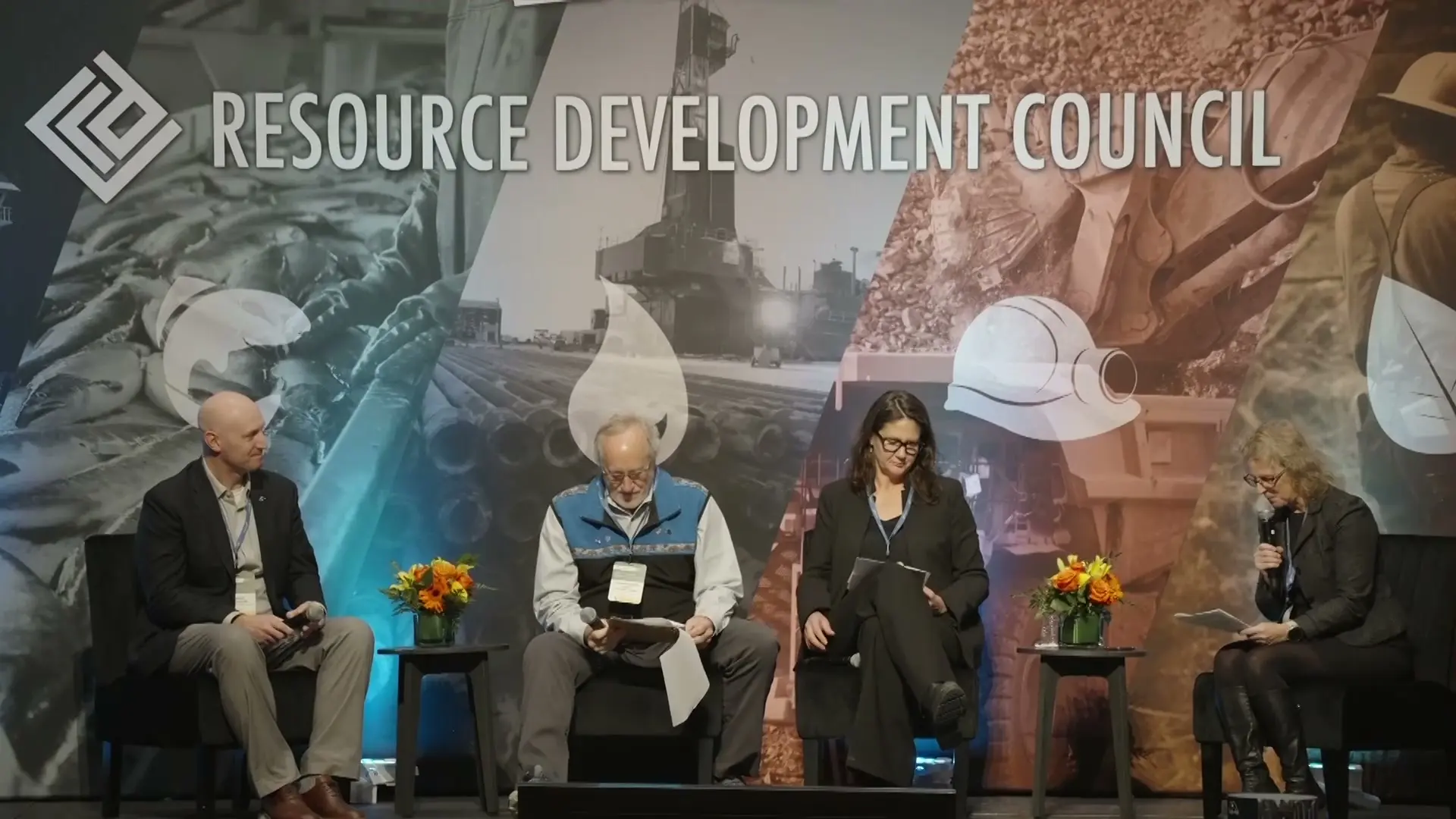
No audio detected at 0:00
Now let's move to our seafood industry, which competes globally to supply the world market. Jobs in communities across Alaska Our next panel will discuss how we can grow this important sector by diving into markets, processing, and the future of the industry. Please welcome fellow board member Julie Decker, president of the Pacific Seafoods Processing Association, to lead the panel. You may view panelists' information on the QR code on the back of your badge. Julie, it's all yours.
No audio detected at 0:20
No audio detected at 0:30
Good morning, everyone. It's really nice to be back at RDC. I just wanted to open up with a recognition about our elections last week. I think we all can agree that it's never a dull moment in Alaska politics.
No audio detected at 1:00
So with that backdrop, I want to say I'm really thrilled to be back at RDC. It's a place where all of our industries can come together. There are many unique challenges across our resource industries, and we're going to talk about some of those things today, as well as what some of our opportunities are for the Alaska seafood industry. We have our panelists today. We have Jeremy Woodrow, the executive director of the Alaska Seafood Marketing Institute.
No audio detected at 1:20
Again, as Scott mentioned, you can look up more information about all our panelists. They're all experts in their field. And in the middle, we probably don't need an introduction for the infamous Commissioner Doug Vincent-Lang with the Department of Fish and Game. Yes, he deserves a round of applause. As well, we have Stephanie Morlan, who's Executive Vice President of Trident Seafoods.
No audio detected at 1:50
We are going to start out with sort of a state perspective. We're going to start with you, Jeremy. Inside the state of Alaska, we know that the seafood industry is really important to the state. It's really important as a part of our identity and our reputation. And help us set the stage for this panel.
No audio detected at 2:30
Explain how important the seafood industry is inside the state and what's the role of particularly the Alaska seafood brand and its connection to some of the other industries. Great, thanks Julie. Well, like so many of our other resource industries, the seafood industry of Alaska is a foundational economic arm for so many communities across the state. You know, a lot of people think of summertime being our peak seasons of our industry. Well, really it's a year-round industry depending on where you are in the state of Alaska and throughout our coastal communities.
Provides over 40,000 jobs throughout the state of Alaska. Just the fishermen alone, that's over 20,000 fishermen in the state of Alaska. And, you know, there's a misnomer that a lot of those are coming from the outside. Well, over 60% of those fishermen live here in the state of Alaska, and that produces over $2 billion of just wages alone to the industry and over $5.2 billion of economic impact throughout the state of Alaska through the industry. And that's the most recent report.
And I like the, the call out that you've probably heard as a theme as the seafood industries, you know, talked about the different woes in the industry over the last few years, that $5.2 billion was over the last 2 years average. And those were the lowest 2 years in this industry's last 50 years. And so that's in its worst times. It still produces over $5 billion economic output to the state of Alaska. It really should be going up and it should be up around $6 billion when we start to get out of these, these last couple of years of downturn.
Long term, but it's a major economic driver. Most coastal communities rely on the taxes that the seafood industry produces. If it's not the number one tax revenue source, it's up there in the top three for coastal communities throughout Alaska. So, um, on top of that, if you aren't in coastal Alaska, you also see returns from the seafood industry in terms of shipping, because the seafood industry is a major producer for the state of Alaska. All those container vans that come up to Alaska they get backfilled by the seafood industry to go back down to the lower 48 or other places in the world for our products that we catch.
No audio detected at 4:20
So your costs that you pay for your goods here in Alaska are actually reduced by the seafood industry because those containers are not going back to Seattle empty. So it has many different ways that it produces and contributes to the state of Alaska, and those are just a few. Excellent. Can you maybe touch a little bit on the Alaska seafood brand? You are sort of the the holder or the caretaker of the Alaska Seafood Brand right now.
No audio detected at 5:00
And so how does that look inside the state? And again, like connections to other industries, you know, like our friends in tourism and such. Yeah, so the Alaska Seafood Market Institute is the public-private— I'm losing my battery here, I'll see if that stays on— is a public-private partnership with Alaska and the seafood industry. And we have the privilege of promoting the Alaska Seafood Brand across the entire world. We have active marketing promotions in over 55 different countries, and we always promote the positivity of Alaska.
No audio detected at 5:20
No audio detected at 5:30
So when you have consumers from around the world, a lot of times their first introduction to Alaska is through seafood, whether it's through a restaurant menu, through the grocery store, through a friend sharing a new recipe they just learned about Alaska seafood. We spend millions of dollars every year promoting the state of Alaska, just the same as the tourism industry. And the tourism industry does a great job through their channels, and then we yet leverage, you know, that Alaska brand name in the channels that, that we touch consumers across the world as well. Yeah, great. Stephanie, when we think about seafood industry, a lot of times people just think about commercial fishing, grundons, extra toughs, Deadliest Catch, but really the seafood industry is a lot broader than that.
It's the largest manufacturer, we're one of the largest employers. It sounds like tourism is right there with us now, 48,000 jobs a year. And we really underpin the transportation sector. We support shipyards, various things. I could go on, but from your perspective at a major Alaska seafood company, really, how extensive is that footprint?
And, and then what would it look like in Alaska if the seafood industry was not there?
Good morning, everyone. Really personal. Trident Seafoods is invested from Southeast Alaska out to the Bering Sea and into the community of St. Paul. And our presence there is a difference maker in terms of whether communities have schools or not. Really fundamental.
No audio detected at 7:10
We have some communities that tax base is nearly entirely dependent on commercial fisheries. And on a presence of a seafood processor or key markets for harvesters that choose to make those communities their home.
I think, uh, in addition to tax base— Julie touched on shared infrastructure— we really are a difference maker with respect to transportation and fuel systems. There is so much activity that comes along with 5 billion pounds of seafood taken each year and moving around this state. And on equipment that carries that to our key markets in the lower 48 and around the world. That's backhaul services that end up positively contributing to the existence of the equipment and to keep costs, to keep those transportation services more affordable. The same goes for shared infrastructure such as energy, you know, power generation, and our ability to help share in those costs as a sector overall.
The last thing I'll mention that just is really a practical consideration is without a commercial sector, Fish and Game would look much different. The commercial fishing industry offers a lot of insights and really has been the backbone of a management structure that provides input towards management overall. And I'm not sure if the Commissioner will speak to this more, but it just occurred to me that a future without commercial fisheries has really far-reaching effects on people who rely on it.
Okay, we're going to zoom out a little bit. In Alaska, our harvest is about 60% of the nation's harvest of seafood. And when you look on a global scale, that 60% shrinks quite a bit when you look at total global production of seafood. And so, Jeremy, we do export a majority of our seafood, and so export markets are really important. And in those markets, those international markets, we compete with many other producers that don't have the same kind of standards that we do, whether it's labor or environmental or other regulatory issues.
No audio detected at 9:10
So how would you characterize Alaska's sort of position in that global competitive marketplace, and what are some of the both opportunities and challenges that you see ahead in the, in the global marketplace? That's a big question, but I'll break it down. You're right. So we produce about 1% of the global supply of seafood, and that is including wild capture as well as aquaculture seafood across the world. I'd like to say that Alaska does a great job of punching above our weight class when it comes to marketing and promoting our products across the world.
No audio detected at 10:00
And that's actually because our state has invested a lot over the last 45 years in making sure that we continue to promote our products in the global marketplace. Of that, about 5 billion pounds of seafood we catch every year, by value, about 70% of that goes into international markets. And as Julie stated, we do have to compete with products that come from environments or from regulatory frameworks that don't have those same restrictions that we do. And that is a challenge. A lot of consumers, and you probably are no different, you know, one of the first ways you shop is by price point.
And so when those lesser regulated fisheries are in the marketplace, a lot of times they come in at a lower price point. So being able to talk about the attributes of Alaska seafood and telling our story to consumers and giving them a reason why it is a good value to pay a little bit more for a product that comes from a location and a place on this planet where we've done a great job and we call ourselves the gold standard in sustainability, and that is the truth. Nowhere else on this planet does as good of a job as Alaska does when it comes to managing our resources and ensuring that we have a good quality product that consumers can trust. And we continue to tell that story time and time again, and it does result in good returns back to the state of Alaska.
So, I mean, this issue of competitiveness, global competitiveness is a challenge not just for the seafood industry, but if you are in the mining business, if you're producing oil and gas, We heard from our friends in Hall America. The cost of doing business in Alaska is high, and that affects all of us, whether it's energy, transportation, infrastructure, construction, you name it. We also have— I mean, part of that cost structure is our high environmental standards and our operational sort of concerns that are tied back to regulations. So from a seafood, again, your perspective as a seafood company, how difficult is it for seafood companies to compete internationally when our costs of production are so much higher than many of our foreign competitors? And, and how do we maintain high standards while remaining competitive economically?
No audio detected at 12:00
Jeremy touched on the downturn in our seafood markets that started late in 2023, and so it's just simply not possible. I mean, we really had regions that we compete against in global markets undercut us on price and really be selling products below our operational costs. That is not something that can be maintained on a long-term basis, fuel the capital needs for us to reinvest in the sector. Now, we've all— other sectors may be familiar with this phrase as well, low prices are the cure for low prices. So there are things within our control that we can do.
Improving efficiency and productivity has been a big driver. We need more capital to do that and we'll continue to we try to do that. We as a company have invested in value-added production that allows us to have the conversation with decision makers, with buyers and markets and retail and food service, etc., really reach the consumer with the Alaska story, try to get value from those strong standards that we have. But a lot of it is beyond our control. We really need an all-of-government approach to be not allowing seafood to fall between the cracks.
We are an industrial good. Many people think of us as ag. Well, you'll see this more tomorrow, but there really needs to be more all-of-government approach. We've got some momentum towards that with an excellent policy that was announced and a lot of opportunity to execute on that, that again will be featured tomorrow with the Secretary's remarks, I would assume. We also need investments in shipyards.
We are Jones Act compliant fleet and we need shipyard capacity to modernize. So having policy complement the risks that we're willing to take on the private sector, be able to reach markets with a story. We are taking advantage right now of U.S. markets having sanctioned protection against Russian imports. It's an opportunity for us to really be telling the story and marketing and reaching the U.S. consumer with Alaska seafood experience.
Commissioner, on this issue of competition, Well, as has been mentioned already, Alaska does have a good reputation of sustainable fishery management, responsible stewards. Those are great strengths, but they come at costs. So do you see a way to ensure that our management system still protects our resources while sort of addresses this issue of the economic realities that the seafood industry is facing? And can we either make our regulatory process more efficient or conversely bring others sort of up to our standard? Okay, first off, let me thank our veterans.
No audio detected at 14:50
Today is Veterans Day. Without your service, we would not have had free elections and we would not be seeing a transition in government. So I want to thank all members of our people that have served in our defense of our country. Thank you all.
So getting back to the question, First off, we need more data to inform our regulatory processes. Our regulatory processes need to become more flexible, but they still need to have data inputs that are feeding into that to make informed decisions. Specifically, we need better at-sea data collection, not simply new cost-efficient AI-dependent models that are going to predict what's happening rather than what's actually occurring out in the ocean with these, with these changing environmental conditions. We need to do better forecasting. Right now we forecast a year out.
That's good for many fishermen, but fishermen are investing for the decade. So we're going to have to start figuring out how to give forecasts in these changing environmental conditions that look out 5 to 10 years. And I challenge my staff to kind of develop those forecasting tools. What's happened in the past may not be a good indicator of what's happening in the future. For instance, I asked my staff, are we going to ever see king salmon get back to those numbers that were historical levels, or are we Anchorage is going to see lower levels of yield given the conditions we have in the ocean right now with marine mammal predation out there.
It's a fundamental question. How much yield are we going to give up? We need to implement the legislative report on Alaska seafood industry to ensure we have infrastructure and regulatory flexibility necessary to complete in the global environment. I think too often we've looked at the Alaskan environment and we've forgotten to look at the global environment. We're part of the global economy right now, folks.
We better start looking beyond just our Alaskan borders moving forward. We need to ensure our fisheries are optimized in terms of participation. We've too often just looked at the regulatory tool of cracking down on, on how fisheries are regulated rather than looking at whether our fisheries are properly optimized. Take a look at Bristol Bay. When we optimized that, those numbers of fishermen out there, there were sailboats with drift gillnets.
Now we have 1,800-horsepower boats running around out there dragging much longer gillnets. That fishery may need to have an optimization look at because all we have in the toolbox right now is reducing the number of hours or reducing the length of the gear.
And as I— as you said, we need to bring others up to Alaskan standards. We can no longer be the— on the top of the pillar with everybody trying to climb up to us and having our fishermen experience the costs associated with that. We need fair and equitable treatment moving forward. I could go on. There's a lot of other things, but I see this timer is clicking quickly, so I'll stop right there.
Okay. Stephanie, Russia is one of Alaska's most significant competitors in the global seafood marketplace. United States has restricted the imports of Russian seafood starting in 2022, 2023. However, that seafood goes other places and still competes with us internationally. How significant really is Russia as a competitor, particularly in our key export markets?
No audio detected at 18:10
And then what can the United States do to address the disadvantage facing American producers?
This region needs a lot of attention from Alaskans. We share a North Pacific basin with Russia and other countries that are not like-minded with respect to investment and understanding of the the ocean, the ecosystem, and aren't as vested in long-term strategy towards responsible management. There's been some very aggressive harvest practices, less transparency, less accountability. That's a concern. It also means that's less expensive supply chain.
No audio detected at 19:00
At the time that Jeremy referenced with the decline in our markets, I want to just share a quote from one of the leaders of one of the Russian large seafood companies. I think we're in much better shape than the Americans. They have old vessels, higher salaries, high repair costs. They have less efficient vessels as their harvest— their cost of harvesting is higher. We operate more cost-efficient fleet, the most cost-efficient fleet in the world.
These prices are no good for anyone, but we can survive for as long as it takes. That's the competitive environment that we were faced starting in late 2023. It needs to be addressed more holistically. It is not fair trade. It is very concerning that a European market, that a market in— a developed market in Japan that we historically relied on has even stronger dependence today on Russian share of production for species that we harvest in Alaska.
Despite their position in the geopolitics, Europe became more dependent on Russian harvest, less dependent on Alaska harvest since the war in Ukraine. So it's been an incredible evolution to watch. They're putting extraordinary pressure on us. And on the investment side, since 2026, after the invasion in Crimea, they've invested $4 billion in modernizing their seafood sector. They've built 48 large new vessels.
And invested in 30 new modern seafood plants. People are aware of us discussing aging infrastructure. This is more, again, than what just the private sector can address alone. We really need systemic policy reform in order to fuel the modernization that we face. I think we've made great progress.
We've got great plans, but the Russia competition is a really huge driver and something that we need to be considering. And I'll just add a little bit to that. Another piece of the competition with Russia has been some strategic investment in the last 10 years between Russia, China, and North Korea. They share a border in one place in the world, and they have been investing hundreds of millions of dollars in building new roads, bridges, rail links, seafood processing facilities in China, And the goal is really to move Russian-harvested fish into Chinese seafood processing plants and move North Korean labor into those plants to process it. This basically produces the lowest-cost seafood on the planet.
They have a name for this. It's called the Golden Channel, and you can Google that. And so, it's something very planned, and it's something like that is setting the stage for our new— like the new era of global competition for seafood. It's going to be with us. Those investments are going to be with us for decades.
So what that really speaks to what Stephanie said, which is we need, we need a larger way to address this with policy reform on the federal level. And that I'm going to move because we are getting short on time to that next section of our panel's discussion, which is more positive. And I will say we are seeing interest on the federal level at this sort of all-of-government approach to supporting the American seafood industry. This deserves attention. It's, it's been something that we've seen sort of steps towards, but we've seen this year more dramatic announcements and programs.
No audio detected at 22:30
So, um, we, we are seeing the government, the federal government, look at the American seafood industry as important to national security, as important to food security, and also an economic priority of the United States. These are all very welcome to us on the stage. The creation of the USDA Office of Seafood happened in April. And as Stephanie mentioned, we're going to hear directly from the Secretary of the Department of Agriculture tomorrow, as well as the new director of the USDA Office of Seafood. So these are really, really welcome things that are happening.
No audio detected at 23:00
Specifically also, the new American First Seafood Strategy was launched just last month. And Jeremy, I want to ask you specifically, what do you see as the opportunities in this new American First Seafood Strategy And does it fill sort of this gap that we've had between the Department of Agriculture and Department of Commerce that the seafood industry always sort of fell in between? What kind of opportunities in the realm of like procurement or marketing and even things like investment in rural development and expanding domestic consumption, things like that, what do you see for this new federal policy? Yeah, thanks, Julie. You touched a lot of the high points and just I think it's good to point out that the last few years, this— the Trump administration has been— has called out the seafood industry in the U.S. more than any previous administration.
No audio detected at 24:10
No audio detected at 24:20
No audio detected at 24:30
And the— and Congress has followed suit with creating an Office of Seafood under the Department of Agriculture. That's never existed. That's something that the U.S. seafood industry has been asking for for decades. And you pointed this out in your comments there, Julie, that You know, there's always been kind of a clumsy baton toss between the Department of Commerce, NOAA, for when seafood really becomes food under the Department of Agriculture. And NOAA does a great job managing our fisheries, um, but we've kind of fallen to the wayside when it comes to being food in front of Americans.
And, you know, I could go on a lot of different stats about how Americans don't eat near enough fish, and I guarantee you that you probably in this room eat a lot more fish than your counterparts in the lower 48, but your, your relatives that live down there aren't doing their share. So the opportunity we have with the USDA to promote American seafood to Americans, really elevate it— there's the— there's a— it's really an endless supply of opportunity, but we're really starting to scratch the surface on where we can go, from, from loan programs for our processors, from added marketing dollars to promote seafood to Americans. We're looking at that from, definitely from an ASMI standpoint. We're hoping that we can see more seafood in seafood or in food purchase programs to the USDA as well too. So there's a lot of opportunity there.
We're just starting to scratch the surface. We're seeing this investment coming through from Congress and from the Trump administration. We hope that that really holds through. You can see why this guy is good at his job. He's basically telling you all to go home and tell all of your friends and relatives in the Lower 48 to eat more seafood.
Want me to throw a stat out there? Here's something that should shock everybody. Americans eat about 20 pounds of seafood a year. We eat over 60 pounds of fried potatoes. Think about that.
60 Pounds. That's just the fried potato variety. That doesn't count all the other ones. So we can all do a share. Yes, there we go.
Good job, Jeremy. Stephanie, on this, like, all of the above approach to this American-first seafood strategy, We've got USDA, NOAA, USTR, and other agencies involved. How important is it that these agencies are working together, really for the first time that we've seen, as far as the seafood industry is concerned? What are the most meaningful things the federal government can do given that cross work?
No audio detected at 26:50
It's fantastic to see the agencies work together. We were very heavily regulated with respect to fisheries and access to resource in the water. Once that fish was out of the water, we get pointed many different directions, and the agencies that regulate were not talking to each other. And we're complicated. We're complicated because fisheries are really a social engineering program.
No audio detected at 27:20
It's very important and foundational in our fisheries management that benefits are directed and benefits actually stay in Alaska of our fisheries. There's a lot of programs that are built on that. Some of the principles of limited entry. And so we're complex, we're a diverse sector, and it's difficult for any agency to immediately understand. So we'll be able to build the understanding, deepen that understanding, and agencies clearly know now that they are to coordinate and adhere to recognition that the Alaska fishery or that the seafood sector and domestic fisheries are a priority, and they're a priority over import— imported seafood interests.
Just that sense of clarity is really empowering and fantastic towards better market access, better trade policy, and then again, something as fundamental as shipbuilding capacity so that the commercial fishing sector has the confidence that there'll be a competitive manner to build modernized fishing vessel and access to resource.
Commissioner, fish don't go by borders. They don't go by state lines or federal lines. So how important is it from your perspective, fisheries management perspective, for the state and the federal government to work together? And what do you see as things the federal government can do to not just support healthy harvest but also sort of the economic side of the industry? Well, I'm gonna throw a little bit of a cautionary note out here.
So too often when the federal government steps in, it becomes a they assume leadership and control, and that often impacts state engagement. And it needs to be a true partnership, not a top-down, one-size-fits-all vision for how Alaska is going to be managed. We know how to manage our fisheries. We have the expertise. We have to be involved in that.
No audio detected at 29:20
Again, we have to be an equal partner at that table if it's going to work. And while there are issues of national concern, we can't lose focus that Alaska issues are truly unique and that state involvement is necessary to solve those issues moving forward. And just remember, cautionary note, we fought statehood over fishery issues. Let's not repeat history by taking a back seat in how to resolve these issues moving forward. Very good words of advice.
Stephanie, given this sort of backdrop of renewed federal interest and support for the seafood industry, From your perspective of a company that is making decisions on investment in this, in the industry, why is this a good time to invest in Alaska seafood, and what opportunities do you see for things like modernization or innovation or market expansion, etc.?
No audio detected at 30:10
No audio detected at 30:20
We do see the new seafood policy and the programs that are coming from that providing the seafood sector, envisioning to provide the seafood sector access to programs that the agricultural sector has had for a really long time. That will help enhance our ability and speed up our ability to reinvest in our infrastructure, work on a better competitive environment, modernize our, our infrastructure. So for that reason, it's a good time. We also have incredibly productive ecosystems and resilient ecosystems and a really fantastic foundation of knowledge and science in management in our region that we continue to improve. We need to continue to improve.
We can't go backwards on the investment in science. And so I do think that we need to really continue to advocate for, on top of the seafood investments, be looking again at rebuilding modernization of data collection and our understanding of our ecosystem and monitoring as changes occur.
Commissioner, I'm going to give you the last question. And in your position, you've been potentially the longest running commissioner of the Department of Fish and Game in our history. I don't know if anyone's looked that up, but, but 8 years is a very long time. That's a very difficult job. I am curious what you think the state can do to help and what kind of a role that they can do in help making Alaska a more attractive place to do business for the seafood industry.
No audio detected at 31:40
No audio detected at 31:50
And, you know, there are things, incentives for investment that they can do. For example, the tax credit bill that was passed by the legislature this year. But from your perspective and, you know, kind of being able to have the history of your position, what do you think are some good things for the state to do? Well, we did two studies. We did a legislative study to figure out what's wrong with the fishing industry and what we can do to go forward.
No audio detected at 32:10
No audio detected at 32:20
The national NOAA just did one and they have a national strategy. We just have to implement them. It's going to cost money, certainly, but we have to have the will to implement it. Just remember, you know, fishing is an integral part of who we are as Alaskans. It's the foundation of our coastal communities, really, of our culture, our economy, and our food security.
No audio detected at 32:40
Newly elected governors and legislators often underestimate the passions Alaskans have for fish and wildlife. I can tell you that they— they— when I became Commissioner, they said, well, I want to do this, this, and this. And after about 3 months, they came back to me and said, wow, Fish and Game is dominating 80% of my time. So don't underestimate it as newly elected officials coming in to serve the Alaskan public. Embrace it.
But most importantly, build on it because it's there and it is a valued part of the economy of Alaska and just who we are as Alaskans. Okay, well, I think we're getting, uh, to the end of our panel here. We're over time, but I just want to say that investing in Alaska seafood is really investing in Alaska. It's investing in our communities, and it's investing in the long-term health of the state's economy. And so we are really excited, actually, about the next decade and what that means for the future of investments in the Alaska seafood industry in the state.
But before the panel gets off the stage, I would like to ask the audience to please give a very warm applause to Commissioner Doug Vincent-Lang, again, who may be the longest-serving commissioner of the Department of Fish and Game, which I believe is probably the hardest, if not the second hardest job in the state of Alaska. So thank you very much, Doug, for your service.
No audio detected at 34:00
No audio detected at 34:10
No audio detected at 34:20
No audio detected at 34:30
No audio detected at 34:40