Anchorage Police: OIS Press Conference November 25, 2026
Alaska News • • 28 min
Articles from this transcript
Anchorage police chief walks through Sunday's officer shooting
Anchorage's police chief says a man came down the stairs with a shotgun before an officer shot him. The man is charged with assaulting the officer.

No audio detected at 0:00
No audio detected at 1:00
No audio detected at 1:30
No audio detected at 2:00
No audio detected at 2:30
No audio detected at 3:00
No audio detected at 4:30
No audio detected at 5:00
No audio detected at 5:30
No audio detected at 6:00
No audio detected at 6:30
No audio detected at 7:00
No audio detected at 7:30
No audio detected at 8:00
No audio detected at 8:30
No audio detected at 9:00
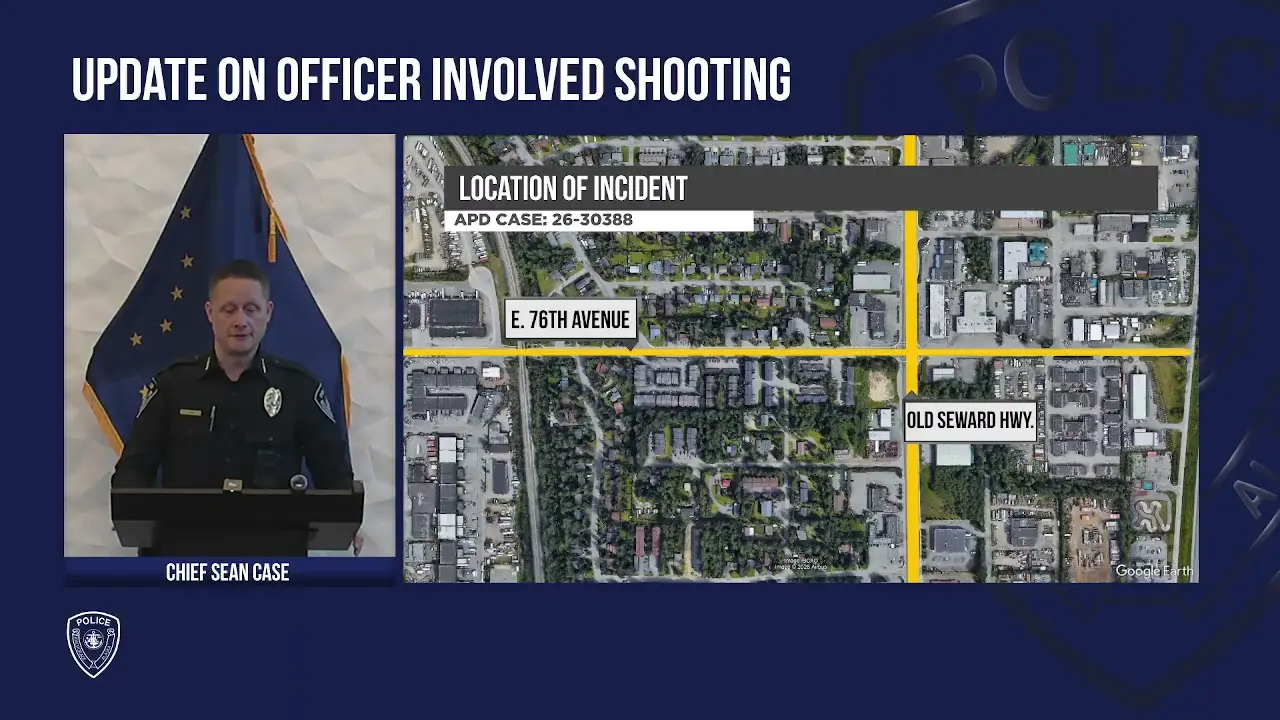
Good morning, everyone. I want to provide some additional details for the officer-involved shooting that took place on November 22nd, which was last Sunday, at the 800 block of East 76th. As a kind of reminder, and I'll repeat some of the information, that I provided last time. This call was from a female that lives in the apartment complex on East 76th. She said that her boyfriend came home intoxicated, that he was acting unusual, and that he physically put his hands on him— or on her, excuse me— and that he was very physically violent.
No audio detected at 10:00
And that was the information that she gave to dispatch when, uh, when officers dispatched to the call. That was at approximately 4:12 in the morning. Officers arrived on scene at approximately 4:25. 2 Minutes later, the female from inside the apartment complex called back and asked what the ETA was for the officers because they hadn't knocked on the door at that time. And the subject, or at this point in time he's a defendant because he's been criminally charged with some crimes, had came from the upstairs to the first floor of the apartment That then caused her to leave the apartment because she knew officers were on scene somewhere, just not at the door, and she met officers outside of the apartment.
She then took the officers into the, uh, the inside the apartment. When they opened the front door, the defendant was standing inside the entryway. He's putting on a sweatshirt, which possibly to come meet the officers is what it kind of appeared. This picture, you can see this is the front door, front screen door, front door. Um, and when the officers made contact with the defendant inside the apartment, he was agitated.
He did not want the officers to be there. The idea was, is that the two officers were going to make entry, and one was going to interview the female, and one would enter or interview the the, the male half, or the defendant in this case. Because he was agitated, one of the officers made a decision to take the female back outside to conduct the interview with her out there. The officer that remained inside, Officer Diaz, had about a 2-minute and 48-second conversation with the defendant. Most of that time was spent with the defendant wanting the officer to take 2 steps backwards so that his feet did not cross the threshold of his apartment.
Uh, after about 2 minutes and 48 seconds, the defendant walked up the stairs. And again, to orient yourself, this orange coat was in the first photograph. The front door is back here, and this is the stairwell that the defendant walked up. The defendant was out of sight for approximately 31 seconds, and the officer during that 31-second time period stayed in the exact same location that you saw from the previous picture, right in the entryway. Um, the officer— this picture that you see right here is as the officer started to turn his shoulders to the left to retreat back out of the apartment complex.
No audio detected at 12:30
He observed the barrel of a shotgun coming down the stairs, and that caused him to turn and retreat out of the apartment. While he retreated out of the apartment, he drew his weapon This is a still photo of the very first round that the officer fired in a series of 3 rounds. As you can see, I've got a body cam that's on my chest. The officer turned to his left, body camera oriented towards the direction that his chest was, while his head and firearm were facing back in the residence towards the defendant at the time. Once the officer got outside of the apartment, he then turned to face and square his shoulders up.
You'll see in the next photograph that this is the officer's arms. This is the cuff of his shirt. Here's his second arm. The officer would fire two additional rounds from this platform, so a total of 5 rounds. Uh, at that time, the, uh, defendant went back up the stairs, uh, and got rid of the shotgun and then, uh, complied with commands for officers to bring him back out.
To the front door, so they were able to render first aid and take custody of him.
Shortly after the incident, the investigation had probable cause for several arrests that had been served on the defendant. So he's in DOC custody at this point in time. He was charged with Assault 3. That would be the shotgun down the stairs causing fear, where the officer is the victim in that case. And then 2 counts of assault 4.
Those were 2 different times prior to officer's arrival, prior to the female calling, where he struck the female. He was also charged with interfering with a DV crime. He took the phone that the female was trying to call on from the female and threw it down the stairs. And then he was also charged with violating conditions of release, which is a separate charge from from a different incident.
I want to close by just kind of reminding everyone that officer-involved shootings is— it's not only a serious event for the police department, but it's a serious event for the community. And when we provide the information on what happens in these officer-involved shootings, we're trying to give as clear a picture as we can and be honest about what we can't share and why we can't share it. But it's always really important that we point out that these are pending charges. I can provide you the information that led to the charges, but there's still a court case that will happen months down the road to determine whether or not he's guilty of these offenses. But I put this information out just so that you know exactly where we're at in the case.
And with that, I'll take questions.
Can you give a little bit more information about that 31-second time frame and I guess the immediately before that. Um, uh, what was the officer doing or saying, you know, as the, the man was going up the stairs? Um, can you shed any light on why, um, whether it's, it's in protocol or not, he should have followed the man up further into the house upstairs? Just, yeah, a little bit more context for that. Yeah, what you see in the, in the videos, the officer stayed in that position There was no conversations between him and the suspect.
In terms of protocol or what an officer is supposed to or not supposed to do during that particular time, you know, that's, that's given the officer at the time. In the interview that we've done so far with the officer, that's a criminal interview, and so those details aren't asked in the criminal interview because they're not really relevant to what happened when the defendant came down the stairs with the shotgun. We'll certainly ask a whole host of questions during the administrative investigation to get all the details on every decision the officer made from start to finish. But there is no policy that would require an officer to run up the stairs after somebody. But what you will see in the video is him standing in the, in the entryway for those 31 seconds waiting.
But he wasn't like giving commands to like, don't go upstairs, stay here, anything like that? No. Can you describe where the defendant was when he was shot? It sounds like the officer was able to sort of observe him coming down the stairs and observe the shotgun. Had he made it to the ground floor when he was shot, or was he kind of maybe up a step or two?
I know he got shot in the arm, so it makes me think that he might have not had his whole body. Yeah, um, based on the best information we have, and so there's going to be a slight bit of speculation here, is when he came down to the landing that was the area where the rounds were fired. So he wasn't, he wasn't downstairs on the ground floor. And, um, do officers know at this time if the shotgun was loaded? So what you also hear in the video, when the video eventually is released, is that you can hear the action of the shotgun loading around.
That's a very distinct noise, and you'll be able to hear that in, in the video. That noise comes, follows when the officer starts to turn his shoulders to the left and observes the barrel of a shotgun, uh, very close proximity. It's all pretty much happening at the, you know, at the same time. So whether or not it was loaded, don't know, but we certainly can hear on the, the audio that the action of the shotgun that would indicate it was being loaded, that took place. On that topic, really quick, you mentioned that he saw the barrel of the shotgun and he heard it being, I guess, loaded.
Was it ever pointed at the officer? What's your guys' protocol when you hear a shotgun being loaded? Is that when you guys shoot? So the direction of the shotgun, I don't believe that we know exactly what that is. If you, if you recall one of the earlier photos, there's a very small window that I pointed out that shows kind of where the, where the the, uh, the stairs kind of wraps around the landing.
And so a clear view of what the officer was able to see, full body, where the barrel actually was pointed, I don't think it's really possible in that scenario to be able to have all that information. They were pointing at anything. That's correct. I think, you know, the, the, the information that we do have is that we had contact with the individual. He leaves retrieves a weapon, appears to load the weapon, and that obviously places the officer in a position where, you know, in this case he has a very, very short length of time to determine what he's going to do.
If you take the time the first round is fired until the last round is fired is approximately 2 seconds. So that movement of turning the body, drawing and firing that first round outside, and then turning back That's, that's approximately a 2-second window there. So you're talking very short period of time to make a lot of decisions while moving, uh, presumably out of the way. And you said that there have been 5 rounds fired, so can you describe sort of when those were fired again? I think it sounded like there was sort of 3 at one point and then 2 afterwards.
That's correct. There's 3 at one point when the officer is turning with his upper body face towards the door and then when he turns and puts both hands on, on his, uh, his handgun, he fires 2 additional rounds. So, uh, so all 5 rounds were fired in that like 2-second period? That's correct. We'll do a couple more.
Your Alaska link. Uh, the injury to his arm, was that the only round that hit the suspect? Uh, injury to his arm is— his arm is the only injured location on his body. Um, do you know if he'd been— uh, if, uh, the defendant had been, uh, if there had been any DV calls for him at that residence? In the past year, 2 years with the, with the woman who was involved?
I believe there's some information in CourtView. If you take a look at his history in CourtView, you'll be able to, uh, to see some of the previous incidents that he's been involved in. And then just to clarify, the, uh, the woman, uh, was outside the residence the whole time that the shooting happened? She had already been outside for a while when the shooting happened? That's correct.
No audio detected at 21:30
No audio detected at 22:00
No audio detected at 22:30
People in this meeting
And 2 more speakers.