RDC: Day_01_Glenfarne AK LNG Update_4.mp4
Alaska News • • 22 min
Articles from this transcript
Glenfarne says Alaska LNG needs a tax bill without federal owners
Glenfarne's Alaska LNG chief says the project could skip the stalled property tax bill if the feds become part-owners. Otherwise, it still needs one.

No audio detected at 0:00
Alrighty folks, welcome back and thank you for being back on time. I hope you enjoyed the ice cream over there, the 3 different flavors. We were, uh, where's Jeff Landfield? We were able to avoid ice cream gate this year, so Jeff, report appropriately. With that, welcome back.
No audio detected at 0:20
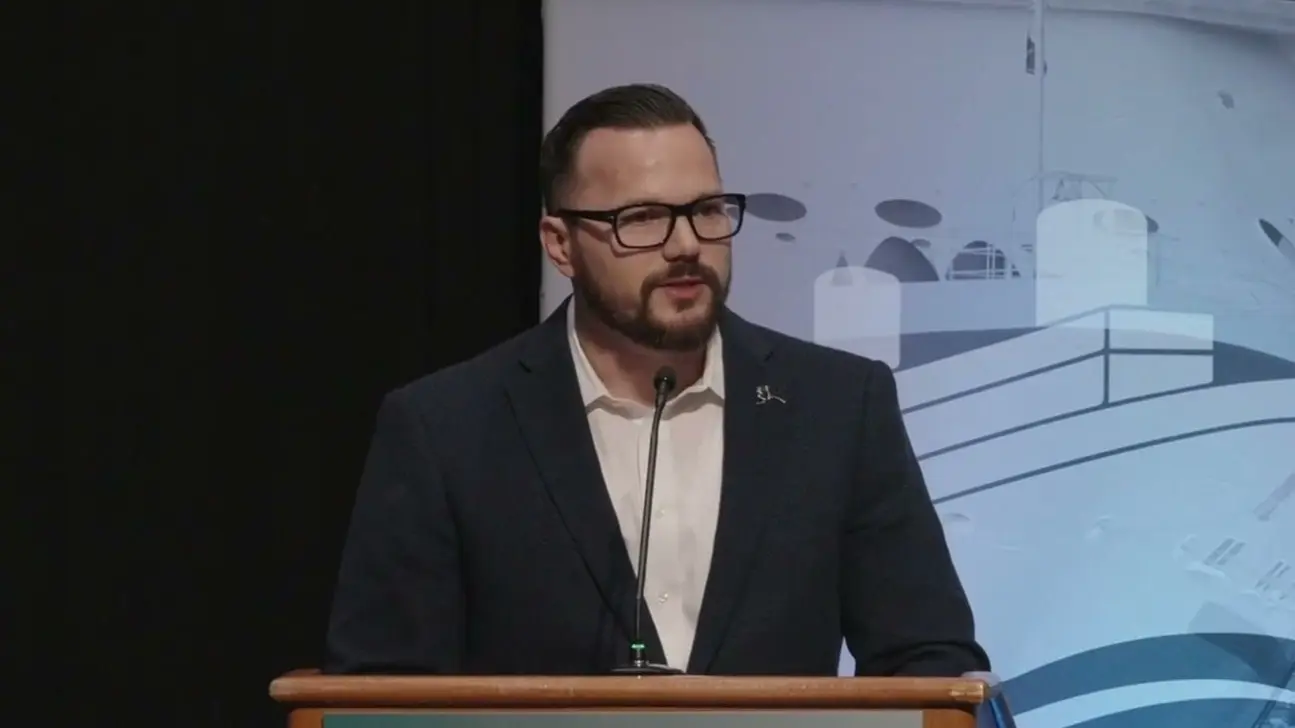
The Alaska LNG project has had a lot of, has had a lot of, has a lot of potential to shape Alaska's energy supply, workforce, and economy for generations. We've heard a lot of big announcements over the last few months, and we're excited to hear what the current status is. Please help me welcome Adam Prestige, president of Glenfarn Alaska LNG and co-president of 8Star Alaska, for an update on the project. Adam.
No audio detected at 1:00
Well, thank you very much. It's a pleasure to be here. I want to thank the Resource Development Council for having me, and thank you all for being here to listen. I know that this topic is something of great interest as I've learned over my 2 years of guiding this project so far. Today is Veterans Day, and first and foremost, if you're a veteran, I want to thank you for your service.
Alaska has more veterans per capita than any other state, and that's not a surprise. There's a reason for that. People who have served recognize that working together is required to accomplish big things. A'akwaxw. I want to give today an update on the Alaska LNG project, which is the next big thing that this state will build.
I'm very happy to be here to give you the update because the project has incredible momentum, and I'm excited to talk about it, and I'm excited about what this project can do and will be.
I love the theme for today's conference, building on momentum. Momentum, like trust, is one of those things that takes time and effort and investment to build. Think about momentum and picture a car speeding up, building that momentum as it speeds down the road. The driver's task behind the wheel is to maintain that momentum through the twists and turns of the road, and it's the same task that is the responsibility of a project developer navigating a project through its pre- construction period, and then into operations. And be sure about this, there is real momentum behind the Alaska LNG project.
It's not just headlines or announcements. Under Glenfarn's development, the project has advanced, has advanced further than ever before. LNG buyers, contractors, governments want to see this project go forward and are pushing it forward.
But a generational project like this doesn't come, doesn't move forward, doesn't achieve success through one party or one person or one team alone. It comes from everyone pulling together to make it happen. This project needs a lot of yeses from the legislature, from the governor's office, from state agencies, from the RCA. We need our customers to sign up, contractors to put the work in, investors to put the money in. The list goes on and on of all the different parties that have to come together in a unified front to make this project happen.
As we open a new chapter with newly elected leaders in Alaska, we're determined to maintain the momentum of Alaska LNG and unify our efforts and our policies to advance the project to success. My ask and my commitment for myself, for Glennfarm, for all of us is to keep our eyes on the same goals, to deliver the lowest possible gas to Alaskans as fast as possible, to deliver LNG to our allies overseas, and to produce revenue and income and benefits to the state and its municipalities.
I want to say a word about the election, recognizing that the election results here in the state are not yet final. I do have some thoughts. First, I want to congratulate all of the gubernatorial candidates. On diligent and well-run campaigns. I can't imagine the level of sacrifice and personal investment that it would take to put on a campaign like that.
One of the things that stood out to me from the gubernatorial campaign here in Alaska is that across party lines, across— universally across the different candidates, and then among the final 4 candidates, the support for this project was consistent. There is a uniform desire among all the gubernatorial candidates to see this project go forward, and we are incredibly grateful for that support. We look forward to working with the new governor, and we recognize that unified leadership in the administration and the legislature creates a new window of opportunity.
As I think about this project and its future moving forward, there are a few data points that stand out to me on the— that give me encouragement about the project's prospects. First, as shown in multiple polls throughout the last year, this is a very, very popular project in Alaska with an approval rate of over 80%. To put that into context of an 80% approval rate, if you can believe it, that is a higher approval rate than such venerable institutions as NASA, higher than the National Park Service. I, I'm amused by this. The approval rate for Alaska LNG is even higher than the approval rate for apple pie.
It is, uh, which is pretty popular. So when you look at it that way, uh, that gives you comfort that the population, the leadership wants to see this project going forward. If you don't believe the polls, I I would say look outside. Look outside over the last year at the Build the Line campaign. We saw a visible reflection of the statewide support for this project.
Yard signs, bumper stickers, rallies, buttons, thousands of Alaskans stepping forward to visibly show their commitment to making this project move forward. Additionally, throughout the experience of pursuing a tax bill in the legislature last year, Eagle River, which I will talk more about in a moment. In my personal experience, I saw a nearly unanimous desire among our state's legislatures to see this project go forward in the right way. In that backdrop, our commitment remains unchanged. We're enthusiastic about delivering this transformative opportunity, the pipeline to bring gas 800 miles from the North Slope down to Nikiski, an import terminal to provide immediate short-term relief for Southcentral's utilities and customers, and the export terminal to export LNG to our allies, but also to utilize the full capacity of the pipeline and bring the cost down for Southcentral Alaska.
Our efforts on these individual— on these distinct subprojects remain, and today, tomorrow, And going forward, they're a continuation, not a restart.
As I mentioned, Alaska LNG has generated a lot of headlines. Over the last few months, many of those headlines have been the product of the federal government's involvement and support for the project. Like state support, federal support for this project transcends any single administration, and it transcends party lines. The permitting and support for this project out of Washington goes back many, many years through different presidents, presidential administrations. And the reason for that consistent support is because this project makes sense.
So as we sit here today and we talk about momentum, momentum down the road, the road ahead presents us with two different paths, which I want to give a little bit of an explanation of. As you've seen from the headlines, as you saw when President Trump came to Wasilla and gave an announcement, we— there is a serious interest from the— from the United States Department of Commerce in having the nation of South Korea fund the equity necessary for this project. And we're currently in detailed discussions with the Department of Commerce on how to structure this project in order to facilitate that investment. We're very enthusiastic about this option because consistent with everything we have done on this project, it creates the fastest path to bringing gas to Alaskans. Korean investment into this project through the U.S. Department of Commerce vehicle would essentially mean an immediate FID across the entire project and would allow us to commence work almost instantly.
We're confident that the Koreans will want to do this deal and make this investment, not only because of the project's positive commercial economics, but because of its compelling geostrategic value. Korean officials have repeatedly noted that Alaska LNG carries strategic value for Korea's energy security, especially after the war in the Middle East. Just today, earlier today in the Washington Post, the Korean ambassador to the United States published an op-ed talking about Korea's $350 billion investment commitment into the United States. She said that Korea is now turning its commitment into real investment in America, including working on the Alaska LNG project, subject to meeting commercial reasonableness requirements. That's obviously a big question, commercial reasonableness.
And right now, Korea is undertaking a review of the financial viability of the Alaska LNG project. We welcome that review. We firmly believe in the project's fundamentals, and we're confident that Korea will find the project to be commercially compelling, just like we do. And we at Glenfarm aren't the only ones who find the project to be commercially compelling. Over the last couple of years, we've spent time and we've had, we've had commitments from some of the world's most experienced and capable LNG buyers.
Not only have we been able to have them step up and make commitments, but we've been able to escort them and accommodate them as they visited the state. We've taken multiple tours of LNG buyers to tour the facilities on the North Slope, to see the export site in Nakiski, and to understand why this state is the right partner for their country when it comes to future energy security.
So that's the commerce Korea investment path forward. I mentioned there are two roads ahead of us. In a hypothetical situation that does not involve Korean investment, the project still needs to go forward and Glenfarm will still pursue the project forward as a private infrastructure investment. In order to do that, we still need fundamental building blocks in order to achieve a final investment decision, or FID. Some of those building blocks— or those building blocks include a property tax bill passed by the legislature, heavily discussed this year.
Those building blocks include gas supply agreements with NStar and the other utilities to be approved by the Regulatory Commission of Alaska. And we'd need to achieve traditional financial investment for private infrastructure finance on the project. Some of these milestones, some of these building blocks are by their nature outside of the control of any commercial party. They're government decisions. Tax legislation, RCA approval, even utility board decisions.
Because these milestones are completely outside of our control, it makes it impossible for us to pinpoint exactly when FID will occur. But we can be sure that under this private path forward, the timeline would be longer than it would be under a Commerce-Korea investment path forward. However, I want to be clear that there are consistencies in either case. In either one of these paths forward, we still intend to pursue an LNG import terminal to relieve the immediate need for gas in Southcentral Alaska. Just as important, in either case, we intend to stick to the commitments that we have made to the state.
Some of those commitments that we reaffirm include delivering the lowest possible gas to Alaskans, delivering that gas as soon as we possibly can in safe conditions, providing an income from the project to the state and to the municipalities. A commitment to protect the state from cost— construction cost overruns. A commitment to make sure that a spur line is built to deliver gas to Fairbanks. We stand by our agreements and our commitments to work with Alaska labor unions to get this project built. And we stand by our commitments to prioritize Alaska contractors and Alaska workers.
Now, when it comes to headlines, I never expected quite so many headlines to be generated as were for the tax bill process that this project went through earlier this year. It was a huge movement. There was an incredible amount of work, progress, and enthusiasm demonstrated in this process. And first and foremost, I want to take my personal opportunity to thank so many people who worked so tirelessly on the tax bill legislation. It was an incredible statewide effort.
That includes my thanks to legislators who put in so much time and effort, to the tireless staff who work for the legislators, who do the underlying work to evaluate the legislation, to the labor unions, to the administration officials, to the grassroots organizers, to the consultants and experts and lawyers who helped advise that huge amount of work and evaluation that went into the tax bill. The sheer number of people who worked on that piece of legislation across the state demonstrated that this truly is a state project. As we collectively progress into the summer, the final versions of that bill did a few things. That the final version successfully, in my opinion, balanced the needs of the state with the needs of pipeline and LNG infrastructure development and finance. And so at the end of the day, at the end of the sessions, I should say, we ended up with a large, very significant, and I will say very complicated pipeline tax bill.
At the same time, We also ended up with a very complicated and very significant S-Corp tax bill. Combining these two major, complex pieces of legislature into one voting initiative, in my opinion, proved to be too complicated to move forward and was ultimately put on hold.
So, like the path forward on the project, which presents two routes ahead, The path forward on taxation of this project presents two paths ahead. The first scenario, again going back to the foreign, the Korean investment concept, is that if this project, and I'm going to give a hypothetical because we're still, like I said, we're still in the structuring discussions. If this project is owned in part by the state government, AGDC, and in part by the US federal government, then by virtue of tax law, the government ownership of the project makes the project exempt from state property tax. Instead, in that scenario, exempt from state property tax, the state's ownership stake and the project would produce royalty income, production tax income, corporate tax income, and most significantly, equity returns from the state's portion of ownership of the project. We would also work together to ensure that those benefits that's reached the communities, the municipalities.
So that is the federal path forward, if you will. In the second scenario, the second path forward, the private path forward, it is a statement of fact that if the project is not under federal ownership, then state property tax would still apply. And in order to take the project forward in that scenario, a tax bill would still be necessary. In order to advance. And this wouldn't be a restart, but would instead build on the foundation established throughout the course of the discussions over this prior year.
Throughout this process, I've heard concerns about transparency, about whether we were sharing enough information, about whether Alaska's elected leaders have enough information to make informed decisions. And have the visibility needed to take the project forward. I take that feedback very personally and very seriously, and we, we respect it, and we know it's important. We know it's critical for Alaska's leaders to have the information that they need to make informed decisions. So as we enter into this new era of leadership in Juneau, I want to make a commitment on behalf of myself and Glenfarn, that we will work to maintain an open and constructive relationship with Alaska's elected leaders and the people that they represent, because maintaining momentum, as I said earlier, requires trust.
I began today with an observation about how our military instills the belief in the power of teamwork and the ability to accomplish big things. I'd like to conclude with some insights about the other players that are part of the team building this project alongside of us. Glenfarm has brought together some of the world's leading and most capable LNG companies, construction firms, and engineering firms to support this project. These project— these companies have worked alongside us diligently for years now, and they've looked at this project and determined that they want to be part of it and they want to support it because the project makes sense. Beyond these valuable commercial partners, our partnership and our alignment with the governor's office, with the agencies of the state government, with the federal government, with the legislature of Alaska, with the White House— these are critical partnerships, and we take them very seriously and we respect them.
Glenfarm respects our partnership with the state and the compliance requirements that come with it, whether it's compliance with tax law, whatever that tax law might be, whether it's compliance with regulatory or administrative processes, however they might be set out. And we recognize and appreciate the social license that is required for this project to succeed. As the new government in Alaska takes shape and coalesces around a new era of leadership in Alaska, I believe that this government has the power to control how quickly this project brings energy relief to Alaskans. We've had the debates, we've had the hearings. Now the future of this project rests with the legislature and a new governor, and we look forward to following their leadership.
In closing, Alaska LNG has been talked about for generations, and through those years there have been changes in leadership, changes in policy, changes in markets. There have been wars, there have been changes and shifts that none of us foresaw. In spite of that, throughout this time, we've progressed the project further than ever before. And there is absolutely real work on the road ahead of us. On that road, there will be more twists and turns, no doubt.
But our commitment has not changed and will not change. It will require the same determination, cooperation, and trust that have brought us this far. The momentum is real. Our job now is to maintain it. Thank you.
No audio detected at 21:20
No audio detected at 21:30