Fairbanks Borough: Animal Control Commission Hearing, 2026-11-23
Alaska News • • 86 min
Articles from this transcript
Fairbanks panel drops dangerous label for mastiff that bit a girl at a Halloween store
A Fairbanks borough panel voted 5-0 to drop the dangerous-dog label from Sonja, the Tibetan mastiff that bit an 8-year-old at a Halloween store.

No audio detected at 0:00
No audio detected at 2:00
No audio detected at 4:00
No audio detected at 6:00
No audio detected at 8:00
No audio detected at 10:00
No audio detected at 12:00
We are ready in the chambers. Thank you. The Animal Control Commission hearing of November 23rd, 2026 is called to order at 5:59 PM. Clerk, please call the roll.
Miss Sherman is excused. Miss Gardner? Here. Mr. Kavappal? Here.
Miss Roddewig is excused. Miss Rosenberg? Here. Miss Olness? Here.
Miss Wilson is not here yet. Uh, Miss Rudy? Here. And Miss Johnson is excused. You have a quorum.
Thank you.
Welcome to an appeal hearing of Animal Control Commission. The Animal Control Commission conducts animal bite hearings as a quasi-judicial body, as set forth in 4.16 FNSBC. In the conduct of its hearings, the commission shall follow the procedures outlined in Chapters 4.04 and 4.16 FNSBC. Any decision of the animal control officer may be amended by the commission to include an order to euthanize. A quorum shall consist of 3 members of the animal control commission.
If only 3 members of the commission are present, it will take a unanimous vote in order to euthanize an animal. If more than 3 members of the commission are present, then a majority of those present must vote in favor of euthanasia. The Animal Control Commission shall review the written decision of the animal control officer, hear statements from the victim and representative of animal control, hear statements from the owner of the animal, and review any pertinent materials. Additional witnesses who observed the event shall also be heard, and the owner may present witnesses to testify to the general character or demeanor of the animal, subject to the discretion of the commission to limit cumulative, redundant, or irrelevant testimony. The commission, the animal control representative, and the owner shall have the opportunity to question witnesses.
When hearing appeals, the Animal Control Commission sits as a quasi-judicial body and as such must avoid any off-the-record conversations with the aggrieved owners, witnesses, staff, and/or victims. Please do not think that the members of the Commission are rude or unsociable, but to guarantee everyone a fair hearing, the Commission is prohibited from engaging in any off-the-record discussions.
Rules that apply in the conduct of hearings and decisions of the Commission: testimony must be taken under oath or affirmation. The clerk shall swear in all persons providing testimony. Formal rules of evidence do not apply. However, the chair may exclude irrelevant, immaterial, or unduly repetitious evidence. Animal control staff bears the burden of proof.
The commission may affirm, reverse, or modify the decision of the animal control officer. Following the commission's deliberations, its decisions shall be announced in public session in the form of a motion that passes by a roll call vote or unanimous consent. A written decision shall follow the oral motion and contain specific findings of fact.
We have an appeal scheduled, uh, filed by Eric Levine appealing a dangerous animal determination. Name of the owner: Eric Levine. Regarding the animal known as Sonya. Microchip number: 981020057559780. Incident number: B26-003785.
Incident date October 28th, 2026. Is Eric Levine present? Thank you. Um, if you could please come up and have a seat here at the table.
And commissioners, now is when we have our chance to state any conflicts. Do any commissioners have any conflicts they would like to state? All right, seeing none. And clerk, could you please administer the group oath? Yes, thank you.
I'm going to administer a group oath and take a roll call for your response. Everyone providing testimony under quasi-judicial hearings, please raise your right hand. Do you solemnly affirm that the testimony you are about to give is the truth, the whole truth, and nothing but the truth? I do. Jennifer Hikimilavic.
I do. Raeann Ross? I do. Mackenzie Christofferson? I do.
Eric Levine? I do.
Sandra Hill?
That concludes the oath. Thank you. Thank you.
All right, at this time I'm asking the parties if they were notified of the procedural rules if they are satisfied with the document exchange. Staff first. I was notified, and yes, all looks well. All right, thank you. Um, Mr. Levine?
Um, yes, I did make an error though. Um, mis— I misjudged the dates, um, and I missed the date, the deadline, I guess, to submit. Okay, so you do have evidence and documents for us that hadn't been—. The next day I sent a bunch of videos and pictures to, uh, the clerk. Okay, so you have some photos and videos for us?
Yes. And I also, uh, she had a meeting with, uh, over at Positive to do behavior analysis, and that was last Wednesday. I just got the, uh the write-up today. So that's— sorry, just, um, just want to know specifically what kind of evidence you have. So you have some info from the— from a specialist?
Yes. Yeah,. Pictures, videos? Yeah. Okay.
And, uh, let's see here. Staff, as the other party, do you have any objections to this evidence being given to us today? I do not. All right, thank you. And we will take a break here for the clerk.
To distribute the info for us. How long of a break do you think that we should take? I'm. Sorry, 10 minutes? We'll recess for 5 minutes.
Thank All right, we are back. Thank you for that. And find my place here.
No audio detected at 21:00
No audio detected at 21:40
No audio detected at 23:40
No audio detected at 25:40
Alrighty, so, uh, staff, do you have an approximate amount of time for your presentation?
No more than 10 minutes. Okay. Mr.— is it Levine? Am I pronouncing Levine? Sorry, thank you.
Um, would 10 minutes be enough time for your case as well, or would you like more time? I think that should be fine. Okay, thank you. All right, and staff does get to begin for us. If you guys could please begin your presentation, and, uh, commissioners will have an opportunity to question when they're finished.
Thank you.
No audio detected at 28:20
No audio detected at 28:40
No audio detected at 29:00
No audio detected at 29:20
No audio detected at 29:40
No audio detected at 30:00
No audio detected at 30:20
No audio detected at 30:40
No audio detected at 31:00
No audio detected at 31:20
No audio detected at 31:40
No audio detected at 32:00
Life used to be so easy before computers.
No audio detected at 32:40
Kristofferson. I was the officer who made the determination regarding Sonya, the Tibetan Mastiff. I am also going to have Officer Ross introduce Title 22 to you guys.
Officer Ross speaking. Before we get into the presentation, I just want to explain a little bit about the processes and code that we're here today to work through. Um, for those people that haven't been through this process before or aren't as familiar with this process, um, we're here tonight to determine if the dog Sonya's actions meet dangerous requirements according to FNSB code and if Officer Christopherson's recommendations are reasonable for public safety. Um, Animal Control bears the burden of proof, but the burden of proof that we're here tonight to prove is not beyond reasonable doubt. It is a preponderance of the evidence, which is not the same.
Preponderance of the evidence is a lesser burden. Um, you hear beyond reasonable doubt for criminal cases, but this is not criminal. Preponderance of the evidence means that it is more likely than not, that it is greater than 50%. Um, we will go through our case today, and the fact-finder, as the commission, will determine if there is a greater than 50% chance that our claims are true.
What an animal— oops.
According to FNSB Title 22, dangerous animals is defined as an animal— sorry, my slides are in the wrong order here. Animal control shall conclude that an animal is dangerous if they have sufficient evidence if the animal has intentionally inflicted or attempted to inflict a bite on a, on a human.
When the animal control officer has sufficient evidence to determine that an animal is dangerous, the animal control officer may declare the animal a dangerous animal and they may make recommendations, set conditions, or order euthanasia.
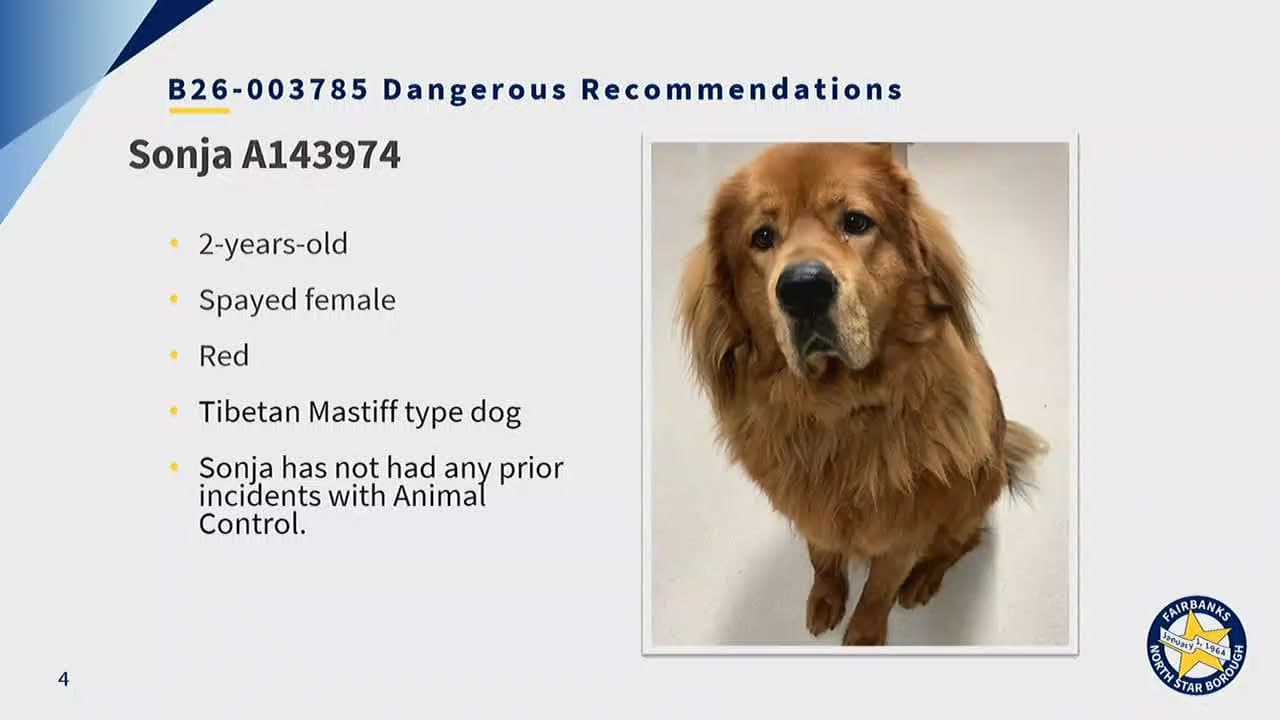
Thank you, Officer Ross. So this is Sonya. She is, I believe, closer to 3 years old now and she is a spayed female red Tibetan Mastiff type dog. Um, she has not had any prior incidences with animal control that we have been reported. Um, the victim in this case is Ruby Hannam.
Uh, she was a stranger to Sonia and Eric. Uh, she is approximately 8 years old and was present at the Spirit Halloween with her brother and grandma when the incident occurred. Um, What I've gathered from both sides, um, is that on October 29th, 2026, um, we were notified that Ruby had been taken to First Care to address a wound to her hand, um, that had been inflicted by Sonia the night prior on the 28th while Sonia um, was with Eric. They were crossing paths with Ruby's family in the entrance area of the Spirit Halloween. Um, Ruby had asked if she could pet Sonia, to which Eric agreed.
No audio detected at 36:00
And at this time, uh, Ruby's brother also set off an animatronic-type decoration that let out a loud noise that startled Sonia. Um, because Ruby was going to pet Sonia, um, and had her hand outstretched over the head of Sonia near her mouth um, slash muzzle area, Sonya did, um, inflict a bite at that time, which, um, was 2 to 3 puncture wounds, one of which required stitches.
No audio detected at 37:00
Due to those injuries and the fact that Sonya did inflict a bite that broke skin, um, per code, I, uh, deemed her dangerous with recommendations. Those recommendations were to have the animal evaluated by a professional trainer that is credentialed in behavior modification for reactive animals and follow the recommended treatment plan. Um, when Sonya is outside and on leash or another physical restraint, that she have a basket-style muzzle, especially when in— out in public spaces. Um, and then also to, uh, make sure that Sonya, because she is a working dog, still continue to, uh, go out and get the exercise that she needs to, um, make sure her mental stimulation is, uh, met. And then also, um, to not allow her with direct contact with anyone outside of immediate family unless controlled by a leash and a competent adult, especially in loud environments.
Um, the reason why I made this determination is because because the bite was an inflicted bite due to a, um, circumstance that was not, um, something that can be, um— oh, I'm losing the words— um, is not something that the animal would do, like, to protect its owner or offspring, or was acting in a manner that the incident required. So she was not acting to protect anything. She was not working. She was not doing anything, um, you know, where a bite would be deemed necessary.
Um, so to wrap it all up, Sonya, the Tibetan— the Tibetan Mastiff type dog, inflicting a bite consisting of 2 to 3 puncture wounds to Ruby at a Spirit Halloween. I have deemed Sonya dangerous for that. Because this is her first incident that we are aware of, and without proper handling within those environments, I do believe that this could occur again simply just because if she has continued to be exposed to environments with loud, startling type noises and another child walk up and ask to pet the dog, it does leave an opportunity.
And then, uh, this is my last slide. It is the recommended motion that I have for the commissioners.
All right, and does that conclude your presentation? Yes, ma'am. Excellent, thank you very much.
All right, commissioners, we now have a chance to question Staff, any commissioners have questions for animal control staff? I do. Commissioner Rosenberg. This is Commissioner Rosenberg. In investigating the situation, did you find out where Ruby lives?
What kind of— is it a private house, an apartment building?
Um, Ruby is the victim. Um, she Lives with her father and I'm in a house, I believe. Okay. And the dog? Um, I, I did not ask, um, like specifics where Miss Sonia lives, but, um, I, I think to my understanding it is a house based off of the address search that I was able to do.
Okay.
Any other commissioners have questions? Commissioner Gardner? Oh, I'm sorry. Do you know if Sonya lives with other— if the dog lives with other children? Um, I believe she is in a household with no children, but she is around other dogs.
Okay.
All right, Commissioner Gardner.
Um, I think the code requires that the bite be intentional. And in this type of situation, how do you decide that it is intentional? Um, so I, um, found it to be intentional because with the startling noise, um, whether Sonya was trying to decide if it was Ruby who was making this noise or something around her, um, I can't speak to that, but Coming from my experiences, dogs who are faced with something that they're not fairly familiar with and then accompanied by a loud, I'm assuming screaming type noise because they were at a Spirit Halloween, um, that encouraged the bite. So whether Sonia felt that she needed to in that moment or if she was just scared in that moment, that is what persuade me to inflict the bite simply because it was a circumstantial bite where if that circumstance where a small child is in front of Sonya again and she— and there's a loud startling noise, it could happen again.
No audio detected at 41:40
Um, Officer Ross speaking. I would like to add to that as well. The injury that the victim sustained had enough force behind it to show an intention to bite. Um, when we see accidental bites that happen by chance, where the dog's mouth by chance comes in contact with the victim, we don't generally see that much pressure behind it. Um, you know, it seems in this case that the dog was startled by a noise and then it acted to defend itself, but it perceived the child as the threat, and unfortunately the child was not the threat in this.
So the dog acted and chose to bite the child. Um, which is unfortunate because I don't believe she was the threat, but that is what the dog did.
Thank you. Any other commissioners have questions for staff? I just had one more question. Was a dog— was, uh, Sonya on leash at that time and under control by its owner here? Sonya was on leash, yes.
Okay, thank you. Yes, uh, this is Commissioner Kavopal. Bring that down a little. For recommendation number 3, I'm just curious what actually constitutes adequate physical exercise and mental stimulation. So for a working dog, it's fairly common, especially, um, with people who, you know, work everyday lives, where dogs are not meeting the correct amount of stimulation to keep them from biting.
No audio detected at 44:00
Or even behavioring in a destructive manner, such as like sled dogs, they need to run, otherwise they will destroy a house. Working dogs who are meant to be livestock guardian dogs who are meant to protect do need to have some form of like mental stimulus to like remove the urge or need to do what they were intended to be bred to do. But there are no guidelines as to what that is or what that means. Um, it's all— it comes down to the breed of the dog. So for Sonya, it could be such as going on longer walks, um, you know, working in, um, depending on her personality and how her owner is able to interact with her, it could be that they do tug or pull type activities.
Um, you see like German Shepherds and, um, like Great Pyrenees be pulling— they'll pull tires or they'll do some form of tug where there is a tug apparatus made where she can just let out her frustration or her pent-up energy, as lots of people like to refer to it as. So it's, it's really breed specific in what the owner is able to do for her.
Thank you. Any other commissioner questions for staff? It's our only opportunity to question staff this evening. All right, seeing no other questions, we can move on to Mr. Levine's case. And, uh, Mr. Levine, you have 10 minutes for your case.
And— oh, I'm sorry, do you, do you have questions for animal control? I apologize. Um, since I'm new to this, I guess yes. Um, or there might be more statements. Animal control never contacted me until they gave me a letter stating that I was getting a dangerous dog.
That, that would be part of your testimony. You right now can only ask specific questions to animal control staff. Do you have any questions for them? Did the daughter specifically say she approached me and asked me for permission? Yes, and so did, um, the guardian that was with her said that as well.
Can I repeat that now, or—. That— nope, that would be part of your case. Just questions for animal control staff. And demonstration of a bite, you said it was with intent to injure. Um, I, I can't say that's not the case.
Only questions for them at the moment.
Do you have a different determination based on type, breed, size, everything, action, where the hand was before it actually— the action occurred? No. So we do not try to discriminate when it comes to breeds and the things that they're meant to do. Code is written to simply just, if a, if a bite is inflicted, approach it as we would any other bite. And would it be typical for you to reach out and talk to the defendant when you make, before you make this decision?
No audio detected at 47:20
So it is all based off of evidence, um, the statements that were made, um, the conversations that I've had with both you and Ruby's family. Um, the evidence states that there was an interaction at the doorway. Ruby's family states that she had asked for permission to pet Sonya. You granted the permission, and then there was a loud animatronic-type decoration that went off. When was this interaction with me?
When did I speak with you? We've spoken on the phone quite a few times, but I don't have those calls submitted. Okay, I get— sorry, I've met her before, I haven't met you before, so sometimes I flip visages. So you're Officer Kristofferson? Yes.
Um, all right, and you're saying that I stated that she asked if she could pet the dog? No, her family stated that she asked if she could pet the dog and she was granted permission. And you never asked me that. When I spoke with you, you let me know that, yes, that interaction had occurred and that, yes, your dog did bite her. Was that an interaction where she— because you never asked me if she told me.
No audio detected at 48:40
Um, so was that an affirmation on my part that an interaction occurred, as in a bite did happen, or that something else that I was approached and all the other things that happened. So I am not allowed to share what her statement is with you? When I asked you what had occurred, that is what happened? Like, I cannot—. No, I'm not asking about her statement right now.
I'm asking, did you ask me specifically about the interaction, as in they approached me to ask if they could pet the dog and then it happened after that? No, sir. I— all I asked was what had happened on that evening. All right, I mean, that's— I guess that's all I can ask. I don't know what else.
All right, uh, so now if we're finished with questions, then you've got time to start your case here. You've got 10 minutes for your evidence, testimony, and exhibits, and then we'll go back to questions for you. You can begin. Um, like I said, I don't really know what I'm doing here. Not as in why I'm here, but how to do all this process.
Um, so please bear with me.
Um, there are a couple things I want to address. First off, um, I was never approached. The first time I said anything to that girl was after the dog was already in the car. Um, no one approached me. No one asked anything.
I spoke to the grandmother before I spoke to anybody else. Um, secondly, this is a personal statement. I would not have said yes to a child coming up to my dog. It doesn't matter which dog I have, where I'm at. I do not do it unless I have permission from the adults, the guardian, the parent, if they can approach.
I will not do it.
When this happened, we were getting ready to exit, as I've already stated before, or said in testimony. They were probably about where, where your bench is right there, and I was probably about this far away. Um, there's a little house in there, we had just come through it.
Um, the grandson first came over. Can I stand up? Show you. It's just easier for me while we were standing there.
Oh, you have— sorry, for public record, we have to be able to hear everything you say in the mic. Okay, so I'll just show you what the grandson did first because he was the first one to walk by.
Bear in mind, I'm about right there.
So he made an approaching motion, and at the last second he veered off. I saw that. I reined her in. I pulled Sonja to me. She was roughly standing right here, slightly in front of me, just standing still.
I was going to let the family pass, and then I was going to finish taking her outside.
The granddaughter, I guess she saw her brother, what her brother did, and she mimicked the action. Except she turned back and went straight to the dog the way kids tend to do. At that point in time, she already had her hand up. She went straight to the dog and she grabbed her on the nose. So there was actual contact.
She grabbed her nose. At that point in time, whatever happened went off. I'm sorry. After grabbing her nose, at that point in time, whatever else her brother set off the animatronic, and all Sonya did was pull back her nose and just say, hey, get away. That's what happened.
I was never once approached, never asked, had no interaction with them, like I said, until afterwards. As soon as it happened, I put my hand on Sonya's face. She still had not moved. I told the grandmother, I said, I will be right back, I'm going to get her out of here first. Um, and I just walked her calmly out the door, put her in the truck, and then I came back in to check on it.
It was after that, at some point in time, that was the first time I ever said anything to the little girl after that. So that's why I was asking if anybody had asked me for my side of the story, because none of that happened. Um, I don't know what else I can say regarding that, but it's— even the, the grandmother said the boy admitted to hitting the animatronic. When we were talking afterwards, she asked the girl, are you the one who reached out to the dog? The girl said yes.
I'm not trying to minimize what happened to her, that's not my intention, but this is my dog here and I take this very seriously. Um, I did provide videos and pictures of her out in public all over the place.
Um, she's normally very well exercised. We've been a little bit down. I just had to put another dog down, which was very hard on me, and so I've been kind of in a little bit out of it lately. But, uh, We spent a lot of time out in the hills and the mountains, so she's normally typically very exercised. Um, have you had a chance to— has anybody had a chance to look at any of the— um, have they been able to see those too, or—.
We can't answer questions right now. It's just time for your testimony. Okay, well, do I need to have them put up the pictures and videos put up there for them? I don't think we have the ability to do that.
Okay.
Oh, uh, it would take up part of your testimony time for us to get the stuff on the screen, it sounds like. I, I mean, it's just to establish that she's very well socialized. Um, there are certain things that happens occasionally that you can't You cannot— I mean, it's just things happen. They happen to people all the time too.
The— it wasn't— I don't think that there's enough evidence to show that she had an intent to go out and hurt the child. I don't— yes, there was a nip. She's a big dog. If she had intention of hurting that child, we probably wouldn't be here and she would be already gone. Um, I don't want to say it like that because I don't want it to sound like I have no feelings for the girl, because I do.
But it was simply, I have to pay attention to something else and I need your hand out of my face. It was just— it happened without it.
It wasn't— the intention was not to harm. The intention was to say, clear, clear the space, clear the space. You did not— you approached me, you didn't ask me, you didn't do anything. Something's happening right here I need to pay attention to, and now you have your hand on my nose and I need it gone. And that was the only intention.
I don't know what else I can add to that. Like I said, I'm not a professional here. I do not— you're welcome to ask questions when you can. Um, if you want to, for their benefit, show some of the images of the videos— we've been in there before. Um, I think one of the videos of her in there, uh, in the spirit Halloween, is in the ones I sent you.
Is that something that we could get on the screens? Would be any of his photos, or has animal— was animal control sent the same info we were? They were. Okay, so they were sent the same info that we—. They have access to them so they could see him.
It's just, I don't know if it helps or anything. I'm just trying to establish that, that she is very well socialized. Um, there is the occasional incident that I just don't have, you know, things happen. Um, could I have done something different in 90 days? Sure.
Everybody could have.
Um, yeah, it was not— there was no, there's no lunge, there was no follow-up, there's no nothing. It's just she was standing there perfectly still, someone approached her, grabbed by the nose, loud sound happened, she nipped, and you know, the rest is why we're here. So.
Okay, thank you. You do still have a couple minutes if you have anything else to add. When you're finished, we'll move on to questions. I have— I can add is that when I took her to get evaluated, um, the woman Susan, um, I can't think of her now, Susan Samson, um, didn't even charge me. She said this dog shouldn't be here, it's not reactive.
Um, I believe she— you've read the write-up, um, and even she said the same thing. It was just something that happened. You can't— you know, there was not an intention to hurt the child.
All right, thank you. Are you finished with your testimony? Please ask away. That might make it easier on me. I'm not rushing you at all, but yes, when you're finished, then we can move on to questions.
I don't know what really to say, so,. Okay,. I'm kind of treading wheels here. All right,. Treading water.
Okay, well, commissioners, questions for Mr. Levine?
I'll get started if you guys are shy. I've got to come— all right, um, can you tell me— I do see the letter here from Susan and maybe a receipt for an additional class that you've signed up for, is that right? Can you tell me what class that is? Just the receipt. She told me to register for the graduate class.
I was trying to get more clarification. She doesn't need the intro class, but it's the graduate class. And I believe that has K9 Good Citizen. Yep. At the same time.
And there's a couple other things that all rolled into one. So I— there was one starting on the 5th and there's one starting on the 15th. I chose the 15th so that way we can get more information passed along.
And did you choose to do that based on her recommendation for that group class, on, on Susan's? Yeah, yeah. I spoke with her and, um, I let her know right out, I'm not a trainer. Um, that's not my strengths. I work really well with these dogs because I know how to.
It's just the way I am. Um, I'm a little bit ADHD. I've got some other things going on and I've just had a really good experience with these dogs and I've never had any issues before. So going and speaking with her, it might be a fun thing for the dog and it might also benefit me a bit so that I can learn. Okay.
And do you have any other dogs? I do. Okay. How many? Two.
I just lost one. Sorry to hear that. So I have two others right now. And I think I saw in one of the videos that you had in the folder, Are the other dogs also Tibetan Mastiffs or the similar breed? One's a Tibetan Mastiff, one's a husky something.
Okay. So, and the older Tibetan Mastiff is smaller than Sonya. She's been around kids all of her life. So I live, I don't know if I can answer. I live in a duplex.
So we are on Hampstead Avenue, which is off of Danby. Um, Anne Wien is right across the street from me, and then the middle school is right down there. So there's kids around there all the time. Um, same thing, I don't let them interact with dogs when I'm not out there, and they know, you know. And I just had one more question, and then I'll turn it over.
I see we also have a receipt here for a couple of muzzles that you've—. Just one—. Or a muzzle, and then a— oh, I see the, the quick clip. And so is that something that you plan on teaching, um, Sonya temperament, wearing the muzzle regardless of the outcome here? It is, because as you said, regardless of the outcome here, now things have— things have already changed for her life.
No audio detected at 1:01:20
I can never put her in a situation again where something like that's going to happen, whether it's her fault or not, because my concern is her, and I don't want to lose her or potentially lose her for something that's beyond our control. So Will she be in that situation again? No. That's a hard no. So if we have to be in a situation, something like that, with children around, things like that, then muzzle training will be a good thing.
Okay. You don't have any problem with her wearing a muzzle when you're in maybe new situations or? I am hesitant, and that's one of the things that I was speaking with Susan about.
She's an LGD. And one of her primary methods of defense is— I mean, she's a dog.
Uh, my concern is, because she's never had a muzzle on before, would the— and this is something I was talking to her, and I don't have any experience with this, so I— this isn't something that I know is going to happen. It's just, um, my first thought, since she's never had this on, that it might actually make her slightly reactive because now she doesn't have a method of defending herself. Um, when we were there, we actually tried one on her. She— it didn't bother her too much, um, given we weren't walking around in public, but she seemed to wear it fine. Okay, that's good to hear.
No audio detected at 1:02:40
All right, thank you. Any other commissioners have questions for Mr. Levine?
This is Commissioner Rosenberg.
Can I—. Yep, go ahead. Yeah, so if we deem her dangerous and you comply with everything, including all the recommendations from Susan Sampson, is it not the case that in a year you can come back to get that classification removed?
That might be true, but I'd be sitting in front of here again trying to argue that point. The other point that I would like to make is that that's a year that she cannot be socialized, um, which is not going to have a positive effect. We also spend a lot of our time in the outside outdoors out here. I spent a lot of time in the hills, on the rivers, and everything around Fairbanks. Those are all in the borough.
So that would mean that anywhere I go in the borough, she has to be muzzled. Unleashed. And sometimes where we go, that's not possible. So that restricts all of our motion, all of our movement. It limits her activity levels, basically.
So it's— I'm thinking beyond the, the going to a store part. I'm thinking about when we're out in the outdoors,. Right? Well, in the borough, animals have to be on a leash unless they're in your fenced yard. They can't be just roaming with you even if they're not a bite animal.
So there's— there are— and that's something you can ask, you'd have to speak with animal control. There are, um, times that they cannot be— that they don't have to be on a leash. Um, they have to be under control, they have to be under, you know,. Dog park. Yeah.
So, but where I'm talking about going is we're in the middle of nowhere and it's when you're up in the hills on rocks and things like that, there's just certain things you can do and certain things you can't do. I'm not talking about going for a walk at Krieger's Field, if that makes sense.
Any other commissioner questions? Yes,. This is Commissioner Kavappal. Just to confirm, you said you live with two other dogs. Is there anyone else in the household?
No, no, it's just I live by myself.
Any other commissioner questions for Mr. Levine? This is our, our only chance to ask questions.
I have just one more to clarify because I saw it here in Susan's letter. Um, so she— Sonia, there was no, no warning before the bite? No lunge, bark, or growl? No indication. There was no bark, there's no growl, there was no nothing.
She literally— I— she just kind of— I— like I showed you before, felt kind of funny doing it, but it's basically what happened. She came forward, she swerved, then she looked over, and then she swerved back and kind of swerved again, and then her hands were already up and she just— right, sorry, right onto her nose. Um, there was no 'Can I do this? Can I touch your dog? Can I pet your dog?' There was nothing.
It's, you know, that it's as simple as it is. I'm not trying to fault her. That's not my— you know, she's a child, she does the child, you know, kid things. Um, so it's not that I'm saying that she was a bad child, she did bad things. It's just this is what happened.
Um, so,. Okay, thank you, Commissioners. Last call for questions. Mr. Levine?
All right, seeing none. Staff, do you have questions for Mr. Levine? I do. Um, I have just a few questions here. Um, uh, how much does Sonya weigh?
Um, last time I weighed her, she was 135. She's probably about 140, somewhere in that area, 135, 140. Um, and I heard during the questioning Um, that you mentioned her having to defend herself. In what instance do you believe she needed to defend herself from Ruby at Spirit Halloween? I'm sorry if you misconstrue me.
I don't think she needed to defend herself against Ruby. I don't think she was defending herself at all. I think what happened was there was— she was reacting to something in the nearby, and all of a sudden this child's hand was on her nose, and all she did— and if you look at the bite marks, it lines up perfectly. All she did was pull back and go, hey, you need to move back, you need to clear the space. Um, I know it broke skin.
Um, would it have— would it have broken skin on an adult? I don't know. I honestly don't know. Um, and yeah, I mean, that's— I, I don't know how else to put it. Um, and then for, um, when you state that you are going to limit bringing her into spaces like that, is it, um, what, what type of spaces do you feel like are appropriate to bring such a large, potentially reactive breed into?
Um, My intention is not bring her into tight-knit spaces like that anymore. Whether or not she can handle it is immaterial to me at this point in time. So I'm not saying that she can't handle it or that she can, or I'm just saying that I'm not going to risk it. Um, maybe I'll take her to Lowe's still. Um, she loves it in there.
The employees love her there. Um, she's been going there since she was 8 or 9 weeks old since I first brought her up here. Um, but she will never be in an area that potentially has a lot of kids running around. And that's, that's not a statement on whether or not I trust her with children. It's a statement on I don't want to put that— I don't want that situation to arise again.
And then my last question, um, do you understand that these are recommendations and not conditions? Like, they are not forced upon you. They are simply just recommendations that would help her, such as like with the large areas. I cannot tell you to muzzle her, but within the recommendations, yes, you should, like out in the field when you take her on these walks. So I do understand that, and I think I brought it up with you when I spoke to you on the phone.
It's— is it a should or is it a must? The problem I have with this is that You can probably see it around. I do get a little bit anxious at some times, so I tend to overcompensate.
It says should, but if I don't and something happens, then I'm just throwing her into the fire. And that's, and that's what goes through my head.
So for me, I have to change her lifestyle around. I have to change all of her lifestyles around.
I don't mind doing that, but I don't think it's warranted in this, in this instance. I really don't. Um, can I make changes? Sure. But to say at the age of 3, one incident happens, it's— and if you had been there, I think you would have said the same thing.
It's I think this is a little bit too much, um, is what I'm getting. It's just too much. So I'm more than happy to make changes, but I am having this hanging over her head is, is difficult for me.
That was all of my questions. All right, thank you. And See here, Mr. Levine, you can return to the audience, please.
And Animal Control has their time for rebuttal here. How much time would you guys like for that?
Sorry, no more than like 2 minutes. Okay, all right, uh, you can begin that, please. And just a reminder that no new evidence may be submitted during your rebuttal.
Regarding Sonya, I do understand that this was an unfortunate incident and that due to the circumstances of this bite occurring, there was a lot of unpredictable behaviors, not just from Sonya but also from the child itself. And the reason for my recommendations was to not only protect future children but also Sonya from a child walking up and doing as Mr. Levine states, if, um, you can't stop them all.
Um, and then just reiterating that the bite was seemingly intentional due to stimuli within the environment. And again, with no warning, it is concerning that a bite like this could happen again.
That is all. All right, thank you.
And commissioners, we are looking for a motion. Any commissioners have a motion to affirm, reverse, or modify this determination?
I can give an example motion, if that would be helpful.
Could move to affirm the dangerous animal determination issued to the owner for Sonya and adopt the 4 recommendations and 8 findings of fact.
We can reverse the determination altogether, modify to keep the determination but change the recommendations or conditions.
Question for the clerk: without a co-chair to hand the gavel to, how can I make a motion? Oh, um, you can just avoid— okay, okay.
Would a recess, 5-minute recess, be helpful for the commissioners to think about a motion? Let's do a 5-minute recess, please.
No audio detected at 1:14:20
No audio detected at 1:16:20
Alright, I think we've had about 5 minutes, um, to reconvene here. Commissioners, does anyone have a motion?
Commissioner Kvapil, would you mind being my vice chair for the moment and being the chair for the moment? Sounds good. Thank you. All right, I would like to make a motion. In that case, I would move to reverse the dangerous determination for Sonya.
I would like to affirm the findings of fact 1 through 7 Strike finding 8 and replace it with the following: There's not enough evidence to determine the bite was intentional per FNSB code 22.20.010.
Circumstances were such that the bite was accidental or happened by chance rather than intent.
Excuse me. And that would be my motion.
I'd be looking for a second if anyone would like to second. This is Commissioner Rosenberg. I'll second it, especially for discussion. All right, thank you. And seconded.
We get to discuss. Commissioners, please discuss.
Yeah, this is Commissioner Rosenberg. I think, I think the animal was startled and that's what happened. Um, You know, the kid was there, there were lots of people, I'm sure it was noisy, and then she reached forward and simultaneously this loud explosive kind of noise went off that the animal probably associated with the kid and not with another child making a noise. So I think the odds of it happening again are not tremendously great. Um, at the same time, it is a large animal that could cause quite a bit of injury.
I would hope that if it's reversed, um, that the owner uses the leash law and even out of town doesn't let this animal run except in fenced areas or a dog park or a place that's controlled because kids could go by or people could go by on bicycles or whatever, snow machines. Or yelling or screaming or doing what people do when they're— and something serious could happen given the size and power of the animal. So, and I, I would hope that the animal would go to these reactive classes with Susan Sampson. That would be very useful. With or without conditions.
And I do, um, part of the reason that I made that decision is I appreciate that the owner's already taken Sonya to see Susan, who does not think Sonya is a reactive dog at all, doesn't recommend the reactive class even. So they're doing the Canine Good Citizen evaluation, which I think is great for anybody to do. And so that'll be good, I think. And I am very heartened by the fact that you've ordered a muzzle, and that even though you're personal opinion of them makes you a little more fearful for your dog than I think you need to be wearing it, for them wearing it. I'm happy to hear that you're open to learning and training her to use it so she can be comfortable if she needs to get into a situation where she should wear a muzzle.
So I appreciate hearing that too. Any other commissioners have any discussion? Please, Commissioner Gardner. Um, I would like to say I agree. I believe this was not an intentional bite.
I think the dog was startled and did a defensive— like Susan Sampson said, this is just a reaction, a defensive reaction that wasn't even thought through. Um, so I'll see— I'll support the motion.
Are there any other questions from commissioners?
Or not quite. Any other comments from commissioners? I swear I vaguely know what I'm saying.
Yeah, uh, if there's no more discussion, then, uh, the clerk could call a vote. Would you like me to restate my motion? Click. All right, thank you. I move to reverse the dangerous determination for the dog Sonya.
Affirming findings of fact 1 through 7 and adding finding 8: there's not enough evidence to determine that the bite was intentional per code, um, 22.20.010. The circumstances were such that the bite was accidental or happened by chance rather than intent.
Miss Lowness? Yes. Miss Gardner? Yes. Miss Rosenberg?
Yes. Mr. Cavopoli? Yes. Miss Rudy? Yes.
5-0. Uh, motion carries. And then, yeah, uh, well, we gotta adopt findings of fact first, so I would like to see if there's a motion to— oh, oh, we did that already. Oh, perfect. Yep.
Okay, uh, then the commission shall issue its findings and conclusions in written form. An owner aggrieved by the decision of the Animal Control Commission may appeal to the Superior Court within 30 days. An appeal may be filed at the Alaska State's Rabinowitz Courthouse located on 101 Lacy Street, Fairbanks. Notice of intent to appeal shall be given to the animal control officer within 72 hours of the decision of the Animal Control Commission. If the animal which is the subject of appeal is impounded, the animal control office officer shall require advance payment for 1 month of room and board expense if the owner provides notice of intent to appeal.
Uh, the animal control hearing of November 23rd, 2026 is adjourned at 7:11.
No audio detected at 1:26:20