Valdez: City Council, 2026-11-17
Alaska News • • 108 min
Articles from this transcript
Union workers ask Valdez to push Alyeska to reverse its oil terminal contract switch
Union workers asked Valdez's city council to press Alyeska after it awarded oil terminal maintenance work to a contractor the workers call non-union.

Valdez votes Dec. 1 on a $96.8 million budget as oil taxes rise and homeowners' bills fall
Valdez votes Dec. 1 on a $96.8 million budget riding a 40% jump in oil property taxes. Homeowners who apply could see taxes fall from $4,700 to $1,080.
Calling to order. Please join me in the Pledge of Allegiance.
I pledge allegiance to the flag of the United States of America and to the Republic for which it stands, one nation under God, indivisible, with liberty and justice for all.
All right, first off tonight, do we have a roll call?
Yes, Mayor, all council members are present this evening with the exception of Council Member Stites, who's absent and excused. Okay, then we'll go to, uh, this is, uh, public hearings. Uh, we're going to go start off with the, uh, 2027 budget. Uh, first up tonight, we have public hearing on the 2027, uh, City of Valdez proposed budget. No, we're accepting comments formally at the beginning of the work session.
This is our formal public hearing required by Section 3.0.050 of the Municipal Code. City Manager Nate Duval will provide a brief overview of the proposed budget and then we'll hold the public hearing. Any interested person shall have an opportunity to be held for the public hearing for the purpose of an estimate of any budget item. After the public hearing, the council will adopt the budget with or without amendments. Dennis Fleming.
Go ahead. Thank you, Mayor Fleming.
A couple slides, so run through.
Uh, just first to kind of touch on the— this is the culmination of the budget process. As you know, we've been through the various budget work sessions and hearings, and what you've got presented before you today is a reflection of y'all's priorities and the work plan for 2027. Uh, speaking of council priorities, uh, housing for 2027 is, is one of the top priorities to provide opportunities and incentives to increase housing stock, improve affordability, and promote economic development by the fall of 2028. Uh, the second one was to increase appropriated funds and resources toward deferred maintenance and critical infrastructure, and the last one was to establish a 5-year CIP plan. Many of these dovetail into the 2026 priorities, which are somewhat carried forward in the budget process.
No audio detected at 1:40
Continue work on the child care facility to ensure we have licensed operational child care in Valdez. We had some, but some schedule slip on that project, but it is still ongoing and it's on track based on the current, current schedule.
To touch on the priority for housing and affordability, you all passed the new primary home exemption, which is not necessarily a budgeted item, but there is foregone revenue of approximately $2.5 million, which should be put back into the pockets of, of the individual homeowners.
There was a contribution from the permanent fund. The intent as articulated by Council, was to utilize those funds not directly but indirectly to offset that property tax exemption, and then also to find opportunities to reinvest any remaining funds.
From the budget parameters, you also said to ensure maximum funding to the schools, which we did. And with the increase in property value, there's an additional approximately $3 million increase to the school's budget.
We still account for the $595 per resident energy credit.
The budget reflects status quo service levels, with an exception of with the receipt of the SAFER grant for the fire department. 3 New personnel will be added to that department, largely funded by that grant from FEMA. There are specific maintenance appropriations within each department budget to account for your priority for increasing Maintenance, not simply expenditures, but completion of maintenance tasks and priorities. The parameter related to community service organizations, you all had your work session, is reflective of what your priorities were, your goal qualifiers as well.
Bonded projects, later on the agenda we have the bond proposition that will be posed in a special election. This ties into both the maintenance as well as the 5-year long-range plan, reflects the reimbursement for the meals project that was recently completed, construction of the rural roads program, most specifically is the upgrades and maintenance and potential paving of Corbin subdivision, the BCT water line replacement that is currently nonfunctional, and then the Baylor replacement, which has some significant deficiencies. So all those 4 projects total $32 million. Again, you'll see that later on in the project, but it's, it's not necessarily reflected in this budget, but it is in the fact that we do have to have our debt payments in order to capture all excess revenue. And so anyone who is, who's looking at the, at the budget and trying to understand why we have these debt obligations, in order to accept all the revenue, we have to spend it on bonded debt.
And so if we want to get all this money, we have to have projects to apply it towards.
General overview of appropriations. The total budget, one way to slice it, is $96.8 million.
$44.4 Million of that is operations. That's a 1.6% growth over 2026. Debt service accounts for $17.5 million. Education at $16.3 million, which incorporates that $3 million increase that you saw $9.6 million for reserve contributions and $6.5 million for legal-directed tasks. And then CSO's increased support of $1.3 million.
All total, this allows us to make a contribution of $1.5 million to the permanent fund. There was some— I do want to point out that this number is slightly different from what it was before. There's about a $300,000— The formula from the state for the schools was off by about $300,000, so that $300,000 is appropriated to the permanent fund contribution.
Uh, just to highlight a couple other things for Parks and Recreation as it relates to events, uh, economic development supported city-sponsored events and then the city's own events.
Uh, a couple clarifications. We did appropriate within this budget $590,000, which is reflective of last year's bed tax.
Estimate to be used towards the new Destination Valdez organization once it's fully established and they present a budget to you all. So it will live in your contingency account, and then you will be able to appropriate it as, as you see fit when the time comes.
Just some facts and figures. Oil and gas, as it relates to property tax, oil and gas makes up 93% of our property tax revenue. Of our total revenues, it's 75%. The other revenues come from our rates and fees, port revenues, interest income, etc.
Last year I drew up this little graph. It showed that we're— a lot of people talk about how expensive it is to live in Valdez. I'm not discounting that, but we're kind of middle of the pack once you count from a tax liability for residents in Valdez. What I do want to show— well, I'll highlight here. So it was approximately $4,700 per homeowner to live in Valdez per year.
With the new primary home exemption, as a homeowner, you're now at about $1,080.
We're not in the middle of the pack anymore, but we are certainly here well beyond the bottom. And so I think that's a testament to y'all's goal to reduce that burden on the taxpayers. Again, this isn't reflective of every resident. There are those who rent or have other commitments and don't necessarily own the home, but it is, it is a significant impact for those who do own a primary residence in Valdez. For those who don't live in Valdez, it's, I think it's an encouraging opportunity to do so.
You can see where we fall compared to the rest of the state. You can do the math for yourself.
Uh, just another number that I threw out there. So last year's per capita, uh, expense was $171 to $175 per person per month for city services. Uh, adjusting for the new budget and adjusting for the estimated population, it drops at about $50 a month, uh, per resident in Valdez. Hopefully contributing to a cost of living that's a little bit more affordable for people who are here. So with that, I will leave it to public hearing.
Okay, thank you, Nate. We'll now open up the public hearing for the 2027 proposed budget for the City of Valdez. Um, we're going to limit it to a 5-minute conversation on the budget. Uh, so if you wish to speak about the budget, please step forward, state your name clearly, And you can go ahead and talk about the budget. All right.
Okay, moving on then.
Um, we will, uh, the budget will be brought forward for adoption at the regular meeting on Tuesday, December 1st. Okay. And then we'll go to, uh, approval of minutes.
Are there any corrections or objections to the approvals of minutes? None seen. Let it stand. Okay, moving on to public business from the floor. Um, we have a large crowd tonight, and I probably won't be able to get through all of you guys that want to testify.
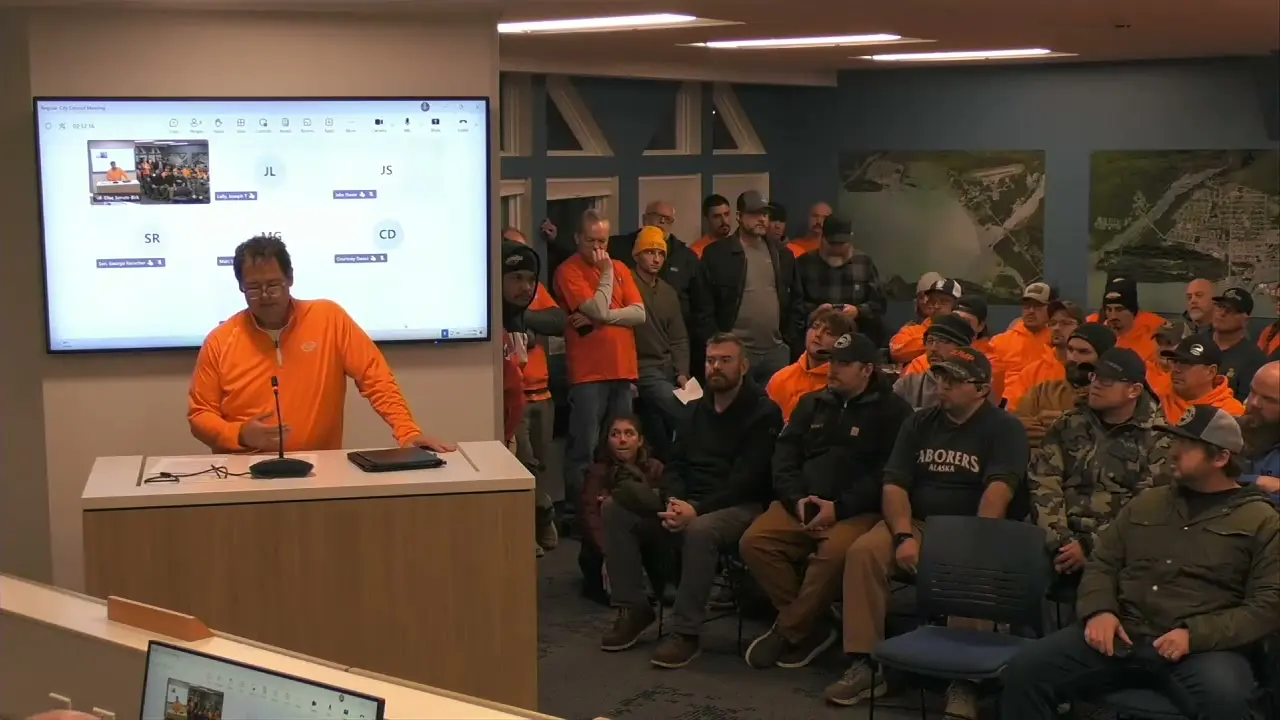
So what I'd like to do, and with the council's blessing, is let Joey come up and speak for the laborers union and take as much time as he needs to have this conversation with the council. And it will be okay for the council to ask questions back to Joey at this time. That will limit the number of people that we can bring up afterwards. And when, when I say that, bring you up, I kind of want to make sure that we're not repeating what Joey's saying, other than if you wanted to testify, we do have other meetings that will go on all the way next year, that you're more than welcome up to come up and speak on behalf of anything that you may miss tonight. So with that being said, I'd like to leave the floor to Joe.
No audio detected at 10:20
No audio detected at 10:40
Uh, thank you, Mr. Mayor. This is on already, right? Um, so, you know, first of all, you know, I, I appreciate the opportunity to, to testify and to talk with, uh, with, with you all tonight. Um, pretty, uh, pretty pretty serious issue. But, you know, one thing I had mentioned, I didn't really want to speak up on the budget, but I'm kind of curious of this decision that Alyeska is making, how that's going to impact your budget down the road when you get about 100 people that end up moving out with their families.
That's probably going to affect your budget quite a bit. But that said, so my name is Joey Merrick. I'm the business manager, secretary treasurer of the Alaska Laborers Union, and I'm also the president of the Alaska Petroleum Joint Craft Council. We represent, you know, probably 15,000 or more members across Alaska with just these 5 unions. So, those of you that don't know what the APJCC is, it's basically all the laborers, operators, teamsters, electricians, and plumbers and pipefitters.
So, that's basically— These are the folks that do the work every day to keep the terminal running. You know, these are the folks that shovel the tank tops, clear the snow around the facility. They install and maintain electrical work. They excavate, maintain piping systems, perform drain downs, work on vapor systems, all the crane work, loaders, heavy equipment, all the materials that are ordered, handling materials, moving materials. These are all some of the things that we do.
That's just a part of the work. I mean, you know, they're building scaffold under the berths, you know, insulation, you name it. So these are the people that run the terminal, know the equipment, understand what it takes to do the maintenance safely and correctly. You know, the baseline work we're talking about here, Alyeska has decided to award this to CCI. Industrial Services.
It's a company that's, you know, not done a lot of work here, but they've done some. I'll save some of that for the folks that work with them every day. I have not done that myself. You know, I worked on the pipeline. I started in 1989 when I first worked on the pipeline up in, I think, pump station '06, that was my first spot.
And I worked every station along the line, so I'm very familiar with the line, even the stations that are long gone. I've worked at the Valdez Marine Terminal. I've worked at Pump 1. I've worked, you know, everywhere there. And the last of my career, I came down to Valdez, and that's where I met my wife, who I, you know, am with today.
You know, it wouldn't have mattered if it wasn't for wasn't for TAPS and getting transferred down to Valdez. Valdez has always been special to me. I'm very close with a lot of people, a lot of Alyeska folks, a lot of just people that are in the community and doing other things, business owners, you know, and I can tell you, you know, I've always taken pride in doing work right, doing quality work, working safely, being productive, and, those are the standards that our members bring when they're working on the pipeline and they're doing this work.
I can remember, boy, I think it was about 2000, God, I can't even remember when it was, 2008, 2006, and we had a special meeting, ALIESCA had, and I don't know if anybody was here. I don't think anybody was here at that time, but You know, it was an interesting meeting. It was a bunch of Alieska, you know, top management, president and everybody like that. And then it had other folks that, you know, different contractors. And I was the only one there that wasn't working for Alieska, that wasn't, you know, maybe not directly, but had a contract or something.
And one of the questions, you know, that was brought up, they had a facilitator there that was trying to, He had this little beach ball with all these little things on it. I can't remember exactly what it was, but it was pretty interesting. And he asked the question, he said, "What's the elephant in the room?" He said it called like the mojito or something. And I said, "What?" He's like, "What's the elephant in the room? What's the thing that everybody knows but nobody will say it?" So that's me, I'm that kind of guy.
I don't have any, I've never had a problem saying the thing that everybody else is thinking. And I said, well, what is it that, you know, why is it that Alyeska treats all their own employees and some contractors different than others? And oh man, that room got quiet. All those guys that are looking at their contracts, they weren't going to say a word. Nobody was going to talk about it.
And the Alyeska management at the time, one of them was Rod Hanson, and probably some of you guys might know Rod. He might have even been the guy that took over for just a little bit. He ended up saying, well, you know, let's talk about this another time. Let's have a special meeting just to talk about that issue because you can see that I was the only one that was going to have any dialogue on that. You know, that question to me is about, you know, fairness, and that stuck with me for a long time.
And today, you know, as Alyeska changes who performs the maintenance work, It matters more now than ever how this is done. You know, safety qualifications, accountability, that can't change just because we have a different contractor. A lot of what I'm hearing from Alyeska folks that I know and contractor folks that I know, they're telling me that there's already been that difference between what is done by Houston, the current contractor there, or TCC or Adna or whoever. And, and CCI, you know, another, another contractor that, that does things different and has a different mentality, different reporting. I mean, I go to the Alyeska safety meetings and everything is zero, zero, zero.
So they, they do fantastic. You look at the North Slope and, you know, if you did a little research, you might find out that maybe it's not zero, zero, zero up there. And there's been some really tragic things that have happened. But, you know, it's more, more than just the pipeline. I mean, I didn't come here just to talk about the pipeline, but I, you know, I think about, you know, I think about the families.
I think about Valdez community, which is why I called the mayor and asked him if I could speak, you know, because I, I have, you know, a bond with this, with this town and the people that live here. And I think it's important to talk about that because the people that we're talking about who this is going to affect, those are the folks that buy homes to pay that tax, that minimal tax that you got to pay. I think, you know, I looked at the 75% number that you were talking about. Maybe that number should be higher. I don't know.
But I do know that, you know, these are the folks that teach your kids. These are the folks that, you know, coach your kids playing T-ball, playing soccer, baseball, basketball, wrestling coaches, all of that. They're the ones that run the Cub Scouts, the Girl Scouts. Everything. They're the volunteers that look after your neighbors.
You know, these are the folks that actually come in and shovel snow, you know, for the residents that can't do it themselves. I mean, it's just a shame that we're gonna let somebody do what they're doing and take people that have made their lives doing the work that they do become part of this community leave because they're not gonna have an opportunity to do anything else. I mean, 'cause they're not just gonna leave themselves, they're gonna have to leave, you know, their whole families will be uprooted. And it's pretty awful. They're the ones that shop in the local stores, eat in the local restaurants, help all your small businesses, hire local tradespeople.
You know, when a good pan job leaves Valdez, It's not just the impact of one worker, it reaches the whole family and the businesses they support and the organizations that depend on them. You know, this— there aren't endless jobs around here, as I, you know, as you know. I mean, there's a certain amount of jobs, there's certain things, and the folks in this room are the ones that are doing a lot of those jobs. Local hire for the unions that work is almost close to 100% when we're talking about Alaska residents. And I can speak just from the laborers' point of view, and our local hire that's going to be impacted here is probably 75%.
And these are people that they're gonna have to look elsewhere.
Not sure why these decisions are going on, but they're not just gonna lose workers, they're gonna lose parents, they're gonna lose volunteers, neighbors, people that have spent years making this town their home. And these jobs aren't gonna make people rich, right? These jobs are things that allow you to build a home, you know, and maybe, maybe rent, you know, you never know. They're, you know, they're— it gives you healthcare for you and your family. I mean, that's what it does.
I mean, it helps you pay a mortgage, you know, maybe have a little modest retirement at the end so you can actually retire with a little dignity. You know, I mean, the decision Alyeska has made here is just, it's— unfathomable to me. And I, I can tell you about a year ago when I first heard about it, I started to talk to— I talked to Alyeska about it and I, you know, and I had a lot of communication with them. It's funny, on my way in here 15 minutes ago, I get a call from John Kers. The announcement was made on Thursday.
Today is Tuesday. So it's been almost a week. And that's the first I've heard anything from Alyeska.
And it, you know, it's just ironic to get that call at that time of all times. And, you know, I think Alyeska and the owners, they need to answer some basic questions. You know, how are they planning on preserving the experience, the knowledge of the current workforce? I mean, I don't know. I mean, what are the safety and training standards for the incoming contractors?
You know, what are the apprenticeship programs that they have? How many jobs will stay Alaska residents and how many in Valdez? Just out of curiosity, does anybody have any idea what the North Slope out-of-state hire is? So we're about 90-plus percent here in Valdez. Local hire, resident hire on the North Slope, it's about 46%.
You know, it, I mean, it's basically nothing. They fly right in. And they fly right out. That's what happens on the north slope, and, uh, and it's very unfortunate. Um, you know, there's a few things that I would ask, and I, I want to make sure that I, I'm here to answer any questions that you might have as well.
But there's a few things specifically, um, that I, that I would like to, to ask, and I, and I think that there's time to reconsider, um, some of these things because You know, I don't know why, you know, they had to wait until now and then to tell the families right before the holidays that start figuring out what you want to do with your life, you know, before you buy any presents, you know, make sure you save a little money so that you can move and do whatever you need to do. No idea why the timing of that would come in, but it's pretty, pretty horrible if you ask me. But there's a few specific things that I would ask of this council and the mayor. You know, one is have Alyeska come in before the city council, explain their decision and why they awarded it to CCI, who doesn't have the experience to do this type of work. They, you know, I'm real curious.
I'd love to be, you know, be able to listen in on that. Ask for answers about safety records, qualifications. And safety's number one, number two, number three, right? I mean, safety's supposed to be everything.
And I feel like sometimes that we're playing on a different playing field.
Ask if AES can listen to its own people, if they talk to their own people about it. One of the things I was just told was that, yeah, they talk to their own— they don't talk to their own people because these are done in a very confidential way when you're making decisions like this. And I find that, you know, you know, I understand there's some things that are confidential, you know, probably like financially, maybe it's confidential, things like that. But when I'm talking to Alyeska folks, your constituents, and they're telling me that they have no idea how they're gonna be able to do the work. They're scared to death, you know, about having a crane on the berth or whatever with a guy in a man basket or whatever, you know, have to do without knowing they have the skilled, trained workforce that they've had for all these years.
So I think those are questions. I mean, when you're talking to the managers, of Alieska, and those are your friends too, I know. And, you know, did they even ask them? Did they? Because they didn't.
And, you know, I mean, they've told me that, you know, I'm baffled by that. It's a different model. Hillcorp on the North Slope tells everybody that we listen to our middle managers and that's how we award things. We don't award it, you know, ourselves. We have these other folks, these middle management folks.
So the middle management here, and I say the middle management, but they're actually the ones that make the oil flow and make sure everything's done safely. The Spocks, the, you know, all those types of people, you know, they're, they're the ones that they're worried. If they're worried, I'm freaking worried too. I mean, that's a, that's, that's very concerning.
You know, ask why the Valdez community leaders weren't consulted. I don't think, I mean, I feel like when I called the mayor and asked him if I could speak here, that he didn't even know it. And it was a few days after the announcement. It's like, how does the council and the mayor not know about a decision like this? I mean, even if it's like once they make it, but maybe before they make it, they should at least consider some of these things.
So I guess, you know, probably the biggest thing that I'd like to see is like a formal resolution asking ALIESCA to reconsider the contract. And I think that's something that you guys could, you know, take a look at and talk about and maybe have a good resolution to have them reconsider their decision because, you know, I think it's really important that we don't wait till the transition's complete because right now they say, It's going to happen at the end of February. You know, the contract's over the end of February. That's when CCI takes over right in the middle of the prime of, you know, some of the most dangerous work that goes on doing those tank top snow removals and all of that work. But, you know, I'm asking that you guys stand up for the workers and the families that have stood for TAPS and Valdez for generations.
I could probably go on for a long time, but I know there's a lot of people that want to talk. And, uh, I, you know, I'd love to answer any questions if you have any, or try to answer them. And, uh, does Council have any questions? Go ahead, Lester. Just one comment.
Joey, thank you for being here and, uh, and speaking up there. Um, I do appreciate the good work that the laborers union has done and the other members of the Joint Craft Council. It's good, safe work. And I do appreciate it. Thank you for showing up.
Go ahead, Chip. So I haven't, I haven't heard any information as to whether the, the people currently employed in the trades across the Bay would be offered a similar position under the new company. But is it your understanding that even if they were offered a new position, essentially they would be given a decision between relinquishing their union membership investment, their retirement through the union, their healthcare through the union to maintain a similar but different job under a new company, or maintaining their union membership but having to relocate somewhere else to work in a similar position? Yeah, through the chair. So basically, I'm gonna let you ask the folks that are here as they come up, you know, what their thoughts are because they have to make those decisions.
But yes, you're absolutely right. There is a health and welfare plan that every person has healthcare that they will not be able to continue if they're not working here or if they're working for this other contractor. I've been told by some folks that they've been offered, maybe not offered, but they've been told they can reapply and they're gonna get a wage that's, you know, comparable and, uh, and a better benefit plan, which I highly doubt. But, uh, but yeah, they will not be able to continue that unless they— unless there's other work down here in Valdez and they were able to get it, um, you know, like road work or whatever. But, you know, certainly it's going to displace a lot of people, and the majority of folks are not going to be able to stay here.
Um, they— there's not that much remote work. There might be a little bit on the North Slope for a little while. It's definitely going to impact their ability to contribute to their pension. Their retirements are extremely important to them. You know, and there's a lot of people that still live in Valdez that are collecting a retirement check, and they won't be able to do that unless they either work somewhere else or relocate.
That's correct.
Any other questions?
Go ahead, Olivia. Um, Jimmy asked a lot of the questions that I was going to ask, but I do want to just empathize with all of you folks that showed up here tonight, and I'm sorry that you're having to face something like this at this moment in time. Um, so I don't know the you know, what we can do with Alyeska. I think perhaps talking to the city clerk about potentially creating a resolution, um, but you know, it is a private company, um, but I do empathize with all of you right now, and I, I'm willing to do what we can to have a discussion or try and figure out how we can, um, protect our community members and you know, do what we can. I just don't know what that looks like.
So, but I do appreciate you all coming out tonight. I mean, I know you could be with your families right now, and I understand why you're here.
So thank you. Anybody else wish to comment? Go ahead, Jimmy. Uh, do you, do you know the, the timeline or the transition Well, I mean, the timeline that they, that they are saying, that we've been told, is the end of February. Um, you know, I, I've seen similar situations where they say there's a timeline and then something comes up and then they push it down the road and do things like that.
Um, so I don't know what it'll actually be. I know that that's, uh, that's what that we've been told, that the end of February all these folks will be out of a job and, uh and looking for other work. And, you know, just, you know, if I'm in their situation, I'm not going to wait until then. I'm going to start looking for opportunities now. You know, if I'm a skilled craftsman and there's work somewhere else that I can get on, I'm going to take it when I can get it.
So, I would be surprised if if it didn't start to change in the near future and just become a lot more difficult to handle the work that's, that's, you know, to be done right now. I'm sure it'll, it'll get done and we'll do our part to, you know, be professional and fulfill the contract. But I think you'll lose a lot of your very skilled workforce. And, and, you know, the folks that you're going to be losing They're probably some of the most skilled people that you have that live in this community. So it's going to be, it's going to be a major impact on the workforce here locally.
Just for clarification on what you just said, what you mean to say is that the people that have moved higher on the union ladder through work experience are the ones that are most likely to want to keep their union position and therefore would have to relocate? Yeah, I mean, I think the folks that are, that are, you know, skilled and have not just longevity, but that have went through the apprenticeship, that have been through the hard times, the good times, they're, they're going to certainly be the most sought after somewhere else. And I can tell you from experience, I mean, when I, when I worked down here, we had 200 laborers at one point. I mean, there was a ton of work going on. And when we had to lay people off and get it down to 50 and just kind of keep the local guys and everything, it was, it was hard to get it down to 50.
No audio detected at 33:40
And, and those, those folks, some of them are still here and, and they're very, very skilled and have unique skills in all the different crafts. And, and there's work everywhere. So, I mean, it's not like they're going to have to a hard time finding a job. They're just going to have to find it somewhere else.
And I guess I would be making an assumption based on all of your presence here that the new entity that is looking to take over the contract, they have not shown a lot of interest in negotiating a labor agreement with the existing 5 trade unions. They've not reached out to us at all. You know, I don't, and I wouldn't anticipate that they would based on some of the experience with this contractor, the work that they've done and some of the things that have happened on the North Slope. I mean, we've, you know, we would certainly entertain, you know, bringing them into the TAPS family, into the TAPS Contractors Association if they wanted to sign an agreement. Through there, then we, you know, we would be happy to do a letter of assent or something like that.
No audio detected at 34:40
We haven't reached out to them yet ourselves. We're waiting to see how all this, all this, you know, what everybody's thoughts are. And we're not sure what will happen with that. But, you know, looking at it is I just did a little bit of research and one of the things came up was unfair labor practices and things like that where they're doing different things to try to not be union. So I kind of would anticipate that that would be their, you know, what they're looking to do.
And this may not be a question that you have the answer ready at hand, but, you know, like a common concern that comes up even, you know, just from our position doing municipal projects is finding experienced tradesworkers is a growing difficulty in our state and nationally. Are you concerned at all that with a new contractor coming in to fill these positions that they may not be able to? I'm extremely concerned because I know the skill set. I mean, I was a project manager and a superintendent down here, and I know what it takes to do the work that's done over there. And it's very specialized.
No audio detected at 36:00
It's very dangerous. I mean, we've done tons of different projects that were like planned things, and we've done a lot of things that were not planned. Where we had to deal with an issue like somebody shooting a hole in the pipeline or different things like what's happened up at Pump 1 and some different big reroutes. And it's major, major specialty work that I would certainly have great concerns if I were you on whether or not they can fill those positions. And I certainly don't think there's gonna be folks in the state that are gonna be able to handle that work unless they come through the crafts.
Are you concerned that if they can't find the skilled labor to fill these positions, that it would be a safety consideration, not just for the workers but also potentially for the public? I'm very concerned. I'm so concerned that I had a meeting with the Prince William Sound RCAC today to express my concerns with them as well. Yeah, it's a huge concern as far as the safety of the environment, the safety of the people working and the community, because if something happens over there, it's gonna affect what happens over here.
Presumably there's a lot of worksite-specific training that exists maybe uniquely to this area that other tradesmen that they could get to fill these positions would not have received. Yeah, yeah, there's a, there's a ton of work, um, that's specialized. I mean, you know, you just look at, you know, the blankets that the guys sew on in, in the work that they do on the valves and all the, all the different things. I mean, there, you know, some of it is, is work that is done in other places, similar type of things, but there is definitely some unique aspects to the work that go on in Valdez. Like I said earlier, I mean, when you, when you have to build scaffold and hang underneath the berth to access the piping and the electrical work and the different things that you have to do.
That is, that is very challenging work and it is very skilled work. And it's something where somebody coming in is going to have a tough time to fill a room full of skilled tradesmen that we have right here and women.
And has there been discussion with the existing tradesmen that are doing these operations yet? Regarding a transition plan to be sure that this could be done in a safe manner? You know, I can tell you what I've heard from them. There hasn't been any talk about transition, but I can tell you what I've been told, 'cause we had a meeting last night that was probably got twice as many people as we have here today, and they were very much, you know, very clear that they were not the transition plan and they were not going to be teaching folks how to do their jobs. And that was very, very clear to me.
And, you know, the contractors, I'm sure, feel the same way, that they're not going to teach somebody how to do their job. Well, I appreciate all of your answers. I think that's been very illuminating. Thank you. Thank you for all the questions and comments.
All right, I'm going to open it up now, and I'm going to open it up to 5 individuals for 3 minutes. So kind of figure out who's going to come up and speak, and we'll— then we're going to go ahead and end this session.
Glenn, you want to come up first?
Thanks again for your time. I really appreciate it.
Thanks. You. Good evening, Mayor and the Valdez City members of the council. Yeah, my name is Glenn Sodergren. I've been a member of the laborers for over 50 years as of last year and been here since the early days of the pipeline.
I've watched Valdez grow and I've spent much of my life around people who work on the pipeline. I started my career in Prudhoe Bay in 1975 and '76 working in Prudhoe, moved to Valdez in '77 and started a family here. So I've seen firsthand what LES expects when it comes to safety, training, quality, and professionalism. In my experience, Hughes& Contracting and the experienced crews working on this pipeline have shown these qualities year after year. They know how to work and take pride in doing it right.
I've also watched members of my own family work for Alyeska and its contractors, and we built our lives here. Valdez is our home. 3 Generations actually in the laborers union with my family right now. So, um, that's why I'm concerned about the proposal to bring in CCI Industrial Services. Changing contractors isn't just a name on a piece of paper.
It affects experienced workers, their families, and the whole community. I believe moving ahead with this change would be a serious mistake for Valdez. We should not take for granted the people who have spent years learning this pipeline and keeping it running. I'm asking the mayor and the city council to speak up to Alyeska and its owners. Ask them to reconsider this decision and stand behind the local workers and families who have supported this pipeline.
I worked for Alyeska for 24, 25 years and retired and, and definitely know the quality of work and what needs to be done to make it right as well as, well as they are. And Valdez has been good to the pipeline and the pipeline ought to be be good to Valdez. Thank you for letting me speak. Thank you. And next, just state your name when you come up.
And hi, my name is, uh, Tom Ramos Jr. I was born and raised here in Valdez. Um, I've been working on Terminal for, uh, will be my 20th year. I got about 50,000 hours. About 40,000 of those hours are labor union hours.
And before joining the laborers, I performed similar work in the non-union sector. I've experienced firsthand what it's like to work for companies where cutting costs becomes more important than doing the job right. I saw corners being cut and it became fed up with the constant pressure to do more with less. The wages weren't comparable to union wages and neither were the benefits. In fact, there was no benefits.
The one reason I decided to join the laborers in 2020 or 2012 was the benefits. Since becoming a union member, I've spent my entire career working for Houston Contracting at Valdez Marine Terminal. In 2014, I became a labor foreman, a position I hold to this day. As a foreman, I understand, uh, responsibility that comes with getting the job done safely, efficiently, and correctly. I understand how important it is to have experienced, properly trained workers who know the facility and take pride in their work.
I've worked on both sides, union and non-union. I know the difference, and I can tell you the difference matters. Union wages and benefits provide workers with the opportunity build a career, and support their families. Union training and workplace standards help ensure that workers have the skills and knowledge to perform the job safely.
What concerns me most about IASCA awarding Houston Contracting's work to a non-union contractor is the possibility of going backward. I spent nearly 15 years building my career with Houston Contracting. I've worked my way into a leadership position and invested years learning the work and the facility. Now, because of a contracting decision, everything I've worked for could be put at risk. And it's not just about me, it's about the people I work alongside every day.
These are skilled, experienced workers who have dedicated years of their lives to maintaining this facility. We shouldn't have to sacrifice our wages, benefits, and retirement security just to continue doing the same work we've done for years. I'm asking the City Council to take a stand.
Please pass a resolution supporting the retention of the experienced union workforce at Valdez Marine Terminal. Send a formal letter to Aliaska and the pipeline owners asking them to reconsider awarding this work to a non-union contractor. And demand that Aliaska publicly explain how this decision will affect local jobs, wages, benefits, and the safety and experience of the workforce. I joined the union because I wanted something better than what I experienced in the non-union industry. After nearly 15 years of building a career here, I shouldn't have to go backward.
Neither should the workers who have helped make the Valdez Marine Terminal what it is today. Uh, thank you for your time. Thank you.
Good afternoon. My name is Marisa Roberts. I'm a member of Laborers Local 341. Unionwork has been a part of my family for generations. Several members of my family have built their careers in the trades.
My father, Roy Escalita Jr., worked as a laborer in this town for decades and retired here. My stepfather, Billy Linnell, works as a team— worked as a Teamster and now is an operator in Glen Allen. And my paternal grandfather was a teamster, teamster out of Pump 12. My maternal grandfather helped build both the pipeline and the railroad. My family's roots run deep in the organized labor, but for my father, my sister, and myself, those roots also run deep in this community.
My father spent decades working here, and I've spent much of my life building a future here. I'm proud of my family's union legacy, and the opportunity I've had to carry it forward. For 26 years, I've called this town my home. I've raised my children here. I bought a home and I built a life I never imagined having to possibly leave behind.
When I joined the union, it wasn't just about following in my family's footsteps. It was about being able to stay here. I was once faced with the possibility of moving away because I could no longer afford to live in this community.
The union gave me a way to stay. It provided the wages, stability, and security I needed to continue raising my family in the place we call home.
Today, I'm not only providing for my children, but also I'm the primary caregiver for my grandfather who lives with me and has Alzheimer's. He depends on me, and I take that responsibility very seriously. As the cost of living continues to rise, good-paying jobs that allow working families to remain in this community are becoming harder to find. Losing this contract to a non-union company threatens the stability I've worked hard to achieve. And while working for the incoming company may be an option for some, it isn't one I'm willing to accept.
The safety culture of that company causes serious concern for me, and I refuse to compromise the standards and the values I've become accustomed to while working for the union. A paycheck should never come at the expense of a worker's safety.
The reality is there are very few opportunities in this town that offer comparable wages and benefits. I may once again face the possibility of leaving. What makes this especially difficult is knowing that the very job that once allowed me to stay in this community is now the job I'm losing, putting me right back in the position I've worked so hard to get out of.
This isn't just about losing a paycheck. It's about the possibility of losing the life I've spent 26 years building and disrupting the lives of the people who depend on me. We're not just employees on a contract. We're parents, caregivers, homeowners, neighbors, and generations of union families who have invested our lives in this community. When these jobs disappear, the impact doesn't end at the job site.
It follows us home. It affects our children, our families, and the future of the community we help build for generations. Thank you. Thank you. Garrett Williams, um, going to deviate from this for a second, and I actually have personal experience working for CCI.
They had a union electrical branch for a short time which failed miserably. I was part of a crew that was fairly successful within our small crew, but we had to go fix multiple other jobs that CCI had, including airport work, road construction work. And so it's a poorly managed company, and I have personal experiencing that. Um, I am Local 1547 Union Wireman, a homeowner, a husband, father of 3. My wife teaches at the Valdez Middle School and High School.
2 Of our children are still in school here. Our oldest graduated last year and is attending UAA. Valdez is not just where we work, it's our home. It's where we've chosen to raise our family, invest in our future, and put down roots. For our union wiremen, the work at the Valdez Marine Terminal is the only long-term union electrical job in this community.
If that work disappears, there is no other union electrical contractor in Valdez to go work for. There is no backup plan down the road. When people talk about replacing this workforce, they talk about contracts and costs. What they don't talk about are the families behind those jobs. They don't talk about my wife teaching local children every day.
They don't talk about families paying mortgages, supporting local businesses, coaching Little League teams, volunteering in the community, and raising the next generation right here in Valdez. They don't talk about what happens when those families are forced to leave. My family was given years of— my family has given years of service to this community. We bought a home here, we've paid taxes here, we've raised our children here. We have built our lives around the promise that hard work and commitment to this community still matter.
This decision threatens that promise. If Alyeska and CCI replace local workers with lower-paid, non-local labor, Valdez loses more than jobs. It loses families. It loses homeowners. It loses students in our schools.
It loses customers from our businesses. It loses people who have chosen to make this community their home. I am asking you to stand up for the people who live here, not just the corporations that profit here. The oil industry has benefited from Valdez for nearly 50 years. I hope at this time Valdez can also benefit and support the families too.
Please fight for local jobs, for local families, and for workers who have spent their careers keeping the terminal running safely and reliably, because once those jobs are gone, the families that depend on them may be gone too. Thank you. Thank you. Thank you.
Good evening, Mayor and members of the Valdez City Council. My name is Ed Baldwin. I'm a member of the Teamsters Local 959, and I work as a puler on the Trans-Alaska Pipeline. I spent a significant part of my career working on TAPS, 17 years to be exact, and I've seen firsthand the importance of having experienced, qualified workers who take safety seriously. One of my biggest concerns with Eliasca awarding this work to CCI Industrial Services is safety.
No audio detected at 52:40
I personally witnessed situations involving CCI employees that have raised serious safety concerns. From what I observed, there seems to be a different level of accountability when it comes to union and non-union contractors. Union contractors are expected to follow strict safety procedures And when something goes wrong, there are reporting requirements and consequences. I haven't seen that with the non-union, non-union contractors. That concerns me because we aren't talking about a small job site.
We're talking about the Trans-Alaska Pipeline, Valdez Marine Terminal, and the entire community of Valdez. When safety concerns go unreported and unaddressed, it's only a matter of time before somebody gets hurt seriously killed or, or environmental pact. I don't want to see that happen to anyone, union or non-union. My other concern is Alaska jobs. We spent decades building a skilled workforce right here in Alaska.
We have qualified workers who live here, raise families here, and contribute to our communities. Why should those workers lose their jobs so a contractor can potentially bring in people from out of state? I'm also a family man and a grandfather. Throughout my career, my union wages and healthcare benefits have allowed me to provide for my family and get the medical care we have needed without constantly worrying about how we will be able to afford it. Those benefits helped me build a life in Alaska, and when I retire, I plan to stay right here in the state.
What's good about union jobs? Excuse me. That's what's good about union jobs. They allow working people to build families, retire with dignity, and continue contributing to their community. I'm asking the City Council to take these safety concerns seriously.
Please request that Alyeska publicly explain how CCI safety performance, incident reporting, and workforce qualifications were evaluated before this contract was awarded. I also ask the Council to demand transparency regarding Alaska residents hired and how many experienced union workers will lose their jobs. Finally, please pass a resolution and send a formal letter to the Eliasga and the tax owners asking them to reconsider this non-union contract award. No amount of cost savings is worth someone's life, and the Eliasga workers shouldn't have to lose their livelihoods in the process. Thank you for your time.
Thank you. One more to go. I know I'm number 6. Go ahead.
My name is Brittany Rose. I'm 42 years old, a resident of Alaska, and a first-generation union member with Local 341 with the laborers. I have a bachelor's degree in biology with a minor in English from Texas A&M University. Obviously, those credentials are not necessary to be a laborer. And that is not where I started.
For 15 years, I worked in veterinary medicine, and for 15 years, I could not afford continuing education, health insurance, or to put any funds towards a pension or a retirement plan. For 15 years, I always had to have a second job, if not a third, to make ends meet. 5.5 Years ago, I moved to the great state of Alaska. And I still had 2 jobs plus my own business, and I still struggled. After months of conversations and convincing by a multi-generation union member, I came here in November of 2023 on a snow call, and I have been here ever since.
For the first time in my adult life, I have been able to afford life. I have a pension. I have excellent health insurance. Growing up, I was always told, "Go get a college degree. It'll get you to do anything." My 4-year college degree did not give me these things.
The union did. Over the last 3 years of working at Terminal, I was able to work my way up to a leadership position. And when you're a leader, that means you're in charge of the job, yes, but the biggest responsibility we have is to ensure the safety of those on our crew. We are tasked with enforcing and mentoring both compliance and efficacy of the protocols set in place to guarantee everyone goes home to their families every night. You will not get this from CCI.
I have witnessed on numerous occasions their lack of discipline and their lack of respect for the inherent dangers of this job, from poor compliance of confined space and fire watch protocols to blatant disregard for tank top safety. In 2022, RCAC initiated a report in response to concerns of safety culture at VMT due to to, and I quote, continued budget cuts and reductions in staffing levels at agencies with key oversight. Be assured, members, when the contract ends on February 28th, the loss of 5 union crafts, decades of knowledge and experience specific to Terminal, and over 80 skilled workers will be a massive reduction in staffing levels with key oversight. But hey, at least they're saving money. Be prepared for all the locals who rent homes to us to no longer receive their monthly income that we pay as rent.
Be prepared for local businesses to have less revenue as our income streams move with us to other job sites. And be prepared for your locals to have to make the tough decision to sell their Valdez homes and move elsewhere where union work is supported. And in their stead, be prepared for CCI to ship in all non-locals from the lower 48 who won't see Valdez as a home or their career, but simply as a place to claim a paycheck and then leave. As the saying goes, skilled labor isn't cheap and cheap labor isn't skilled. And I beg of you— I beg of you to not allow Alyeska to show you exactly how true those words really are.
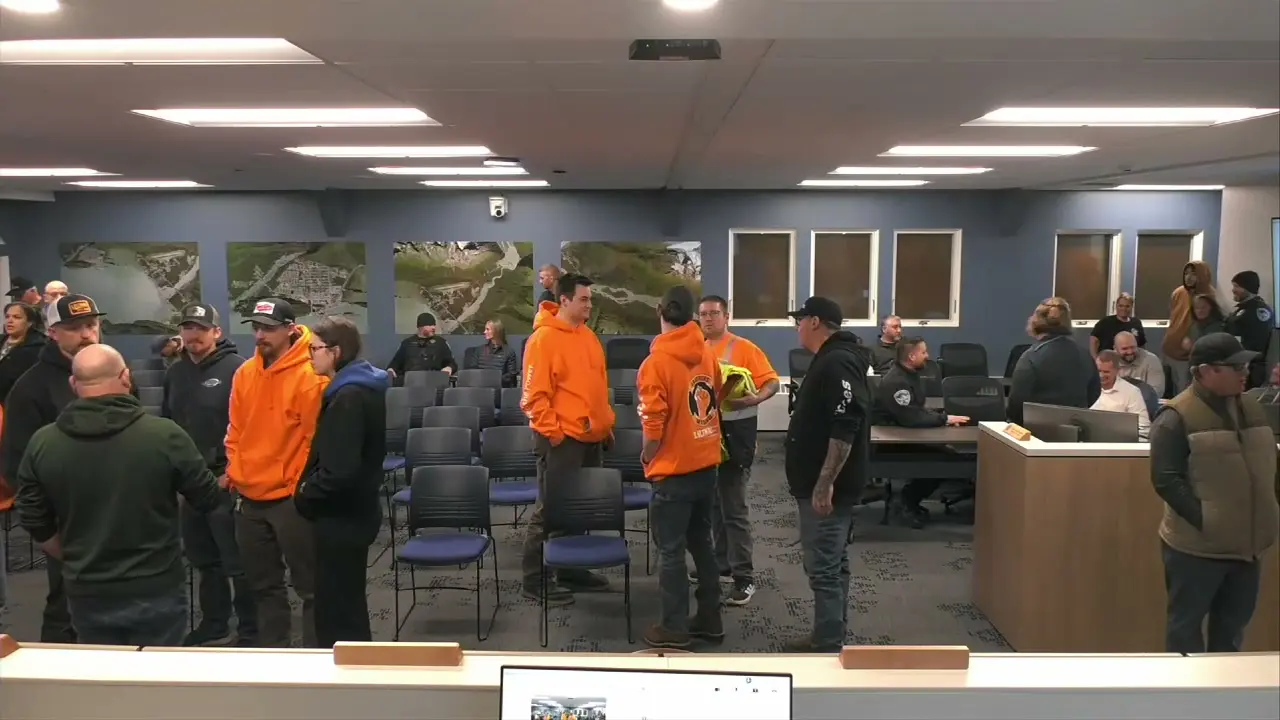
Thank you. Thank you. All right, I'm going to go ahead and call a 10-minute break. I really appreciate everybody that showed up and talked. And again, you can come at the next meeting and speak, those that didn't get a chance to.
Again, this will be continuous until something different goes along, but please, thank you, and it's much appreciated. Thanks.
No audio detected at 1:00:00
No audio detected at 1:00:20
No audio detected at 1:00:40
No audio detected at 1:01:00
No, I can't hear you. But if you guys can hear me, then I can speak full English.
No audio detected at 1:02:00
No audio detected at 1:02:20
No audio detected at 1:03:20
No audio detected at 1:03:40
No audio detected at 1:04:40
No audio detected at 1:06:00
No audio detected at 1:08:00
No audio detected at 1:08:20
No audio detected at 1:08:40
No audio detected at 1:09:00
No problem.
Really appreciate your time. You guys have a great night.
Okay, I'll go ahead and call this meeting back to order.
Um, we will go on to the consent agenda. There are 3 items on the consent agenda. If council members would like to move any of them for new business for discussion, please flag it as I read the title. Proclamation congratulating PST Supervisor Lori Mott. Number 1.
Number 2 is approval to go into executive session, discussion of implications of tax revenues and litigation strategy regarding Trans-Alaska Pipeline System ad valorem tax issues. And number 3, approval of memorandum of agreement between the United States Coast Guard Cutter Blacktip and Valdez Fire and EMS Department. Is there anyone that wish to pull any item off the consent agenda? Yes, I'd like to pull item 3. Okay, number 1.
Okay, and with that, do I have a motion for the rest of the items on the consent agenda? Move to approve. All right, second. Second. I'm sorry, who made the motion?
Olivia Foster. Councilmember Foster moves, second by Councilmember James Devens. I heard 2 seconds. Council Member Devens to approve the remaining items on the consent agenda, or moving item number 3 to be item number 1 under new business.
Okay, that being said, we'll go into the— oh, can I get a vote? And then you'll read them. All those in favor, please say aye. Aye. All those opposed.
We have 6 yes, 1 absent. Council Member Stites, motion carries. Okay, now it gives me great honor to give a proclamation to Lori Mott. Proclamation.
All right, whereas Public Safety Technician PST Supervisor Lori Mott began her career with the City of Valdez as a dispatcher on February 1st, 1995 And whereas PST Supervisor Lori Mott demonstrated exceptional dedication and leadership throughout her career, starting as a Valdez Police Department dispatcher and promoting to PST Supervisor overseeing the VPD dispatch center and jail. And whereas PST Supervisor Lori Mott undertook the challenging task of combining BPD dispatch and corrections positions into one unified operation of public safety technician. And alongside her duties as PST supervisor, Lori Mott continued to serve where needed, filling in as a dispatcher and jailer, further demonstrating her unwavering commitment to public service and leadership. And whereas PST Lori— supervisor Lori Mott single-handedly developed and implemented the Spillman Computer Aided Dispatch system that is the backbone of the Valdez Police Department's daily operations. And whereas PST Supervisor Lori Mock contributed to the community by volunteering several years of her time as a youth basketball coach, providing a positive role model for aspiring female athletes.
No audio detected at 1:12:20
And whereas PST Supervisor Lori Mott was an active member of the Association of Public Safety Communication Officials and National Emergency Number Association. Her involvement with these organizations allowed Valdez Police Department Emergency Dispatch to provide excellent services to the citizens of Valdez. And now, therefore, I, Dennis Fleming, Mayor of the City of Valdez, do hereby congratulate PST Supervisor Lori Mott on her retirement and ask the citizens of Valdez to join the city council and our fellow city employees in recognition over 31 years of Lori Mott's outstanding service to the community.
No audio detected at 1:14:20
No audio detected at 1:14:40
Well done!
So when's the party? Yeah, take care.
Okay, um, we moved the, uh, we at resolution still?
Okay, we're going to go to item number 3, approval of memorandum of agreement between the United States Coast Guard Cutter Blacktip and Valdez, uh, Fire and EMS Department. Do I have a motion? Move to approve.
Second. Second. Let him have it.
Joe Lally.
Okay, it's moved by Council Member Foster, seconded by Council Member Lally to approve a memorandum of agreement between the United States Postcard Cutter Blacktip and Valdez Fire and EMS Department. Okay, council discussion, go ahead. Hi, yes, I'm actually moving to postpone. The memorandum is incomplete. Um, I did a little bit of research and there's actually a 2024 model agreement that specifically outlines, um, the language.
No audio detected at 1:16:20
Um, and so it is missing some mandatory language. Um, and if, uh, if the city manager would like to jump in about what's kind of happening behind the scenes, um, that we're just waiting, I think, on some things.
Yeah, uh, thanks to Council Member Wei for looking into this a little bit. This is the MOU that we've had with the Coast Guard for a number of years, and they just sent it over to us and we thought it could go. However, there is a model agreement for the Coast Guard as of 2024. There is some language in there that is in the required section for the '24 agreement that's not necessarily included in this.
Substantively, having this MOU is not going to having it or not having it, we're still going to respond if there's an issue. But just for the sake of keeping our i's dotted and t's crossed, we're asking the Coast Guard if they would like to use that agreement, if there's some changes that need to be made to this one. Again, because it's their agreement to us, we're kind of putting it back into their court. But there's no harm in postponing this till we get an answer from them because we don't have one at this point. Okay.
Go ahead. What language is missing?
Are you aware? There's some indemnification language. I guess I'll defer to Jake a little bit too. He was a little bit more in depth on the analysis of it, but I believe the indemnification clause was the primary piece. Oh, we have to get a second before we can move it to the floor to discuss it.
I'm sorry.
There hasn't been a formal motion to postpone yet, so go ahead. Okay, okay, sorry. Continue, City Manager Deval. Go ahead, Jake.
Uh, first of all, thanks. I'd like to thank Council Member Witte for, um, researching this agenda item because we weren't aware that there was a new model agreement. Um, the, the real mandatory language at issue has to deal with hazard identification on the vessel and the provision of safety data sheets to VFD. And the guidelines in the model agreement say that the Coast Guard needs to have that in place, so it's their requirement. This MOA didn't have that, so we figured we ought to at least reach out to them, see whether that's mandatory or not in their view.
And, uh, we can fix it if need be.
Thanks, Jake. Sorry, one more time. It's the safety data sheets, and what was the other point that—.
Hazard identification. Hazard identification, which would probably be included in the SDS. In SDS. Well, we call it an SDS. Now.
But yes, MSDS for some. Um, okay, thank you.
Okay, do we have any further discussion? Joe, any further discussion?
Nothing from me, Mayor. So, so I do make a motion to move to Postpone. Need a second. Second. Okay, the motion, uh, it's been moved to postpone by Council Member Witte, second by Council Member Green, and it will be postponed to the first, uh, meeting of December 1st.
We can only postpone to the next regular meeting, so this will appear again on your agenda on December 1st. Um, ask for discussion on that. Any discussion on the postponement?
Go ahead. I'm just curious, are there SDS documents that already exist with the fire department currently? And are you aware of the hazards that exist with the Blackfin, or would those be new compared to those cartons? We have everything on the plan. Okay, so you have the SDS as current, and if you didn't, they would give it to you every year?
Annual training with them. Okay, thank you. Yeah, from a practical perspective, I believe we're checking all the boxes that are required. It's just not specifically outlined in the, in the agreement.
Hey, is there any potential for issue from postponing, or is that probably fine? Is the Coast Guard going to be upset at us if we postpone this? If somebody calls 911, we respond.
Okay.
All right, call for the vote. All those in favor, please say aye. Aye. Aye. All those opposed?
Aye. Is this on the motion or is this on—. No, no, this is on the motion to postpone. Nay. Okay, you're changing your vote?
I'm, I'm, I'm, I'm voting nay. Nay. Okay. Yeah, so we have, uh, 5 yays, 1 nay. The nay is Council Member Foster.
1 Absent. Councilmember Stites. Motion carries on the postponement. Okay, moving on, moving on to resolutions. Uh, two resolutions to consider for tonight.
Uh, 2554 or 2654, requesting the Governor of the State of Alaska designate by proclamation the area of Prince William Sound pink salmon fishery and any other applicable pink salmon fisheries as an area impacted by economic disaster in 2026 and supporting a recovery plan for affected fishermen. Motion to approve. Second.
Moved by Councilmember Devens, second by Councilmember Green to approve Resolution 2654. Is there any discussion? Go ahead. I just had a question. So I was looking over this and Alaska statute 4433.285 requires a recommendation from the Commissioner of Commerce, Community and Economic Development, and an income analysis to establish statutory criteria.
Has that all been met?
So this proclamation is what goes to the Department of Commerce. The context, I think it's the fifth whereas down, like about the earnings and the projections. That's what is going to satisfy that requirement. So just— you just included that section. You didn't do a full analysis?
No. So what they'll end up doing is they'll end up going through and doing a more in-depth analysis on what the impacts are. Okay. So that's why it goes to them prior to going to the governor, is we make the recommendation, they do the analysis of the real and actual economic impacts. And then the governor makes the determination and finds any money.
Perfect. Thank you for that clarification.
Um, have we reached out and requested a parallel resolution from the other municipalities within Prince William Sound?
I have not specifically done so, no. Can we do that? Uh, we certainly can. Uh, I would say that the local fishery was impacted to a greater extent than some of the other pink salmon fisheries, and that's why it's— while it is Prince William Sound, it's pretty well targeted towards the FDA. Fair enough.
Go ahead, Lester. I would like to see this move forward with this. I think this is the right call. You know, it was a devastating season this last year. Impacted the fisheries, our fishermen, canneries, and this town.
And I'm happy to see this motion or resolution move forward. Thank you, Mayor.
Councilmember, Councilmember Devens, we could certainly send this to Cordova. That would probably be the closest. I mean, that would—. Yeah, I'm just having a recollection of the last time we did an almost identical resolution. Cordova asked us for a parallel resolution, if I'm remembering correctly.
So I think, you know, we could probably reflect that back at them, and I think they'd probably be happy to support us. Yeah, send it to the clerk. Certainly. Okay, call for the vote. All those in favor, please say aye.
Aye.
All those opposed? We have 6 yeas, 1, um, absent, Council Member Steik. Motion carries.
Okay, uh, call for the vote— or sorry, um, Resolution 2655, providing for the submission to the qualified voters of City of Valdez, Alaska, the question of incurring general obligation bond indebtedness in an amount not to exceed $32 million for capital improvements to public city public works infrastructure consisting of a new solid waste baler facility, a water line serving the Valdez Container Terminal, rural roads improvements identified in the city's rural roads assessment, including improvements in the Corbin Creek subdivision and other city rural road areas and reimbursements of cost of the Mills Avenue improvements at a special election to be held in the city Tuesday, February 2nd, 2027. Council discussions? Move to approve. Sorry, yes, second.
Foster, a second.
Councilmember Foster, second by Councilmember Witte, to approve Resolution Number 2655. Okay, now council discussion.
Seeing none, um, call for the vote.
All those in favor, please say aye. Aye. All those opposed? We have 6 yeas, 1 absent, Council Member Stites. Motion carries.
Okay, we have one, uh, report, which is the contract amendment report, professional service agreement with Dow LLC for construction administration services, pavement management, Phase 4, Neals Avenue. Do we have anybody that wants to discuss that?
Go ahead. Um, yeah, I just had one question. It was, um, it kind of talked about construction costs that are remaining while work is completed in 2027. Do we have any idea what those costs will be?
I guess clarify, as far as construction costs? Yeah, it, it mentioned, um, that there were anticipated additional construction administrative costs in 2027. Uh, some of that is based on the fact we don't have a completion schedule yet from the contractor, and so it's somewhat unknown what, how, and when they'll be done in '27. So this was to get us through the end of this year, um, the first part getting ready and prepared for the beginning of next season, but there is still an unknown whether or not it's gonna be done when say they're going to be done. Sure.
No audio detected at 1:28:40
Okay, thank you very much. Okay, moving on to reports. We have the city manager, city clerk, city attorney, and mayor's report, uh, starting with the city manager report.
Uh, thank you, Mayor Fleming.
Um, I guess, uh, you had the public hearing on the budget. That's kind of a big deal. Um, it'll be at the next meeting. Um, myself, Council Member Stites, and the mayor will not be. I'm going to do my best to patch in online, um, but, uh, certainly if there are any questions or comments from the, from the public, they're more than welcome to come and reach out and ask any of those.
No audio detected at 1:29:20
If you all need any additional clarification that you didn't get, feel free to, to come and ask as you prepare for that approval at the next meeting.
You know, a huge thank you to Lori Mott. She's been an integral part of what dispatch is for a long time, and her knowledge and leadership will be hard to replace. So I'm excited for her to— I don't know what Dan's going to do with somebody in the passenger seat of his motorhome, but I hope they'll have a good time together.
We've been making pretty good progress on the primary home exemptions. Our target, we think, somewhere between 900 and 1,000 applications. And so we're chipping away at it. Fortunately, we do know most folks who have received that in the past. And so we'll continue to market broadly.
And then as things get closer down to the wire, we'll start knocking on the door or whatever we need to do to get them to apply.
Just a couple of things that have been languishing out there. We've had some good updates on the Valdez Alerts initiative, I guess you could say. It's come full circle of where we were to where we're headed. We're making good progress with that so that people can receive notifications in the event of emergency or other types of disasters. We do have tools in place currently, but it's, Trying to upgrade those and get a little more functional is part of the process.
A thing that was interesting is that Providence, Valdez was recently— we're a tsunami-ready community. We have that title, that designation, and Providence was recently labeled a tsunami-ready supporter. So that's a pretty good accomplishment for them as an organization to meet that criteria. It's a nationwide credential, if you will. And so the fact that they're emergency management and planning is putting them in that place is a very good thing for our community.
Um, yeah, I'll just— I'll let my, my report stand. Uh, if you have any questions, um, I guess I think I've mentioned this in the past, we do have a new Public Works Director who is coming. He's still anticipated to be here the first week of January. He'll be officially moving his stuff sometime in December, but he's scheduled to come to work. Daniel Court is his name.
He's coming out of Homer, is where he's coming from. But I thought I'd mentioned it, but somebody said I hadn't, so I'll do that now. And then just keep an eye out on your email for, for my injuries evaluation. That's it for any questions you may have. Any questions?
All right, seeing none, we'll go to the city clerk report. Um, okay, um, just a reminder that this coming Saturday is our boards and commissions dinner. Um, doors open at 6:00 and, uh, dinner will be served at 7:00. Um, it's going to be just sort of a casual affair this year. We're going to recognize a couple of our longtime boards and commission members for their service, um, and I'm going to do a little bit of government trivia, um, so we'll have a little bit of fun, have a good dinner, and recognize some well-deserved boards and commission members.
So please come and bring a guest.
I received an email from Karen Kirk, and she just wanted to remind the council that during your strategic planning, you talked about working on your vision statement in February. And so she's just checking to see if you're still interested in doing that. And if you are, then she's looking to reserve a couple days in her calendar to do that.
So she just wanted me to reach out to you. She is suggesting that maybe before, if you are still interested in doing that, maybe before we do it, that we do a little bit of public outreach and poll the community, she says, to see what their interests in what their vision, the community's vision, is for the city, so that you have that to work with as well. So any feedback from—. I would like to see that. I like the idea of having input feedback from the community.
Are you interested in doing that in February?
Jimmy. Okay, 3, 4. Joe. Yes, yes. Okay, um, all right, um, so I'll get back, uh, with Karen and then I'll get back with you all too, um, on maybe, um, some, some dates, see how long she thinks it'll take.
Probably just maybe a day. So, um, I'll get with Karen and then, um, I'll work with Nate and we can work with Sarah to maybe do as she suggests and do some work with the community beforehand. Okay, great. And then again, as Nate said, if you're having any trouble, Rhea wanted me to remind you, of course, of the Nate and I's evaluation and to let you know that if you're having any problems accessing NeoGov, please just let her know and she'll, she'll help with that. I know, Joy, you've already completed yours.
I saw that come through. So just a reminder. And I think, I think that's it. That's all I have for you. Okay, Jake, City Attorney report.
Thank you, Mayor Fleming. We have an executive session this evening and we intend to discuss a substantive update in that. We did provide a written legal update that includes mostly procedural things. I'd be happy to stand for any questions on that, but I don't intend to address them in open session here.
Anybody got any questions? All right, Jake, you're off the hook. Nobody's got one. Okay. And Mayor Fleming, before I go here, we'd ask that you sit in for this executive session It has to do with a subtopic that we don't believe presents any conflict of interest.
So we'd ask that you please stay.
Okay. Okay, moving on to, uh, City Mayor's report. Um, I just wanted to take a moment to congratulate Lori on a very, very lucrative and successful career. Um, she's been around forever. My daughters went to her to play basketball.
Um, family friend. She's great. So it's really good to see somebody, uh, be able to retire and spend some time with her husband. Um, with that also being said, our girls took 5th in state for volleyball this year. Um, they went in ranked 7th and came out ranked 5th.
So very good on their part. Um, so with that, we'll go to, uh, council business from the floor, starting with Lester. All right. I'd also like to congratulate and thank Lori Mott for her many years of dedicated service there, not only to the— sorry, not only to her professional position, but more importantly to the community. Very much appreciated.
No audio detected at 1:37:20
Also, I'd like to thank the library, DL and library staff members for a fantastic book basket auction that took place last weekend there.
Incredible different arrangements were made. A good time was had and a good fundraiser. And I still, I strongly believe we are very, very fortunate to have a caliber of library like this in our community. And it serves, you know, ages from toddler to well beyond my age. So my hat's off to them and I thank you, thank all of the community for supporting that effort.
No audio detected at 1:38:00
That's all I got. Go ahead. Veterans Day occurred and I just wanna do a big shout out, say thank you to everyone that has served our country. We are in your debt and especially to staff members that were previously serving. Thank you so much for your service.
And I also want to say thank you to all the individuals that came out tonight to talk to us and make us aware of the situation. It was eye-opening, and I'm very grateful that they came out to inform us and talk to us about a potential change in our community. And to all the families here. So thank you to them.
I guess I'd just start by echoing what everybody else said. I would also like to congratulate Lori. I would also like to thank the library staff, board, and volunteers for their hard work on the book basket auction. I'd like to thank our veterans. I'd also like to thank the members of the 5 trade unions who took time out of their day to come down and speak to speak to us.
I think that took a lot of organization and courage to reach out to us on an important issue, so I just wanted to make sure that they got recognition for that as well. Olivia, I'd like to quote a Led Zeppelin song here, Communication Breakdown. I'd sing it for you right now, but I'm not sure everyone would appreciate that. But this week was filled with, you know, outlook went down. I know that impacted my industry, and it probably impacted a lot of industries.
No audio detected at 1:39:40
And then our air traffic control centers went down because of a piece of software that was added. So I think, you know, it just reassures or reincent— or sorry, it makes us realize how important communication is. Thank you, Sarah. You are the communications person. And I looked at you and I was like, yes, that's what I mean to say.
But communication is important. And And so I do appreciate, like you said, Jimmy, and other council members, that our 5 trades unions came in this evening to share their stories. I'm always interested in people around town whose faces I've seen like so many times, but I don't know their stories. And that is important to me. And it is important that we keep jobs here locally in Valdez.
And it is important that people have a retirement and that they have benefits. And so, you know, I, I don't know what the possibilities are for the city to do or how we communicate with Alyeska or what— I don't know what Alyeska's decisions or what prompted this change and how, why this occurred. Um, but I do know that the people that showed up here tonight are members of our community, and, um, I see a call to action, and I think that we as a council have to step up to that call that we've been asked to step towards. And, um, I know that we— we— I don't know, we— if we can discuss it, that would be great. I don't know how we would do that, but, um, I know that they're going to— a couple members from the union are going to return to our next council meeting.
And Nate, I know you'll be out, but I don't know if I need to call you offline and maybe talk to you offline and kind of figure out what can be done for this. I know it's a private industry, but I really empathize with these folks that came in tonight. And, um, yeah, happy Veterans Day. Thank you to everyone who has served in our country. We have a huge Coast Guard contingency here, and, um, yeah, putting your life on the line like that, it is a big deal.
And I, I'm grateful for the freedoms that I, that I have today because of the veterans who have served and continue. Thank you. Yeah, hey Joe, do you got anything for us? Sure, Mayor, thanks. Um, I just wanted to also congratulate, um, Lori Mott and wish her well in her retirement.
And, uh, I wanted to thank the presenters, uh, tonight, uh, the ones that provided the information, the 3 presenters on the high school renovation project. I also wanted to thank or recognize the people who testified, the, uh, the union members that, uh, had the courage to speak up and tell their stories, like, uh, Councilmember Foster talked about. And, um, I also wanted to, uh, thank everyone within the city that worked on the budget that, you know, came before us tonight and was discussed. So, um, And thanks for everybody recognizing Veterans Day. That's it for me.
All right, thanks, Joe. I'm going to direct the city manager to reach out to Alyeska and see if there's something that we may be able to do to, you know, also hear from them, but maybe something that we can do also that we get both sides, and, uh, we can understand what that situation is. So, uh, we'll have him reach out, uh, to Alyeska and, uh, see what, uh, comes out of that. Go ahead. Um, and Council Member Foster, I guess we were, um, uh, of course we had a room full of people tonight, and, and it was, it was, um, it was rather unexpected.
I think we kind of had a communication break on what meeting that they were planning on coming. We thought it would be a future meeting instead of tonight.
But so I know, you know, we always hate to not give everyone the opportunity to speak.
And so some options that the council has, maybe if we get some more information Alieska's side of the store, whatever, is that you could also at some point, you know, hold a town hall type of a meeting and where it would be just dedicated to, you know, people having that opportunity to speak to the matter. So that is an option for you before you take, you know, like any formal type action. So I'm just throwing out some options. I'm open to a town hall to let everybody have an opportunity to speak, but I don't need a town hall to know that we need to write a resolution and express our concerns. So yeah, that's my thought.
Yeah, I just, as the mayor said, I don't, I don't, I don't think you I think, Alyeska, you've not heard, heard from them either. So maybe, as Nate said, he'll reach out to them and see if they're, they're interested in sharing information with us as well. But I guess just to add to it, it would be helpful. I know it's kind of becoming travel season, and so if you all could pass along your availability for any off-night or special meeting scenarios, that would be exceptionally helpful as I try to coordinate some of this.
Yeah, with Alaska Municipal League and Washington, D.C., we're probably looking at the free week would probably like be the week of the 14th of December. So, and that doesn't mean that, you know, Sheri's looking at the calendar and everything, but if we can reach out to Alyeska, they've got some other dates we can call, you know, talk about it and maybe even have a special meeting if we need to, you know, to decide and talk about this. So there's all kinds of options. Yeah. With that being said, kind of one last thing before we go and call this meeting adjourned and go into executive session.
Jordan, I really appreciate all the work you did on the budget and everything, and I'm sorry it kind of got blown out of the weeds there to where it wasn't really a big fanfare thing going on. So sorry about that. It's a record for public attendance. All right, thank you. Meeting adjourned.
Return to executive session. Moving to executive session. Thank you, Mayor. I just haven't done one of those in a while, so But I've been working at it. Right on.
Okay, I got two grandkids. I want to, I want to, I want to spend more time with them and keep up with them while I'm doing it. Good luck with that.
Okay, regular session, uh, meeting adjourned. There we go. Good night.