Quoted moments from Alaska public meetings, hearings, and press conferences.
Brock Wilson
“by and large, the set of people that have left have come from the Department of the Interior, the Department of Agriculture, Department of Commerce, the Department of Transportation. Those are the set of agencies that are seeing workers leave. When we look at the type of jobs for those people, they are in biological sciences, they're in maintenance, they're in physical sciences. So these are jobs that are not in administrative roles but are generally more in field jobs.”The Impact of Federal Dollars On Alaska’s Economy - 6/23/26 · Jun 26, 2026
Brock Wilson
“Alaska has seen the largest reduction, particularly due to the Deferred Resignation Program, that a large component of who is taking— who is leaving are those that were taking the DRP. When we're thinking about this DRP, these are workers that are relatively experienced. These are workers that have had approximately 10 years working for the federal government.”The Impact of Federal Dollars On Alaska’s Economy - 6/23/26 · Jun 26, 2026

Brett Watson
“between 2015, the start of the Alaska recession, and 2023, this is the most recent year that we have really good data for federal spending apportioned across states. Federal spending grew by about $8.7 billion in nominal terms”The Impact of Federal Dollars On Alaska’s Economy - 6/23/26 · Jun 26, 2026
Brock Wilson
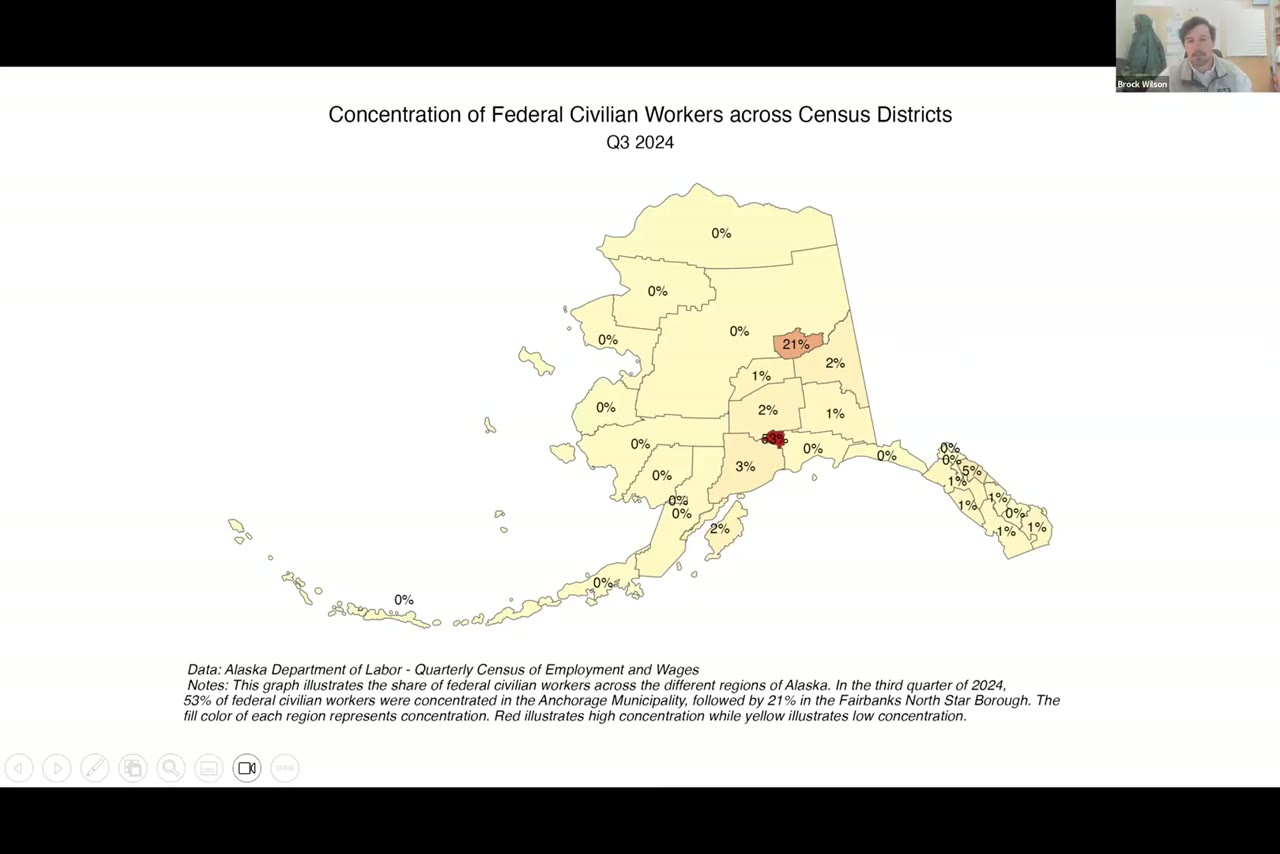
“when you look at rural counties, they are more reliant on the federal workforce than urban centers. The Denali, for example, a large component of their GDP is the federal workforce. So changes that, you know, these national-level changes are going to be falling harder on these rural parts of Alaska, given that they're more reliant on the Alaska federal workforce.”The Impact of Federal Dollars On Alaska’s Economy - 6/23/26 · Jun 26, 2026

Bob Loeffler
“federal government is the most important industry, if you will, that brings money in.”The Impact of Federal Dollars On Alaska’s Economy - 6/23/26 · Jun 26, 2026

Brett Watson
“Many regional economists have often commented that Alaska's economy is a bit like a three-legged stool, that there's kind of three pillars that support the rest of our, the rest of our economy. Bob described that metaphor as a bucket in which industries like the oil and gas industry, the federal government, and kind of all of our other basic industries bring new money into the state.”The Impact of Federal Dollars On Alaska’s Economy - 6/23/26 · Jun 26, 2026

Brett Watson
“federal spending over the last 10 years has grown by approximately $9 billion.”The Impact of Federal Dollars On Alaska’s Economy - 6/23/26 · Jun 26, 2026

Brett Watson
“I was presenting data from 2023 because that's sort of the latest data that we have available to us to see what actually got spent”The Impact of Federal Dollars On Alaska’s Economy - 6/23/26 · Jun 26, 2026

Brett Watson
“if you think about the difference in our GDP between 2015 and 2023, our state's economy grew by $16.5 billion. Well, federal spending grew by just under $9 billion, meaning half of the growth in our total GDP, both our basic GDP and all of our non-basic GDP, all the money sloshing around in the bucket, not just the new money coming into the bucket.”The Impact of Federal Dollars On Alaska’s Economy - 6/23/26 · Jun 26, 2026

Brett Watson
“Around half of the growth in our total GDP, half the water in the bucket was federal spending growth. And I think that that's, that's pretty significant, especially if you compare it to some of our other key basic sector industries. For example, oil and gas, which Bob mentioned, is kind of our second largest basic sector industry in the, in the state.”The Impact of Federal Dollars On Alaska’s Economy - 6/23/26 · Jun 26, 2026

Brett Watson
“we do have a better picture of what's been going on on the federal employment side. How has the Deferred Resignation Program impacted federal employment? What about reductions in force?”The Impact of Federal Dollars On Alaska’s Economy - 6/23/26 · Jun 26, 2026

Brock Wilson
“this is me providing that information again across all states. We are third highest in reliance on the federal workforce. The only two above that are Maryland and Hawaii.”The Impact of Federal Dollars On Alaska’s Economy - 6/23/26 · Jun 26, 2026

Brock Wilson
“over $1.5 billion is federal civilian wages paid to Alaskan federal workers, and that's approximately $100,000 per job. So these are high-paying jobs. There's approximately 15,500 federal workers living in Alaska, and across all states, we're the third highest share of federal workers in a state's workforce.”The Impact of Federal Dollars On Alaska’s Economy - 6/23/26 · Jun 26, 2026

Brett Watson
“Federal spending grew by $8.7 billion from just, just under $11 billion in federal fiscal year 2015 to just under $19, just under $20 billion in federal fiscal year 2023.”The Impact of Federal Dollars On Alaska’s Economy - 6/23/26 · Jun 26, 2026

Brock Wilson
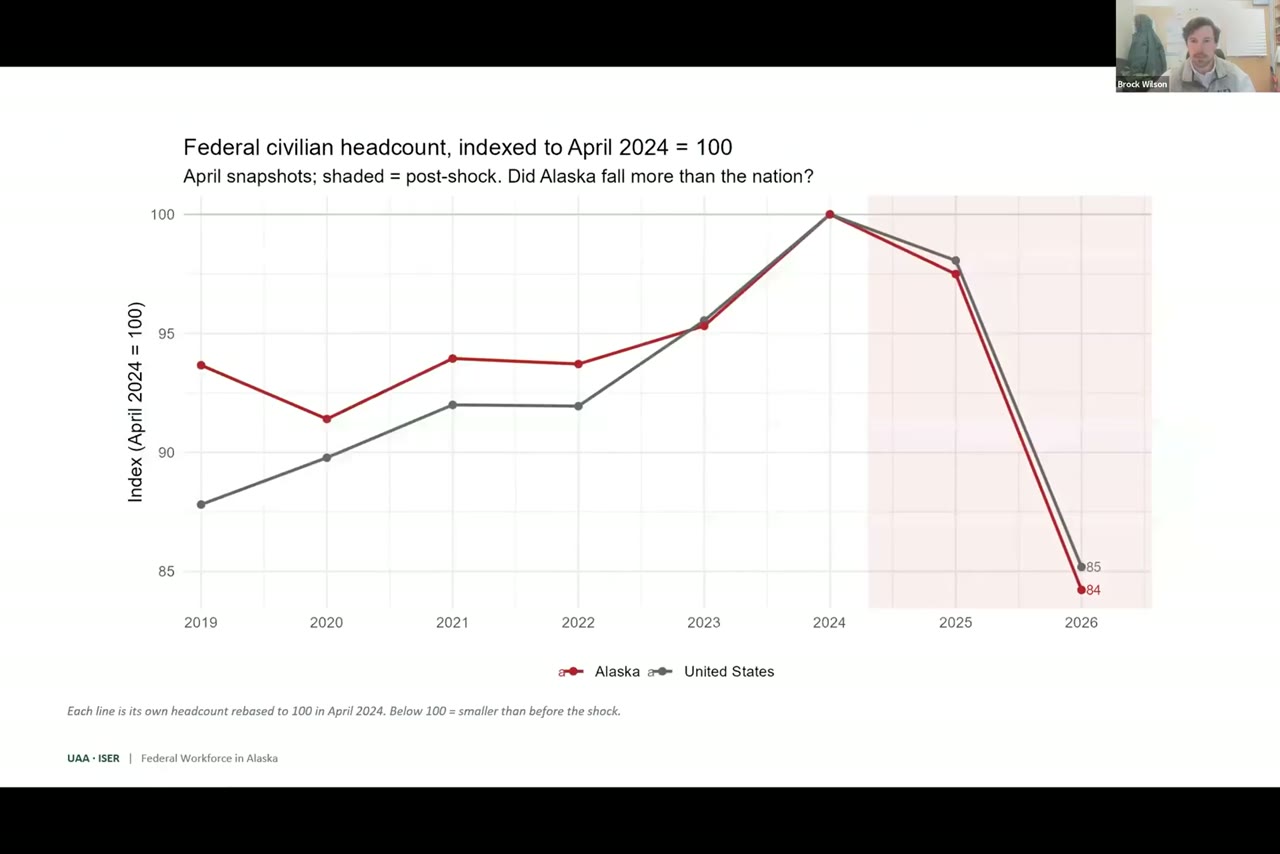
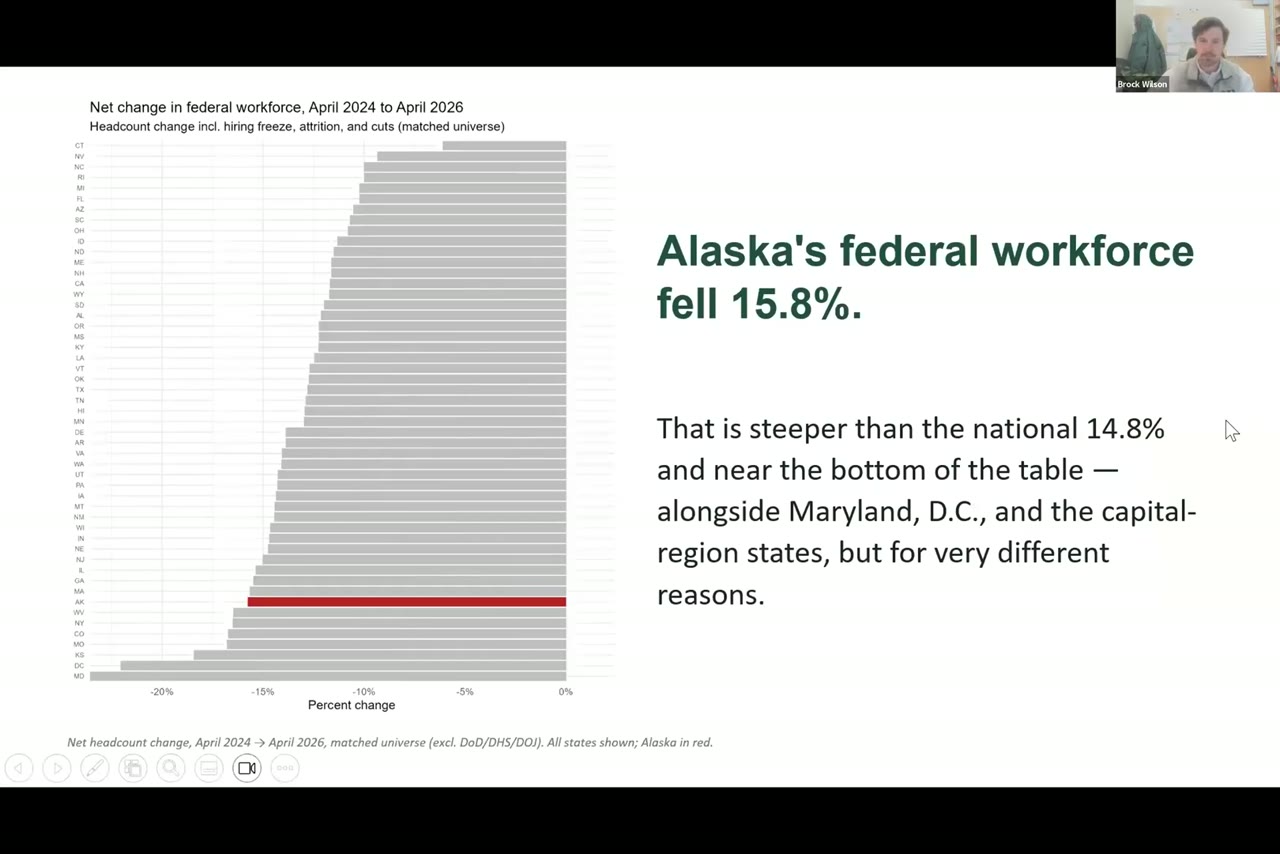
“between April 2024 to April 2026, we've seen across the entire nation a 14.8% decline in the headcount of the US federal civilian workforce. There's a large decline. Alaska specifically has seen a 15.8% decline. So we are seeing a larger decline than most other places.”The Impact of Federal Dollars On Alaska’s Economy - 6/23/26 · Jun 26, 2026

Brock Wilson
“I think broadly the way I'm sort of characterizing this is like the Capital Area, and then Alaska, right? We are— we're particularly reliant for federal workers.”The Impact of Federal Dollars On Alaska’s Economy - 6/23/26 · Jun 26, 2026

Brock Wilson
“by April 2026, we've taken a larger loss. That is this, the red line. And I think one thing to sort of caveat here or start with is if we look at sort of prior to April 2024 and we look at the trend upwards, we can see that the nation saw larger growth in federal jobs compared to Alaska.”The Impact of Federal Dollars On Alaska’s Economy - 6/23/26 · Jun 26, 2026
Brock Wilson
“this is now showing that sort of by state, which states took the larger, the largest declines in the federal workforce. And here we can see Alaska is quite high in that, probably about the 8th largest decline.”The Impact of Federal Dollars On Alaska’s Economy - 6/23/26 · Jun 26, 2026
Brock Wilson
“when we look at the reduction in force, the probationary termination, and the buyouts collectively, at a national scale, by far the buyouts are what have caused the largest decline in the federal workforce. That is, we're talking about at a national level here— in one month, approximately almost 75,000 to 80,000 workers suddenly leaving”The Impact of Federal Dollars On Alaska’s Economy - 6/23/26 · Jun 26, 2026
Brock Wilson
“Alaska did not see a large share of their workers cut. This is more so the case for places like D.C., Maryland, more capital-centric areas. Alaska did not experience a large cut to the workforce due to the RIFs or the probationary firings.”The Impact of Federal Dollars On Alaska’s Economy - 6/23/26 · Jun 26, 2026

Brock Wilson
“prior, there's some, you know, baseline workers that are being hired in the offseason. And we can see that that offseason hiring has declined significantly. But also we're seeing lower peaks for the seasonal workers that we're bringing in.”The Impact of Federal Dollars On Alaska’s Economy - 6/23/26 · Jun 26, 2026

Brock Wilson
“we're talking about park rangers, biological science technicians, maintenance mechanics, forestry technicians. These are sort of the jobs that have, you know, direct implications for their particular field for what they were doing.”The Impact of Federal Dollars On Alaska’s Economy - 6/23/26 · Jun 26, 2026

Bob Loeffler
“So we have 5 of our 12 were in the top 10 contractors for defense.”The Impact of Federal Dollars On Alaska’s Economy - 6/23/26 · Jun 26, 2026

Bob Loeffler
“if you look at the employees from federal facilities, if you will, Denali National Park, Glacier Bay National Park, people around the bases, they may have a different— some of them may be leaving Alaska. We don't know.”The Impact of Federal Dollars On Alaska’s Economy - 6/23/26 · Jun 26, 2026

Brock Wilson
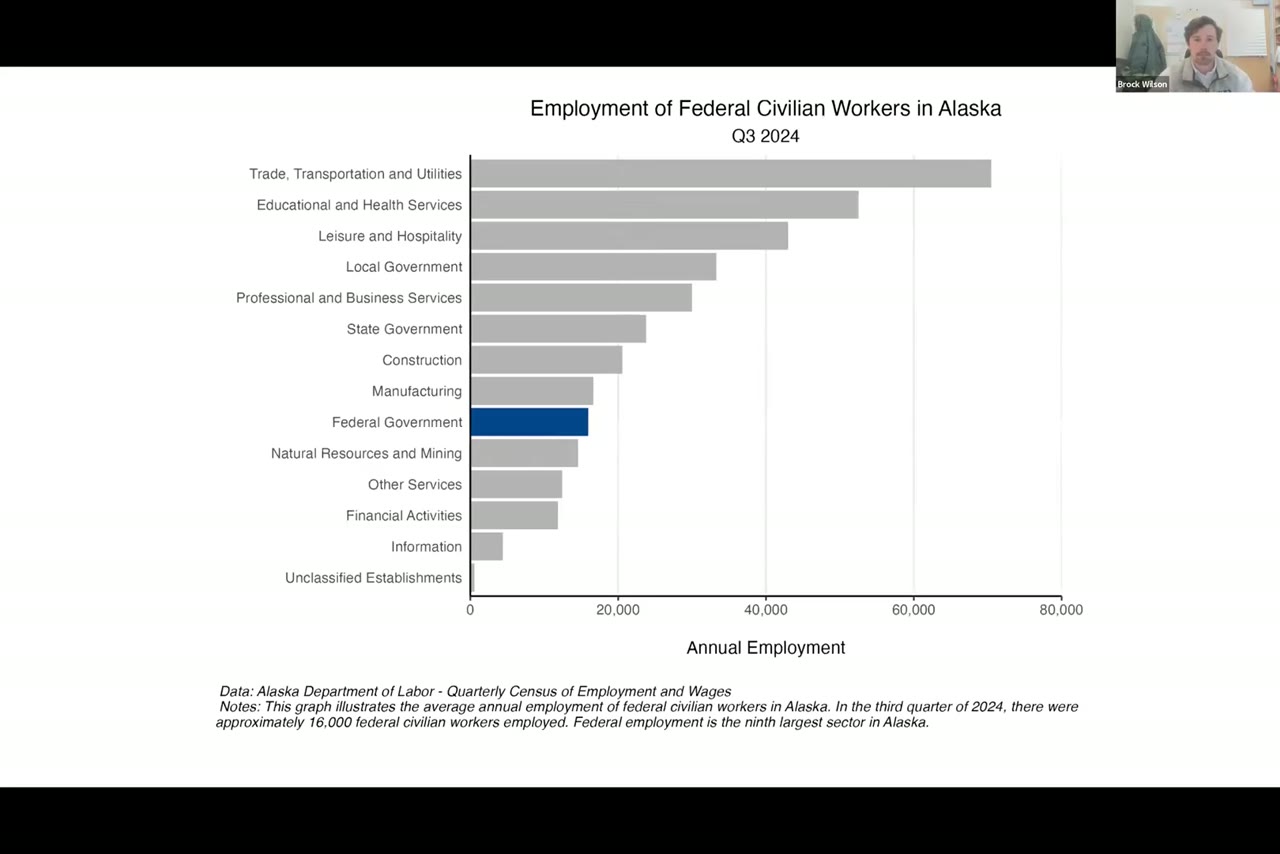
“the federal government is 9th largest. This is as of 2024 Q3, is 9th largest in employment across all these sectors. But when you look at the average salary of those of federal workers, it's quite large. It's the third highest. And as I had said earlier, they're making approximately $100,000 annually.”The Impact of Federal Dollars On Alaska’s Economy - 6/23/26 · Jun 26, 2026

Brett Watson
“either way you calculate this contribution of the oil and gas industry, it's grown over this time period between $3 and $4.5 billion. Or less than half of the growth in federal spending over the same time period. What about for some of our other key basic sector industries like the hard rock mining industry or the fishing industry? Well, the fishing industry over this time period grew by about a quarter billion dollars while the hard rock mining industry grew by just under a billion dollars.”The Impact of Federal Dollars On Alaska’s Economy - 6/23/26 · Jun 26, 2026

Brett Watson
“probably the biggest category of growth though across all of these spending categories grew 150%, uh, was federal spending in contracts. So contracts are spending that the various federal agencies engage in. The largest federal agency that spends money in the state of Alaska is the Department of Department of Defense.”The Impact of Federal Dollars On Alaska’s Economy - 6/23/26 · Jun 26, 2026

Brett Watson
“Just under $20 billion of federal spending in 2023. Let's compare that to the total size of the Alaskan economy in using gross domestic product as, as the denominator here. Alaska's gross domestic product in 2015 was $51 billion, and in 2023 that had grown to $68 billion. And so federal spending accounted for just under 30% of our 2023 total GDP.”The Impact of Federal Dollars On Alaska’s Economy - 6/23/26 · Jun 26, 2026

Brett Watson
“we're now— we have now a pretty good picture of what the federal workforce was up to. But that's only one important but small component of aggregate federal spending in the state.”The Impact of Federal Dollars On Alaska’s Economy - 6/23/26 · Jun 26, 2026

Brock Wilson
“I think for me, one of the frames that I carry is that I would think about the federal workforce as potentially a complement to our base, to our industry, rather than a substitute. For example, you know, cruise ships bring in people, those people go to Denali, and the complement being that if Denali no longer has park rangers, people don't go to Denali because there's no ability to get basic access”The Impact of Federal Dollars On Alaska’s Economy - 6/23/26 · Jun 26, 2026

Peter Micciche
“This is a condensed facility that will receive every borough service at a very large proportion to the neighboring neighbor, to the neighbor next door who's going to be paying $9,000. Okay, first bill is $2,000, quarter of what the neighbor's paying”Taxes and the Alaska Gas Line: The Fiscal Questions Behind AK's Energy Future · Jun 9, 2026

John Sims
“Because of the cold temperatures, NStar was short on gas. And so we reached out to Hilcorp and luckily they were able to deliver an additional half BCF of gas during the month of March. That came at a cost of $16 per MCF.”Taxes and the Alaska Gas Line: The Fiscal Questions Behind AK's Energy Future · Jun 9, 2026

John Sims
“The Hillcorp contract is down there at $8.36. There is an annual inflator, so it's not going to stay at that rate for the entirety of the contract. We expected about a 1.5% increase over the duration of that contract.”Taxes and the Alaska Gas Line: The Fiscal Questions Behind AK's Energy Future · Jun 9, 2026

Brett Watson
“over the last 10 years, Pacific LNG prices, which is the market that we would be purchasing gas from, have ranged between about $5 to $15 per thousand cubic feet in what I would call sort of normal time periods.”Taxes and the Alaska Gas Line: The Fiscal Questions Behind AK's Energy Future · Jun 9, 2026

Brett Watson
“In 2033, when all of NStar's contracts have expired,, we're probably facing around $15 per MCF gas.”Taxes and the Alaska Gas Line: The Fiscal Questions Behind AK's Energy Future · Jun 9, 2026

Brett Watson
“estimates from NSTAR suggest that in addition to the purchasing the commodity on the spot market, we'd need to pay an additional dollar or so per MCF to ship that gas an additional $3 to $5 on top of that to build the infrastructure to receive that gas and regasify it from its LNG form. So kind of all-in costs from this no-project case represent gas prices somewhere in the neighborhood of $9 to $21.”Taxes and the Alaska Gas Line: The Fiscal Questions Behind AK's Energy Future · Jun 9, 2026

Matt Kissinger
“pursuing the loan guarantees with the federal government, getting lower gas prices and addressing the property tax imbalance”Taxes and the Alaska Gas Line: The Fiscal Questions Behind AK's Energy Future · Jun 9, 2026

Matt Kissinger
“even with relief, we'll still be sort of 5 times higher than LNG Canada in our property taxes”Taxes and the Alaska Gas Line: The Fiscal Questions Behind AK's Energy Future · Jun 9, 2026

John Sims
“Looking over a much shorter time frame from 2010 to 2026, you can see that that's dropped from about 350 million cubic feet a day down to right around 200 million a day. Again, how this relates to NSTAR in the wintertime when we need it the most, NSTAR's annual— or excuse me, daily peak is right around 320 for gas that we have to make sure that we have available to our customers.”Taxes and the Alaska Gas Line: The Fiscal Questions Behind AK's Energy Future · Jun 9, 2026

Matt Kissinger
“we were sort of 10 times order of magnitude higher than any of these other jurisdictions”Taxes and the Alaska Gas Line: The Fiscal Questions Behind AK's Energy Future · Jun 9, 2026

John Sims
“Well, they didn't do 185 wells, they did 192 wells, and they've spent over $1.5 billion over that time frame, again, to make sure that Cook Inlet customers, both on the natural gas side, on the electric side, had energy.”Taxes and the Alaska Gas Line: The Fiscal Questions Behind AK's Energy Future · Jun 9, 2026

John Sims
“The predominant activity is from Hilcorp, which is one of the reasons why NStar is so concerned about them kind of slowing down production and moving their investments other— other places is because there's no one else in Cook Inlet that has the balance sheet to be drilling 192 wells over a 10-year period.”Taxes and the Alaska Gas Line: The Fiscal Questions Behind AK's Energy Future · Jun 9, 2026

Peter Micciche
“please wrap up Phase 2 ASAP with Phase 1. That divorce has made us very nervous”Taxes and the Alaska Gas Line: The Fiscal Questions Behind AK's Energy Future · Jun 9, 2026

Cathy Giessel
“We were given the legislation for this project on March 20th. That's 2 and a half months ago”Taxes and the Alaska Gas Line: The Fiscal Questions Behind AK's Energy Future · Jun 9, 2026

Cathy Giessel
“The Senate Resources Committee, since March 20th, had 36 hearings in less than 2 months on this”Taxes and the Alaska Gas Line: The Fiscal Questions Behind AK's Energy Future · Jun 9, 2026

Cathy Giessel
“we looked at capping the price of gas to consumers. We looked at not allowing any cost overruns to be put on taxpayers, onto consumers, Alaska consumers”Taxes and the Alaska Gas Line: The Fiscal Questions Behind AK's Energy Future · Jun 9, 2026

Cathy Giessel
“What if it stops with only Phase 1? We want a limit on how long the tax abatement the forgiveness, the elimination of those property taxes go”Taxes and the Alaska Gas Line: The Fiscal Questions Behind AK's Energy Future · Jun 9, 2026

John Sims
“The biggest difference between no project and Phase 1 is really the volatility that you'll see on the LNG import market. So, you know, you can look at JKM futures and get sort of an indication as to what the market thinks they may be. But the reality is, when you look at those futures versus what they actually were, there's an enormous amount of volatility that happens on the LNG market”Taxes and the Alaska Gas Line: The Fiscal Questions Behind AK's Energy Future · Jun 9, 2026