U.S. Attorney warns violence against Alaska officers is rising
A felon resisting arrest fired a weapon during a struggle with Alaska officers. The bullet passed through the suspect's hip and struck an officer in the knee. U.S. Attorney Michael Heyman used that case Wednesday to anchor a warning at a statewide memorial ceremony: violence against law enforcement is rising, and much of it is no longer making the news.
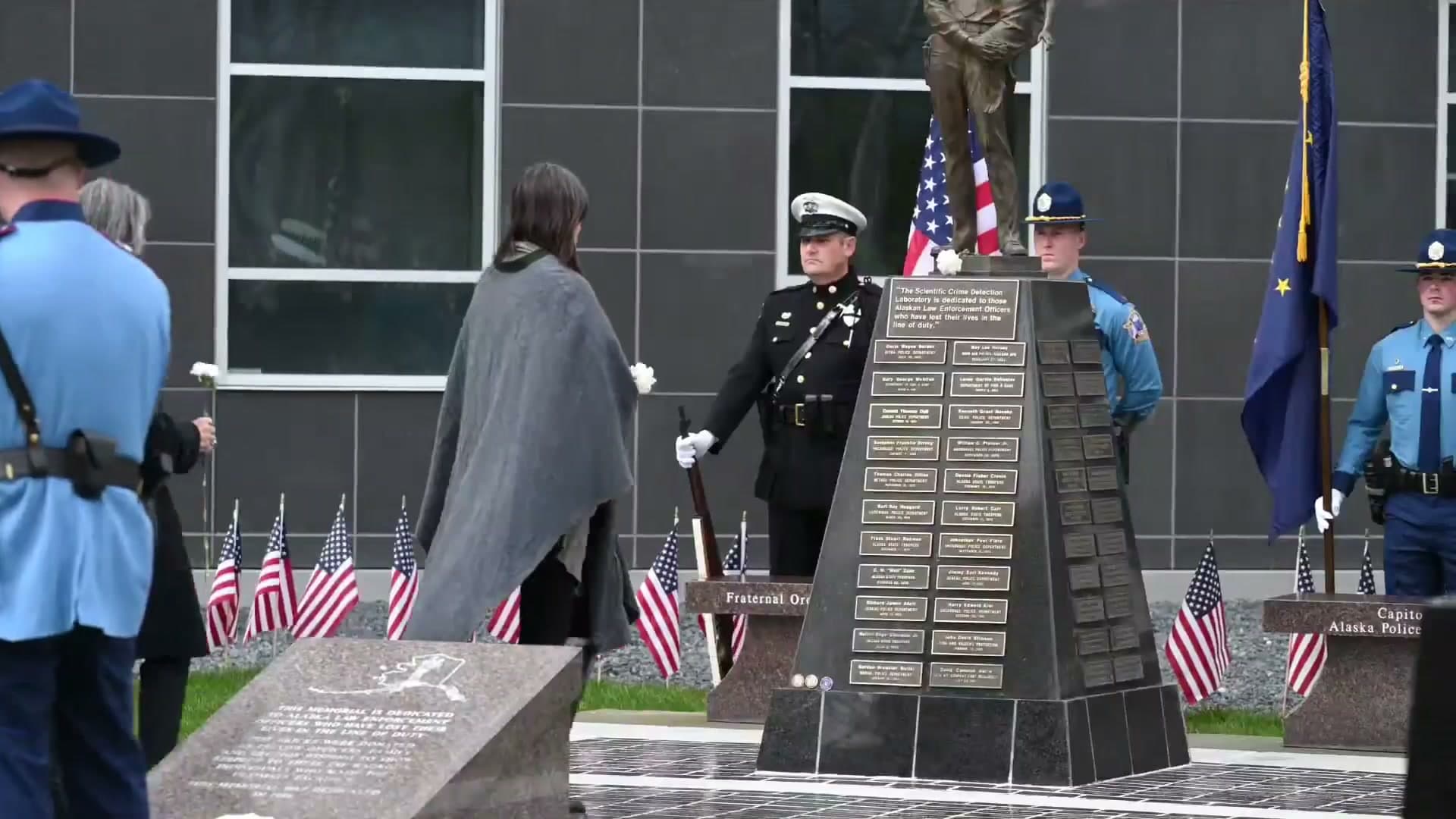
Heyman delivered the remarks as the keynote speaker at the 2026 Alaska Police Memorial Day Ceremony in Anchorage.
Officers gathered to honor the 69 law enforcement officers who have died in the line of duty in Alaska since 1897. Deputy Commissioner Leon Morgan noted that President John F. Kennedy signed the executive order creating Police Memorial Day and Police Week in 1962.
"In recent history, we've seen a troubling surge in violence against law enforcement across our country," Heyman said. "Norms have changed. It's becoming commonplace and often encouraged."
He described the knee injury as representative, not exceptional. "Actual shootouts and violent altercations between citizens and law enforcement have become standard fare," he said. "And while we are distanced from the rest of the country, we're not immune to some of these same problems that are affecting the lower 48." Heyman said uniformed officers in the room were probably shrugging at the story, because they wake up every day expecting exactly that kind of call. "To the rest of us, that is remarkable," he said. He cited his office's caseload of resisting-arrest cases, several of which he said had escalated to violence, alongside the Alaska shooting and the Oregon incident.
Heyman also thanked law enforcement families, calling them "the bedrock of our law enforcement community" and the legacy left behind when officers make the ultimate sacrifice.
A Gap in Coverage
Heyman raised a concern about media coverage as well, saying he learned Wednesday morning about a January assault on federal officers at a federal building in Oregon and found almost no coverage afterward. "It is now to a point where local media outlets are not even reporting on these incidents," he said.
The Fallen
DPS Commissioner James Cockrell addressed the families of fallen officers directly. "It's just as important to recognize the families of the fallen here today," Cockrell said. "Please know that you have my deepest sympathies." He framed the roll of the dead as a shared obligation across every agency present. "State agencies, local departments, tribal partners, BPSOs, and federal colleagues are separate organizations, but we are one community," he said. "The sacrifice of the fallen reminds us that we share a common mission and that we must stand together to achieve it."
The memorial ceremony honored officers from federal, state, borough, and local agencies. The roll of the fallen dates to 1897. Heyman noted that Deputy U.S. Marshal William C. Watts, killed September 1 of that year, was the first.
The most recent name is Trooper Curtis Worland, Alaska State Troopers, December 13, 2022.
The ceremony included a wreath of 69 red roses, one for each fallen officer, and a single white rose representing all currently serving officers across the state. Flags were placed on the lawn for each of the fallen, and Anchorage Police Department Chief Sean Case and Alaska State Troopers Colonel Maurice Hughes conducted the final roll call, with a bell tolling after each name. The ceremony concluded with a 21-gun salute and the playing of Taps.
This article is based on a public meeting of Alaska State Troopers - Official — Alaska State Troopers: 2026 Alaska Police Memorial Day Ceremony ().
Drafted with AI. Edited by Cale Green (1 revision). No full editor review is on record. Who is accountable. Transcript byLucas Brown
Discussed in
Watch key moments from the source meeting. Click to expand.
Stay informed. Support what matters.
Free, permanent access to local news you can verify. Subscribe to support Walter AlaskaNews and go ad-free.
Related Coverage
FBI steps up Alaska security task force, adds agents to state
Alaska News · 4mo ago
Reported crime in Alaska rose 7.2% in 2025, driven by Anchorage increases
Alaska News · 3w ago
Alaska has reviewed 22 police shootings since 2024 and charged no one
Alaska News · 1w ago
One new rural Alaska prosecutor, against deep tribal-justice cuts
Alaska News · 1mo ago
Murkowski presses federal law enforcement on Alaska trafficking, missing Indigenous people
Alaska News · 4mo ago
Comments
Sign in to leave a comment.
No comments yet. Be the first to share your thoughts.