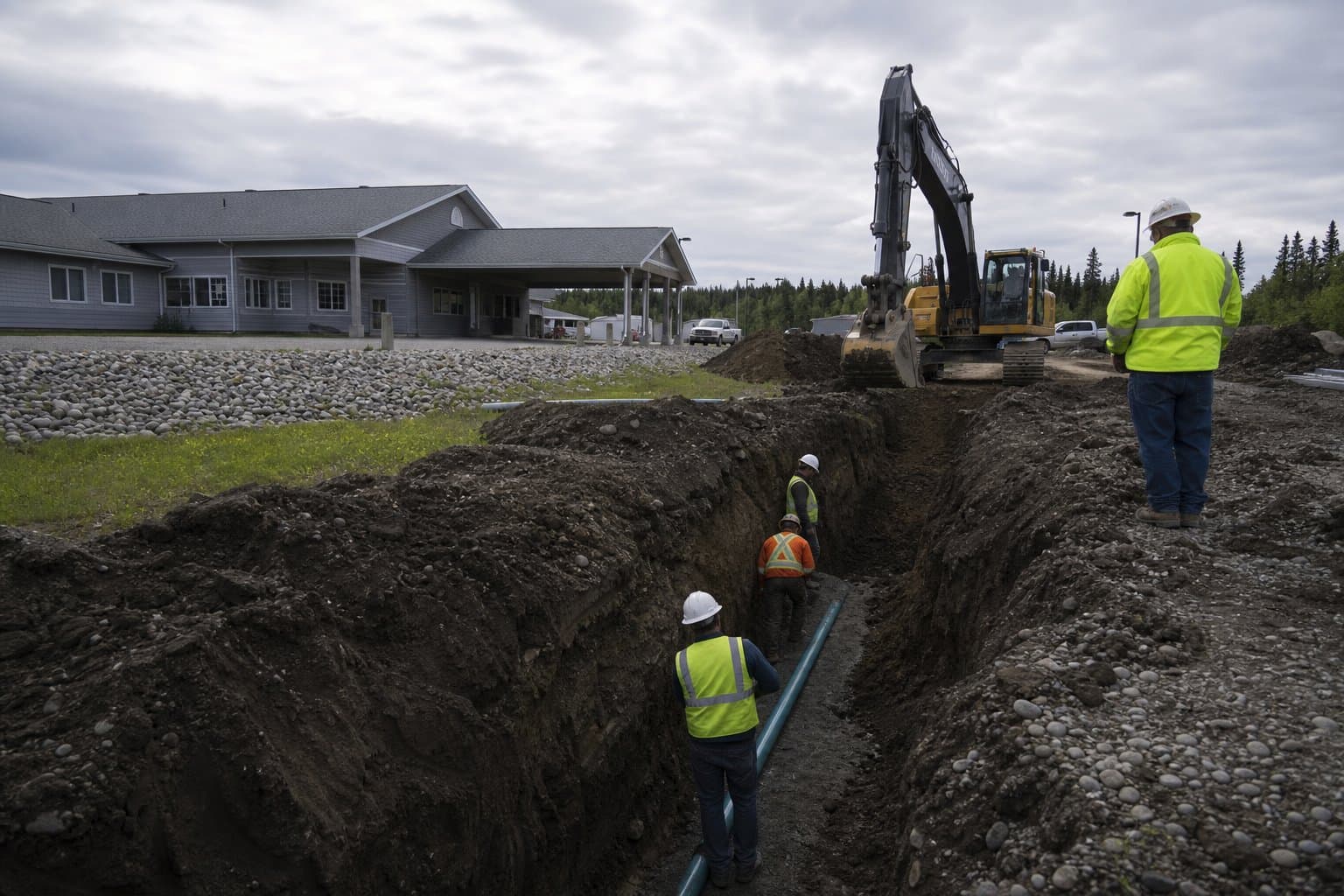
State alert says Delta Junction trench that killed two had no cave-in protection
The trench that buried and killed two Delta Junction workers last month had no cave-in protection of any kind, according to the state's own fatality alert.
Fatalgram 26-04, published by Alaska Occupational Safety and Health, says two maintenance employees of a local medical clinic were replacing a septic tank when a sidewall gave way. "The employees were laying pipe in a trench that lacked any protective systems; no benching, sloping, or trench box was in use," the alert says. Responders ran a technical rescue, used an excavator to move the soil, and recovered the workers only after determining the trench was safe to enter.
Alaska News reported the deaths on July 31, when Alaska State Troopers identified the dead in case AK26074003 as Paul Hebert, 68, and Jacquelyn Wilder, 71, both of Delta Junction. Troopers took the report at 1:26 p.m. on July 30 and said then only that the cause was under investigation. The trench was roughly 13 feet deep. What the Fatalgram adds is the finding about the trench itself.
The federal excavation standard, which Alaska adopts by reference, states that "each employee in an excavation shall be protected from cave-ins by an adequate protective system," with only two exceptions: excavations cut entirely into stable rock, and excavations less than 5 feet deep where a competent person examines the ground and finds no sign of a potential cave-in. At roughly 13 feet, the Delta Junction trench would not qualify for either exception unless it had been cut entirely through stable rock, and the alert does not say what the soil was. The alert's own prevention recommendations tell employers to put benching, sloping or a trench box in any excavation deeper than 5 feet.
Enforcement opened the next morning. Federal data shows two Alaska Occupational Safety and Health inspections opened July 31 at Family Medical Center, 2360 Remington Road: 1909431.015, a safety inspection, and 1910002.015, a health inspection. Both are flagged under the national trench emphasis program, which logs every trenching inspection opened under it. Neither record carries a case closed date or **a single violation item** in data current through Aug. 12.
The Fatalgram itself names only "a local medical clinic," so the tie to that establishment rests on matching date, place and incident type. No statement from Family Medical Center or any other confirmed employer representative appears in the records reviewed, leaving the clinic's account of the worksite and its protective systems **unaddressed in the public file**.
A Fatalgram is written inside an open investigation. If citations follow, the penalty scale effective Feb. 1, 2026, runs from about $1,200 to $16,550 for a serious violation, and up to about $165,500 for a willful or repeat one. The employer would then have 15 working days to contest in writing.
26-04 is the fourth Alaska fatality alert of 2026 and **the only one classified as construction**. The log lists three for all of 2025.
AI-assisted, reviewed by editors. Spot an error?
Stay informed. Support what matters.
Free, permanent access to local news you can verify. Subscribe to support Lucas Brown and go ad-free.
Related Coverage
Two Delta Junction residents killed when a septic trench caved in on them
Alaska News · 2w ago · 89% match
Mat-Su Emergency Services Certifies 25 Responders in Trench Rescue
Alaska News · 3mo ago · 75% match
Seth Whiteman, 22, dead after going overboard near Egegik Bay
Alaska News · 3w ago · 73% match
Two Skiers Rescued After Avalanche Near Turnagain Pass
Alaska News · 3mo ago · 72% match
Helicopter sinks in Chelatna Lake; bystander pulls both survivors from water
Alaska News · 1mo ago · 72% match
Comments
Sign in to leave a comment.
No comments yet. Be the first to share your thoughts.