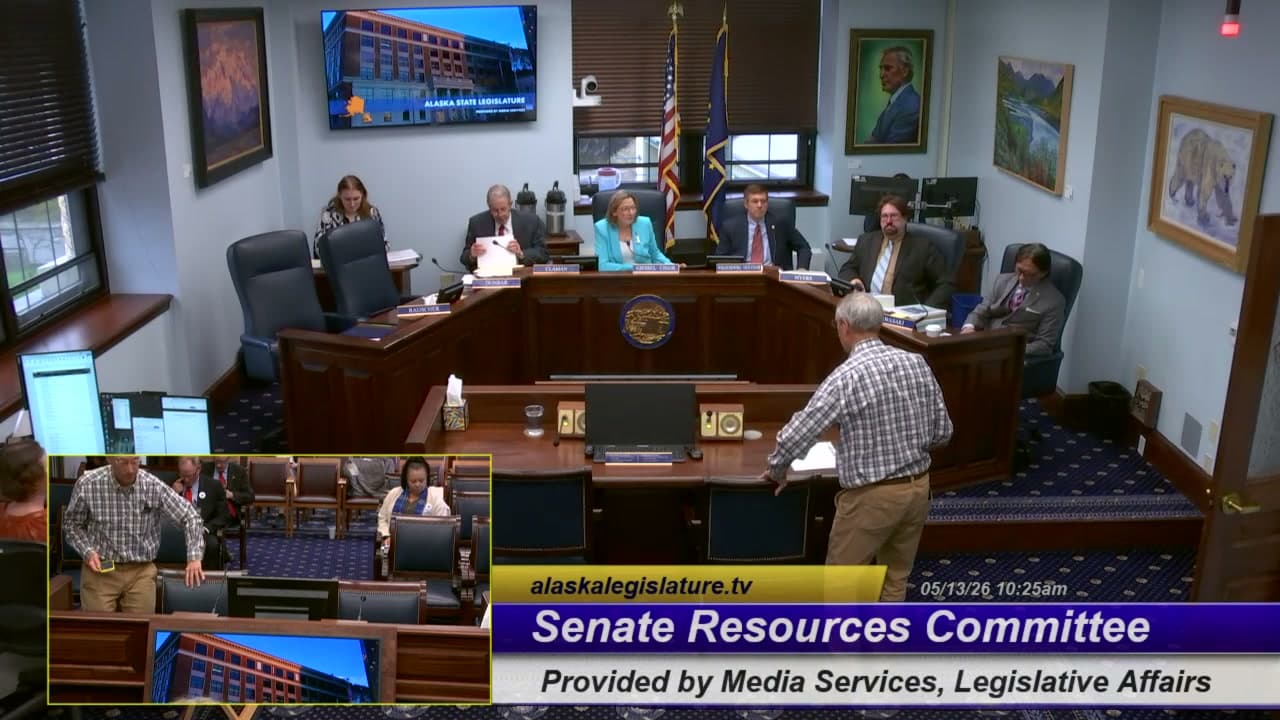
Senate cuts community impact fees for gas pipeline by half
The Alaska Senate Resources Committee voted Wednesday to cut community impact fees for the Alaska LNG pipeline project in half, from $1 million to $500,000 per mile. That drops projected payments to municipalities from about $740 million to $370 million during construction.
The reduction is part of Senate Bill 280, which would replace the current property tax system with a volume-based tax on gas flowing through the pipeline. The broader bill would exempt the Alaska LNG project from taxes for a decade during construction and startup. At full capacity, it would reduce municipal revenue by about 90 percent. Municipalities would receive $13 billion less than under current taxation.
The committee adopted Amendment H6 without objection after rejecting a further reduction to $250,000 per mile by a 3-4 vote. The original $800 million figure came from a 2016 Municipal Advisory Group analysis adjusted for inflation, according to testimony at the 28th hearing on the bill.
Senator Wilkowski said the million-dollar-per-mile fee came from an attempt to replicate the Municipal Advisory Group report from 10 years ago. The producers got together with the local communities and the governor's office at the time and they came up with a number, community impact fee, of around $800 million.
Supporters of the reduction said lower fees could improve the project's economics and help it move forward. Wilkowski said he understands the economics of this project are a challenge. If this is what it takes, this is a significant, significant cut in the community impact fee. But if this is what it takes to get this pipeline forward, he could be open to supporting it.
Senator Myers questioned whether the original fee accurately reflected actual municipal costs. The projected employment for this pipe is 10,000 to 12,000, so roughly half of what TAPS construction was in terms of employment. And honestly, a lot of people, especially if we're talking about the remote camps out, a lot of them probably will do some sort of remote commute.
Myers added that the dollar figure looked too high because it was copied from a project that did not go forward. Staying with that model says to me, well, we're trying to copy from something that didn't work.
Senator Kawasaki defended the original analysis. This was a discussion about 10 years ago when they did have the Municipal Advisory Group, and it was discussed how much a municipality or community would be impacted, and that's why they came up with the $800 million construction-related payment-in-lieu-of-tax system.
Kawasaki noted that the original base case analysis under Senate Bill 138 projected property taxes during construction would likely reach $1.68 billion to $1.79 billion. The agreed-upon $800 million represented roughly 48 percent of that base case. There are some tremendous costs that we potentially are going to be passing on to municipalities by what we are doing here today.
The committee rejected Amendment H7, which would have reduced the fee to $250,000 per mile, by a vote of 3-4. Senators Dunbar, Myers, and Rauscher voted yes. Senators Clayman, Wilkowski, Kawasaki, and Giessel voted no.
Nick Fulford from Gaffney Klein, the committee's consultant, provided context on the bill's purpose. One of the most important things this bill does is that it removes what some might term an unworkable tax and replaces it with something which is appropriate for the type of project we're talking about.
Fulford discussed the broader tax framework under consideration, noting that a more modest tax rate of 40 cents total once the plant becomes operational would reduce the project breakeven by about a quarter, roughly 25 cents. He said the version of the bill with a 55-cent aggregate tax showed a breakeven of $9.11 at $1.50 upstream cost, compared to $9.07 under existing property tax.
Fulford said Texas and Louisiana both offer LNG projects a reduction in tax burden for 10 years, after which regular property taxes come in. He noted that the Louisiana property tax abatement legislation is blanket legislation applying to any major petrochemical investment meeting certain job creation requirements, not written specifically for LNG.
Senators questioned whether Alaska should include a similar sunset provision. Senator Dunbar asked AGDC President Frank Richards why the original legislation did not include a sunset. Richards said the intent was to align the tax structure with the 30-year contracts for offtake with major utilities in Southcentral Alaska and to provide certainty for equity and debt financing.
Dunbar noted that other jurisdictions with successful LNG projects have sunsets that cannot be renegotiated. I find that answer a little puzzling. Also the idea that we're building it around NSTAR contracts when we know that once you hit Phase 2, everything changes for both NSTAR and the developers.
The committee also adopted Amendment H9 without objection. The amendment allows Cook Inlet gas producers to sell gas into the pipeline if the commissioner determines the supply is economically recoverable. Senator Rauscher, who sponsored the amendment, said he wanted to ensure producers currently keeping the lights on would not go out of business once the pipeline is built.
The committee held over Amendment G3 on spur line taxation for future consideration after Senator Myers and legal counsel discussed potential refinements to the language.
The committee heard brief public testimony at the end of the meeting. Doug Woodby, representing 350 Juneau, urged the committee not to rush legislation with minimal transparency. Please do not set up Alaskans to subsidize this megaproject with rushed legislation and minimal transparency. Siobhan Cutright, president of the Valley Board of Realtors, spoke in support of the project, saying Alaska needs to stop talking about it and be about it.
The Senate Resources Committee will hold its 29th hearing on the bill Wednesday at 3:30 p.m. The public can watch the hearing on Gavel Alaska or attend in person at the Capitol in Juneau.
This article is based on a public meeting — SRES-260513-0900 ().
AI-assisted. How we use AI Transcript byLucas Brown
Stay informed. Support what matters.
Free, permanent access to local news you can verify. Subscribe to support Alaska News and go ad-free.
Related Coverage
Senate panel advances gas pipeline bill with reduced community payments
Alaska News · 4mo ago
House Panel Advances $40M Community Impact Fund for Gas Pipeline
Alaska News · 4mo ago
Senate panel weighs municipal concerns over Alaska LNG tax structure
Alaska News · 4mo ago
Senate panel examines regulatory questions on gas pipeline tax plan
Alaska News · 5mo ago
House Finance advances Alaska LNG tax bill, curtailing North Slope's power to negotiate
Alaska News · 3mo ago
Comments
Sign in to leave a comment.
No comments yet. Be the first to share your thoughts.