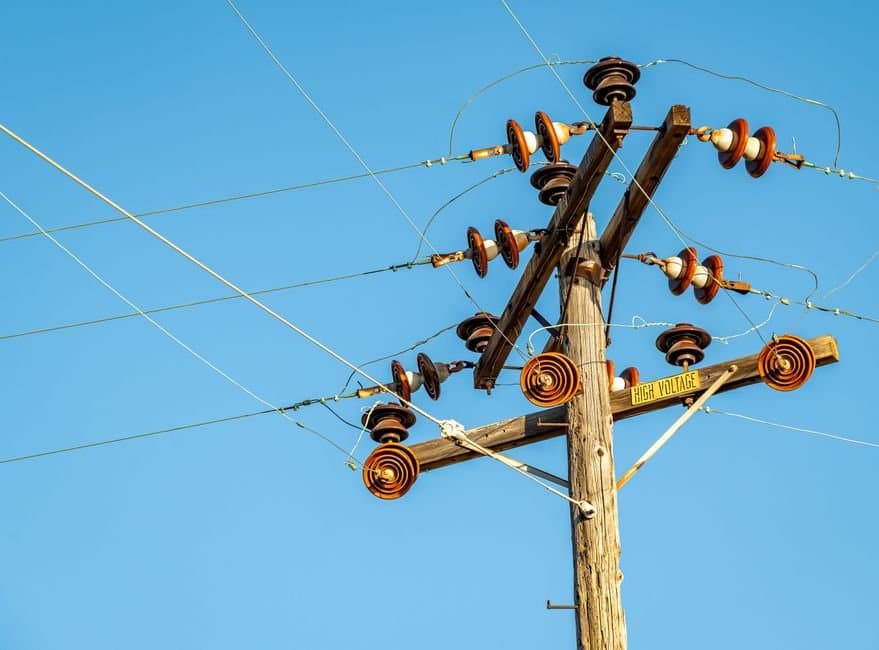
Photo by David McElwee on Pexels · Source
Matanuska Electric members paid $471,639 at the point of disconnection through July
Matanuska Electric Association members paid $471,639 at the moment their power was being cut off during the first seven months of 2026. That figure already equals 83 percent of the $570,827 the cooperative collected the same way in all of 2025, with five months of the year still to run. The numbers come from the chief executive's report to the MEA board dated Aug. 10.
The report's collections line reads: "YTD Payments received by collections on day of disconnection: $471,638.93." Measured against the same seven months of 2025, those doorstep payments are up 20.4 percent, with April up 45 percent and June up 50 percent.
Balances owed to the co-op for 90 days or more rose in every month of 2026. They stood at $74,264.35 at the end of January and $170,562.24 at the end of July, an increase of 130 percent. The sharpest jumps came in May and June, at 28 and 25 percent. The trend line crossed over during the year: January's 90-day balance was 13.9 percent below the same month of 2025, and February's was still 16.1 percent below. By June it was 4.9 percent above the prior year, and by July, 17.1 percent above.
Ordinary lateness is not what changed. The 30-day column swings between $674,429 and $1,128,559 across the same seven months with no direction, and July's is the lowest of the year. The 60-day column climbed from $59,170 in January to $156,403 in April, and July's $97,636 remains 59 percent above the $61,522 of a year earlier.
Growth does not account for the rise. MEA reported 71,700 accounts in January and 72,189 in August, an increase of 489 accounts, or 0.68 percent.
Neither does the latest rate increase. MEA announced on June 30 that its Cost of Power Adjustment would rise for the third quarter, from $0.07879 to $0.10195 per kilowatt-hour, adding about $14.53 to the monthly bill of a residential member using 623 kWh. By June 30 the 90-day balances had already risen for five consecutive months. Rates had moved the other way earlier in the year: MEA told members their average monthly bill would fall $1.35 starting Jan. 1, as a 6 percent drop in the same adjustment more than offset a 2 percent base rate increase.
The cooperative itself is running ahead of plan. "Through June, net margins are $4.9 million favorable to budget, driven by retail sales exceeding budget by 1.6% (generating $0.8 million in additional gross margin) and $3.8M in favorable O&M expense variances," the report says. Equity stood at 32.4 percent of total assets against a budgeted 31.3 percent.
The report publishes dollars collected at the point of disconnection every month and never states how many households were disconnected. And its own arithmetic does not close: the seven monthly figures total $464,575.57, which is $7,063.36 short of the reported year-to-date sum.
The report is MEA's own account of its operations and carries no member voices.
MEA's own service guidance frames disconnection as avoidable rather than inevitable: it says there are no disconnection fees, members can pay their current balance at the time of disconnection, and members who cannot pay in full are directed toward payment arrangements or outside assistance rather than left to wait for the day service is cut. The state Heating Assistance Program's 2026-2027 guidelines set a gross monthly income limit of $3,739 for a one-person household and $10,395 for six, and applications for the coming heating season are open through the Division of Public Assistance.
AI-assisted, reviewed by editors. Spot an error?
Stay informed. Support what matters.
Free, permanent access to local news you can verify. Subscribe to support Walter AlaskaNews and go ad-free.
Related Coverage
Mat-Su power bills climb as Alaska's energy squeeze bites
Alaska News · 1mo ago · 81% match
Matanuska Electric goes on taproom tour as members absorb rising rates and a looming gas cliff
Alaska News · 1w ago · 79% match
Chugach Electric proposes 3.5% rate hike to cover $11.2 million shortfall
Alaska News · 1mo ago · 77% match
MEA seeks RCA approval to pass gas storage costs to ratepayers
Alaska News · 2mo ago · 77% match
Matanuska Electric offers free EV chargers to local businesses, but hosts pay install costs
Alaska News · 1mo ago · 76% match
Comments
Sign in to leave a comment.
No comments yet. Be the first to share your thoughts.