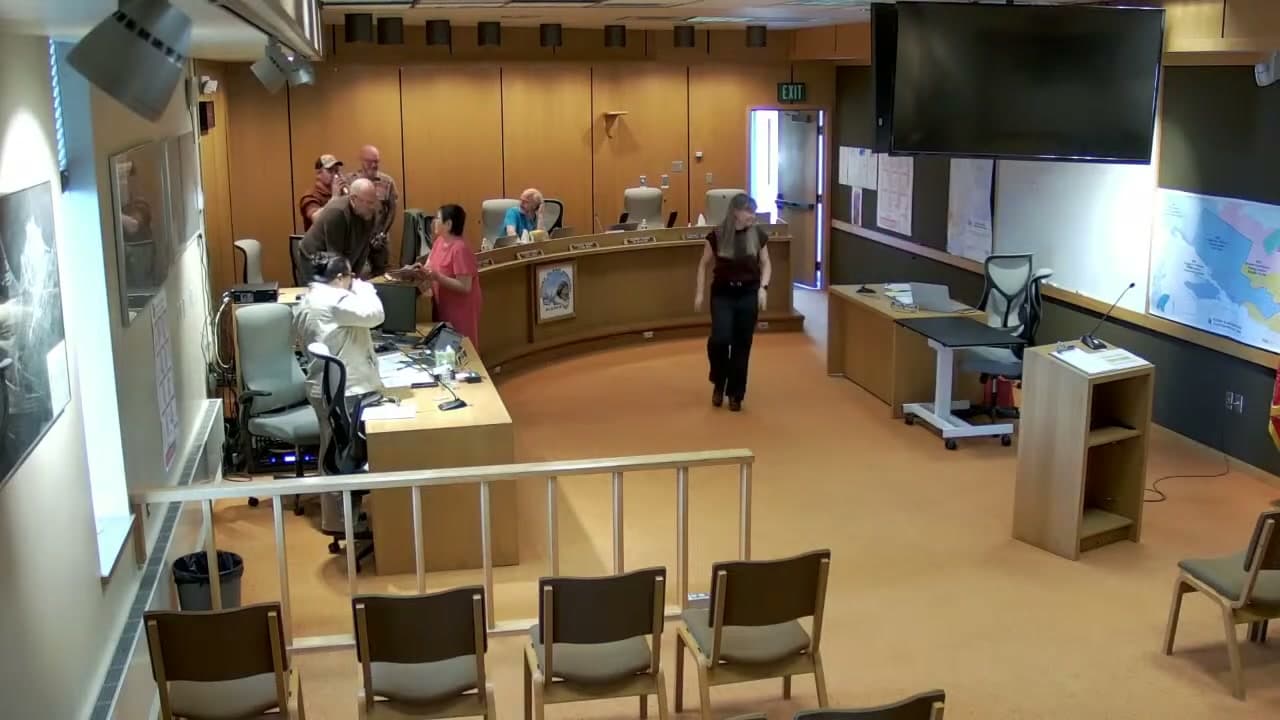
Frame from "Kodiak Borough: Assembly Work Session of June 25, 2026 Part 1" · Source
Kodiak Borough explores natural resource excise tax, marijuana levy
The Kodiak Island Borough Assembly discussed two separate revenue proposals Thursday: a draft marijuana tax ordinance and an early-stage natural resource excise concept modeled on Sitka's fish box fee. Assembly Member Jeff Woods introduced the broader resource extraction idea; Mayor Jared Griffin framed both as revenue diversification. Woods cited Alaska Department of Fish and Game data showing roughly 74 percent of the deer harvested in the borough come from nonresidents. "Fish and Game information indicates that roughly 74% of the deer harvested in the Kodiak Island Borough are harvested by people who do not live in the Kodiak Island Borough," Woods said. "I don't like a system where we take, take, take without a dedicated way to repair, replace, or replenish."
Griffin noted that both proposals shared the same underlying goal: "this and the next item that we are going to be looking at is about kind of like diversifying, not necessarily expanding, but, right, but diversifying our financial foundation, you know."
Unresolved Questions
The natural resource excise concept remained exploratory. Griffin summarized three main follow-up questions for staff and legal counsel: whether a resident exemption or rebate program would be legally feasible, what the administrative burden of collection would look like, and how enforcement and collection at shippers or the airport would work in practice. Assembly Member Scott Smiley raised tentative concerns about the legality of a resident carve-out, noting that fishing license fee structures had previously faced scrutiny over resident-versus-nonresident distinctions. Assembly Member Jeremiah Gardner, who wants language protecting locals, acknowledged the constraint: "My big concern here is for locals. I think language should be in here where if you are a resident of Kodiak, that I don't think that this should apply to you to some degree. There's got to be a concession in there."
On enforcement, Assembly Member Bo Whiteside named the core problem: "I think the biggest hurdle for this would be the burden of enforcement. I don't know how the state would respond to a cooperative approach to this and sharing records with us. But I do agree that there's a very high amount of transporters coming from the mainland down here to extract fish and game resources, a very, very high amount." Whiteside said he would support sending the measure to voters if the enforcement burden and a local exemption could be worked out, but was clear he would not support moving it forward without a public vote.
AI-assisted, reviewed by editors. Spot an error?
Watch key moments from the source meeting. Click to expand.
Comments
Sign in to leave a comment.
No comments yet. Be the first to share your thoughts.