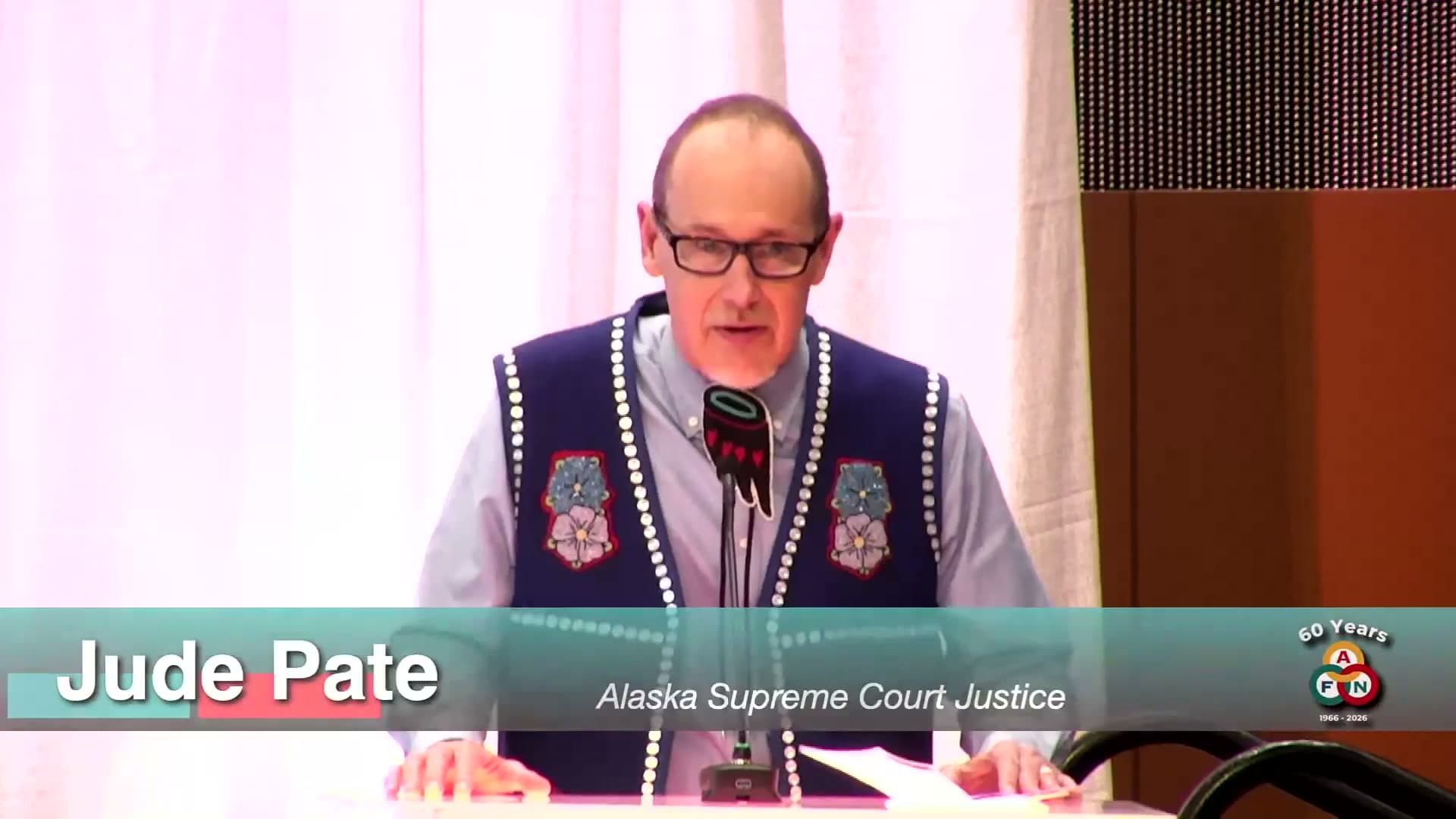
Frame from "Native Federation Video 2526606721442955" · Photo source
Justice Pate tells AFN he knows of no Alaska Native judge since Roy Madsen
Alaska Supreme Court Justice Jude Pate told Alaska Federation of Natives delegates this week that, to his knowledge, no Alaska Native has served as a district, superior or Supreme Court judge since Roy Madsen, whom he described as a Kodiak Superior Court judge about 50 years ago.
"We don't hear your voice speaking on the Supreme Court," Pate said. He named Madsen and, before him, district court judge Nora Guinn. Since then, "there hasn't been, that I'm aware of, an Alaska Native judge," he said.
Guinn, of Bethel, became the state's first Alaska Native judge in 1968, according to Alaska Court System history materials. Madsen, the first Alaska Native on the Superior Court, sat in Kodiak from 1975 through 1990, according to a 2018 tribute by Sen. Lisa Murkowski in the Congressional Record.
Pate tied the gap to the number of Alaska Native lawyers. "We don't have a law school," he said. "We need more Alaska Native lawyers." If there are enough, he said, "hopefully there'll be enough to populate the benches in state court."
Pate told delegates he started out in Alaska 30 years ago as a tribal court clerk. He was counsel for the Sitka Tribe of Alaska in the 1990s and a Sitka Superior Court judge before his appointment to the Supreme Court in 2023, according to his court biography. He is among 21 judges standing for retention this year, according to the Alaska Judicial Council. In a retention election, voters decide whether to keep each judge. Pate ended his remarks by noting that many state judges will be on the ballot in a few weeks.
Pate described joint jurisdiction therapeutic courts, where a tribal judge and a state judge sit together, and said he has sat on one in Kenai. About three years ago, he and the chief justice of the Tlingit & Haida tribal court started dinners where tribal and state judges and court staff in Southeast meet every six months. The next one is next week on Prince of Wales Island, with a tribe hosting, he said.
"We live in a legal desert," Pate said, adding that there aren't enough lawyers to meet the need, especially in rural villages. The court system is working with Alaska Legal Services on community justice workers, trained non-attorneys who can provide basic services, he said. He also pointed to a state criminal rule that he said tells judges that, in certain circumstances, the tribe should be involved in a case, which can include circle sentencing in very serious cases.
"We plant seeds," Pate said. "It takes a long time." The results could come in a decade, maybe 20 years, he said. He helps run the Color of Justice program at Mount Edgecumbe in Sitka, a two-and-a-half-day session for high school students, and said former participants have gone through law school and now come back as lawyers to present to new students.
His Juneau chambers also runs a 10-week remote externship for undergraduates, with credit through the University of Alaska system. Pate singled out two alumni: a woman from Nome now in law school at Seattle University who plans to work in her community, and an Anchorage man at American University, an undergraduate who wants to go to law school and is interning with Murkowski.
"I want them standing in my shoes in the next few years," Pate said. "I want them speaking to you as a Supreme Court Justice."
This article is based on a public meeting of Native Federation — Native Federation Video 2526606721442955.
Made by our human newsroom with AI. Reviewed by Cale Green. How humans and AI work here · Grow with our newsroom Transcript byLucas Brown
Watch key moments from the source meeting. Click to expand.
Stay informed. Support what matters.
Free, permanent access to local news you can verify. Subscribe to support Maggie AlaskaNews and go ad-free.
Related Coverage
Begich tells AFN Southcentral Foundation land transfer is law; Sullivan lists his bills
Alaska News · 12h ago
AFN's 60th convention brings candidates, subsistence and resolutions
Alaska News · 1w ago
Listening sessions tell AFN tribes want real authority over fish, wildlife and land
Alaska News · 13h ago
Judicial Council tries again to fill Kotzebue and Nome superior court seats
Alaska News · 3w ago
AFN prepares for 60th convention with land, tradition and political voice at center
Alaska News · 4mo ago
Comments
Sign in to leave a comment.
No comments yet. Be the first to share your thoughts.