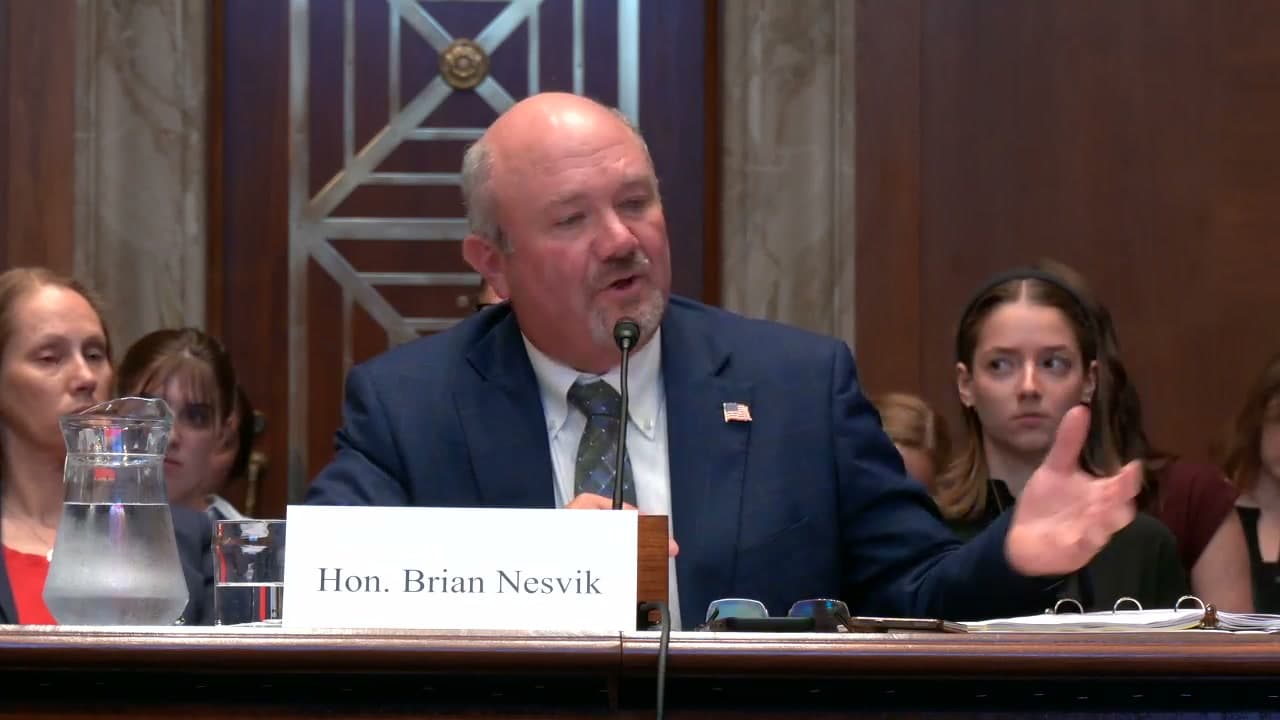
Frame from "Senate Environment and Public Works" · Photo source
Fish and Wildlife Service seeks $5M to cut energy permit times in half
A proposed change at the U.S. Fish and Wildlife Service to cut endangered species consultation times from 30 to 14 days could affect Alaska resource projects that have been bottlenecked for years by federal review.
The change would cost $5.1 million in additional funding, FWS Director Brian Nesvik told the Senate Environment and Public Works Committee on June 10.
Alaska officials have long pointed to ESA consultation delays as a primary obstacle to mineral and energy development, with full permitting timelines for major projects running 15 to 18 years. The state's listed species include polar bears on the North Slope and Cook Inlet beluga whales.
"With this funding, the service will be able to accelerate the review of priority energy projects, and we anticipate being able to reduce consultation timeframes from 30 to 14 days," Nesvik said. He said 80 percent of projects submitted through the agency's Information for Planning and Consultation system (IPAC) are already approved immediately, and that further system improvements could roughly halve permitting timelines.
Ranking Member Sheldon Whitehouse pressed Nesvik on whether the faster timelines would apply to wind and solar projects. Nesvik confirmed that any project submitted through IPAC, including renewables, would receive the same reduced consultation times.
Committee Chair Shelley Capito raised a recent D.C. District Court decision invalidating a 2020 programmatic biological opinion FWS issued for the Office of Surface Mining Reclamation and Enforcement's mining regulation program. The ruling affects coal-producing states with primacy under the Surface Mining Control and Reclamation Act, a group that includes Alaska. The ruling directly affects the framework Alaska uses to permit operations at Usibelli Coal Mine, the state's only operating commercial coal producer, for renewals, amendments, or new activity.
"This is a recent development. This is a pretty recent court decision. We are aware of it in the Department of Interior, and we've already begun looking at what the options may be in order to ensure that this doesn't disrupt our abilities to issue those permits that previously state primacy was able to address," Nesvik told Capito. He did not yet have specific options identified.
The proposed $5.1 million funding change is a request, not an enacted policy. Congress would need to appropriate it for the timeline reduction to take effect. Whether and how it would interact with the larger ESA permitting backlog on major Alaska projects remains an open question.
This article is based on a public meeting of Senate Environment and Public Works (Sullivan) — Senate Environment and Public Works (Sullivan): Hearings to examine the President's proposed budget request for fiscal year 2027 for the U.S. Fish and Wildlife Service. ().
Made by our human newsroom with AI. How humans and AI work here · Grow with our newsroom Transcript byLucas Brown
Discussed in
Watch key moments from the source meeting. Click to expand.
Stay informed. Support what matters.
Free, permanent access to local news you can verify. Subscribe to support Alaska News and go ad-free.
Related Coverage
Trump Wildlife Pick Wants Fewer ESA Lawsuits — Alaska Is Ground Zero
Alaska News · 4mo ago
A permitting bill could open the federal fast lane to Alaska projects
Alaska News · 3mo ago
A proposed rule would cut years of NPR-A oil review down to 60 days
Alaska News · 1mo ago
Alaska says some permits now clear in under a week — as the reforms behind that speed draw both praise and alarm
Alaska News · 2mo ago
Federal rule changes loosen protections for Alaska's listed species
Alaska News · 3mo ago
Comments
Sign in to leave a comment.
No comments yet. Be the first to share your thoughts.