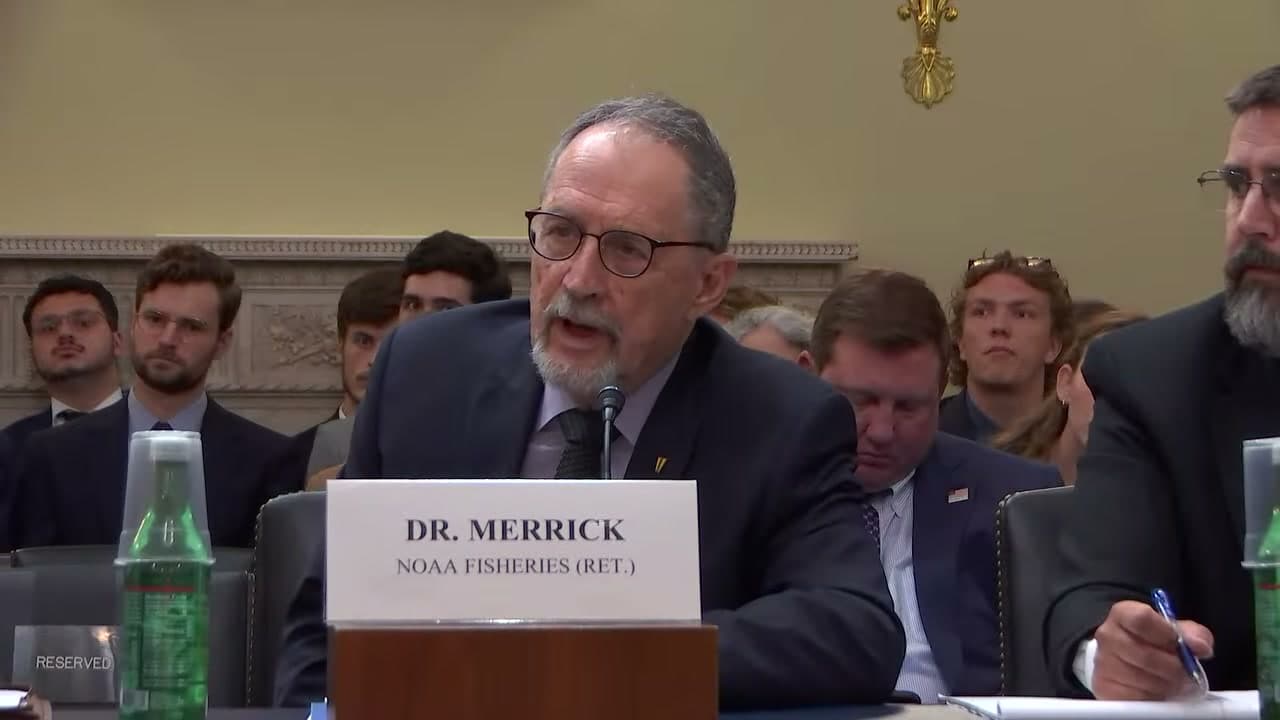
Frame from "House Natural Resources Subcommittee on Water, Wildlife and Fisheries (Begich): Legislative Hearing" · Source
Congress weighs expanded sea lion removal to save Pacific salmon
A proposal to expand lethal sea lion removal across the Columbia River and its tributaries, Puget Sound, and coastal Washington waters received a hearing Tuesday before the House Natural Resources Subcommittee on Water, Wildlife and Fisheries. The bill, H.R. 9621, the Northwest Endangered Salmon Predation Prevention Act of 2026, was introduced July 9 by Rep. Michael Baumgartner and Rep. Emily Randall. It would build on a 2018 amendment to the Marine Mammal Protection Act that first authorized Columbia River sea lion removals and would extend similar authority to Western Washington waters and covered Indian tribes. Salmon and steelhead recovery in the Columbia River Basin has drawn billions of dollars in investment over past decades, and supporters say pinniped predation is undermining those gains.
The measure would remove the current geographic cap at river mile 112, eliminate the restriction to chemical euthanasia, and authorize Washington state and covered tribes to conduct lethal removals, capped at 10 percent of potential biological removal for any covered stock. Dr. Tim Petty, Assistant Secretary for Oceans and Atmosphere at the Department of Commerce, was among the witnesses. Since 1994, NOAA has issued 12 authorizations under the Marine Mammal Protection Act to intentionally take predatory sea lions.
Nate Pamplin, Director of External Affairs for the Washington Department of Fish and Wildlife, cited data in support of the bill. "Prior to lethal removal, listed winter steelhead faced an 89% risk of extinction. After 2 years of targeted removals, the risk of extinction fell to 11%."
Richard Merrick, a scientist who testified in a minority capacity, raised doubts about the bill's reach. "I'm concerned that this well-intentioned act will really do little to recover West Coast salmon."
Rep. Val Hoyle of Oregon raised concerns about the bill's development and scope. "I'm disappointed that Oregon tribes and the communities in my district affected most by this legislation were not included in this development. The people who fish these waters, manage these resources, and depend on healthy salmon populations deserve a real seat at the table. And sea lions cross both sides of the river. They go from Washington to Oregon and back again. So we can't have a one-state solution."
AI-assisted, reviewed by editors. Spot an error?
Watch key moments from the source meeting. Click to expand.
Comments
Sign in to leave a comment.
No comments yet. Be the first to share your thoughts.