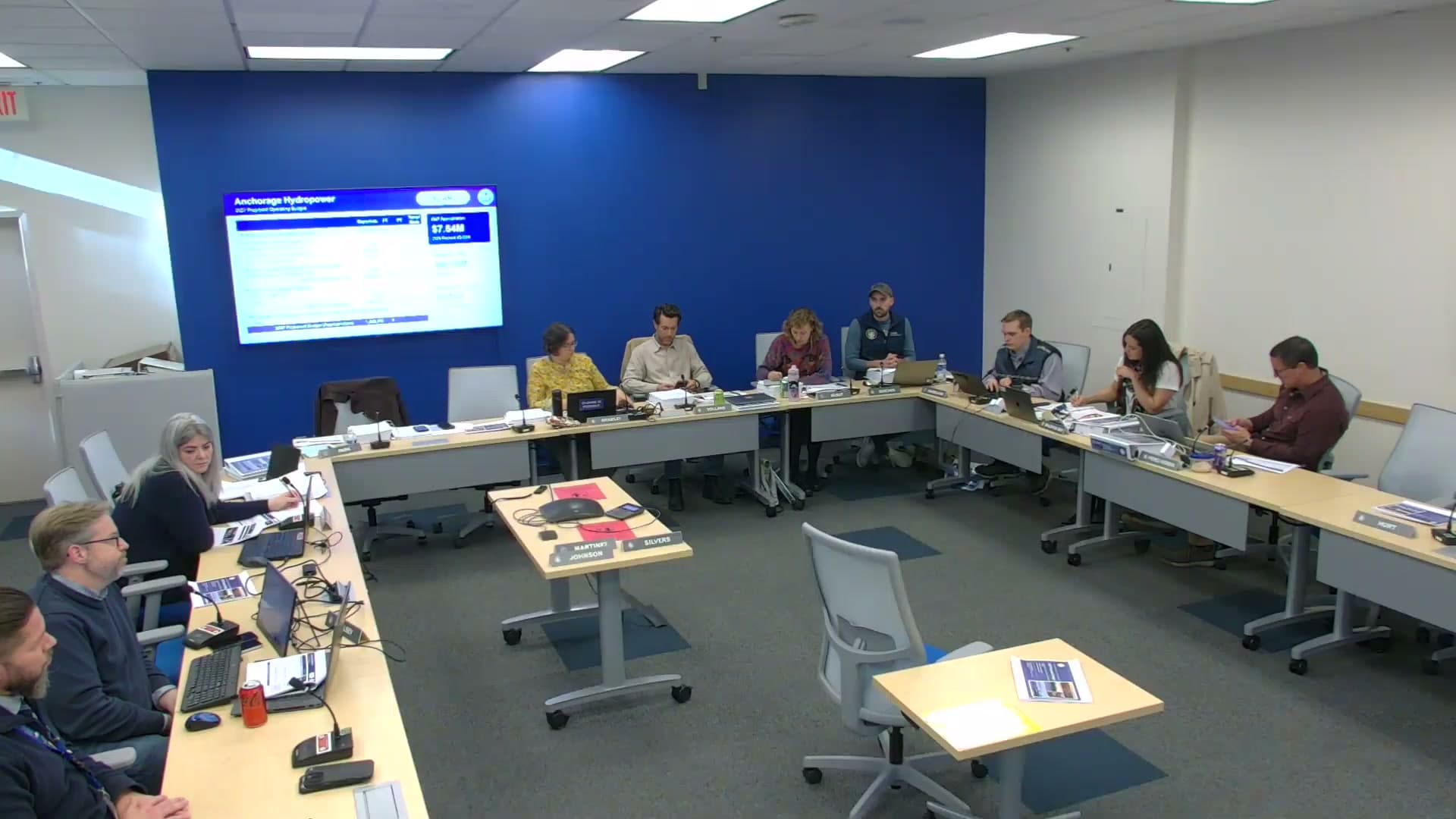
Frame from "Anchorage Assembly: Worksession re General Government Operating & Capital" · Photo source
Anchorage officials propose asking voters to fund an ambulance and its crew
Anchorage budget officials on Friday proposed asking voters to buy one more ambulance and to pay, every year, for the crew to run it.
The 2027 proposed Fire Department capital budget lists $380,000 in bonds for the ambulance and $1,545,000 a year to operate it: $1,345,000 for seven full-time positions to staff it around the clock, and $200,000 for supplies.
Ona Brause, director of the Office of Management and Budget, presented the plan with Fire Chief Doug Schrage at an Anchorage Assembly work session on the budget and put the yearly cost at about $1.6 million.
"The question becomes, do you want to bond to pay for this ambulance, and do you want to levy to pay for the service to drive the ambulance?" Brause said. "Because if we ask the asset question, we do not have the staff or the funding to make it work."
Both pieces are proposals. If the Assembly advances them, voters in the area-wide emergency medical service area, which covers the whole municipality, would decide in April. Bond questions are put together in January for the April ballot, Brause said. Whether the yearly tax would end when the ambulance is retired or after a set number of years would depend on how the question is written, she said.
Anchorage bond questions already carry some operating money. Each comes with what the city calls an O&M increment, a yearly amount to operate and maintain what the bonds pay for. Last April's public safety and transit bond, for example, came with up to $152,000 a year, according to the city's 2026 bond package.
Brause told the Assembly those increments have "traditionally not carried the full loaded cost" of running what voters approve. This one would pay for a crew. "It just involves the humans that operate the ambulance," she said.
Midtown Assembly member Erin Baldwin Day, reading the staffing line, summed it up as "1.35-ish million to staff the thing we just asked you if you wanted to buy."
Brause said the city does not have the capacity to add the crew "under the operating budget, under the tax cap as it is right now," and pointed to burnout and overtime in the Fire Department. The department had spent $6.6 million on overtime through August, against a $4.3 million overtime budget for the year, according to the proposed operating budget.
The ambulance has been in the city's plans since last year. Last year's capital budget listed a Midtown advanced life support ambulance for 2027 at $1.58 million, including $1.2 million for building changes to house the added crew, along with the same seven positions, Alaska News reported in September. That plan cited about 70 times in 2024 when no advanced life support ambulance was available and more than 315 times when no basic life support ambulance was.
This year's version drops the building money and says the new ambulance could run as either an advanced or basic life support unit.
The 2027 budget says demand for emergency medical service has grown 25% over the past 10 years and that ambulances "routinely operate above safe utilization thresholds."
Schrage said the Fire Department has 18 ambulances on the road each day, from Portage to Eklutna, and volunteer departments in Chugiak and Girdwood run five more. The budget lists 13 Fire Department ambulances in full-time service. Schrage said all of them are treated as area-wide resources in a system that is "under strain."
Midtown has been generally identified for the new ambulance, he said, not because the area has more calls but because its ambulances are often sent as backup to the stations around them. No location has been set.
Chugiak-Eagle River Assembly member Donald Handeland asked how the proposal would affect the Chugiak Volunteer Fire Department and residents of his area. Schrage said ambulances shift almost every day: when a Chugiak ambulance is busy, an Eagle River ambulance may respond into Chugiak, and a Muldoon ambulance may move out to cover Eagle River.
Assembly Chair Anna Brawley, who represents West Anchorage, asked whether another ambulance would bring in more reimbursement money. Generally no, Schrage said. The same number of calls would be spread among more units, making the others more available.
The capital budget also includes $800,000 in bonds for the city's yearly ambulance replacement program, which buys new ambulances for the existing fleet. The budget says ambulances are replaced about every seven years.
Brause described the ambulance as part of what she called service-level budgeting, in which voters decide what services they want and pay for them. "That is a service level budget. You tell us what you want us to provide," she said earlier in the session, speaking about levies generally. If voters approve this one, she said, "in future cycles we would think about building on top of this."
Vice Chair Daniel Volland, who represents North Anchorage, said the approach could be broadened beyond ambulances. Susanne Fleek-Green, who spoke for Mayor Suzanne LaFrance's office at the session, said officials don't know when a bond package reaches the point where voters say "too much in a year." Brause said the public conversation about the approach would take "the next 6 to 12 months at a minimum."
The Assembly holds public hearings on the budget Oct. 20 and Nov. 4, with another work session Oct. 23, and is scheduled to vote Nov. 17.
This article is based on a public meeting of Municipality of Anchorage — Anchorage Assembly: Worksession re General Government Operating & Capital ().
Made by our human newsroom with AI. Reviewed by Cale Green. How humans and AI work here · Grow with our newsroom Transcript byWalter AlaskaNews
Watch key moments from the source meeting. Click to expand.
Stay informed. Support what matters.
Free, permanent access to local news you can verify. Subscribe to support Walter AlaskaNews and go ad-free.
Related Coverage
Anchorage had no ALS ambulance available about 70 times last year
Alaska News · 1mo ago
Anchorage Assembly to consider $1.2 million for two fire tenders replacing aging trucks
Alaska News · 1d ago
Anchorage Assembly set to approve $1.4M fire engine with 900-day wait
Alaska News · 2mo ago
Chugiak fire chief to ask voters this spring for first mill rate increase since 2005
Alaska News · 4w ago
Anchorage mayor proposes 2027 budget that relies on one-time money, warns of 2028 fiscal cliff
Alaska News · 1w ago
Comments
Sign in to leave a comment.
No comments yet. Be the first to share your thoughts.