AI image
Anchorage drops landfill injection well plan and turns to an evaporator for leachate
Anchorage has ruled out pumping landfill leachate into a deep injection well and is designing an evaporator that would start out handling less than half of what the city's landfill trucked away on an average day in 2024, according to a May update to the city's solid waste master plan.
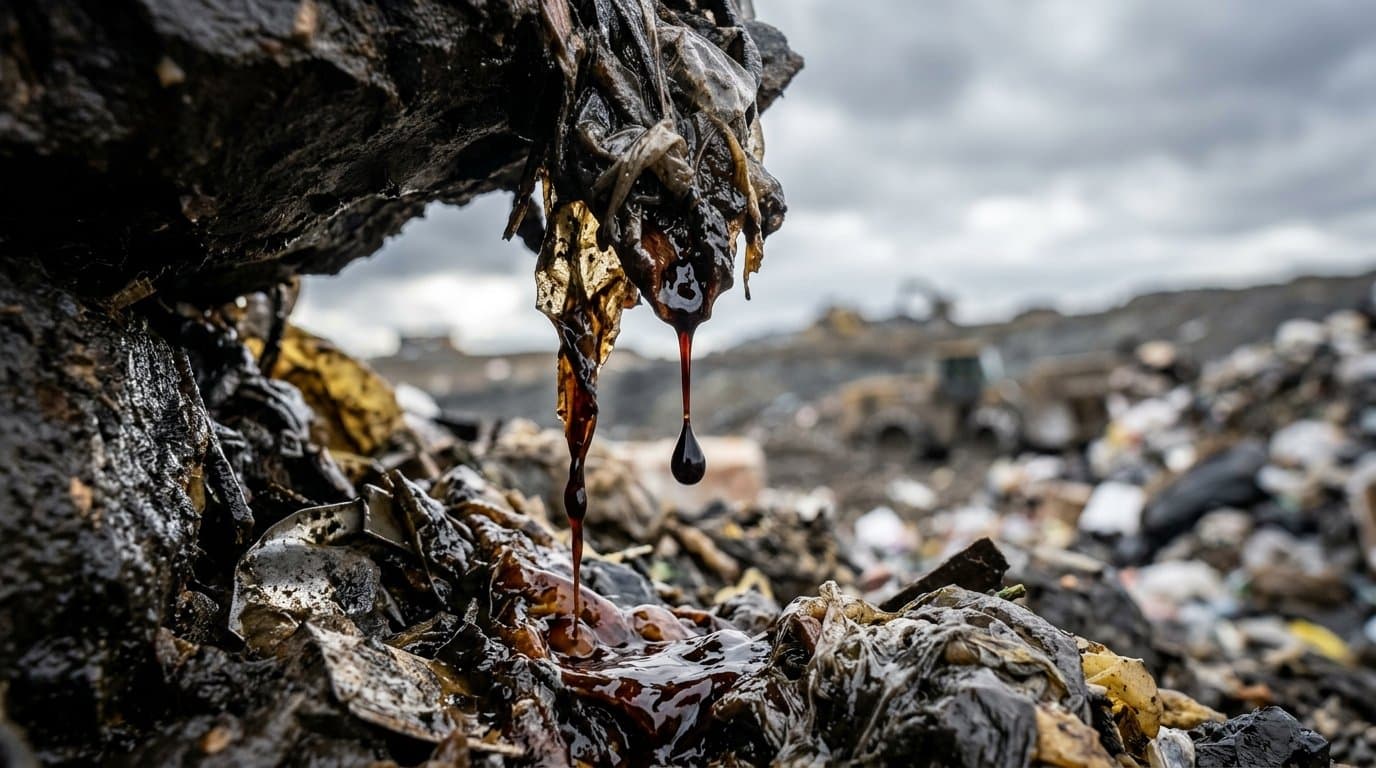
Leachate is the liquid left when rain and snowmelt seep through buried trash. In 2024, the Anchorage Regional Landfill sent off an average of 118,000 gallons a day by tanker truck, and as much as 197,000, with hauling often running around the clock, the plan says. City officials put it at about 6,500 truck trips a year, or 17 a day, in a 2022 presentation.
The trucks unload at the Turpin Street septage station, and the leachate is treated at the Anchorage Water and Wastewater Utility's Asplund plant at Point Woronzof. That plant operates under a federal waiver that lets it discharge after primary treatment and disinfection. The plan says leachate runs high on two measures of pollution the utility must control to keep that waiver, and that much tougher limits on the landfill may be coming. The utility has already cut the landfill's zinc limit from 12 to 5.62 milligrams per liter. The leachate met the new limit only about 80% of the time, though a city study found that letting solids settle in a still pond before loading the trucks would be enough to meet it.
A 2022 compliance order by consent with the Alaska Department of Environmental Conservation requires the city to improve how it handles leachate, with goals including cutting the risks of trucking it and the trucks' air emissions. The order allows two approaches, a deep injection well or an evaporator, and the city expects its leachate program to be largely in place by the order's September 2028 deadline. The order also requires more landfill gas control and more emissions monitoring, the city's 2026 budget says.
The city pitched the injection well in 2022 at $8 million to $11 million. A test well later showed the local geology was unsuitable, and the plan says the option was dropped over uncertainty about seismicity and geology and its high cost.
The evaporator would use heat from burning landfill gas to evaporate leachate, starting at about 50,000 gallons a day and growing as more gas becomes available. It can use only the gas the landfill doesn't owe Doyon Utilities under contract, and it would leave about 5,000 gallons a day of residue at about 25% solids. "Evaporation alone cannot manage the leachate produced," the plan says. The project is in conceptual design and is to be installed no later than August 2028.
The city also plans temporary covers over parts of the landfill to keep water out; weather shortened the life of covers laid in 2021. It is studying advanced treatment for the rest. The plan lists $6.1 million for the landfill's leachate system, $18 million for leachate water treatment and $3.5 million for "leachate avoidance."
The trash-burning power plant the city is studying is meant in part to reduce leachate, the plan says. The Assembly is weighing $700,000 to start designing it, Alaska News reported Oct. 17.
Source: Municipality of Anchorage.
Made by our human newsroom with AI. Reviewed by Cale Green. How humans and AI work here · Grow with our newsroom
Stay informed. Support what matters.
Free, permanent access to local news you can verify. Subscribe to support Walter AlaskaNews and go ad-free.
Related Coverage
Anchorage landfill contract hits $16M after starting at $30,004
Alaska News · 3mo ago
ADEC proposes final discharge permit for Kodiak landfill leachate plant
Alaska News · 3mo ago
Anchorage Assembly set to approve $1.53M landfill loader replacement
Alaska News · 3mo ago
Anchorage weighs a $6.7 million bleach contract for its wastewater
Alaska News · 2mo ago
Anchorage's landfill needs $1.9 million in new heavy equipment
Alaska News · 3mo ago
Comments
Sign in to leave a comment.
No comments yet. Be the first to share your thoughts.