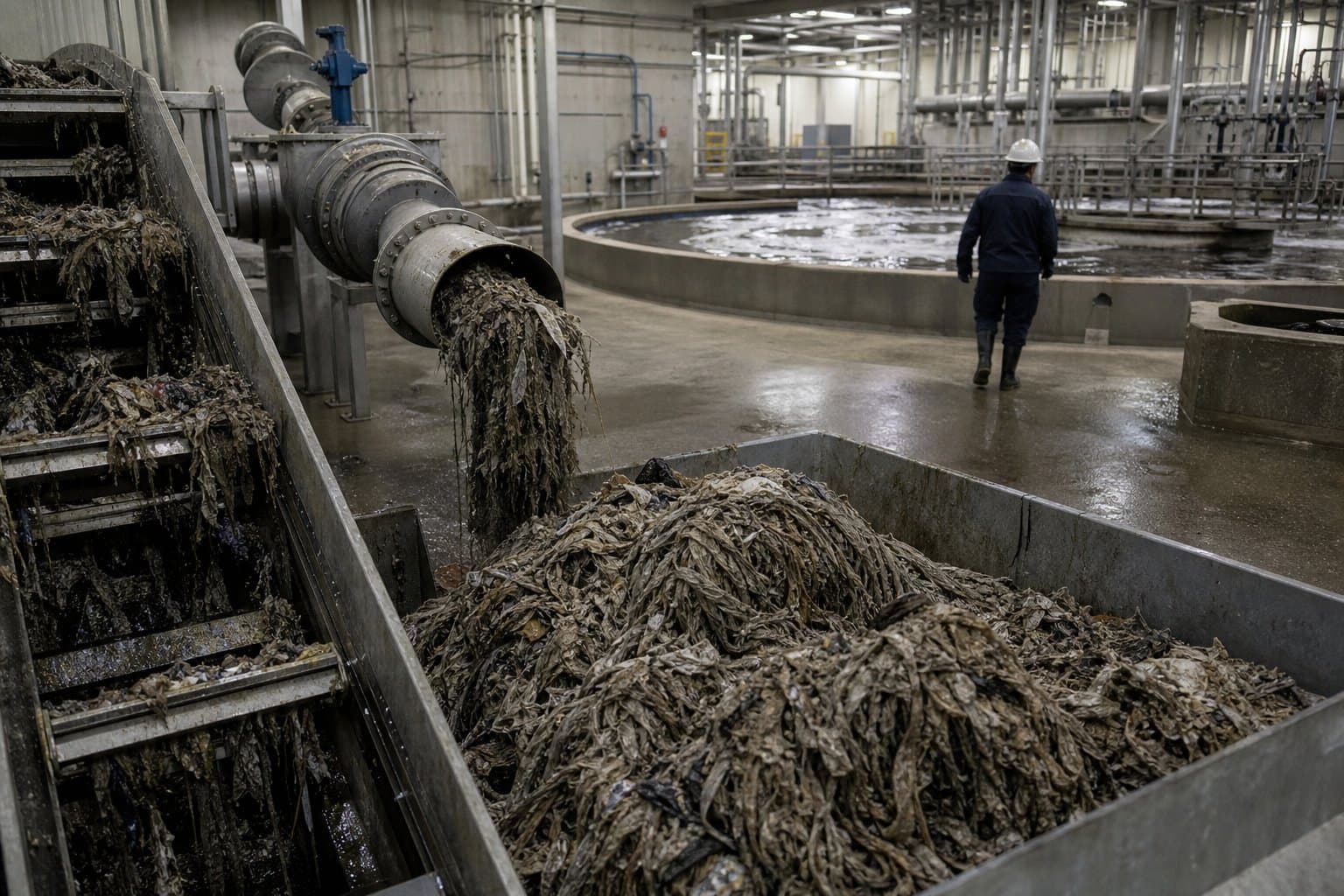
AI image
Anchorage Assembly takes up wipes ban in city sewers June 23
Flushing a disposable wipe in Anchorage could soon carry a fine of up to $1,000. The Anchorage Assembly is scheduled to take a first reading this week of an ordinance that would explicitly ban all disposable wipes from the municipal sewer system regardless of how the product is labeled.
Assembly Members Erin Baldwin Day and Zac Johnson sponsored the measure. It amends Anchorage Municipal Code Section 26.50.050 to add disposable wipes to the list of prohibited discharges and invokes existing Title 14 fines of $75 to $1,000 per documented violation.
The Scale of the Problem
The ordinance and memorandum cite several cost and volume estimates. Anchorage Water and Wastewater Utility's Asplund Wastewater Treatment Facility receives an estimated 6,000 to 7,000 pounds of wipes every day. In 2025, labor and landfill costs at Asplund alone reached roughly $208,000. Pump repairs and emergency responses across the broader collection system add thousands more. Since 2021, wipe-related blockages have caused at least 25 sanitary sewer overflows, backing sewage into Anchorage homes, streets, and green spaces, according to the ordinance text. The memorandum notes that wipes combine with fats, oils, and grease in sewer mains to form congealed masses, sometimes called fatbergs, that are a key driver of those overflows.
"For the wastewater industry, the cost of wipes in it is horrendous," Sandy Baker, AWWU's public outreach coordinator, said in a December 2024 Anchorage Daily News article attached to the ordinance memorandum. Brian Schmitz, superintendent of the Asplund facility, described the masses that form when wipes tangle in machinery. "We call 'em 'rope rags,'" Schmitz said in the same article.
Rate Relief and Resident Impact
The sponsors frame the ordinance partly as a rate-stabilization tool. The memorandum states that reducing wipe-related maintenance costs will slow upward pressure on sewer bills. The Assembly recently voted to allow a proposed roughly 5 percent rate increase for AWWU customers. If state regulators approve the plan, it would mean approximately $72 more per year on ratepayers' water bills.
The WIPPES Act, a federal labeling bill co-sponsored by former U.S. Representative Mary Peltola, passed Congress and was sent to the Senate, where it has remained in the Commerce, Science, and Transportation Committee.
Source: Anchorage Water & Wastewater Utility ().
Drafted with AI. Edited by Cale Green (1 revision). No full editor review is on record. Who is accountable.
Stay informed. Support what matters.
Free, permanent access to local news you can verify. Subscribe to support Walter AlaskaNews and go ad-free.
Related Coverage
Anchorage Assembly to vote Sept. 1 on two $4 million AWWU on-call repair contracts
Alaska News · 3w ago
Anchorage Assembly to vote Tuesday on $6.7 million wastewater bleach contract with lone bidder
Alaska News · 1mo ago
Anchorage weighs a $6.7 million bleach contract for its wastewater
Alaska News · 1mo ago
Anchorage Assembly to vote on health cost increase for operating engineers
Alaska News · 2mo ago
AWWU files new tariff revisions with Alaska regulators, opening public comment on Anchorage water and sewer rates
Alaska News · 2mo ago
Comments
Sign in to leave a comment.
No comments yet. Be the first to share your thoughts.