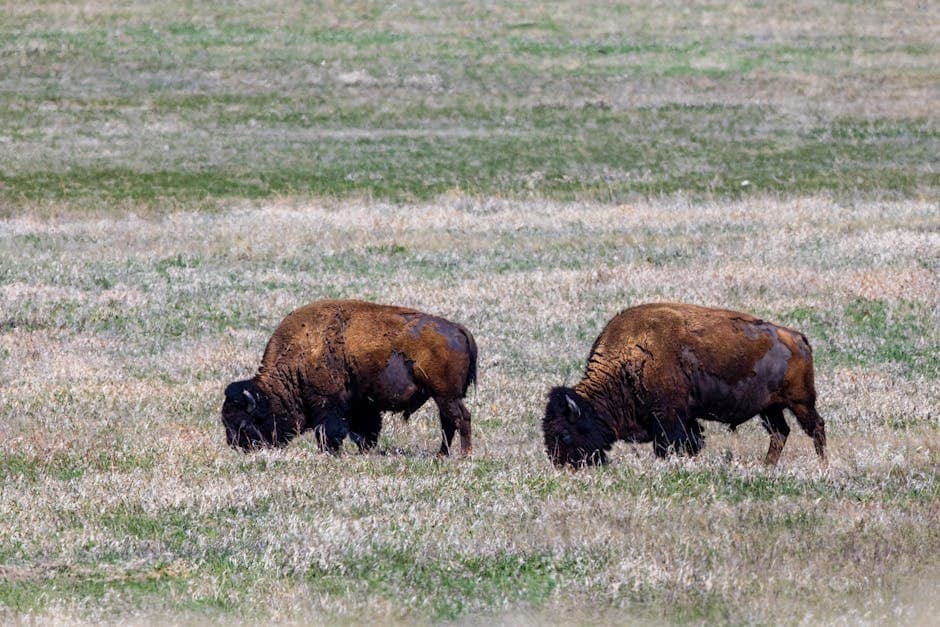
Photo by Aaron J Hill on Pexels · Photo source
Alaska wants to clear 1,000 more acres for the Delta bison herd
The Alaska Department of Fish and Game wants to clear about 1,000 acres of forest within the Delta Junction Bison Range to grow more grass for the herd that's been wintering there since the agricultural fields of Delta Junction made bison and farmers an awkward fit nearly a century ago.
The proposed clearing would add to roughly 3,000 acres of forage fields that were carved out of spruce forest in the mid-1980s, planted with perennial grasses, and managed ever since to feed the Delta bison herd through the long Interior Alaska winter. The new fields would be cleared, tilled, planted, and — like the existing ones — kept productive through ongoing tilling, prescribed burning, fertilization, and herbicide application. The project also calls for drilling new wells and installing additional water sources for the bison.
The bargain at the center of this work goes back to 1928, when 23 plains bison from the National Bison Range in Moiese, Montana, were crated and shipped to Fairbanks, then driven to a release point near the Delta River. The herd thrived — about 400 animals by 1947, roughly 500 by the 1950s. The problem was where they liked to spend winter. Bison preferred the same lowland river bottoms that homesteaders were turning into hay and grain fields, and as agriculture expanded — particularly with the Delta Agricultural Project authorized in 1979 — the conflict between bison and farmers grew expensive on both sides.
The Alaska Legislature's solution that same year was to set aside 90,000 acres east of Delta Junction and south of the Alaska Highway as the Delta Junction Bison Range, the only state-managed bison range in Alaska. In 1984, the Legislature appropriated $1.54 million for development; the next year, crews cleared and planted about 2,800 acres in nugget bluegrass and arctared fescue. The strategy worked. Drawing bison to engineered forage fields delayed their fall migration toward private farmland and reduced crop damage that had been the source of long-running grievance in the Tanana Valley.
The proposed 1,000-acre expansion is the next move in the same bargain. The project requires a federal Environmental Assessment under the National Environmental Policy Act because much of the funding comes through the U.S. Fish and Wildlife Service under the Wildlife Restoration Act — the federal program built on hunter-paid excise taxes that has funded state wildlife conservation since 1937. State dollars provide the required match.
The Delta bison herd is one of Alaska's most prized hunting opportunities. Permits are drawn through a lottery with notoriously long odds, and ADF&G manages the herd both as a conservation legacy and as a hunting resource on state land.
Public comment on what issues the environmental assessment should analyze is open through July 15. Written input should be sent to the U.S. Fish and Wildlife Service's Office of Conservation Investment at [email protected]. For more information on the project, contact Clint Cooper, ADF&G Wildlife Biologist, at (907) 459-7223 or [email protected]. The agency expects to complete the assessment this fall.
Based on a press release from Alaska Department of Fish and Game.
Made by our human newsroom with AI. How humans and AI work here · Grow with our newsroom
Stay informed. Support what matters.
Free, permanent access to local news you can verify. Subscribe to support Alaska News and go ad-free.
Related Coverage
Alaska is about to burn 54,000 acres on purpose, to grow more moose
Alaska News · 3mo ago
Alaska plans to burn the Alphabet Hills to grow more moose forage
Alaska News · 3mo ago
The state wants this gravel pit to be permanent.
Alaska News · 3mo ago
A new power line is proposed through a historic Delta park
Alaska News · 3mo ago
Nelchina caribou could be hunted again in 2027 under a state proposal
Alaska News · 3w ago
Comments
Sign in to leave a comment.
No comments yet. Be the first to share your thoughts.