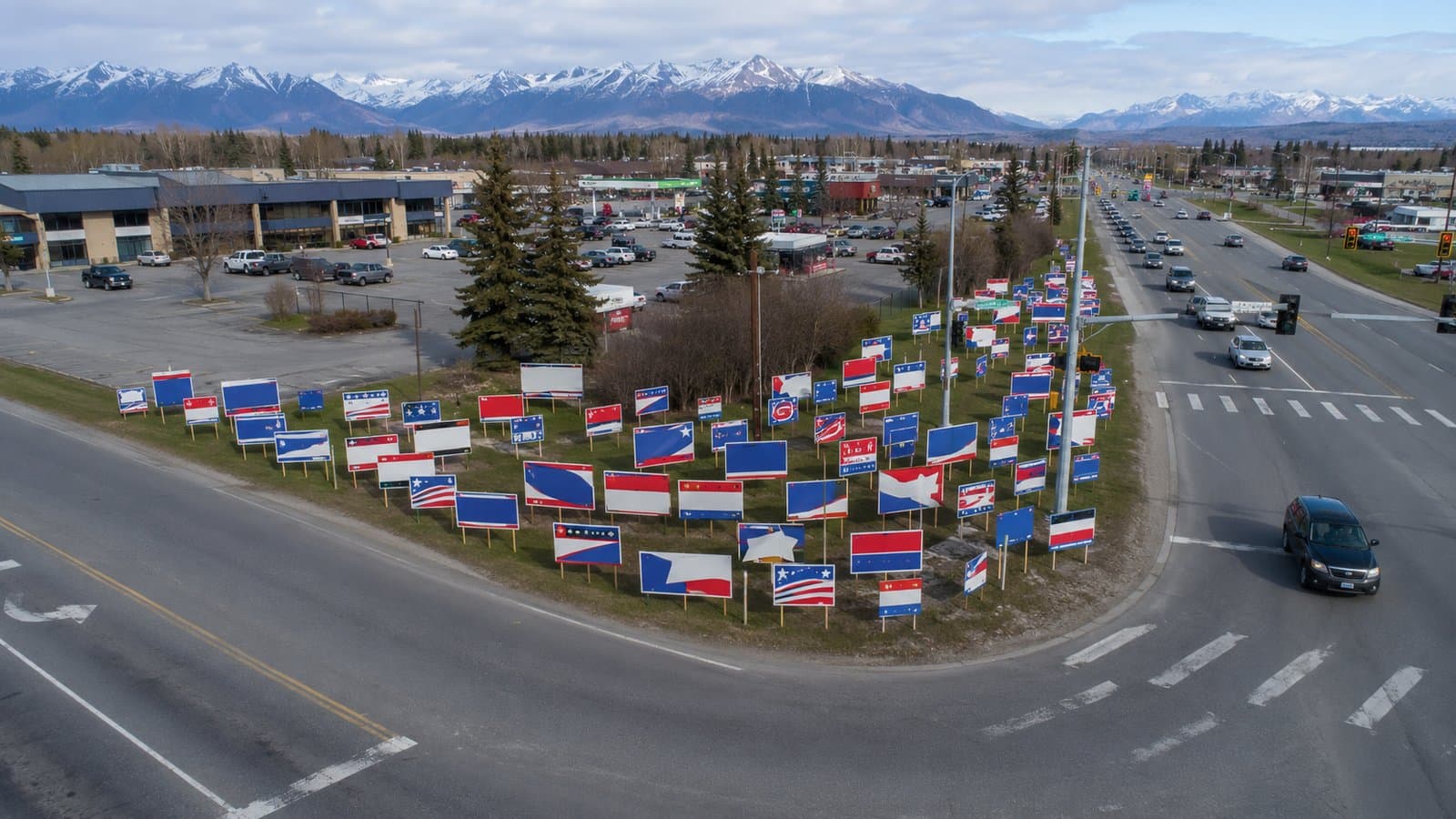
Poorly generated image. Obviously those are fake signs. Two red white and blue not enough Alaska, yellow, and blue.
Alaska banned billboards. Every election, candidates test whether the law means them too.
Alaska is one of a handful of states where you can drive for hours without passing a single billboard — not by accident, but because the voters outlawed them. So when campaign signs sprout along the highway shoulders each election season, they stand out. And every cycle, the Department of Transportation and Public Facilities sends crews to pull them down, accompanied by the same patient reminder that this is, in fact, illegal.
The ban isn't DOT's idea. Alaskans adopted it themselves in the Outdoor Advertising Law (AS 19.25.075–19.25.180), on a finding that billboards visible from the state's highways "endanger Alaska's uniqueness and its scenic beauty." It tracks the federal Highway Beautification Act of 1965 — and there's a hard incentive behind the housekeeping: if Alaska fails to enforce the rules, it puts its federal highway funding at risk.
Signs planted in a highway right-of-way are unauthorized encroachments, and DOT removes them. The agency casts its latest warning as ongoing enforcement, not a new ban — it issues some version of it every election — and says the signs block sightlines, distract drivers, obstruct maintenance crews, and create crash hazards. Signs near intersections and driveways come down first.
What makes the ritual a little absurd is that candidates already have a perfectly legal way to plant a sign — one a court had to hand them. In 2018, after the ACLU of Alaska sued DOT, the Alaska Superior Court ordered the state to allow small, temporary political signs on private property: no larger than 32 square feet — a standard 4-by-8 sheet of plywood — posted with the owner's permission, for no payment, and kept out of the right-of-way. The billboard ban survived intact; the carve-out for signs was made by litigation.
So the lawful path is well marked: ask a property owner, stay off the public shoulder. Signs that drift into the right-of-way instead are impounded, held about 30 days for the candidate to reclaim — for a fee covering removal — and then destroyed. The people campaigning to write Alaska's laws have until the next election to find the property line.
Based on a press release from Alaska DOT&PF.
Drafted with AI. Edited by Cale Green (1 revision). No full editor review is on record. Who is accountable.
Stay informed. Support what matters.
Free, permanent access to local news you can verify. Subscribe to support Walter AlaskaNews and go ad-free.
Related Coverage
DOT says cameras don't read plates; vendor policy allows video storage
Alaska News · 4w ago
Alaskans vote Tuesday on restoring campaign contribution limits
Alaska News · 1mo ago
Anchorage Assembly will vote June 23 on $214,684 for a pedestrian safety campaign
Alaska News · 3mo ago
DOT&PF cuts Chiniak Highway to 50 percent axle load during fishing season
Alaska News · 3mo ago
Alaska attorney general says law seating campaign finance commission is likely unconstitutional
Alaska News · 1mo ago
Comments
Sign in to leave a comment.
No comments yet. Be the first to share your thoughts.