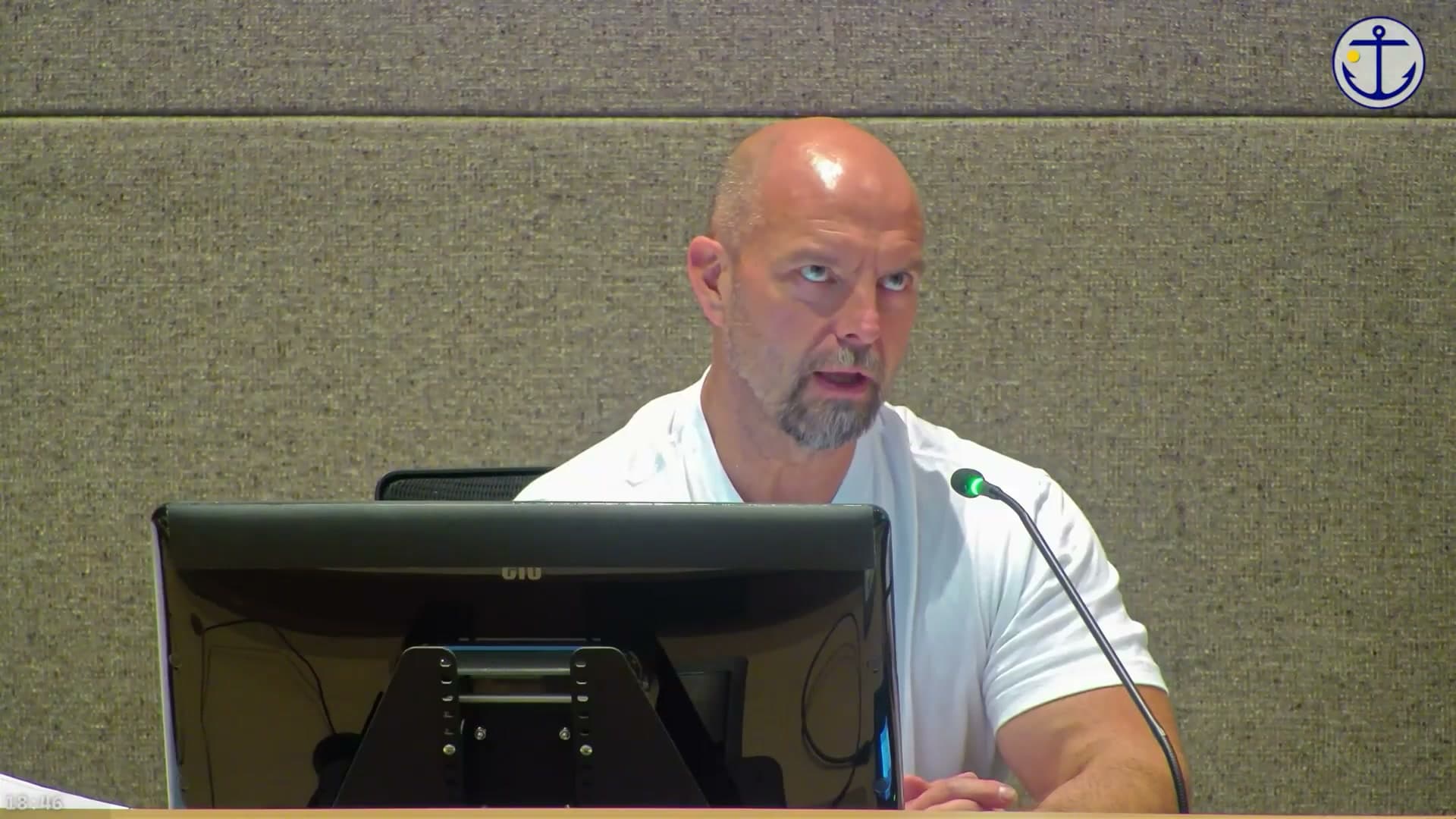
Frame from "Anchorage Assembly: Platting Board - July 1, 2026 - 2026-07-01 18:30:00" · Source
A Knik Arm bridge easement survives — and so does the debate
An easement for the long-debated Knik Arm Crossing will stay on a Port of Alaska subdivision plat, the Anchorage Platting Board decided Wednesday — a small procedural vote that keeps the door open, however slightly, on one of Alaska's most ambitious infrastructure ideas.
The board's reasoning was narrow: the easement already exists on a state Department of Transportation plat, and state authority supersedes the municipality's, so removing it from the city's version would change nothing. Board member Kevin Cross, who moved to leave it in place, also made the affirmative case for keeping it. "If it's not a realistic project, then the plat note doesn't matter," he said. "But if there is a remote chance, given our demographic challenges, and God only knows what the future looks like, having that in there could be future benefit that can't be measured right now."
That captures the real argument for the bridge, which the state has never fully abandoned. The Knik Arm Crossing would span roughly two miles of Cook Inlet to link Anchorage with Point MacKenzie and the fast-growing Mat-Su Borough. Its rationale, in the state's own project documents, is redundancy and growth: today the Glenn Highway is the only road connecting Anchorage and the Valley, a single point of failure in a disaster or a bad crash, and DOT has framed a second crossing as critical resiliency for a region with few routes. The project cleared federal environmental review, earned a Record of Decision in 2010, and entered the right-of-way phase — real milestones, not a napkin sketch. As recently as its 2019 report, DOT laid out what it would take to revive the project rather than bury it.
The skeptics have an equally real case, and they made it Wednesday. The bridge has no funding, appears in no current municipal or statewide transportation plan, and was paused in 2016 amid the state's fiscal crisis over a cost that has been estimated in the hundreds of millions to as high as $2 billion depending on scope and era. Government Hill resident and engineer Bob French urged the board to strip the note or require full funding first, arguing past toll-revenue projections were unreliable — "reverse engineering," he said, with traffic numbers worked backward from the revenue the project needed to pencil out.
The board threaded it by leaving the note untouched, wary that writing funding conditions into a plat could be either unenforceable or exploited. The plat itself does something more concrete: it splits about 48 acres of port land into two tracts, one headed for rezoning as a future park.
This article is based on a public meeting of Municipality of Anchorage — Anchorage Assembly: Platting Board - July 1, 2026 - 2026-07-01 18:30:00.
AI-assisted. How we use AI Transcript byLucas Brown
Watch key moments from the source meeting. Click to expand.
Stay informed. Support what matters.
Free, permanent access to local news you can verify. Subscribe to support Walter AlaskaNews and go ad-free.
Related Coverage
Anchorage's park rezone meets the Knik Arm bridge route
Alaska News · 1mo ago
Anchorage's next park would sit on the Knik Arm bridge route it has long fought
Alaska News · 1mo ago
A Corner of the Port of Anchorage Is Becoming a Park
Alaska News · 3mo ago
Anchorage P&Z recommends rezoning 7.9 acres of port land to parks
Alaska News · 2mo ago
Port of Alaska seeks road realignment for Chugach Electric substation
Alaska News · 1mo ago
Comments
Sign in to leave a comment.
No comments yet. Be the first to share your thoughts.