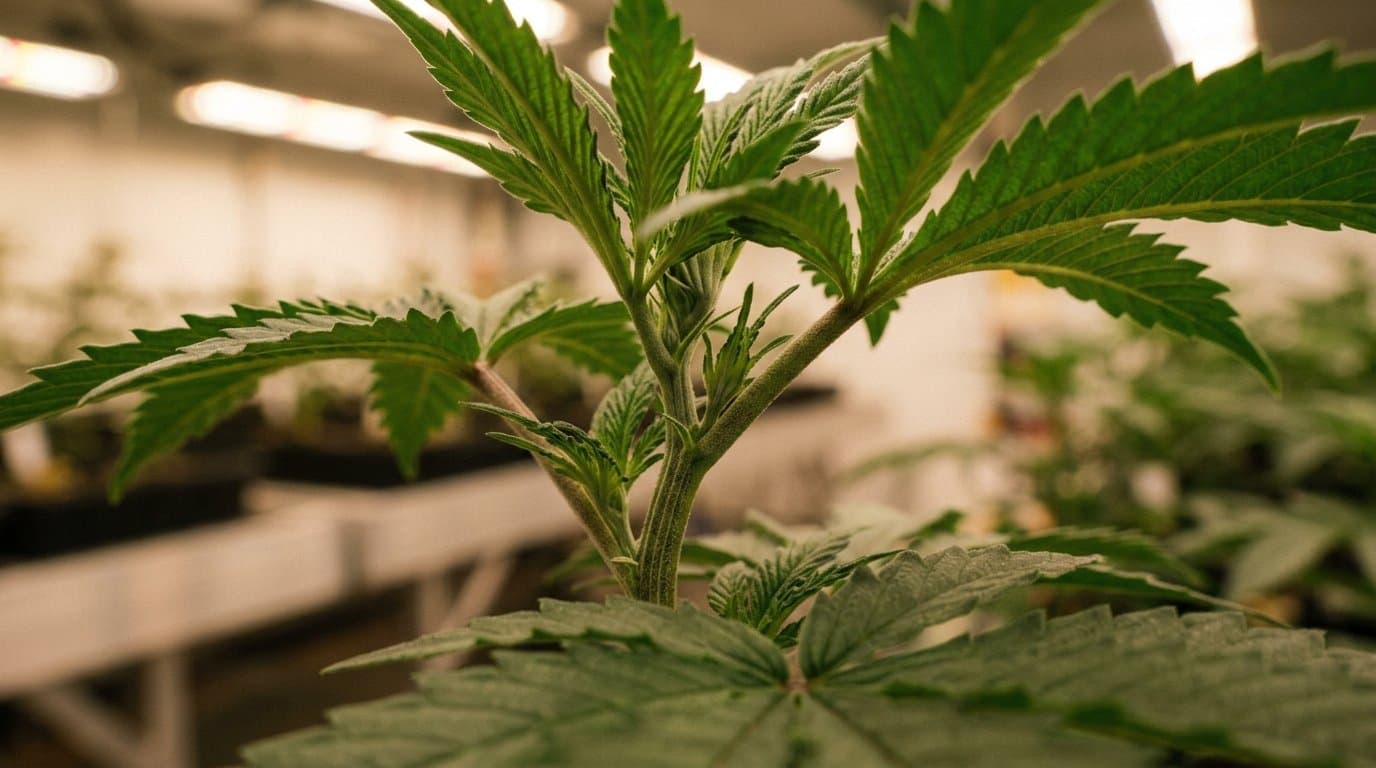
AI image
A decade in, Alaska's marijuana industry is squeezed by taxes as the state rewrites the rules
Ten years after Alaska legalized recreational marijuana, the industry is under real financial strain — and the state is spending this fall both cracking down on operators who've fallen behind and rewriting the rules they all operate under.
At its early-September meeting, the Marijuana Control Board took up ten cultivation and retail licenses that state staff can't renew, because their operators show up on the Department of Revenue's tax-delinquency list. Among them are Alaska Botanical Farms, Moon Forest Legends, Area 49 Farms, Alaska Tasty Cannabis and Rainforest Cannabis Cultivation. As of late August, the state counted roughly a dozen active and nearly forty inactive cultivation facilities behind on their excise taxes, owing about $6.3 million in all.
Normally the state renews these licenses as a matter of routine — the office's director has had that authority since 2017, unless there's a violation or a local government objects. Unpaid taxes don't automatically block a renewal, but they can't be quietly approved either, so each of these goes to the board. State law separately lets Alaska suspend a license until the taxes are paid in full. The Mat-Su Borough waived its right to protest its five flagged licenses, and the Kenai Peninsula Borough didn't object to one of its own.
The unpaid taxes point to a deeper squeeze. Alaska taxes marijuana at the cultivation stage — $50 an ounce of bud, due whether or not the product ever sells — one of the highest such rates in the country. As retail prices have fallen, growers have been caught between a fixed tax and a shrinking margin. Marijuana tax collections have slid from around $30 million a year at the industry's peak to roughly $25 million, according to state revenue figures, and the number of licensed growers has fallen sharply over the same stretch. Cultivators have told lawmakers the current structure is an existential threat, and bills to cut the cultivation tax or shift to a retail sales tax have been introduced, though the Legislature has been slow to act.
The financial pressure is only half of it. The state is also revising the rules the industry runs under — a rulebook now a decade old, getting a round of changes that range from consequential to housekeeping.
The biggest of them would change how the strength of edibles is measured. The board is weighing a switch from measuring "active THC" to "total THC," a formula that also counts THCA, a compound that converts to THC when heated. The serving cap stays the same on paper — 10 milligrams — but the math changes, meaning an edible that passes today could test over the limit tomorrow, without the product itself changing at all. Industry advocates warn it could force manufacturers to reformulate.
Another draft would drop the requirement that marijuana workers complete a state-approved training course before getting a handler permit, replacing the class and test with a criminal background check. The change would save workers the course fee — up to $500 — and narrow who needs a permit at all, dropping cultivation, manufacturing and testing workers from the requirement.
Other gaps are being left alone. At a February meeting, the board declined to define what a "non-flowering" plant is, even though the term appears in the rules — growers can begin operating with up to 12 "mature, non-flowering" mother plants, plus unlimited immature plants and seeds. Regulators noted the term is used but never defined. Board Chair Bailey Stuart said the existing definitions of "mature" and "flowering" were enough. Board member Lacy Wilcox read it more broadly, suggesting that for enforcement, "non-flowering" could mean "mothers, veg plants, clones, cuttings," with only the plants actively making buds in the flowering room counting as flowering. "Everything else is technically non-flowering," she said. The office's enforcement supervisor agreed the term is "more all-encompassing."
Ten years ago, the question in Alaska was whether a legal marijuana market could work at all. Now it is a different one: whether the operators who built it can stay afloat under the tax structure that helped fund the state, and what the rules look like on the other side.
Source: Marijuana Control Board, Marijuana Control Board: Definitions: immature, mature, flowering, non-flowering.
Made by our human newsroom with AI. How humans and AI work here · Grow with our newsroom
Stay informed. Support what matters.
Free, permanent access to local news you can verify. Subscribe to support Walter AlaskaNews and go ad-free.
Related Coverage
A decade after Alaskans legalized weed, the industry is thinning out
Alaska News · 2mo ago
Alaska Marijuana Control Board denies Anchorage cultivation license renewal over $633,000 tax debt
Alaska News · 10mo ago
An Anchorage marijuana grower has to pay its back taxes before it can keep growing
Alaska News · 2mo ago
A grower denied renewal in June is still listed as active, owing $664,440
Alaska News · 1mo ago
An Anchorage cannabis grower's license hinges on a $12,761 tax bill, with tonight the deadline
Alaska News · 2mo ago
Comments
Sign in to leave a comment.
No comments yet. Be the first to share your thoughts.