AI image
14 federal notices make 46 Alaska Native ancestors eligible for return, with two dates still open
Federal notices published since late May have cleared at least 46 Alaska Native ancestors and 14 cultural belongings for return from museums and federal agencies outside Alaska. Twelve of the dates on which return could begin have already passed. Two are still ahead.
The National Park Service published the 14 notices between May 28 and Sept. 9. Together they name 14 tribal governments, from the Sitka Tribe of Alaska to the Native Village of Mekoryuk. Under the Native American Graves Protection and Repatriation Act, the duty to tell the tribes rests with the institution, not the government.
Two dates still ahead
Beloit College's Logan Museum of Anthropology published on Aug. 24 for a headpiece of human hair from Wrangell Island, which the law treats as human remains. Repatriation may occur on or after Sept. 23. Princeton University published on Sept. 9 for one individual and two associated funerary objects, a snuff box and a drum buried with him, taken from a grave in Sitka. That date is Oct. 9.
Requests for the Beloit headpiece go to Nicolette B. Meister at the Logan Museum of Anthropology in Beloit, Wisconsin. Requests for the Princeton ancestor go to Lauren Jakobsson at the Princeton University Art Museum.
The Beloit headpiece is a cloth cap covered in matted tufts of hair, worn by Tom Ukas, 1879 to 1973, whose Tlingit name was Ghunaaneistí and who was Kiks.ádi from the Sun House in Wrangell. Ukas said in his own oral history that the cap was made of old scalps taken in war. The notice states that consultation identified a top knot of bound hair, and that top knots are worn by warriors going into war, which supports his account. The affiliation is to the Central Council of the Tlingit and Haida Indian Tribes.
Beloit bought the cap in 1963 from the Reverend Glen H. Ridnour, who had bought parts of a collection from the Saint Paul Gallery in 1959. The notice says the headpiece may be part of that collection, assembled between 1921 and 1944 by Axel Rasmussen, superintendent of schools in Wrangell and then Skagway, from the communities he served and from regional dealers. The Portland Art Museum bought the Rasmussen collection in 1948.
The Princeton remains were acquired by John Green Brady, a Presbyterian missionary and founder of the Sitka Industrial and Training School. Brady gave them to Sheldon Jackson, who confirmed receipt in a letter dated Feb. 2, 1880, referring to them as "the Medicine Man." The notice states that the snuff box and drum match collection records of items Brady removed from the grave. Princeton Theological Seminary donated the Jackson collection to the university's now-defunct Guyot Museum in 1881. The affiliation is to the Sitka Tribe of Alaska.
Older removals, longer trails
The largest single holding is at Case Western Reserve University, which reported 29 individuals donated in 1931 by Dr. I. Lester Furnas, a professor at its School of Dentistry. Furnas traveled to Alaska that year on a United States Public Health Service expedition to study Inuit dentition and provide dental services. The notice attributes 13 individuals to Nunivak Island, eight to Point Hope and four to Point Barrow, places two at one of those three and two in Alaska with no location given, and counts four children among the 29.
That Feb. 2, 1880 letter makes the Princeton ancestor the oldest removal in the 14 notices. The oldest after it dates to 1884, when Captain M.A. Healy took an individual from Point Hope and donated the remains to the Smithsonian. They went to the Army Medical Museum in 1886 and are now held by the Defense Health Agency's National Museum of Health and Medicine.
The Bureau of Land Management's Alaska State Office reported at least ten individuals from Kachemak Bay, five from the Yukon Island site and five from Cottonwood Creek on the north shore, along with 21 funerary objects buried with them. They are held at the University of Pennsylvania Museum, in the fourth notice on those sites after ones published in 1993, 2000 and 2023. The affiliation is to the Native Village of Nanwalek, the Native Village of Port Graham and the Seldovia Village Tribe. The University of Michigan reported one ancestor taken in September 1934 from about 40 miles northeast of Shishmaref. The same Anchorage office reported two ancestors removed from Unalaska Island in 1973 by an unknown person, later passed to the archaeologist Christy Turner and deposited at Arizona State University. The notice states no further contextual information is available.
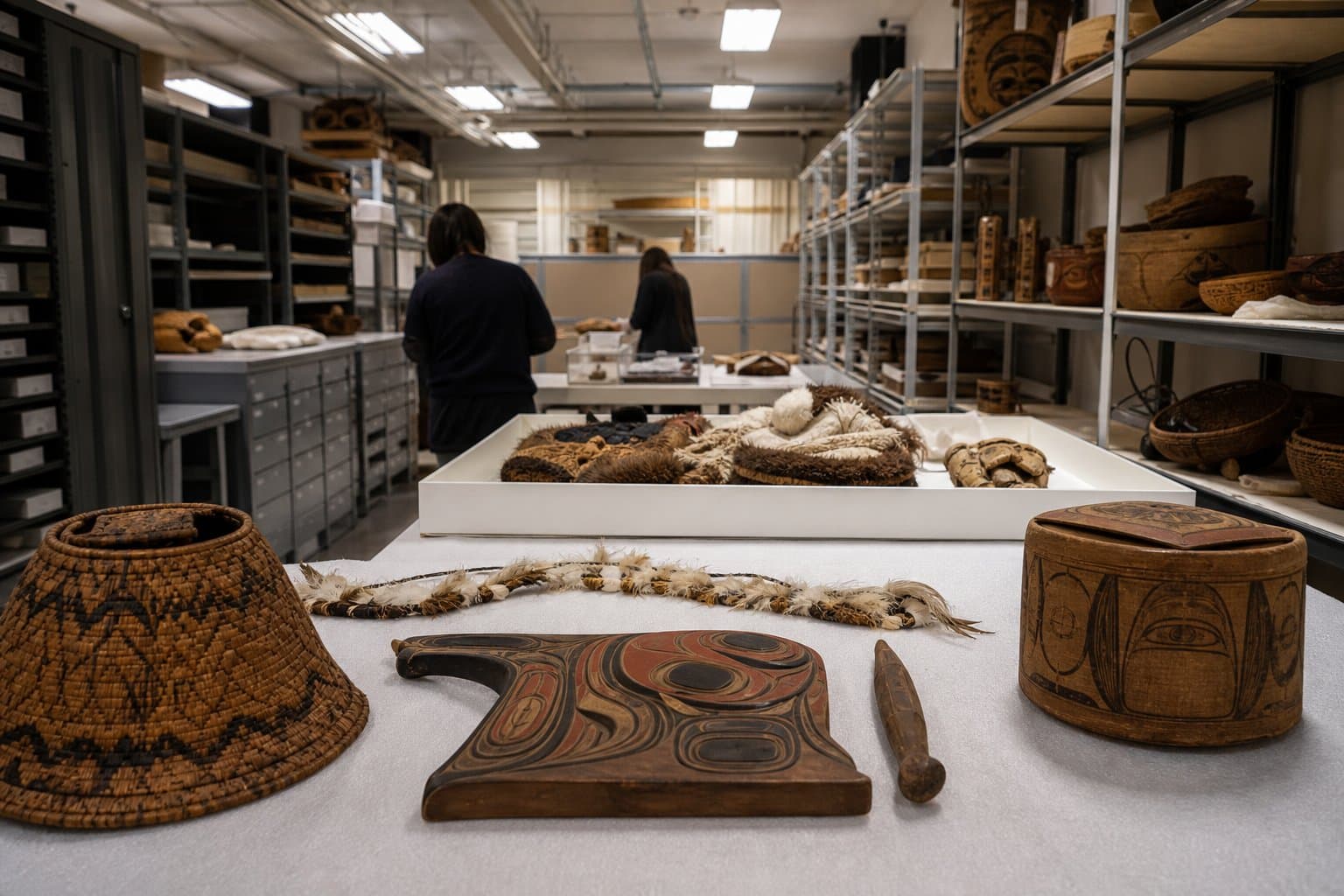
The Hudson Museum at the University of Maine reported five belongings held in common by a whole people, which the law calls objects of cultural patrimony. Among them is a Chilkat shirt attributed to the Tlingit weaver Annie Klaney, 1882 to 1965, or to Jenny Thlunaut, 1891 to 1986, which reached Maine through Morton D. May, Stendahl Galleries in Los Angeles and a 1982 bequest from William P. Palmer III. The Santa Barbara Museum of Natural History reported a Tsimshian amhalaayt, a chiefly headdress, that consultation identified as created and worn by Sm'oogyit Niishluut, Chief Sidney Campbell, a founding leader of Metlakatla. Major Max Fleischmann bought it from the Bear Totem Store in Wrangell in 1939. The Eiteljorg Museum reported four Tlingit and Haida objects taken from undisclosed sites in the nineteenth century, and describes its documentation of removal and transfer as scarce. The San Bernardino County Museum reported a twined bowl whose paper tag reads "Eyak Ind., Alaska."
A final rule published Dec. 13, 2023, and effective Jan. 12, 2024, replaced NAGPRA's regulations wholesale and requires museums and federal agencies to defer to tribal traditional knowledge. In response to comments, the rule allowed five years, rather than the two originally proposed, for institutions to consult and update inventories. That sets a deadline of Jan. 10, 2029. Alaska notices are not coming faster this year. A Federal Register search for them returns 16 through mid-September, against 19 by the same point in 2025, with nine in March 2025 alone.
The 46 figure is a floor. It is a sum across eight notices, each of which states a minimum rather than an exact count.
No record reviewed for this article establishes whether any tribe has requested the return of anything named in the 14 notices, whether the tribes were notified, or what has physically gone home after the twelve dates that have passed. The accounts here come from the notices, written by the institutions that hold the remains and belongings. No representative of any of the 14 named tribal governments is quoted in any of them.
Source: Fourteen federal notices since May have made 46 Alaska Native ancestors and 14 belongings returnable. Twelve of the dates have already passed ().
AI-assisted. No editor review is on record for this article. Who is accountable.
Stay informed. Support what matters.
Free, permanent access to local news you can verify. Subscribe to support Walter AlaskaNews and go ad-free.
Related Coverage
Wrangell elder's headpiece cleared for return from Wisconsin museum
Alaska News · 6d ago
BLM Alaska to repatriate Native remains and cultural items under three federal notices
Alaska News · 3mo ago
Kodiak Island artifacts set to leave Maine museum under NAGPRA
Alaska News · 2mo ago
A Tlingit infant, held for years in a Seattle museum, is coming home to Petersburg
Alaska News · 3w ago
Army plans to return four Alaska children's remains from Carlisle
Alaska News · 1w ago
Comments
Sign in to leave a comment.
No comments yet. Be the first to share your thoughts.