Dan Stickel
71:02 - 71:50
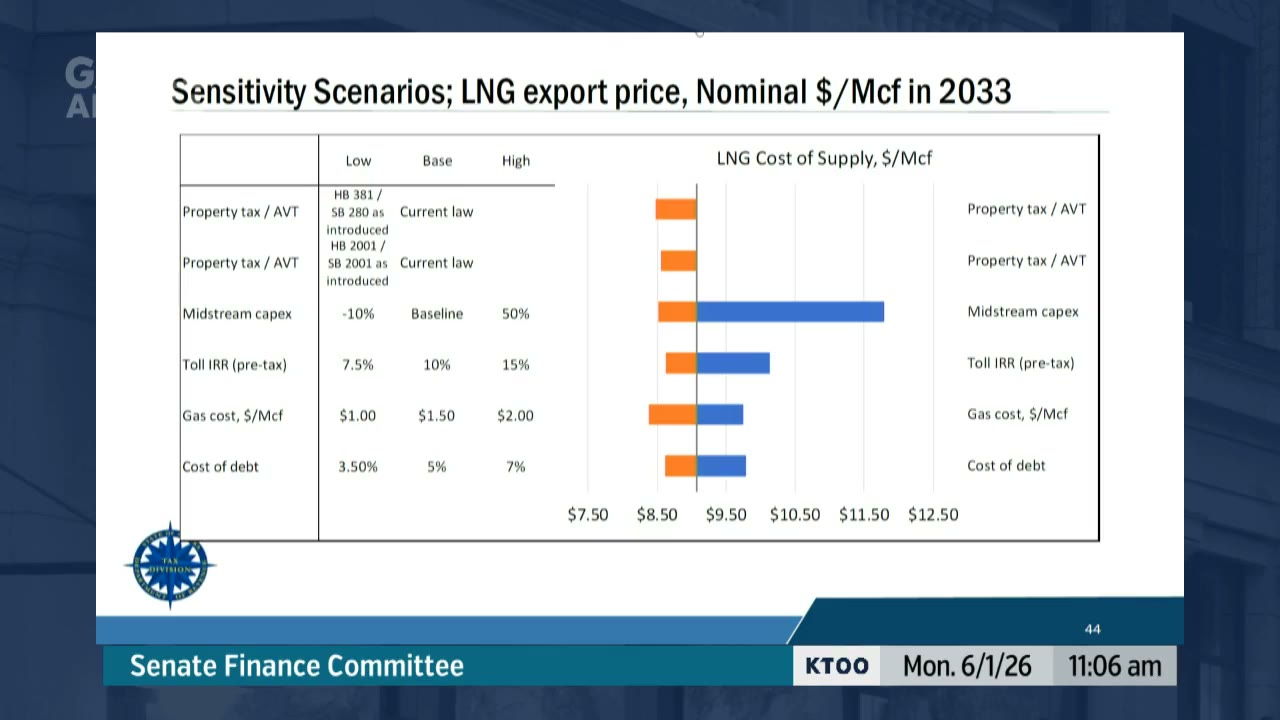
"you can see that the replacing the property tax with the alternative volumetric tax decreases that cost of supply by about $0.50 per thousand cubic feet. If capital costs were to come in 10% below our assumption, it would have a similar impact. And we can see here that if capital costs were to come in significantly higher than what we're assuming, that would have really the largest impact of any of these variables on the economics of the project"
“you can see that the replacing the property tax with the alternative volumetric tax decreases that cost of supply by about $0.50 per thousand cubic feet. If capital costs were to come in 10% below our assumption, it would have a similar impact. And we can see here that if capital costs were to come in significantly higher than what we're assuming, that would have really the largest impact of any of these variables on the economics of the project”
- Speaker
- Dan Stickel
- Timestamp
- 71:02 – 71:50
- Community
- Alaska News
- Captured at
- June 1, 2026
From the transcript
How do some select assumptions sensitivities impact that cost of supply? And you can see that the replacing the property tax with the alternative volumetric tax decreases that cost of supply by about $0.50 per thousand cubic feet. If capital costs were to come in 10% below our assumption, it would have a similar impact. And we can see here that if capital costs were to come in significantly higher than what we're assuming, that would have really the largest impact of any of these variables on the economics of the project and what the delivered cost of supply would be. So that is a very important assumption.
Related Coverage
Senate Finance hears $18 billion revenue trade-off for Alaska LNG tax break
Alaska Senate Finance Committee reviews fiscal analysis of proposed tax structure for Alaska LNG project, showing $18 billion combined revenue reduction over project life in exchange for improved global price competitiveness.
 by Bill AlaskaNews3mo ago2 min readAI