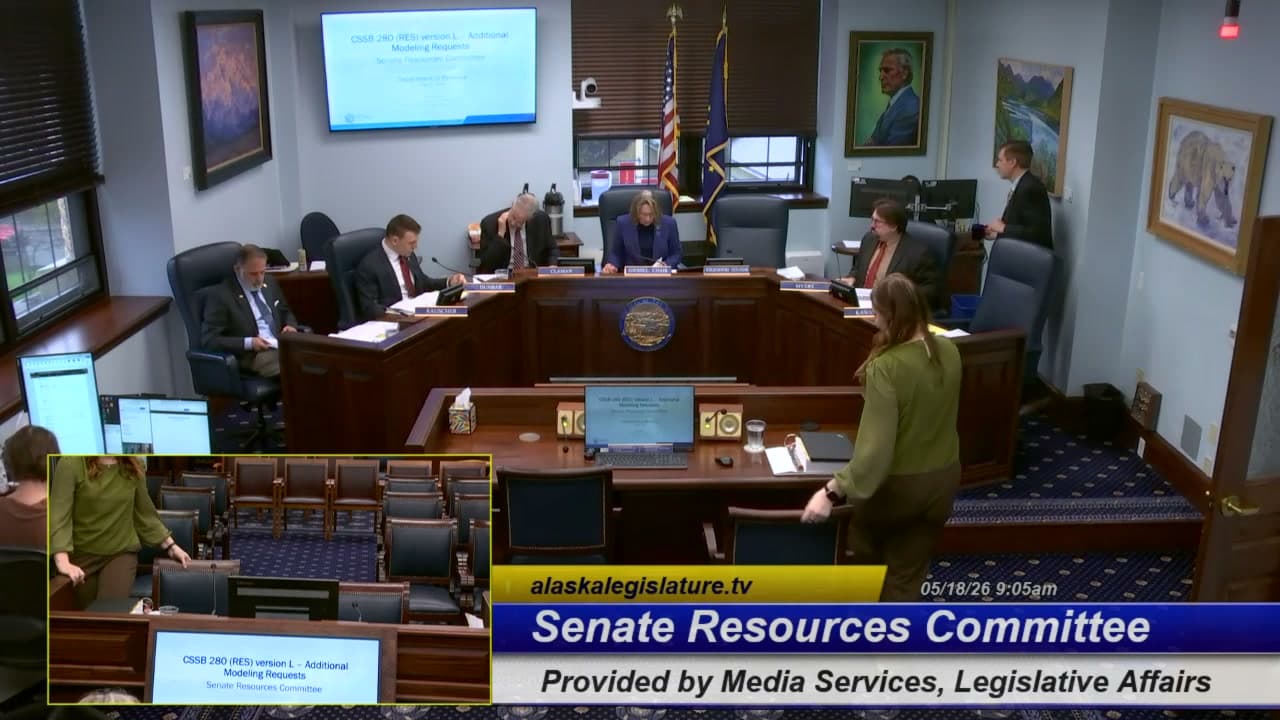
Senate panel reviews oil tax floor increase projecting $132M annual gain
The Alaska Senate Resources Committee on Monday reviewed Department of Revenue modeling showing that increasing the state's minimum oil production tax floor from 4% to 6% would generate an average of $132 million in additional annual revenue over the next decade, though the analysis revealed complex interactions with existing tax provisions that could reduce revenue in certain years, according to the department's presentation.
The committee first adopted a committee substitute, Version S, as its working document before hearing the modeling presentation, which was one of several analyses requested from the Department of Revenue, mostly received the previous Wednesday.
The analysis, presented by Owen Stevens, a commercial analyst with the Department of Revenue's Tax Division, projected the higher floor would increase state revenue in most years between fiscal year 2027 and fiscal year 2036, peaking at $199 million in 2033. The modeling showed a negative revenue impact of $50 million in fiscal year 2034, reflecting how the increased floor would affect companies' ability to apply carryforward lease expenditures and interact with per-barrel tax credits.
Alaska's oil production tax has been the subject of repeated legislative revision since the state replaced Alaska's Clear and Equitable Share system with the More Alaska Production Act in 2013. The current system calculates tax as the greater of a 35% net tax or an applicable minimum tax floor, which stands at 4% of gross value at the point of production when North Slope oil prices exceed $25 per barrel. The Alaska Legislature has considered multiple bills in recent years to adjust per-barrel credits, corporate income tax treatment, and minimum tax floors for oil producers, with the Senate Rules Committee introducing Senate Bill 114 in March 2023 to raise corporate income tax rates and reduce per-barrel credits.
Stevens cautioned that the production tax system is very complex, with multiple interacting provisions, and that the numbers were based on a preliminary interpretation of bill provisions. "Many of the provisions here would need to be addressed through regulations," Stevens said. "I'm an economist, not an auditor."
The department modeled the increased floor in two ways: first by examining impacts on the spring 2026 revenue forecast for existing North Slope production, and second by analyzing how the change would affect revenue from a potential Alaska LNG project. Stevens noted that the two models were "not necessarily directly joined to each other" and that a full company-by-company integration could potentially change results to some extent, though directionally the numbers should be reasonable.
The combined modeling showed total revenue impacts ranging from negative $50 million to positive $243 million depending on the year, with the variation driven by how companies would apply lease expenditures under different minimum tax scenarios.
Stevens explained that as the minimum tax floor increases, some companies cannot use as many carryforward lease expenditures in earlier years, leaving larger balances to deduct in later years. This dynamic creates the counterintuitive result of lower state revenue in fiscal year 2034 under the 6% floor compared to the 4% floor, despite the higher gross tax rate.
The Alaska LNG project modeling, conducted separately from the spring forecast model, showed an average annual impact of $16 million from fiscal years 2027 through 2036 when the higher floor was applied. Stevens noted this was "incremental revenue" and "not in addition to the production tax modeling I just showed based on forecast." In early years, the increased minimum tax limited lease expenditures companies could apply against tax, producing positive revenue impacts. In later years, the interaction between the floor and net tax calculations produced more complex results.
Senator George Rauscher questioned the terminology used in the presentation, asking why the analysis referred to the "minimum tax floor top rate" rather than simply the minimum tax floor. Stevens acknowledged the phrasing was imprecise and said the word "top" could be removed, noting that at oil prices below $25 per barrel, the minimum tax percentage gradually decreases to 1%.
The committee did not take action on the oil tax floor analysis Monday. The presentation was part of a broader set of modeling requests the committee made to the Department of Revenue regarding Senate Bill 280, the Gasline for Alaskans Act, which the committee has heard in 35 of its 63 meetings this legislative session.
The committee adjourned at 10:00 a.m. and planned to reconvene at 3:30 p.m. to continue reviewing additional modeling scenarios.
This article is based on a public meeting — SRES-260518-0900 ().
AI-assisted. How we use AI Transcript byLucas Brown
Stay informed. Support what matters.
Free, permanent access to local news you can verify. Subscribe to support Bill AlaskaNews and go ad-free.
Related Coverage
Senate panel advances gas pipeline bill with oil tax floor increase
Alaska News · 4mo ago
Gas tax hike could net Alaska $590M over pipeline life, analysis shows
Alaska News · 4mo ago
Gas pipeline bill adds oil tax increase, industry calls process rushed
Alaska News · 4mo ago
Department of Revenue presents Senate Finance with Alaska LNG breakeven modeling across cost and tax scenarios
Alaska News · 3mo ago
Department of Revenue presents Senate Finance with 25-scenario sensitivity analysis on Alaska LNG fiscal impact
Alaska News · 3mo ago
Comments
Sign in to leave a comment.
No comments yet. Be the first to share your thoughts.