Municipal League urges local control in Alaska LNG tax negotiations
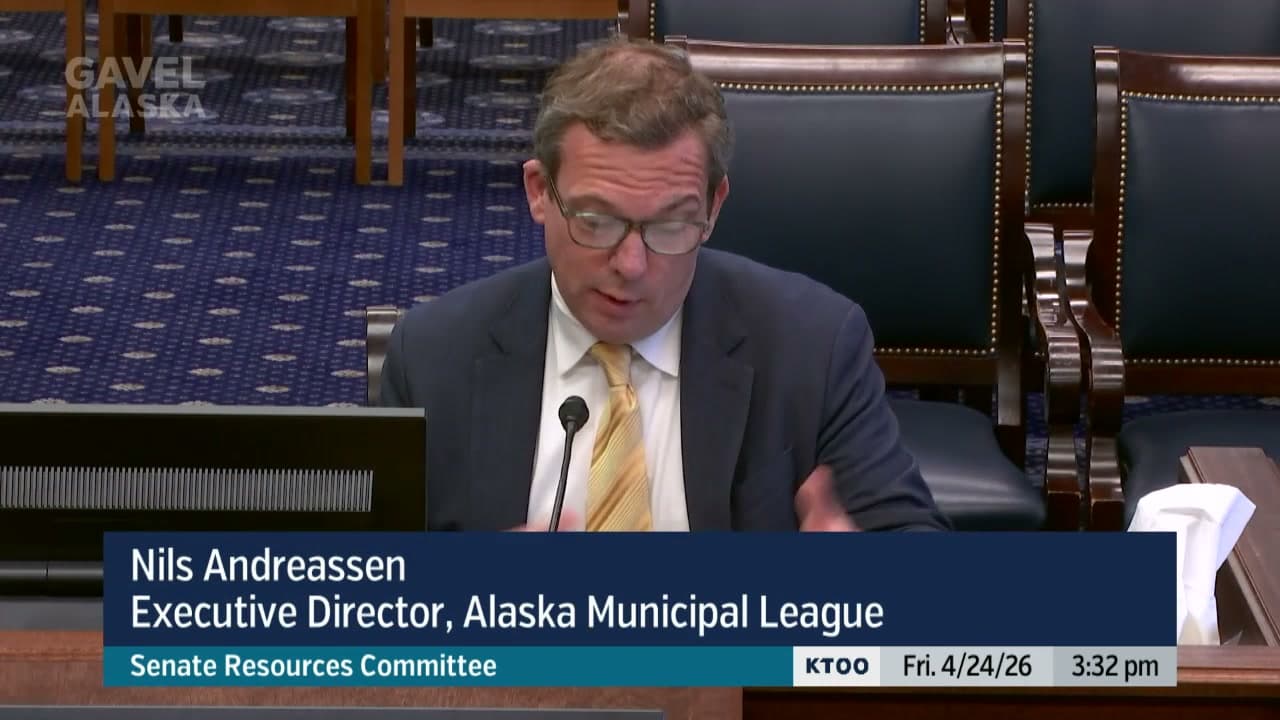
The Alaska Municipal League told state senators Friday that local governments need the power to negotiate their own tax agreements with the Alaska LNG project developer rather than accept a statewide formula.
Nils Andreassen, the league's executive director, testified that member communities want tools to address project impacts that vary widely from borough to borough. He proposed adding language to Senate Bill 280 that would let municipalities negotiate economic development exemptions individually, similar to authority they already have under general property tax law.
"Under statute AS 29.45.050(m), municipalities may adopt ordinances to provide partial or total property tax exemptions or deferrals for economic development property for up to five years," Andreassen said. "That is a tool that could be applied in the case of oil and gas property tax."
The legislation comes after Gov. Mike Dunleavy floated a proposal late last year to cut the property tax rate by 90 percent for the Alaska LNG project. Local governments criticized that proposal, which would have reduced their property tax revenue by 90 percent. Municipalities would have had to forego revenue that otherwise helps them deliver essential services, relieve tax burdens on residents and other businesses, meet deferred maintenance needs, and invest in infrastructure. The governor introduced SB 280 on March 20 in response to that criticism.
The Senate Resources Committee is working through a committee substitute that breaks the project into three components: the gas treatment plant, the pipeline, and the LNG export facility. Each would receive different tax treatment. The current version would split some revenue between the North Slope Borough and Kenai Peninsula Borough while directing other portions to a community impact fund.
Andreassen said that structure moves in the right direction by recognizing impacts beyond the two boroughs that contain most of the infrastructure. But he stopped short of endorsing the committee substitute. The league's December resolution called for not touching oil and gas property taxes at all.
"The original version of the bill is not consistent with the resolution that members passed," Andreassen said. "One, our resolution says do not touch oil and gas property taxes."
The original bill introduced by the governor would have capped local property tax revenue at roughly 10 percent of what boroughs could otherwise collect. The committee substitute increases that amount, though Andreassen said local officials still question whether it covers construction and operational impacts.
"Big projects, or any for that matter, have an impact within a community," Andreassen said. "A project of this scale has impacts at scale, affecting not just the socioeconomic fabric of a community, but creating real bottlenecks for services and burdens on infrastructure. We have heard that these impacts range from public safety and housing to local roads, land management, and so many others."
Senator Click Bishop asked whether communities had weighed lower utility costs against reduced tax revenue. Andreassen said energy security matters to local governments, but they need better modeling of what final costs would look like for residents and businesses.
"Ultimately, what will the end cost look like for electricity or other types of energy costs that they need?" Andreassen said. "More modeling or some kind of assurance of what those final numbers look like. And I think what I have heard is at least some doubt in what has been presented."
Vice Chair Bill Wielechowski noted that the project developer has told utilities to expect gas prices between $16 and $18 per thousand cubic feet in Phase 1, compared to current Anchorage prices around $10 to $12. That represents a 60 to 80 percent increase, he said, with potential for much higher costs if the export facility is never built.
"What we have been told by Glenfarn is that, I know there is this thought out there that when this goes through, we are going to have $4.50 gas," Wielechowski said. "And that is not the case. Maybe down the road if Phase 2 is done, but in Phase 1, we are looking at $16 to $18 gas with this project."
Andreassen said the league resolution from December offers a path forward that does not require immediate legislation. It calls for convening the Municipal Advisory Gas Line Project Review Board, establishing an impact mitigation fund, including local governments in workforce development planning, and working within local permitting processes.
"AML and its members offer to be partners, to convene and facilitate, to work together across jurisdictions with the project proponent to find agreement prior to the final investment decision," Andreassen said. "That offer has been in place since December."
Senator Lesil McGuire asked whether the league supports passing legislation this session or waiting until next year. Andreassen said he lacks guidance from members on timing, but noted that local governments cannot negotiate individually under current law.
"It does suggest that there is a greater imperative to pass something sooner," Andreassen said. "Even if not everything is included or not everything is right, some of those elements could be passed without some of the broader implications that are currently being considered."
The committee also received written responses from the Regulatory Commission of Alaska on questions about federal versus state jurisdiction over the pipeline. Senate Majority Legal Counsel Sonya Kawasaki said the commission indicated uncertainty about whether the Federal Energy Regulatory Commission would retain authority if only the in-state portion of the pipeline is built.
FERC approved the full Alaska LNG project in 2020 as an integrated system including the pipeline and export facility. But the current plan calls for building the pipeline first to deliver gas to Southcentral Alaska, with the export facility coming three or more years later.
"FERC may cede its authority over the intrastate portion of the pipeline to the state regulator," Kawasaki said, reading from the commission's response. "In practice, FERC has almost invariably done so."
The committee will continue work on the bill Monday when the Department of Revenue testifies. The session ends in less than 30 days.
This article is based on a public meeting — Alaska Legislature: Senate Resources, 4/24/26, 3:30pm ().
AI-assisted. How we use AI Transcript byLucas Brown
Stay informed. Support what matters.
Free, permanent access to local news you can verify. Subscribe to support Alaska News and go ad-free.
Related Coverage
Senate panel weighs municipal concerns over Alaska LNG tax structure
Alaska News · 4mo ago
Alaska LNG seeks 90% property tax cut; Kenai Peninsula pushes back
Alaska News · 3mo ago
Senate panel examines regulatory questions on gas pipeline tax plan
Alaska News · 5mo ago
Mayors Oppose Alaska LNG Tax Bill, Cite Revenue Concerns
Alaska News · 6mo ago
Denali Borough mayor opposes state control of pipeline tax payments
Alaska News · 5mo ago
Comments
Sign in to leave a comment.
No comments yet. Be the first to share your thoughts.