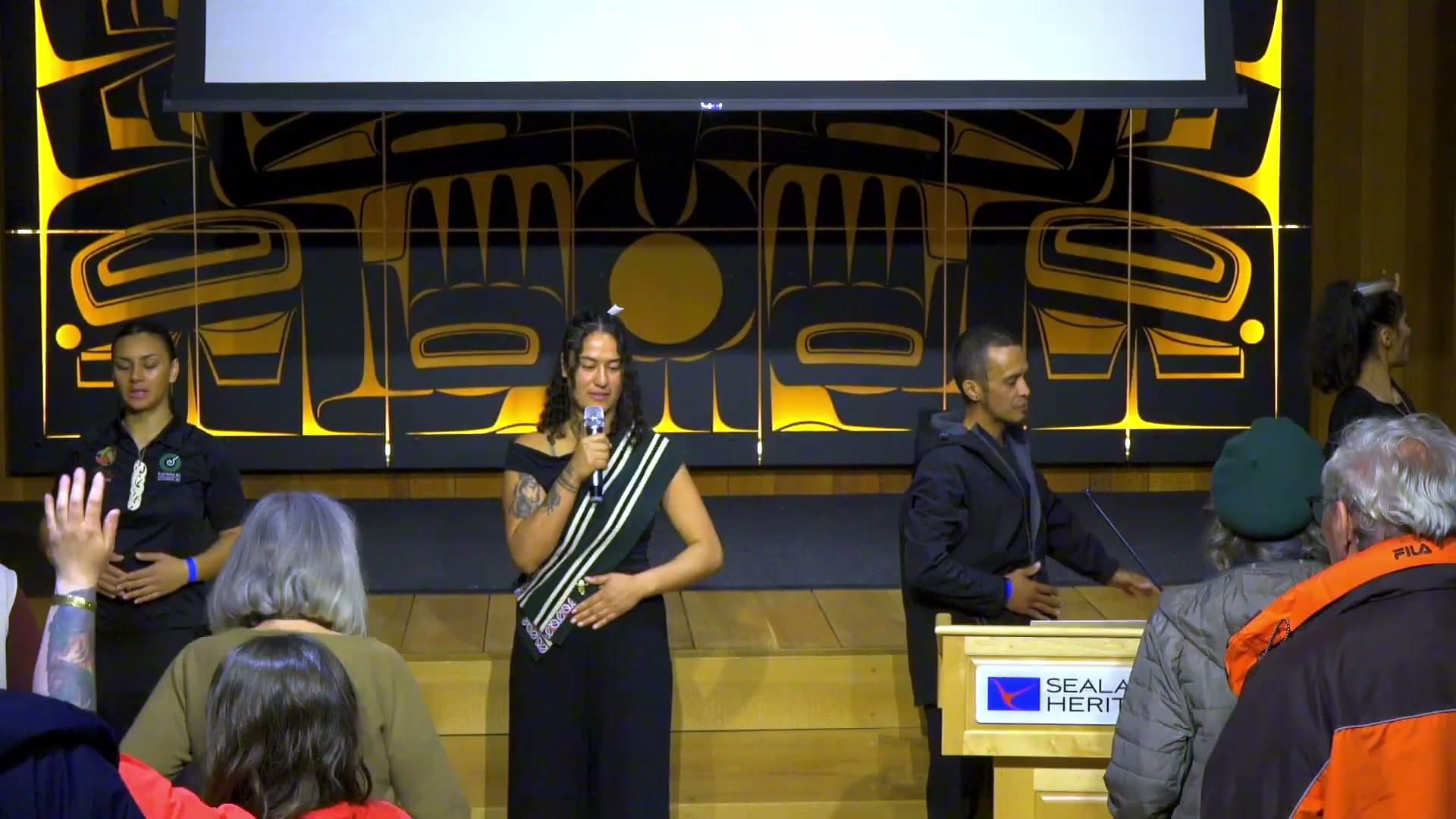
Frame from "Sealaska Heritage Institute: Māori yesterday, Māori today, Māori tomorrow, Te Ara Kuaka | Sealaska Heritage" · Source
Māori delegation brings holistic wellness framework to Juneau, finding common ground with Alaska Native practice
A Māori delegation visited Sealaska Heritage Institute in Juneau and walked a room of Alaska Native community members through Te Whare Tapa Whā, a holistic model of health developed by Sir Mason Durie in 1984 that treats spirit, mind, body, and family not as separate health categories but as four walls of a single house: remove one, and the structure falls. Connection with the whenua, or land, forms the foundation of the model, and imbalance in any dimension affects the whole.
The group, Te Ara Kuaka, named themselves after the bar-tailed godwit, a migratory bird that, as one presenter described it, only lands in two places: Aotearoa New Zealand and Alaska, with no stops between them. One presenter described a rugby injury and how the physical damage cascaded outward into mental state, spirit, and family connection. "Just through one example of something happening to your tinana, it can also affect the other sides of your hauora as well," she said. "So without one, you can't have the other, and when one falls, so do all." A second speaker explained the relational dimension of identity through pepeha, the practice of locating yourself through your mountain, your river, your clan. "These are not things that I own," he said. "These are things that I belong to."
The presentation moved through each of the four dimensions in turn: physical wellbeing (taha tinana), mental and emotional wellbeing (taha hinengaro), spiritual wellbeing (taha wairua), and family and social wellbeing (taha whānau). It included demonstrations of traditional Māori games and movement practices. Presenters connected those games to the group's earlier visit to Juneau for Arctic sports, describing the exchange as the foundation of the relationship between the two communities.
The session carries weight in Alaska because Māori wellbeing frameworks have moved well beyond community settings. Te Whare Tapa Whā informs New Zealand government health policy, and the Whānau Ora framework builds on it as an evidence-based approach to delivering social and health services. Sealaska Heritage Institute President Rosita Kaaháni Worl, an anthropologist and member of the Tlingit Nation, closed the session by acknowledging that the Alaska Native language revitalization movement has drawn on Māori example. "It was the Māori people who led the way for language revitalization," Worl said. "It was not just methods, it was the power, the determination, and also the realization that we could revitalize our languages that were almost extinct." She also connected the hauora framework to a broader social diagnosis: a scholar she had recently heard argued that Americans are lonely because "we have lost ritual in our lives."
Worl observed that the presentation revealed shared elements between Māori and Alaska Native approaches to wellness. "I could see that we share many of the same elements in our society where we have our current generations that are connected to our ancestors and also have responsibility for future generations," she said. The session grew interactive toward its close, with audience members asking about honoring local iwi when visiting Aotearoa, the practice of , language learning, and the presenters' choice to go barefoot. One speaker linked that practice to staying connected to the earth and noted it is now supported by research on grounding and inflammation.
AI-assisted, reviewed by editors. Spot an error?
Comments
Sign in to leave a comment.
No comments yet. Be the first to share your thoughts.