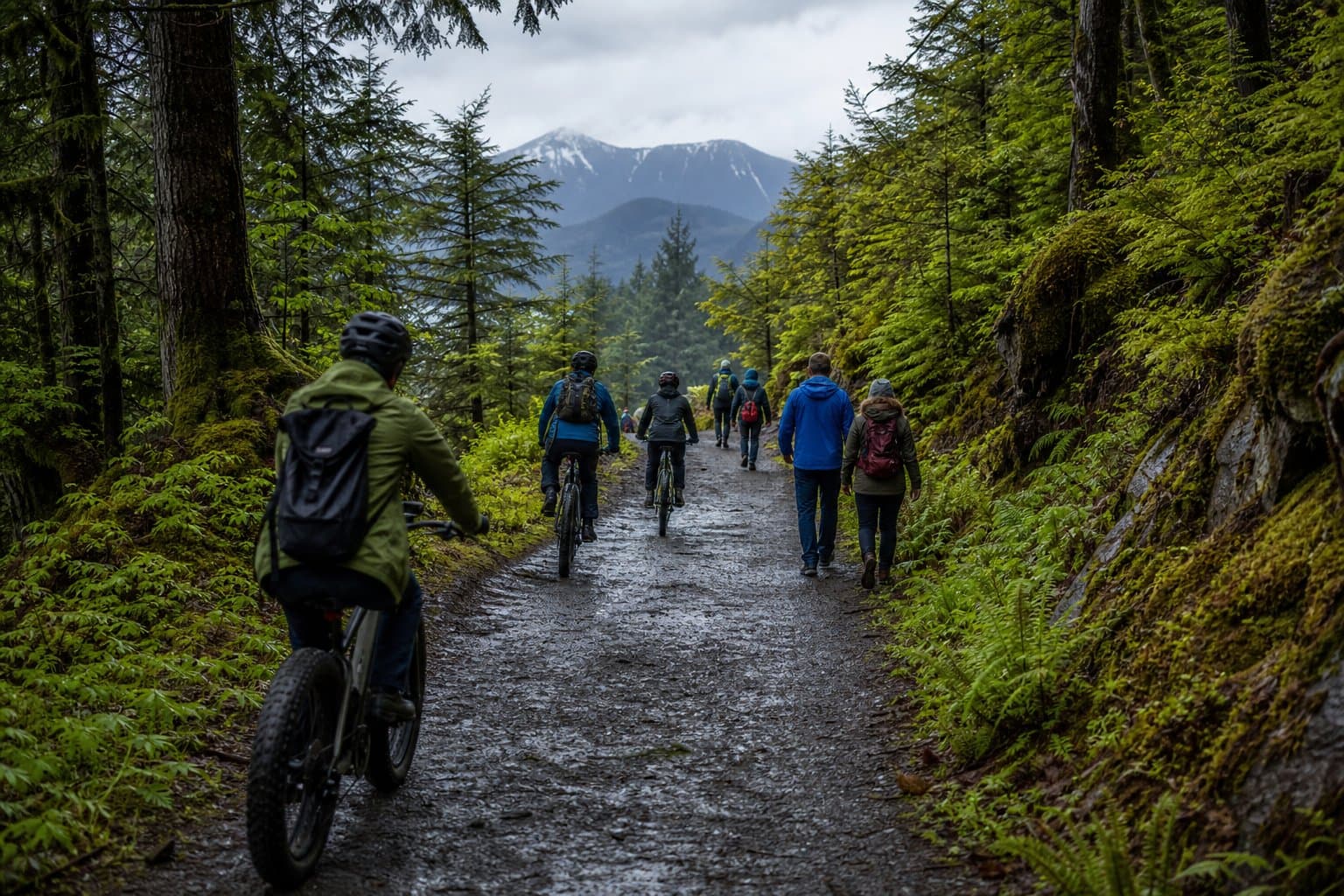
AI image
Juneau may bar the fastest e-bikes from its trails — but not the most common ones
A draft the City and Borough of Juneau's parks committee takes up July 7 would set new rules for electric bikes on local trails — and, for all the worry around it, it isn't a ban. It would keep the most common kind of e-bike on trails already open to bikes while barring faster, throttle-driven models from parks closed to motor vehicles. The whole thing turns on a distinction most riders have never had spelled out: the e-bike "class."
There are three. A Class 1 assists only while you pedal and cuts the motor at 20 mph — the closest thing to a regular bike, with a boost on the hills. A Class 2 adds a throttle, so it can move without pedaling, also capped around 20. A Class 3 returns to pedal-only assist but carries you to 28 mph. Juneau's draft would let Class 1 stay on trails already open to bicycles and push Class 2 and 3 off non-motorized parkland unless a spot is posted otherwise.
Parks Director Marc Wheeler says the push follows a real trend — bikes that "have gotten much faster in recent years," with the potential to damage trails and create safety hazards — and that Juneau is following an approach common nationally and in line with Alaska State Parks. The evidence, such as it is, mostly backs the line the draft draws: the limited research on e-bikes and trails, including a U.S. Forest Service assessment in California, has generally found Class 1 models no harder on trails or on public safety than an ordinary mountain bike. The sharper concerns about speed attach to the faster throttle classes, which almost no one has studied.
The catch is who else gets swept up. A blanket line against Class 2 and 3 also shuts out commuters and, especially, older or mobility-limited riders who lean on a throttle not for speed but to ride at all — and the draft offers them no exception.
None of this is settled. The committee is only being asked whether to forward the draft to the CBJ Assembly, which would have the final say. It meets July 7 at 5:30 p.m. in Assembly Chambers, with public testimony taken in person and online.
Source: Parks & Recreation Advisory Committee, Parks & Recreation Advisory Committee: Parks & Recreation Advisory Committee Agenda - July 7, 2026.
AI-assisted. How we use AI
Stay informed. Support what matters.
Free, permanent access to local news you can verify. Subscribe to support Walter AlaskaNews and go ad-free.
Related Coverage
Juneau advisory committee to vote on banning Class 2 and 3 e-bikes from city trails
Alaska News · 2mo ago
Juneau moves to ban electric motorcycles on nearly all public property
Alaska News · 1w ago
Juneau staff recommend banning electric dirt bikes on all public property
Alaska News · 1w ago
A Chugach e-bike rule became a fight over who belongs in the backcountry
Alaska News · 3mo ago
Wrangell-St. Elias weighs letting e-bikes park at Kennecott
Alaska News · 1mo ago
Comments
Sign in to leave a comment.
No comments yet. Be the first to share your thoughts.