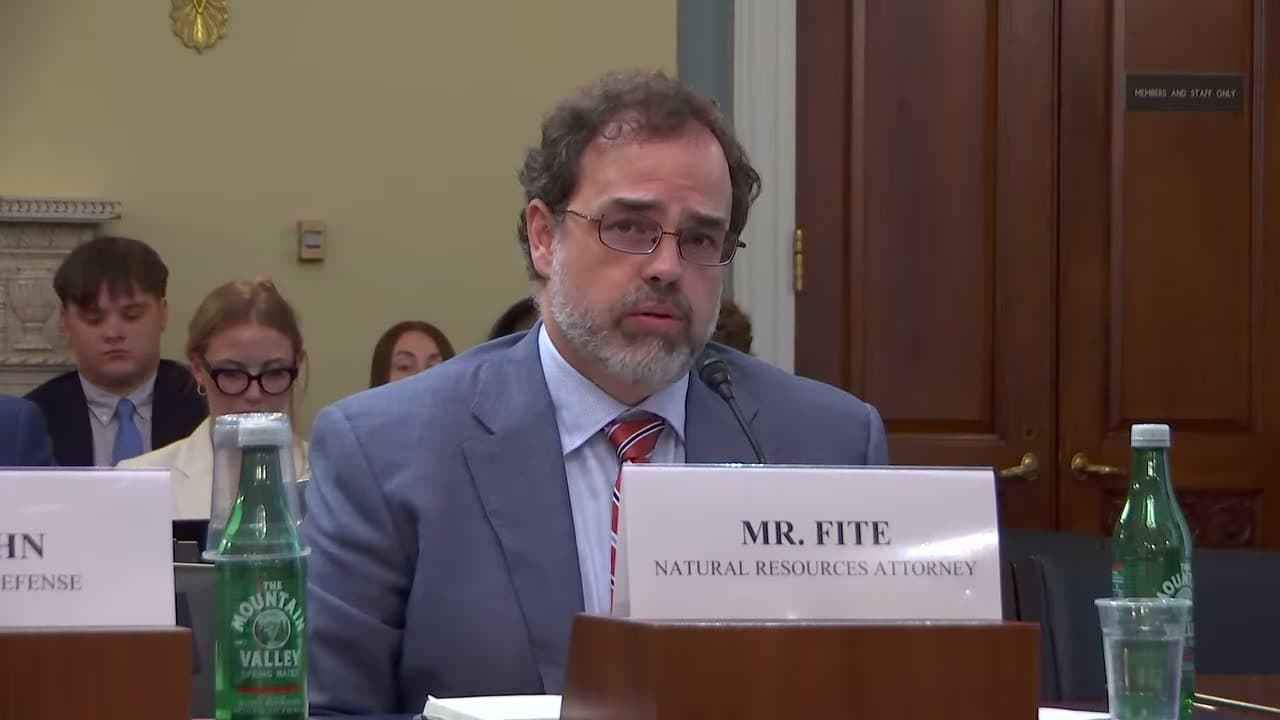
Frame from "Oversight Hearing titled “The Profit Engine Driving Environmental Nonprofits.”" · Source
House Republicans examine $24.8M in federal attorney fees to environmental groups
A House Natural Resources subcommittee examined Wednesday how federal agencies paid environmental nonprofits $24.8 million in attorney fee awards between fiscal years 2019 and 2024. The payments affect Alaska by shaping how litigation over federal lands, endangered species protections, and resource development projects is funded nationwide.
Rep. Paul Gosar, the subcommittee chairman, said roughly 76 percent of Equal Access to Justice Act awards from the Department of the Interior and Forest Service went to environmental nonprofits instead of forest management or energy development projects. Endangered Species Act fee-shifting payments totaled more than $20.2 million over the same five years.
Alaska has seen environmental litigation affect mining permits, timber sales, and oil and gas leasing on federal lands. The Department of the Interior manages roughly 60 percent of Alaska's land mass. The Forest Service oversees the Tongass and Chugach national forests, which together cover nearly 22 million acres.
How fee-shifting laws work
The Equal Access to Justice Act allows courts to award attorney fees to prevailing parties in certain civil cases against the United States when the government's position is not substantially justified. Environmental statutes such as the Endangered Species Act and Clean Water Act contain separate fee-shifting provisions that allow courts to award costs of litigation, including reasonable attorney and expert witness fees, to prevailing parties.
Supporters, including many Democrats, say these provisions are essential tools for individuals, tribes and nonprofits to hold the federal government accountable on issues like environmental protection and public lands management.
Some nonprofit attorneys bill at rates far exceeding their actual salaries, witnesses told the subcommittee. Jonathan Wood, vice president of law and policy at the Property and Environment Research Center, cited a case where an attorney paid less than $62.50 per hour asserted a reimbursement rate of $515 per hour, representing a 700 percent profit margin for the employing nonprofit.
The Equal Access to Justice Act has statutory caps on hourly rates that can be adjusted for cost of living or special factors, such as limited availability of qualified attorneys, which can permit higher rates than the statutory baseline. Environmental fee awards under statutes like the Endangered Species Act are uncapped and use the lodestar method, which multiplies a hypothetical hourly rate by the number of hours worked.
Gosar said courts using the lodestar method allow nonprofit lawyers to set their own hourly rates, which are usually rubber-stamped because time spent by the Justice Department contesting fee awards is added to a nonprofit's ultimate windfall.
Nonprofit funding from litigation
Advocates for the West reported 40.5 percent of its average annual funding comes from legal representation and advice, according to testimony from Ken Braun, managing editor of Capital Research Center. The Center for Biological Diversity received $23.4 million in legal recoveries over five years, averaging 13.6 percent of total annual revenue.
Both organizations have filed lawsuits challenging Alaska projects. The Center for Biological Diversity has sued over Cook Inlet beluga whale protections, polar bear habitat designations, and oil and gas lease sales. Advocates for the West has challenged logging plans in the Tongass National Forest.
Lawson Fite, a natural resources attorney, said courts are issuing Equal Access to Justice Act fee awards disproportionate to market rates. An Oregon district court recently awarded over $180,000 for a case involving a single motion for preliminary injunction and one hearing, he said.
Fite said the Equal Access to Justice Act was originally established for small business owners and homeowners who cannot afford counsel, with asset limits and rate caps. Environmental fee-shifting statutes under laws like the Endangered Species Act have no such limits, he said, and courts generally do not scrutinize fee petitions closely.
Wood described a case where environmental groups declined to purchase a 355-acre Oregon forest tract for $787,000, or $2,000 per acre, then spent nearly $1.2 million in attorney fees litigating over logging plans. The lawsuit required the timber company to seek a permit but did not permanently conserve the forest.
Alaska-specific implications
Critics of environmental litigation, including some Republican lawmakers, argue that frequent lawsuits under statutes like the National Environmental Policy Act and the Endangered Species Act can delay infrastructure and conservation projects, increase federal agency workloads and result in taxpayer-funded attorney fee awards to advocacy groups.
Alaska's congressional delegation has raised concerns about litigation delaying resource development. The Willow oil project in the National Petroleum Reserve-Alaska faced multiple lawsuits before federal approval in 2023. Lawsuits over the Ambler mining district access road and Donlin Gold mine permitting have delayed those projects for years.
Rep. Pete Stauber, a Republican from Minnesota, said the Center for Biological Diversity entered a settlement agreement with the Biden administration in May 2021 that blocked mineral development in northern Minnesota and awarded the group $25,000 in taxpayer funding to cover legal bills. Similar settlements have affected Alaska mining projects, including challenges to Bureau of Land Management mineral leasing decisions.
This article is based on a public meeting — House Natural Resources Subcommittee on Oversight and Investigations (Begich): Oversight Hearing titled “The Profit Engine Driving Environmental Nonprofits.” ().
AI-assisted. How we use AI Transcript byLucas Brown
Watch key moments from the source meeting. Click to expand.
Stay informed. Support what matters.
Free, permanent access to local news you can verify. Subscribe to support Walter AlaskaNews and go ad-free.
Related Coverage
Tribal groups seek $1.1M in fees after beating Alaska on Kuskokwim fishing rights
Alaska News · 3mo ago
A record year for federal research-fraud enforcement — and Alaska's stake in it
Alaska News · 3mo ago
A Senate vote on the federal lands maintenance fund has major Alaska stakes
Alaska News · 3mo ago
Trump Wildlife Pick Wants Fewer ESA Lawsuits — Alaska Is Ground Zero
Alaska News · 3mo ago
A renewed federal fund to fix public lands could land hardest in Alaska
Alaska News · 3mo ago
Comments
Sign in to leave a comment.
No comments yet. Be the first to share your thoughts.