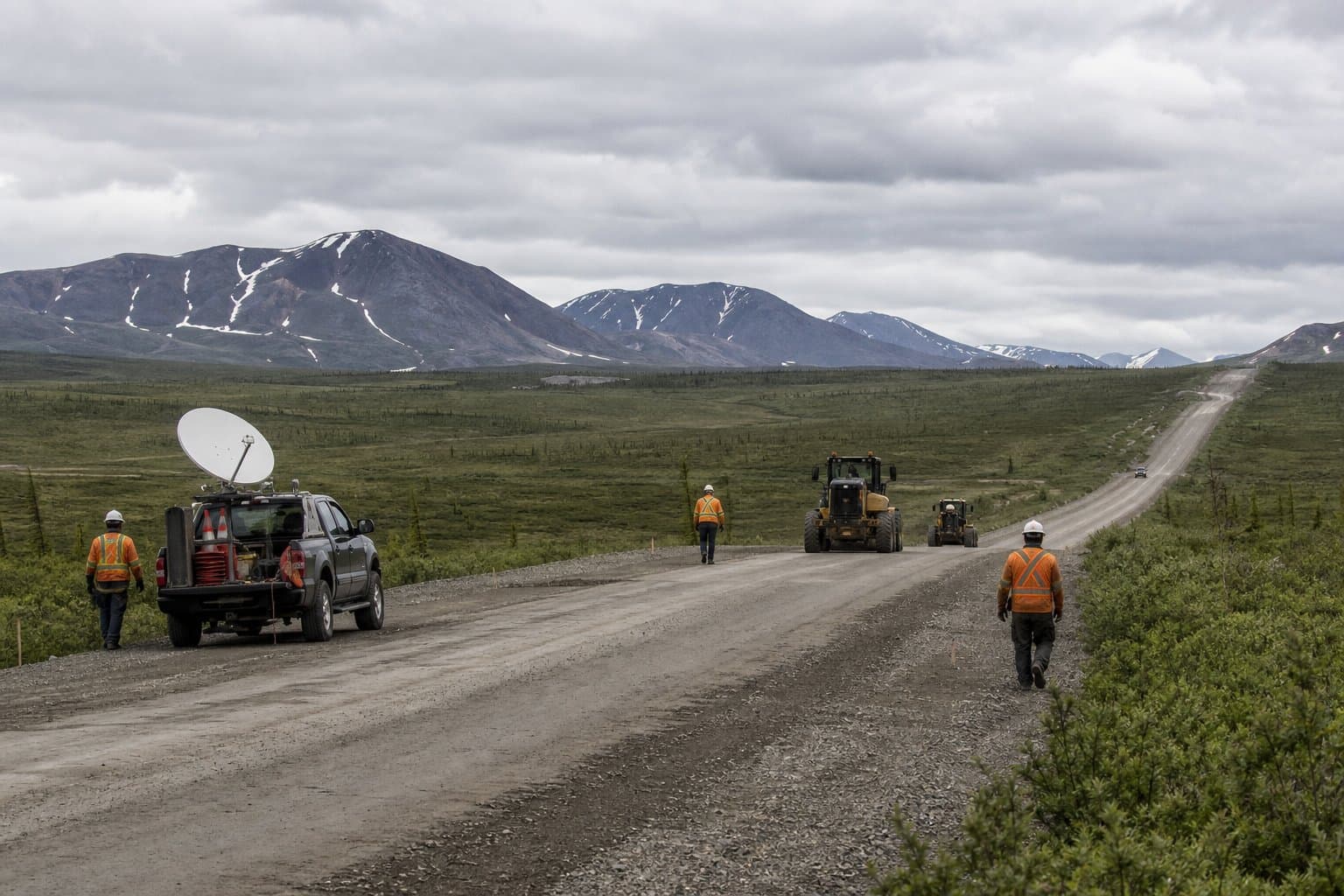
Federal grant of $159,953 funds Alaska DOT&PF Starlink evaluation
Alaska's statewide equipment fleet is the subject of a $159,953 federal cooperative agreement funding an evaluation of low Earth orbit satellite internet for state operations. The Federal Highway Administration award to the Alaska Department of Transportation and Public Facilities runs through Dec. 31, 2026.
Low Earth orbit broadband, satellite service delivered from constellations orbiting far below geostationary satellites, has a longer history in Alaska. The 2021 Governor's Task Force on Broadband identified satellite and LEO service as a potential answer for remote and unserved communities, and GCI announced in June that it is integrating dedicated Starlink service with bonded gateways into its resiliency strategy. An earlier Alaska News report on Starlink's bonded-gateway claims in Utqiagvik described middle-mile capacity a local provider would distribute, not per-household speed. At a May 20 panel on extreme-weather resilience, Sean Williams, vice president of government affairs and strategy at Pacific DataPort and a former assistant commissioner of commerce, said, "We know that there are somewhere between 60,000 and 70,000 Starlink terminals throughout the state of Alaska at the moment."
The award lists eight objectives: evaluating Starlink deployment services, integrating and testing with the statewide equipment fleet, field trials of wide-area network connectivity, testing and standardizing mobile priority panels, testing field backpacks, developing a DOT&PF usage policy and account management system, implementing an on-demand credit system for standby units, and drafting governance recommendations for normal and emergency technology use. Quarterly, interim and final reports, technical advisor meetings and a final presentation are required.
Research finds limitations in Alaska performance. The Internet Society's Pulse project reported in April that "Alaska and remote Canada show modest gains from Starlink," attributing the result to a constellation concentrated at mid-latitudes. The Fiber Broadband Association's January technical assessment concluded LEO broadband is "best viewed as a complement to, rather than a replacement for, terrestrial broadband infrastructure."
AI-assisted, reviewed by editors. Spot an error?
Stay informed. Support what matters.
Free, permanent access to local news you can verify. Subscribe to support Melinda Communities.News and go ad-free.
Related Coverage
Federal grant funds planning for Parks Highway separated paths
Alaska News · 22h ago · 79% match
Alaska DOT&PF Awards $2.2M to 15 Trail Projects Statewide
Alaska News · 1mo ago · 78% match
Akiachak could gain hardwired broadband under an airport permit, with comments due Sept. 10
Alaska News · 1d ago · 77% match
Alaska DOT files five equipment bids for snow blowers, paint trucks, road maintenance gear
Alaska News · 3mo ago · 77% match
Alaska DOT seeks snow removal equipment for statewide airports
Alaska News · 3mo ago · 76% match
Comments
Sign in to leave a comment.
No comments yet. Be the first to share your thoughts.