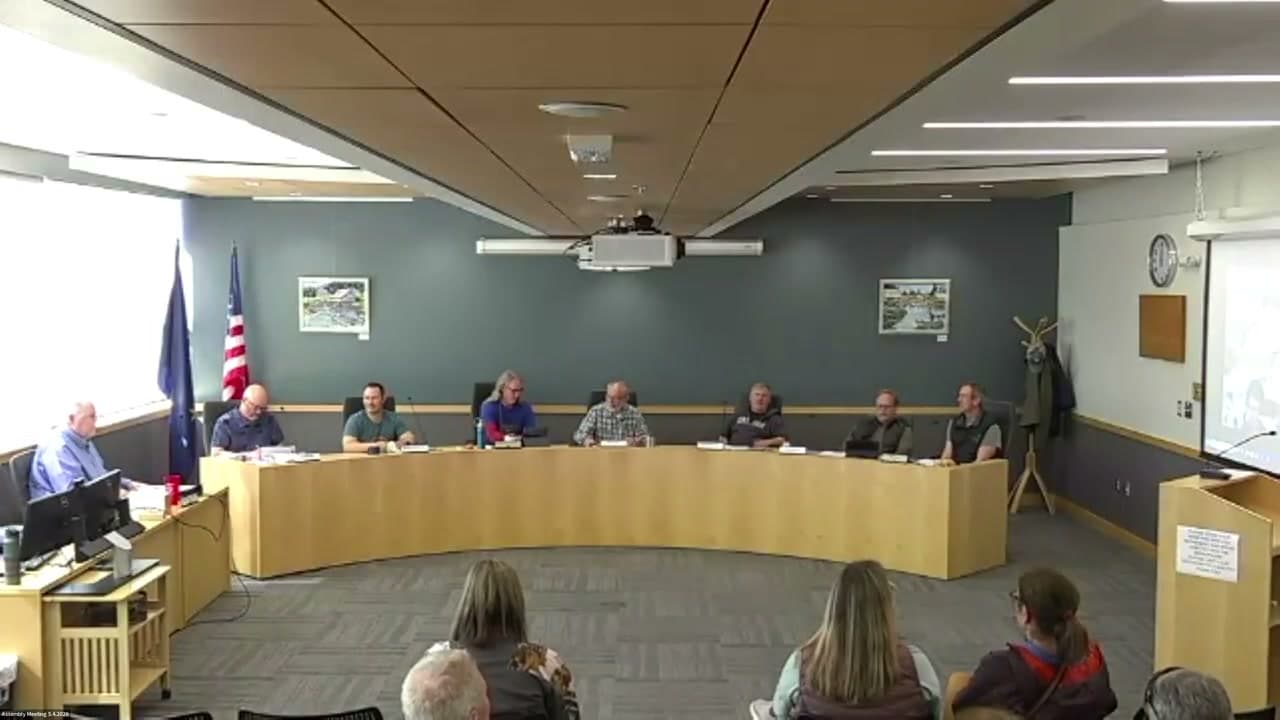
Data center project promises rate relief amid public concerns over noise, power
A proposed cryptocurrency data center in Petersburg could stabilize electric rates and generate $2 million annually for the utility. Residents questioned Monday whether the project would limit power for future growth and create noise problems.
The Greensparc data center would occupy the former Ocean Beauty cannery site and consume 17 million kilowatt-hours annually at full capacity. The project would use an existing 2-megawatt transformer at the property.
Petersburg Municipal Power and Light Director Carl Hagerman told the borough assembly Monday that the project requires no borough infrastructure investment. He said ample power is available with a third Southeast Alaska Power Agency turbine planned for completion at Tyee Lake in 2027.
Residents raised concerns about noise levels, fire safety of lithium batteries, power availability during low-water years, and impact on future housing development. One resident asked what happens when the utility is restricted by low water. Another questioned where power would come from if the third turbine is already committed to the data center and the borough is developing additional homes.
Hagerman said the data center would be much quieter than the five freezer vans that previously operated at the cannery site. Sound levels would reach about 60 decibels outside the building, comparable to normal conversation. The facility would use lithium iron phosphate batteries, which are safer than lithium-ion batteries and include self-contained fire suppression systems. The project would need only about 1,500 to 2,000 square feet of space and minimal water and sewer use.
Andrew Mazzella, CEO of Mazzella Alaska, said the project would use hydropower with zero emissions. He said his company already pays about $5,000 per month for electric and utilities across his Petersburg properties.
Sam Inoka, CEO of Greensparc, said the company looks for communities where stranded energy is available so no utility or community investment is required. Greensparc would be willing to curtail operations during peak demand periods or pay diesel surcharges to avoid burdening existing customers, he said. Those provisions would be handled through a large commercial sales agreement between the utility and Greensparc.
The company would use a closed-loop cooling system with predominantly water and possibly an antifreeze-type agent. The system would require minimal water use and only occasional topping up, Inoka said.
Joshua Adams, speaking for himself and with the Planning Commission, supported the project as a way to diversify Petersburg's economy beyond fishing. Adams said the data center would produce heat that could be integrated with public infrastructure for district heating, similar to systems in Helsinki.
Petersburg has one of the lowest electric rates in Alaska, Hagerman said. The data center would help stabilize rates and lessen future increases. The utility presented a 4 percent electric rate increase for fiscal year 2027, which Hagerman said would be reduced if the data center project proceeds.
Data centers have drawn attention at the state level as an economic opportunity. The Alaska Industrial Development and Export Authority approved a loan of up to $17 million to Greensparc in June 2025 to support development in Cordova. That project built on a 0.5-megawatt pilot micro data center installed at the Cordova Electric Cooperative site in 2023. A House panel held a hearing on a bill to shield ratepayers from data center costs, though that measure has not advanced.
The assembly took no action Monday. The project is a private development between Mazzella Alaska and Greensparc and does not require assembly approval. The utility will negotiate a large commercial sales agreement with the company.
This article is based on a public meeting — Assembly Meeting ().
Made by our human newsroom with AI. How humans and AI work here · Grow with our newsroom Transcript byLucas Brown
Stay informed. Support what matters.
Free, permanent access to local news you can verify. Subscribe to support Walter AlaskaNews and go ad-free.
Related Coverage
Petersburg planning commission to vote next month on one-year data center ban
Alaska News · 1mo ago
Petersburg assembly deadlocks 3-3, rejecting one-year data center moratorium
Alaska News · 1w ago
Petersburg planning commission recommends one-year data center moratorium; developer threatens suit
Alaska News · 3w ago
Assembly hears call for tower rules as residents warn of land-use impact
Alaska News · 5mo ago
Cordova's co-op wants a data center to soak up unsold hydropower
Alaska News · 2mo ago
Comments
Sign in to leave a comment.
No comments yet. Be the first to share your thoughts.