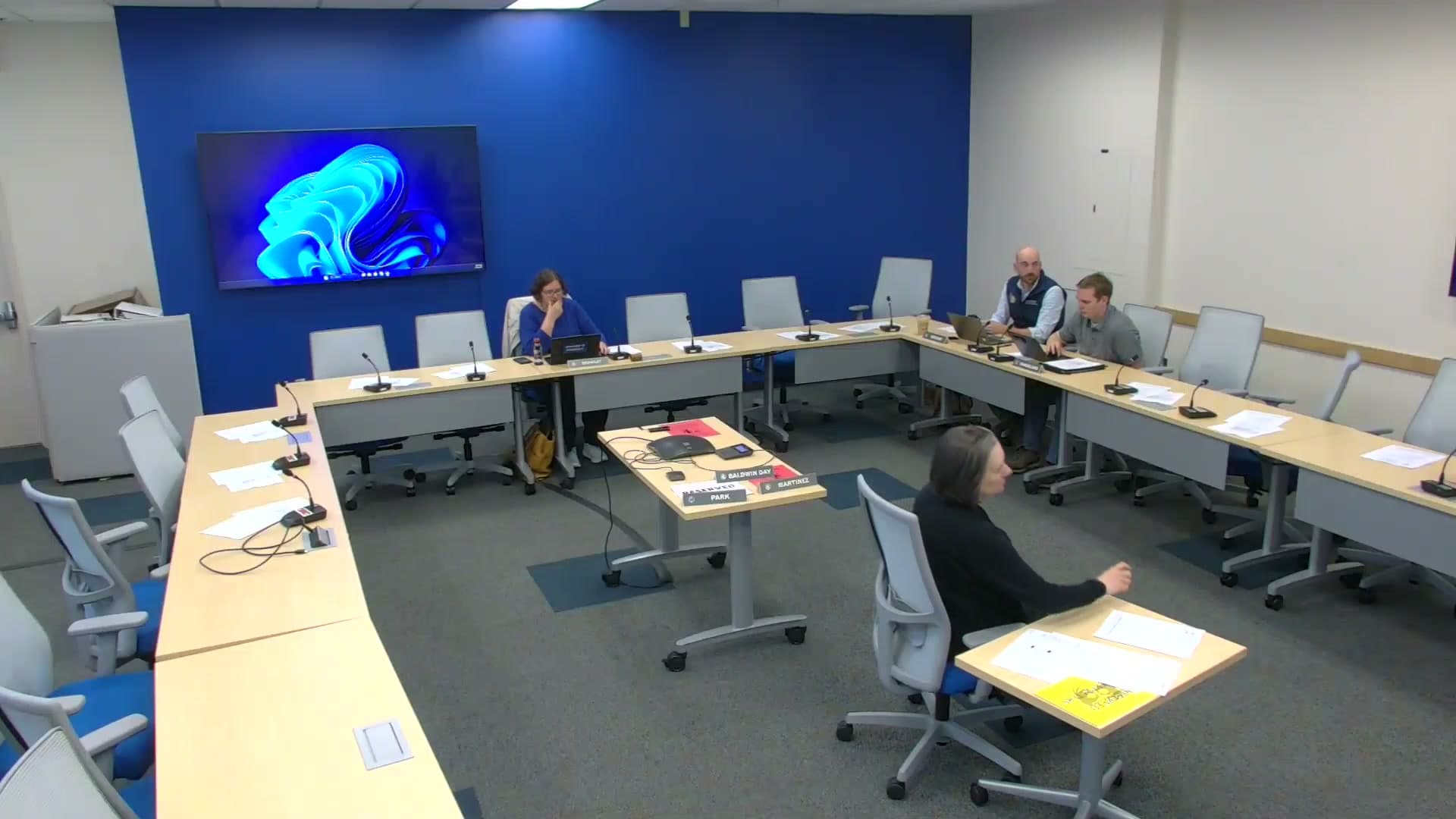
Frame from "Anchorage Assembly: Budget and Finance Committee-of-the-Whole Meeting" · Photo source
Anchorage police and fire overtime budgets built on 2010 math, OMB says
Anchorage police and fire departments are each running significantly over their approved overtime budgets, and the city's budget office told the Assembly Budget and Finance Committee on Thursday that the math behind those budgets has not been updated in at least four years and may trace to a continuation-budget baseline dating to roughly 2010.
Assembly Member Erin Baldwin Day named the gap for both departments. "Our full-year actuals with police were over $10 million in overtime spend," she said. "The approved overtime budget for this year is $4.9 million." Fire Department actuals ran close to $7 million against an approved budget of roughly $4.3 million.
OMB Director Ona Brouse said the gap reflects two distinct problems: overtime allocations that have not changed in at least four years, and a continuation-budget structure that can carry forward old numbers indefinitely. "We're working from a base budget of about 2010," she said, "and if the 2010 overtime number was never adjusted, then that would be the number we are working with every single year."
Brouse also said OMB's standard practice is to wait roughly three to five years and use rolling averages before changing budget assumptions, so a single-year spike would not automatically trigger a correction.
Two Departments, Different Causes
The two departments face different root causes. For the Fire Department, federal labor law requires the last several hours of each 56-hour firefighter shift to be paid as overtime, and the blended wage used to budget that cost has not kept pace. "The wages have changed dramatically," Brouse said, "and so that blended average, that $50, we think is now— these are numbers we're working on— we think are now closer to $60 an hour, which means that this OT amount would have to be recalibrated even for their regular accepted approved overtime that's in their operating budget."
For the Police Department, vacancies are the driver. "The reason their overtime is so hot is because of their vacancies," Brouse said. "They are missing 70 police officers." She added that for a vacancy-driven department, the relevant question is whether the department is staying within its overall labor allocation, not just whether overtime spending exceeds the overtime line.
A Correction Is Underway
Brouse said this year brought new clarity. "This is, you know, the first year that we have had the rolling confirmation that the overtime allocations are not right," she said. Three years of post-pandemic data now support a correction, and analysis is underway as part of the fiscal year 2027 budget process.
The Assembly is also drafting a budget priorities resolution it intends to bring to a vote July 21. The resolution was still in draft form as of Thursday's meeting. Members discussed requesting scenario planning information and a clearer accounting of vacant positions and the labor-versus-overtime balance across departments as part of that process.
This article is based on a public meeting of Municipality of Anchorage — Anchorage Assembly: Budget and Finance Committee-of-the-Whole Meeting ().
Made by our human newsroom with AI. How humans and AI work here · Grow with our newsroom Transcript byLucas Brown
Watch key moments from the source meeting. Click to expand.
Stay informed. Support what matters.
Free, permanent access to local news you can verify. Subscribe to support Walter AlaskaNews and go ad-free.
Related Coverage
Anchorage keeps blowing past overtime budgets stuck on a 2010 baseline
Alaska News · 1mo ago
Anchorage's 2027 budget leaves out money for downtown police foot patrols
Alaska News · 9h ago
Anchorage city funds carry $45 million in deficits — biggest two still growing
Alaska News · 3mo ago
An ordinance would tighten oversight of Anchorage's staffing overruns
Alaska News · 1mo ago
Anchorage faces $31M deficit across internal service funds
Alaska News · 4mo ago
Comments
Sign in to leave a comment.
No comments yet. Be the first to share your thoughts.