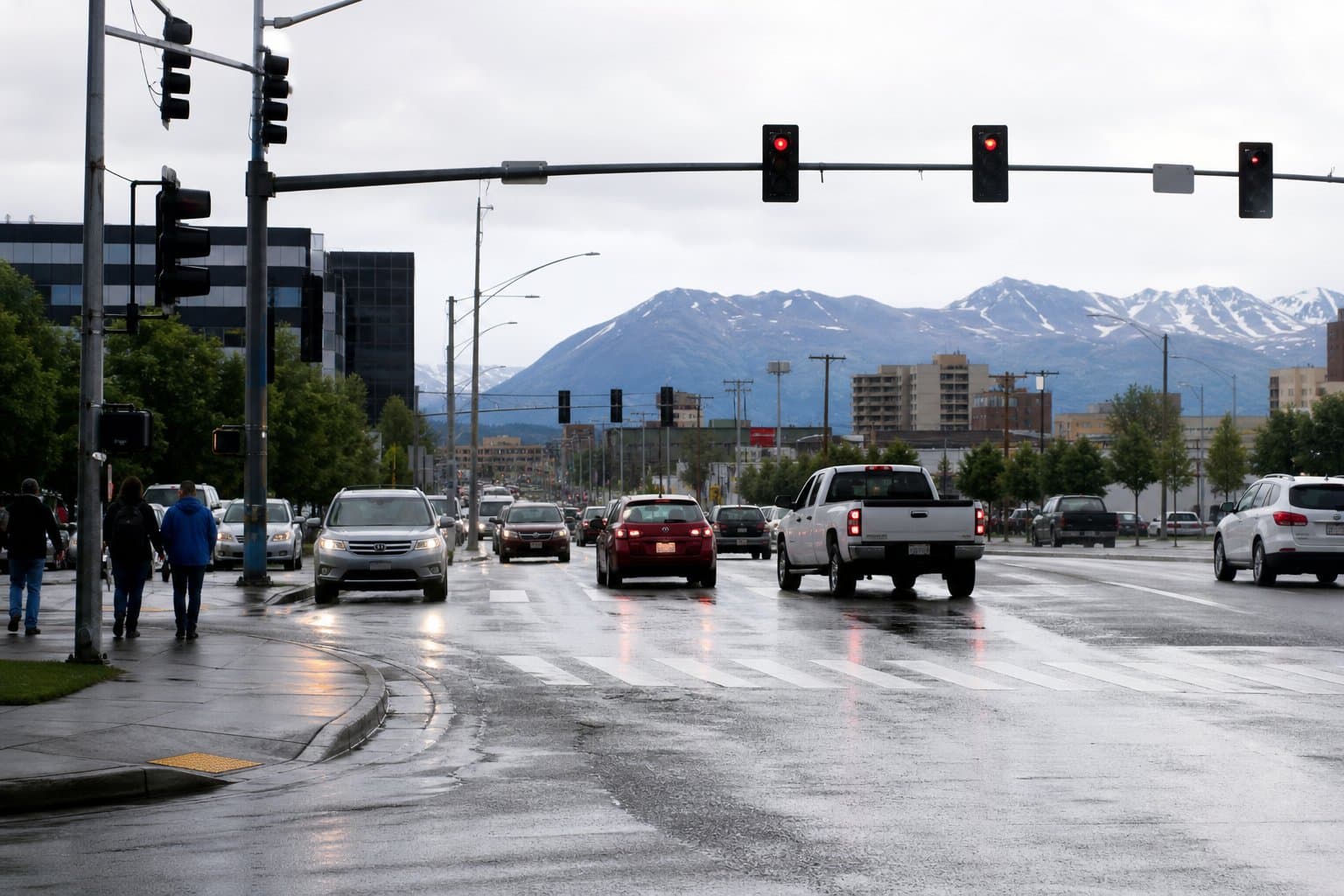
Audit: Anchorage traffic unit didn't track state signal power costs
Anchorage's Traffic Engineering Department never tracked the actual cost of electricity powering state-owned traffic signals, according to a report the Municipality of Anchorage Office of Internal Audit released Aug. 20. The gap makes it hard to tell whether the city has covered the state's share for two decades.
The signals fall under a Transfer of Responsibilities Agreement, or TORA, that the municipality signed with the state in 2005 and last amended in 2006. The state pays Anchorage a fixed amount, adjusted annually by the consumer price index, to operate and maintain the signals. Management assumed that adjustment covered electricity. The report says the municipality "may have paid the utility (i.e. electricity) expenses that should have been paid by the State through TORA." A 2017 Legislative Finance Division document put the agreement at about $1.43 million in fiscal year 2007, with automatic cost of living increases and adjustments for signals added later.
"Finally, we found some Transfer of Responsibilities
Agreement costs were not properly tracked," wrote Alden Thern, director of internal audit. A similar finding on the same agreement appeared in Internal Audit Report 2021-01, five years earlier. Auditors recommended the municipal manager require Traffic Engineering to track actual TORA expenditures, including utility costs, and compare them with TORA revenue.
Management said Public Works Administration, not Traffic Engineering, tracks utility costs and payments, and that the data are "granular to the specific traffic signal." The report does not say auditors reviewed that data. Traffic Engineering will assess whether Signals TORA revenue covers maintenance and operations costs, then "initiate discussions with ADOT as needed."
Auditors said most TORAs were properly administered despite this and two other findings. No central repository or managing agency oversees all TORAs. The Assembly appropriated $17,179,185 for 47 projects between January 2021 and December 2025, covering traffic counts, non-motorized safety, transit marketing and dust control. Management said the agreements do appear in the annual budget and SAP accounting system, but agreed a centralized categorization system would help. Auditors also found the term "TORA" used interchangeably with grant, memorandum of agreement, memorandum of understanding and maintenance agreement. Management said it will standardize the terminology when agreements go before the Assembly.
Assembly Chair Anna Brawley submitted the report for the Assembly's Sept. 1 meeting.
AI-assisted, reviewed by editors. Spot an error?
Stay informed. Support what matters.
Free, permanent access to local news you can verify. Subscribe to support Walter AlaskaNews and go ad-free.
Related Coverage
Anchorage let $11.8 million skip the books it promised to check
Alaska News · 3w ago · 83% match
Anchorage let federal grant recipients off the hook, audit finds
Alaska News · 1mo ago · 81% match
Audit of $11.8M in off-the-books Anchorage spending heads to the Assembly
Alaska News · 3w ago · 81% match
Anchorage funded a program to fix 20 homes. It fixed one — and no one was penalized.
Alaska News · 1mo ago · 79% match
A board steering Anchorage's biggest project met nine times. The public heard about one.
Alaska News · 3w ago · 78% match
Comments
Sign in to leave a comment.
No comments yet. Be the first to share your thoughts.