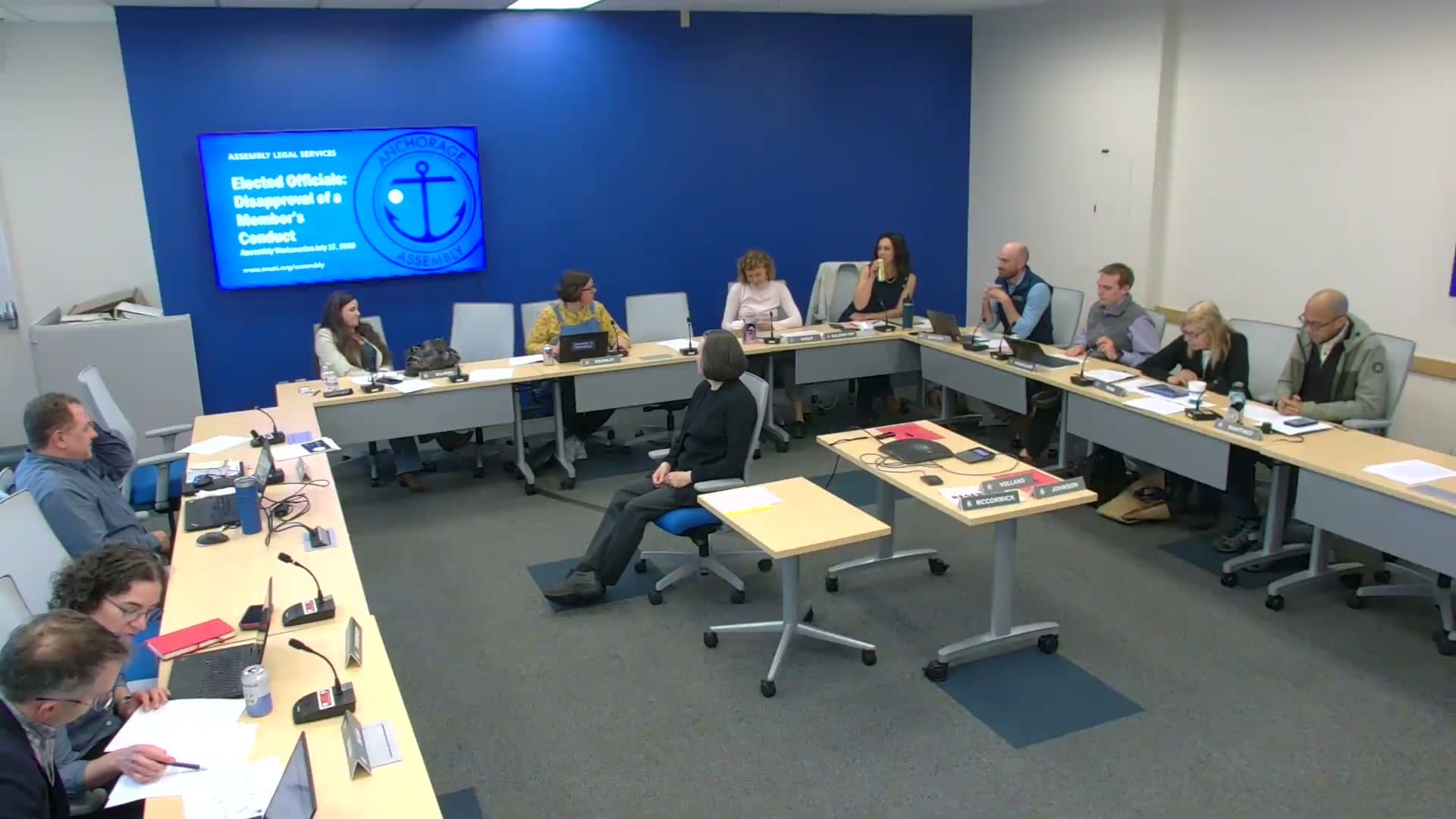
Frame from "Anchorage Assembly: Worksession solely for discussion and clarification of the removal procedure set forth..." · Photo source
Anchorage Assembly studies removal process it has never used
The Anchorage Assembly convened Friday to review the procedures for censuring or removing one of its own members. Removal procedures were first enacted in 1993 for Assembly and school board members. A 2022 ordinance expanded the process to cover the mayor and other elected officials. No current member has ever seen the process applied.
Censure is a formal public expression of disapproval by majority vote and does not remove a member from office. Removal requires notice, a complete statement of the charge, a public hearing before an independent hearing officer, and judicial review. The ordinance's supporting memorandum notes the standard requires proof of egregious conduct or a serious pattern of conduct.
Once a formal accusation is filed, independent investigation by Assembly members must stop. Assembly attorney Jeremiah Gardner explained the reasoning. "That process should end once it becomes a formal accusation, because the Assembly should protect itself and preserve, really protect the universe of information it's looking at. Because at the ultimate end of this process, the Assembly will be called upon to review hearing officer's decision, and at that point you should only be looking at what's in the record there. So this is the point where we kind of drop the gate on Assemblymember investigation," he said.
As described at the session, the process would require a majority Assembly vote to submit an accusation and, after the hearing officer’s recommendation, a two-thirds vote to remove. The hearing officer would be selected from outside the municipality, such as through the American Arbitration Association. Legal fees for the accused member's attorney were estimated at roughly $50,000 to $100,000, described at the session as very rough ballpark estimates.
Assembly Chair Anna Brawley emphasized throughout that the session was limited to process and was not intended to answer what the Assembly should do in any specific case. She noted that "none of us have done this in these seats, and any predecessor who has taken this up or anything, any action of this kind, are all gone now." On the question of what action the body should take, Brawley was direct. "The what you should do is ultimately in the political realm, it's in the personal decision realm, and it is something that everybody has to grapple with," she said.
The session was informational. No date was set for further action on any specific removal or censure measure.
This article is based on a public meeting of Municipality of Anchorage — Anchorage Assembly: Worksession solely for discussion and clarification of the removal procedure set forth... ().
Made by our human newsroom with AI. How humans and AI work here · Grow with our newsroom Transcript byLucas Brown
Watch key moments from the source meeting. Click to expand.
Stay informed. Support what matters.
Free, permanent access to local news you can verify. Subscribe to support Walter AlaskaNews and go ad-free.
Related Coverage
The Anchorage Assembly studied how to remove one of its own. It never has.
Alaska News · 2mo ago
Removing an Assembly member takes 94 days and a supermajority
Alaska News · 2mo ago
Anchorage Assembly introduces resolution to initiate first-ever removal proceeding against member Martinez
Alaska News · 3mo ago
Anchorage Assembly to consider first-ever removal proceeding against Martinez
Alaska News · 3mo ago
Anchorage's Assembly weighs censure — or removal — of George Martinez
Alaska News · 3mo ago
Comments
Sign in to leave a comment.
No comments yet. Be the first to share your thoughts.