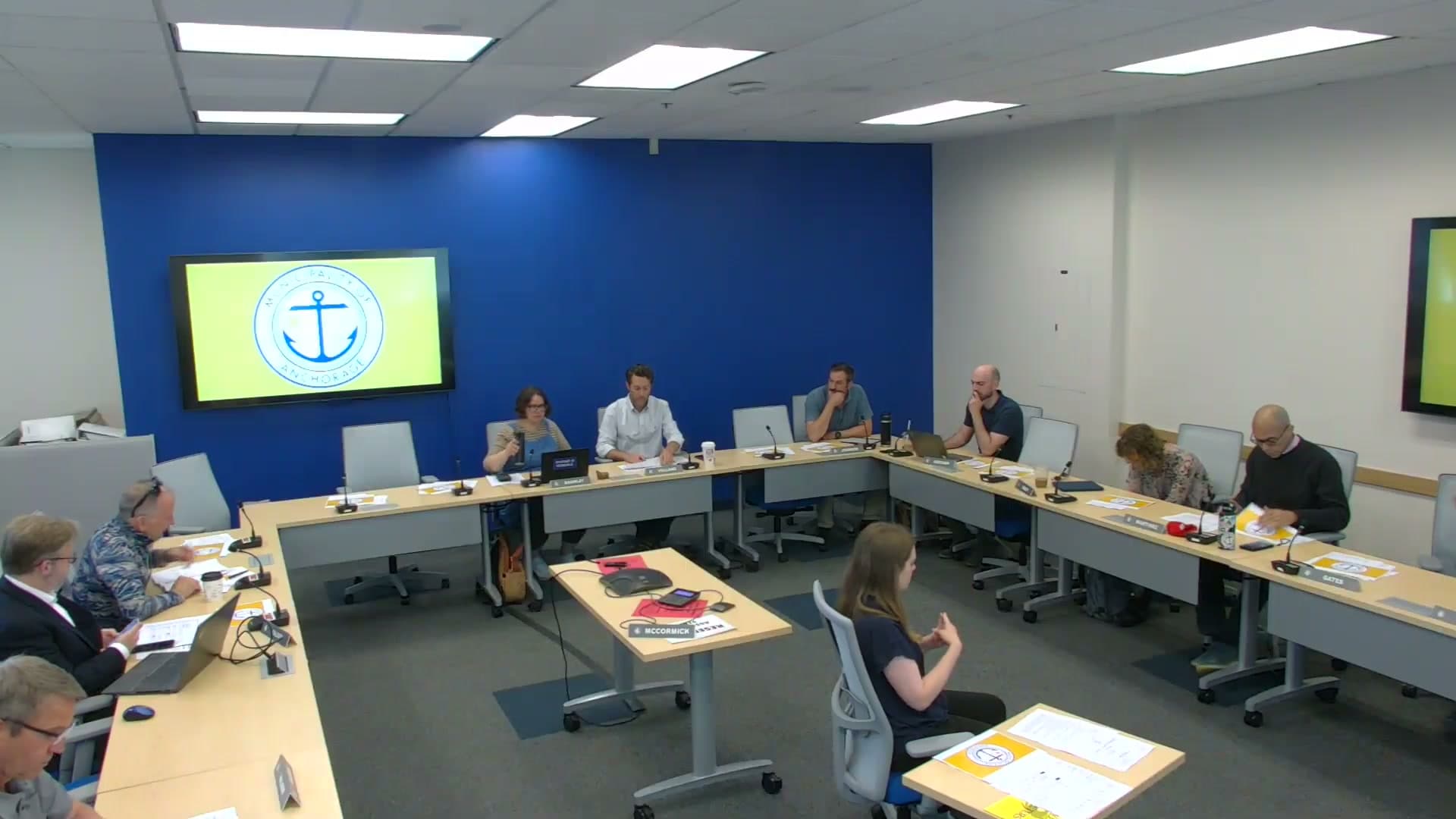
Frame from "Anchorage Assembly: Budget and Finance Committee-of-the-Whole" · Source
Anchorage Assembly gets first look at five municipal fund deficits totaling $45M
Five Anchorage municipal funds carry combined deficits of roughly $45 million, the Anchorage Assembly's Budget and Finance Committee-of-the-Whole heard Thursday, with workers' compensation and information technology accounting for the two largest shortfalls.
Workers' Compensation and Liability
The General Liability and Workers' Compensation Fund holds the biggest gap at $16.6 million. The administration noted the fund had previously hovered at $3 to $5 million before accelerating after 2020, reaching $6.5 million, then $9.4 million, then $13.7 million in successive years. Officials described the current deficit as primarily an accounting issue that does not affect the municipality's ability to pay current claims.
Ona Brouse, Director of the Office of Management and Budget, told the committee that skipped annual true-ups allowed the problem to compound alongside rising claims costs. "This fund and the way this fund is recovered should be calculated and analyzed on an annual basis," Brouse said. "There were a few years where that was not occurring, and during that time frame, the costs of the claims also increased. So the inflationary impacts of the cost of everything combined with the, the sort of lost corrections on an annual basis to do this annual true-up that we have now done sort of ballooned the deficit that we saw occurring."
IT and Remaining Funds
The IT Internal Services Fund shows a $14.7 million deficit driven largely by depreciation on the SAP enterprise software system outpacing departmental repayments. The administration described it as a largely non-cash accounting issue tied to the timing of depreciation and repayment schedules. The administration expects that fund to self-correct by 2034.
Three remaining funds account for the rest of the roughly $45 million total. The Downtown Improvement District, tracked under the Other Restricted Resources Fund, carries a deficit of over half a million dollars. The administration said it has not yet fully explained that gap, noting the district collected $900,000 in special assessment revenue against a budgeted $1.1 million. The Federal Grants Fund shows a $1.1 million deficit tied to unresolved FEMA earthquake recovery. The Building Safety Service Area carries a $12.8 million deficit dating to a 2010 decision to make the fund entirely fee-supported, a structure that proved insufficient by at least 2013.
The administration expressed an intention to address the Building Safety Service Area deficit in the 2027 budget cycle, though the approach remains subject to budget development. Brouse said the administration still needed to determine how much could be transitioned during that process. "We have to go through the 2027 budget development in order to determine how and exactly how much of the BSSA can be transitioned during the 2027 budget," she said. "It's the intention to clear all of it, but I think while we're finalizing the ACFR and working through '27 development, we'll have more information about how we're actually able to do that."
AI-assisted, reviewed by editors. Spot an error?
Watch key moments from the source meeting. Click to expand.
Comments
Sign in to leave a comment.
No comments yet. Be the first to share your thoughts.