5 min readThe Petroleum Club of Anchorage, 3301 C Street, AnchorageAI
Share
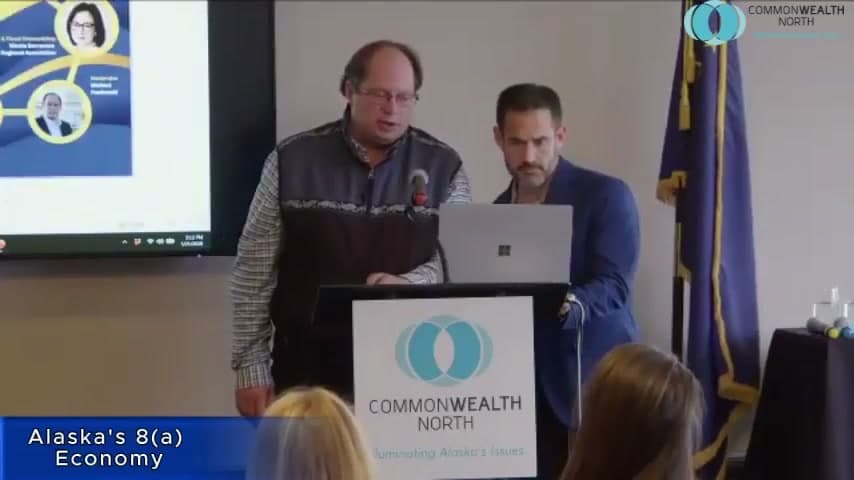
Alaska Native corporations' four-decade participation in the federal 8(a) Business Development Program is entering a period of uncertainty as the Trump administration reviews federal contracting practices, speakers at a Commonwealth North forum said Thursday.
Katherine Carlton, president of Chugach Alaska Corporation, said the Small Business Administration has stalled processing applications for new 8(a) entities, preventing Alaska Native corporations from bringing new subsidiaries into the program.
"The applications processed by SBA that allow us to renew our entities and then provide reform work in the 8 space has been stalled by SBA," Carlton said. "And so we've seen no applications, which means the ANCs cannot have their new entities come into the business."
The freeze blocks future contracting access for ANC subsidiaries awaiting entry and affects the flow of community benefits that 8(a) firms report annually to the SBA.
The 12 Alaska Native regional corporations generated $13.5 billion in combined revenue in 2022, with $9 billion coming from business activities outside Alaska, according to McKinley Research Group data presented at the forum. The regional corporations employ about 50,000 people worldwide, including 8,000 to 9,000 based in Alaska, Katie Berry of McKinley Research Group said. About 110,000 Alaska Native regional shareholders live in the state, representing 15 percent of Alaska's population. The corporations distribute $300 to $350 million annually through regional corporate dividends, elder benefits, and other direct benefits.
The 8(a) Business Development Program is a nine-year SBA program consisting of a four-year developmental stage and a five-year transitional stage during which firms receive business development assistance and access to federal contracting opportunities. All participants, including Alaska Native Corporation-owned firms, must maintain continuing eligibility and submit annual certifications as part of an annual review process. SBA regulations require Alaska Native corporations, Indian tribes, and Native Hawaiian organizations participating in the program to report annually on the financial benefits that flow from 8(a) participation back to their Native communities.
Emil Notti, the first president of the Alaska Federation of Natives and an ANCSA negotiator, said Congress authorized Alaska Native corporations to participate in the 8(a) program in 1986. "We know rural Alaska has many small communities that are economically disadvantaged," Notti said. "These communities fit the program definition for inclusion."
Congress enacted the Alaska Native Claims Settlement Act in 1971, creating Alaska Native regional and village corporations as the primary Native institutions to receive and manage settlement assets. Alaska Native Corporation-owned firms were incorporated into the 8(a) Business Development Program in 1986 through congressional action and SBA regulatory amendments that included specific provisions facilitating their ability to participate in federal contracting. In 2011, SBA adopted regulatory revisions requiring Alaska Native corporations to report annually on the financial benefits from 8(a) activities flowing back to their Native communities.
Carlton said the current scrutiny stems from two sources: allegations of fraud, waste, and abuse in federal contracting, and the administration's broader review of diversity, equity, and inclusion programs.
"I think when we began this fight, it was centered around fraud, waste, and abuse," Carlton said. "So there were some articles and some media out there that kind of was a gotcha moment to contractors out there that supposedly were performing fraud, waste, and abuse and not applying the rules of the program correctly."
Nicole Borromeo, president of the ANCSA Regional Association, said the administration's focus on rooting out fraud, waste, and abuse is appropriate, but that 8(a) participants already operate under extensive oversight.
"Fraud, waste, and abuse does not belong anywhere in business, let alone in federal contracting," Borromeo said. "But there has been some misinformed and misguided attacks at the program in Washington."
Carlton said Native-owned 8(a) firms already operate under extensive oversight and compliance obligations, including SBA eligibility requirements, annual reporting requirements, financial reporting standards, subcontracting limitations, and community benefit reporting obligations.
"In our world, relationships are built on execution," Carlton said. "You do not continue supporting sensitive military or national security missions for decades unless you consistently deliver on high-quality work."
Carlton said Chugach operates and maintains airfield systems at NAS Fallon, home to Top Gun, helps sustain critical ballistic missile defense infrastructure at Fort Greely, and supports infrastructure and operational readiness across Navy and Coast Guard platforms and throughout the Indo-Pacific region. "This is mission-critical work, and we are just one of the many Native corporations that perform these important services across the United States defense infrastructure," Carlton said.
Notti said the program operates under explicit congressional authorization and extensive scrutiny. "8S operate under explicit congressional authorization. They are among the most audited and scrutinized contractors," Notti said. "They are subject to the same contracting laws and regulations as all government contractors. They do not have any preference or special preference for special treatment."
In 2024, Advanced Simulation Technology Inc. filed suit in the U.S. Court of Federal Claims challenging the SBA's rebuttable presumption that tribally owned firms and Alaska Native Corporation-owned firms are socially and economically disadvantaged for 8(a) eligibility, asserting that the special treatment of such entities in federal contracting is unconstitutional.
Notti said the program is designed to build sustainable businesses in disadvantaged communities. "The goal of these regulations is to build sustainable businesses in disadvantaged communities. Build capacity and competition in contracting with the federal government without preference," Notti said. "It is not about special treatment. It is about measurable outcomes, efficiencies, jobs, developing capacity, economics, and self-determination."
Carlton said the concern is not oversight itself, but when oversight evolves into a climate of suspicion around lawful contracting tools. "When that happens, agencies can become hesitant to use authorities intentionally created by Congress, even with firms that have decades of proven performance," Carlton said. "That uncertainty creates real consequences like slowing procurement decisions, discouraging partnerships, and ultimately reducing opportunity flowing back into the Native communities."
Carlton said Chugach has diversified its portfolio and is not as heavily reliant on 8(a) revenue as some other Alaska Native corporations. "We went through an 8 fight probably in, I think it was 2008, and we had probably 90 percent of our revenue from 8 contracting or government contracting," Carlton said. "And so we really learned our lesson back then that we needed to diversify our portfolio, and we have done that over the years."
Berry said the corporations have decades of history proving they deliver goods and services competitively. "Many of our corporations, it's been 55 years, it's been 55 years," Berry said. "They have decades of history, decades of qualifications, decades of proving that they are delivering these goods and services."
Stay informed. Support what matters.
Free, permanent access to local news you can verify. Subscribe to support Alaska News and go ad-free.
Comments
Sign in to leave a comment.
No comments yet. Be the first to share your thoughts.