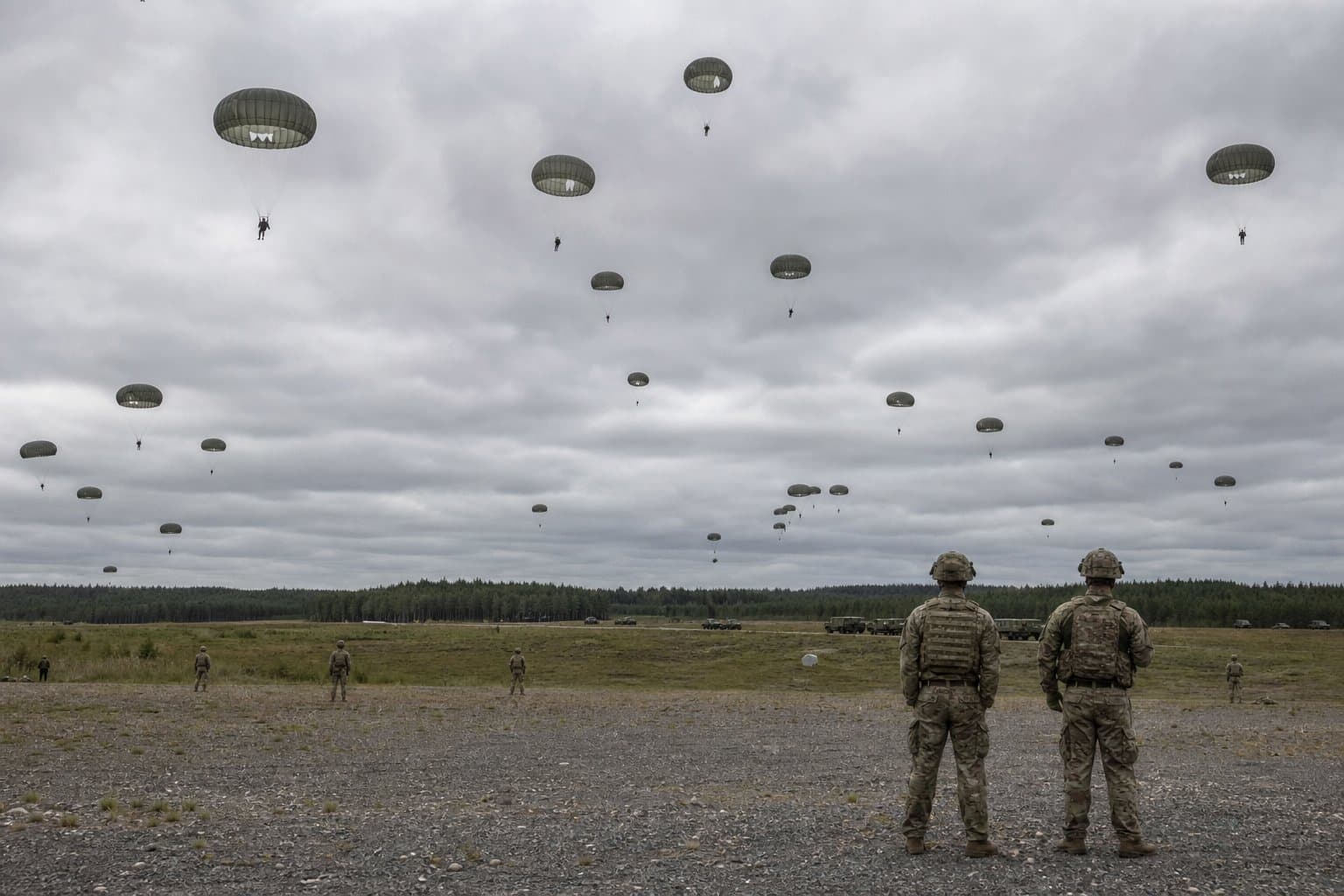
Alaska cavalry unit makes final jump before July rebirth as 1-511th PIR
Alaska's 1st Squadron, 40th Cavalry Regiment is becoming a parachute infantry battalion in July, and June 10 marked its last major jump under the cavalry designation. The unit conducted a joint forcible entry at Donnelly Drop Zone near Fort Greely, executing live TOW missile fires, 81mm mortars, and drone reconnaissance alongside U.S., Royal Air Force, Canadian, and New Zealand crews before reflagging as the 1st Battalion, 511th Parachute Infantry Regiment.
The June 10 operation came near the close of RED FLAG-Alaska 26-2, a large-force multinational exercise that ran May 28 to June 12 and involved about 2,100 service members and roughly 70 to 75 aircraft training across approximately 120,000 square miles of airspace within the Joint Pacific Alaska Range Complex, with operations at Joint Base Elmendorf-Richardson and Eielson Air Force Base. Alaska's ranges have hosted repeated high-end Arctic and Indo-Pacific readiness exercises, including RED FLAG-Alaska 26-1 in April and May, as the military expands its use of the state's training infrastructure. Not everyone welcomes that expansion: the Gwich'in Steering Committee and Interior Alaska rural residents and subsistence users have criticized large exercises for noise, low-flying aircraft, and disruption to wildlife, hunting, and fishing that affect their quality of life.
Lt. Col. Bryson Shipman, who served as both airborne and ground force commander, led the June 10 operation. The mission included seizing a forward landing strip and conducting an air assault to secure key objectives. "This is as close as you get without being in combat," Shipman said. "Joint forcible entry to seize an airfield, clear a forward landing strip, and then air assault to secure key infrastructure. This mission mirrors what the 11th Airborne Division would be called to execute in a large scale combat operation. The standard we set here is the standard we will be held to when it matters."
An earlier joint forcible entry on June 3 used a multinational airlift package of approximately 35 aircraft; the 517th Airlift Squadron and 36th Airlift Squadron transported 452 personnel from the 11th Airborne Division during that operation.
The reflagging is part of a broader Army transformation emphasizing Arctic operations and rapid deployment in the Indo-Pacific, not simply a ceremonial rename. The 511th designation revives World War II lineage: the 511th Parachute Infantry Regiment joined the 11th Airborne Division in 1943 and fought in the Pacific theater on Leyte and Luzon in 1944 and 1945. "Though we're still designated as a cavalry squadron, we have been training and operating as a parachute infantry battalion," Shipman said. "Our Paratroopers are already living the mission and setting the standard for what 1-511th Parachute Infantry Regiment will be."
Sources
Based on: View Transcript
AI-assisted, reviewed by editors. Spot an error?
Comments
Sign in to leave a comment.
No comments yet. Be the first to share your thoughts.