
AI image
AI is becoming Alaska's front page. It only knows the Alaska that's online.
The first AI answer many Alaskans see today does not come from opening ChatGPT. It shows up inside an ordinary Google search, above the links, before anyone has clicked a source.
Type a name, a district, or an issue into Google, and an AI-written summary may sit at the top of the page. Most people do not think of that as using artificial intelligence. They think they are searching. But that box comes from the same kind of model that powers a chatbot. Google says these AI Overviews now reach 1.5 billion people a month, across 200 countries and territories.
This is the quiet shift. AI is not replacing search. It is becoming the search result. And it does not act like a neutral directory. It works more like a compression layer over the web. It summarizes what is already written, what ranks high, what is recent, and what has enough online coverage to show up at all. In Alaska, that last part is the catch.
Two modes: summarize, or go quiet
A benchmark test ran this from inside Alaska. It asked the kind of question any resident deserves a clear answer to: who is running, and where do they stand.
From a clean browser in Valdez, Google's AI summaries showed up for the higher-profile statewide questions. They hedged, listed candidates, and leaned toward names with recent, well-covered records. But ask about the local state senate district, from inside that district, and no AI summary appeared at all. The page fell back to plain links, several of them about other races. Ask directly who to vote for, and it returned nothing.
That is the whole pattern in miniature. Where the coverage exists, the machine summarizes. Where it does not, the machine goes quiet.
The silence is measurable, and it tracks the news deserts
That test runs every day, across six consumer AI models, on voter-style questions about Alaska's 2026 races. The pattern holds. For the U.S. Senate race at the top of the ballot, the models refused to name any candidate 18 percent of the time. For the governor's race and a state senate district, they stayed silent more than half the time.
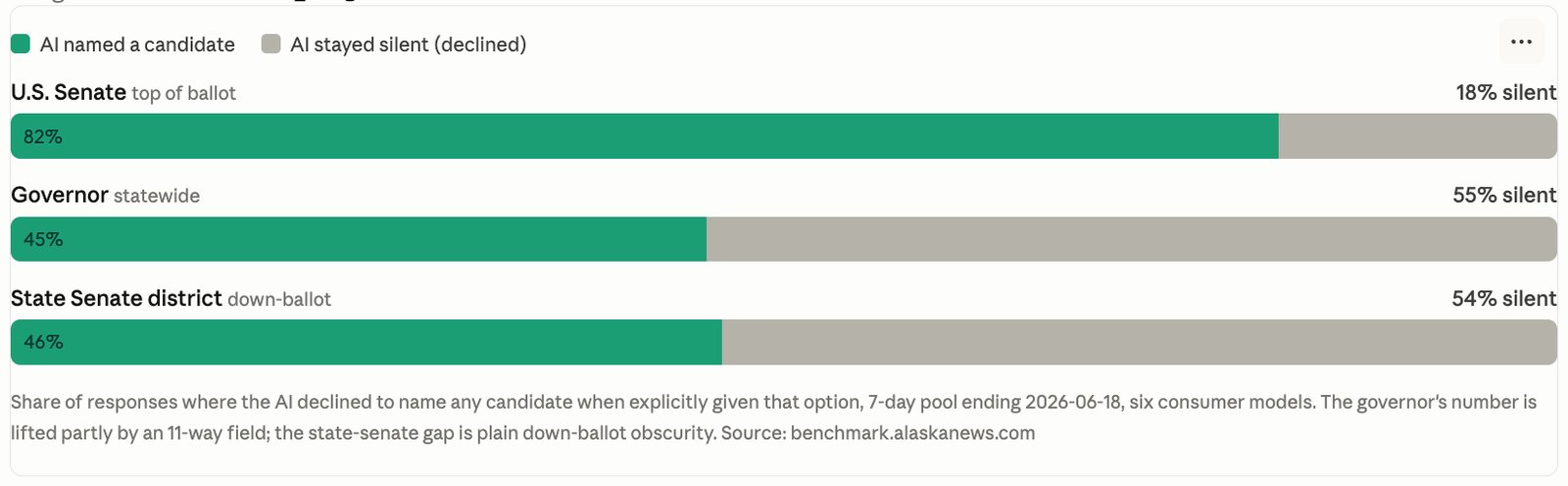
The silence is not the machine being careful. It is the machine reading a map. High-profile Alaska races have candidate pages, national mentions, and fresh links. Down-ballot races, in a state that has lost much of its local press, often have almost nothing for a model to read. The AI knows what the web knows. And the web does not cover Alaska evenly.
What the answer is really made of
Here is the part that should give pause to anyone who reads an AI summary as a verdict.
The answer is mostly not the model's judgment. It is retrieval. In one test, a single model changed which candidate it named on a contested cost-of-living question based only on how many web searches it was allowed to run. A shallow search surfaced one candidate. A deeper search surfaced another. The sample is small, one contested race, so hold it loosely. But the direction points to something bigger.
Almost no one runs the deep search. A voter sees the top result, or an AI summary of the top results. That is the shallow setting. And the shallow answer has a real author: whatever ranks first. A page of ten links at least shows you there are ten sources. An AI summary folds them into one confident paragraph and hides the ranking that picked it. Search ranking did not go away. It just got compressed into prose.
The same thing decides who the models lift up. In one statewide race the benchmark tracks, the chatbots named a front-runner that neither the latest public poll nor the betting market listed as a factor. The coverage was there, so the summary surfaced it. Being written about is not the same as being ahead. To a compression layer, the two look the same.
The AI we can measure is not the one that matters most
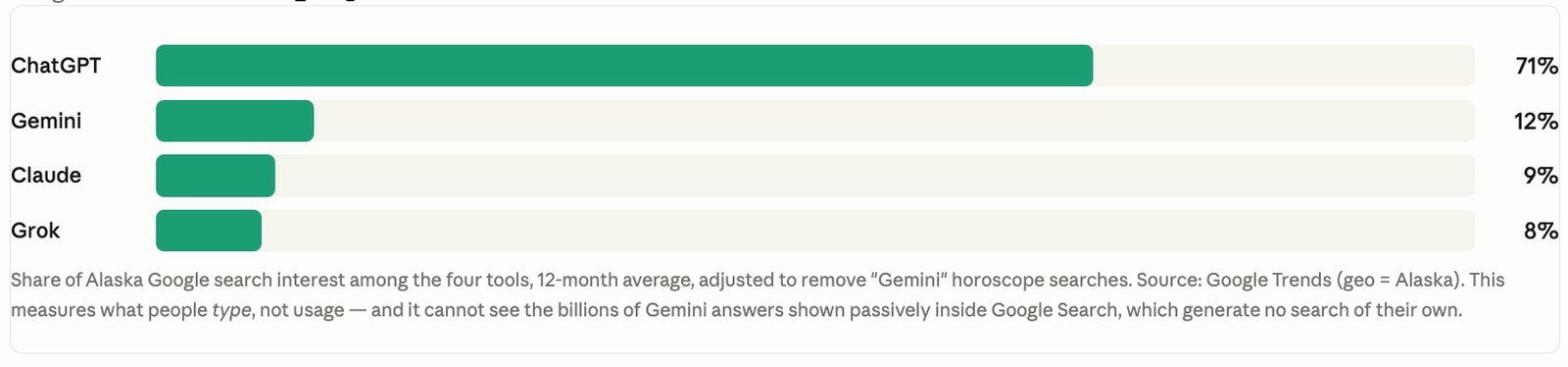
There is a twist worth naming. When Alaskans go looking for an AI tool, they overwhelmingly search for ChatGPT. Gemini, Claude, and Grok trail far behind. But that only counts the people who go looking. It misses the Gemini-powered answers Google drops into ordinary searches, which reach far more people and ask nothing of them. The AI that reaches the most Alaskans is not the one they would name. It is the one they never chose.
This is bigger than an election
Elections are just the visible test. The same machinery will shape what an AI answer says about a village school, a tribal health program, a fishery closure, a borough assembly vote, a wildfire, or a boil-water notice. If AI search becomes the first answer layer, the Alaska communities with the thinnest online record will be summarized poorly, ranked low, or skipped entirely. Not because they do not matter, but because the web never wrote them down.
What the benchmark measured, and what it did not
What it measured: how six consumer AI models answer Alaska questions, every day, with the sample sizes published. And, in clean-browser tests from inside Alaska, whether Google's search AI chooses to answer at all.
What it did not measure: how many Alaskans use each tool. No public state-level data exists for that. Search interest shows curiosity, not use. And the channel and depth tests are small and early. Read them as a direction, not a number.
Daily election benchmarking results are published at benchmark.alaskanews.com.
Source: AI is becoming Alaska's front page. It only knows the Alaska that's online. ().
Drafted with AI. Edited by Lucas Brown (1 revision). No full editor review is on record. Who is accountable.
Stay informed. Support what matters.
Free, permanent access to local news you can verify. Subscribe to support Melinda Communities.News and go ad-free.
Related Coverage
Two days out, AI chatbots, betting markets and polls each name a different Alaska frontrunner
Alaska News · 1mo ago
Alaska's newsroom is auditing what AI tells voters — and it keeps changing
Alaska News · 2mo ago
The AI money came first. The data center moratorium came Thursday.
Alaska News · 1mo ago
Cordova turns to posted notices after local newspaper closes
Alaska News · 2mo ago
A Democratic group brings AI-analyzed canvassing to Alaska's Senate race
Alaska News · 2mo ago
Comments
Sign in to leave a comment.
No comments yet. Be the first to share your thoughts.