
A judge weighs whether Alaska gets two Dan Sullivans
Alaska has, somehow, two men named Dan Sullivan trying to land on the same U.S. Senate ballot — and on Thursday, an Anchorage judge spent the better part of a day deciding whether the state can keep the second one off. A ruling is expected Friday.
The first Dan Sullivan is the sitting Republican U.S. Senator, in a race both parties see as a possible tipping point for control of the chamber. The second is Daniel J. Sullivan Jr., a retired schoolteacher from Petersburg who switched his party registration to Republican just before the deadline and asked to appear on the ballot as, simply, "Dan Sullivan." The state's elections director threw him off, ruling he hadn't filed in "good faith." He's fighting to get back on.
Alaska Superior Court Judge Thomas A. Matthews fast-tracked the case, citing "great public interest" and a looming print deadline, after the challenger appealed earlier in the week. There's almost no slack in the calendar: ballots are set to print at the end of June, and absentee ballots have to reach military and overseas voters in early July. Whoever loses Friday is expected to appeal right away — leaving the Alaska Supreme Court just days to decide whether two Dan Sullivans share the August 18 primary ballot.
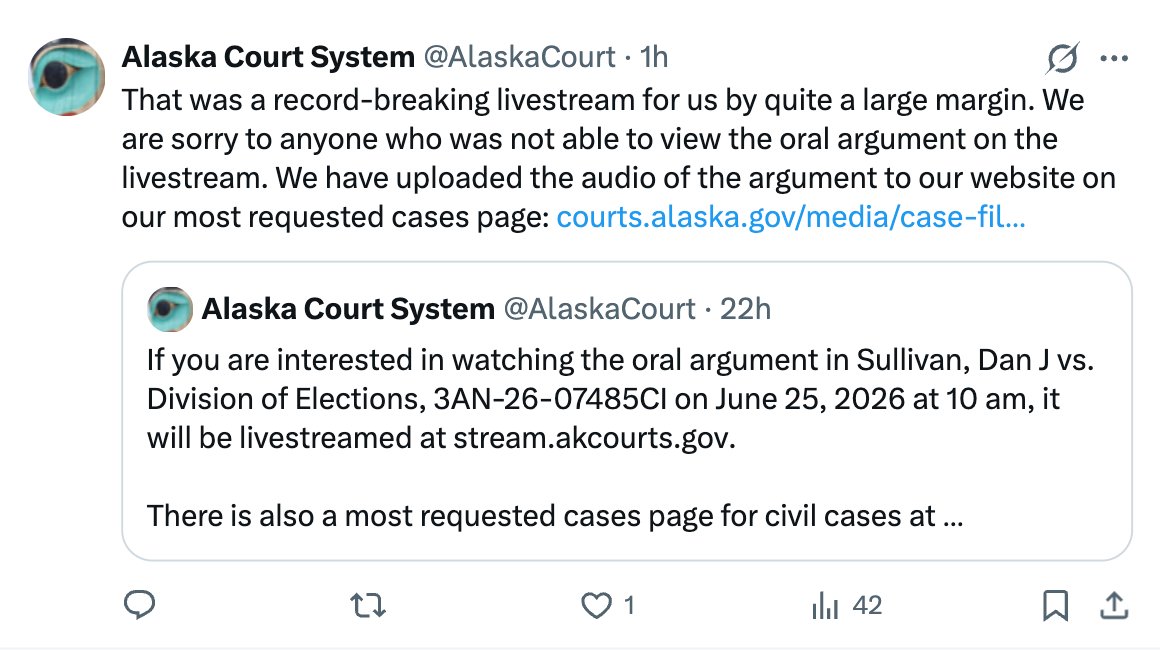
That "great public interest" wasn't only a figure of speech. So many Alaskans tried to watch the hearing that the court's livestream buckled. The Alaska Court System later called it a "record-breaking livestream for us by quite a large margin" and apologized to anyone shut out. A ballot-name dispute, it turns out, can draw a crowd.
In court, the two sides argued past each other about one basic question: what is a ballot really for?
The challenger's lawyer kept it simple. The Constitution lists only three things you need to run for Senate — be 30, be a citizen for nine years, and live in the state. His client checks all three boxes, and that, he argued, is the whole list. The state can't bolt on a fourth requirement like "good intentions" and then disqualify someone for failing a test the Constitution never set. The rules let the state decide how a name is printed on a ballot, he said — full name, middle initial, whatever avoids confusion — but not to bar a real person using his real name.
The state's lawyer flipped the frame. Yes, he said, this is about a fundamental right — but the right that counts is the voter's. A ballot exists to capture what voters actually mean to do, and the law tells the state to keep ballots fair, simple, and clear. Nothing in the Constitution, he argued, forces a state to print a deliberately confusing candidate and then clean up the mess afterward.
The judge zeroed in on the weak spot for both sides: if the state can reject a "confusing" candidacy, how is it supposed to measure that? Is there a real standard a court can hold the state to — or does it just let officials decide they don't like someone's reasons for running? That question may matter more than any legal precedent.
One loose end is still dangling. The challenger also asked the court to freeze ballot printing until everything's resolved, and the judge didn't rule on it. If the Supreme Court can't act before the presses roll, his lawyer signaled he'll be back asking to hit pause.
Judge Matthews promised a decision Friday, June 26, though he warned it might not come before the day's deadline. The primary is still weeks away on August 18 — but the ruling that decides whether Alaska sees one Dan Sullivan or two will likely land within days.
Stay informed. Support what matters.
Free, permanent access to local news you can verify. Subscribe to support Cale Green and go ad-free.
Related Coverage
A judge says Alaska can't keep the second Dan Sullivan off the Senate ballot
Alaska News · 2mo ago
Two Dan Sullivans, and a ballot solution the state wrote itself
Alaska News · 2mo ago
Alaska ballot will show two Dan Sullivans differently — here's what voters need to know
Alaska News · 2mo ago
Alaska Supreme Court puts Petersburg's Dan Sullivan back on August ballot
Alaska News · 2mo ago
The other Dan Sullivan case tests Alaska's election-law limits
Alaska News · 3mo ago
Comments
Sign in to leave a comment.
No comments yet. Be the first to share your thoughts.