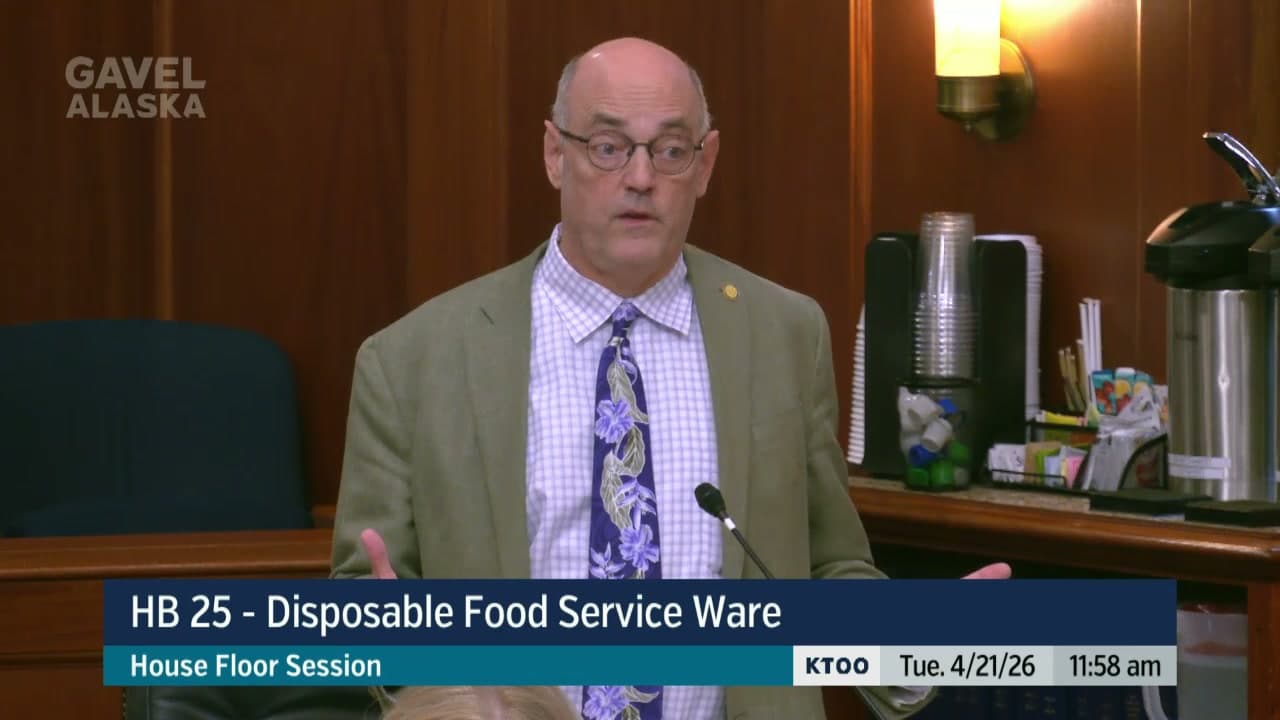
House Passes Polystyrene Ban for Restaurants Despite Business Concerns
The Alaska House of Representatives voted Tuesday to ban polystyrene foam food service containers in restaurants and food establishments statewide, passing House Bill 25 by a 25-15 margin after extensive debate over health risks, environmental impacts, and costs to small businesses.
The measure, which takes effect more than two years after passage, prohibits restaurants and food service operations from using expanded polystyrene, commonly known as Styrofoam, for takeout containers, cups, and similar items. The bill includes graduated enforcement starting with education and written notices, with fines ranging from zero for a first offense to $400 for a third violation.
Representative Andy Josephson, who introduced the legislation, told the House that polystyrene stands out among plastics for its toxicity. "It leaches its chemicals into food products and those chemicals can increase the risk of cancers such as leukemia and lymphoma and they damage white blood cells like lymphocytes," Josephson said. He noted that the National Toxicology Program called styrene "reasonably anticipated to be a human carcinogen."
Josephson said polystyrene cannot be recycled and breaks down into fragments that persist in the environment. "The main issue, along with its toxicity, is that it is not recyclable," he said. "It's friable, it breaks down, it goes into the environment, it's lightweight, and it blows away. And when fragmented, it can simply not be recovered."
Representative Ashley Carrick pointed to the long-term environmental consequences, particularly for Alaska's coastal communities. "The polystyrene takeout container that any one of us used 20 years ago is still in our environment today," Carrick said. "That polystyrene container has probably decomposed into teeny tiny little pieces that marine mammals in particular end up eating. The bioaccumulation in those marine mammals passes from mother to offspring, crosses their blood-brain barrier, and it crosses through breast milk from mother to offspring."
The bill received support from environmental organizations including Green Alaska Solutions, Alaska Community Action on Toxics, and Oceana, as well as recycling organizations across the state, including the Mid Valley Recycling Group, Big Lake Recycling Center, and Valley Community for Recycling Solutions.
Opponents raised concerns about the bill's narrow focus on Alaska businesses while exempting products packaged outside the state. Representative Justin Ruffridge argued the legislation unfairly targets local restaurants. "This is a ban on certain, one industry, food service, not using polystyrene," Ruffridge said. "This is narrowly, and I think the key word here is targeted, is targeted for Alaskan businesses specifically."
The Alaska Chamber of Commerce, Plastics Industry Association, and CHARR opposed the measure, joining industry groups like the Foodservice Packaging Institute in raising concerns about costs and regulatory burdens on businesses.
Representative Dan Saddler opposed the measure on economic and philosophical grounds. "This bill would actually mandate that private industry must use more expensive alternatives to polystyrene, which is already known to be inexpensive and effective and has been the industry standard," Saddler said. He added: "I oppose this on the philosophical grounds. Forgive me for using the term nanny state, but it is. This is using the power of government to force people to do things the government believes are best for you."
Representative Kevin McCabe questioned the bill's fiscal impact, noting that state agencies estimated costs between $1.8 million and $2.6 million. "This is how we increase our budget without even noticing it," McCabe said.
Supporters countered that alternatives are now widely available and often cost-competitive. Representative Rebecca Schwanke, a small business owner, said she found alternatives that were both better quality and cheaper. "I found an alternative that actually looked better, felt better, and it was cheaper," Schwanke said. "But only because I decided personally as a business owner to go down that path."
Representative Genevieve Mina cited recent research showing microplastics in Alaska waterways. "There's a recent study in South Central Alaska that tested 39 waterways. Microplastics were found in all of them," Mina said.
Three Alaska communities, Bethel, Seward, and Cordova, have already enacted local bans on polystyrene food service containers. Twelve states and more than 250 communities nationwide have implemented similar restrictions. Josephson noted that 31 percent of Americans now live in areas where polystyrene food service containers are banned.
The Department of Environmental Conservation will oversee enforcement through existing food safety inspection procedures. The bill allows the department to grant exemptions for restaurants in disaster areas and for certain circumstances where alternatives are not reasonably available.
The measure now moves to the Alaska Senate for consideration.
This article is based on a public meeting — Alaska Legislature: House Floor Session, 4/21/26, 10:30am ().
AI-assisted. How we use AI Transcript byLucas Brown
Stay informed. Support what matters.
Free, permanent access to local news you can verify. Subscribe to support Alaska News and go ad-free.
Related Coverage
Alaska Senate Passes Statewide Styrofoam Ban for Restaurants
Alaska News · 4mo ago
Alaska House bill to ban polystyrene food containers moves to Senate
Alaska News · 4mo ago
Alaska House passes tobacco age increase, vape tax, cigar lounge exemption
Alaska News · 4mo ago
Alaska House passes pay-card wage bill after fee provision removed
Alaska News · 4mo ago
Alaska House passes fisheries tax credit expansion unanimously
Alaska News · 4mo ago
Comments
Sign in to leave a comment.
No comments yet. Be the first to share your thoughts.