
AI image
Alaska asks for free civics lessons as a new graduation requirement approaches
Alaska's education department is asking for free civics lessons, tests and projects to post for schools as the state gets ready for a new graduation requirement. It starts with students who enter high school in fall 2027.
The department's request, issued Friday, seeks materials from publishers, nonprofits, educational institutions and content developers. Responses are due Nov. 6. The department says it will rate what comes in and choose which to share on its website. The request commits the state to buy nothing, and only free materials will be considered.
Under the new law, students who enter ninth grade on or after July 1, 2027, can't get a diploma unless they've been taught 14 civics topics and score at least 70 percent in one of three ways: a one-semester course, a civics test they can retake as often as needed or a project-based assessment.
Students who transfer in from another state after 10th grade, and students with disabilities who get a waiver, can be exempted. The law also has the department create a "seal of civic readiness" for the transcripts and diplomas of students who show high proficiency.
The law doesn't have the state write a course or a test. It requires a list of existing free materials, which the state Board of Education must post on the department's website and keep updated. Districts may use it.
That's a smaller job than the bill first called for. Earlier versions would have had the state build a statewide civics course and a 100-question test based on the civics portion of the U.S. citizenship exam, which the department estimated would cost about $837,000 in the first year. A rewrite in the House Education Committee dropped that work and cut the estimate to $58,000, according to the department's fiscal notes.
Sen. Gary Stevens of Kodiak sponsored the bill after a decade-long push. The House passed it 37-3 in May, Alaska News reported May 19, and it became law without the governor's signature June 18. Rep. Nellie Unangiq Jimmie, one of the three no votes, said it failed to acknowledge Indigenous contributions to American government.
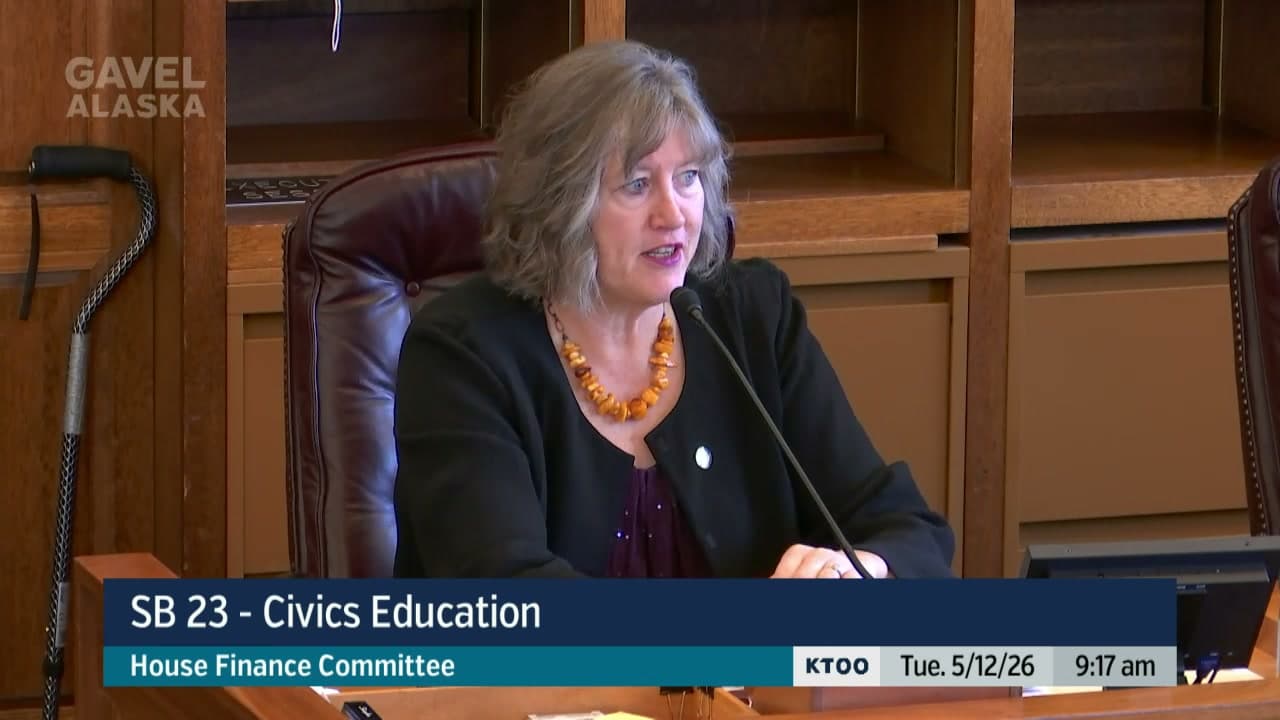
At a House Finance hearing in May, Stevens' aide Tim Lampkin said the requirement would fit within existing social studies credits. "This isn't creating anything new," he said, as Alaska News reported May 13.
The 14 topics run from founding documents and federalism to the Alaska Constitution, campaigns and elections, foreign policy and systems of government used around the world and by Alaska Natives. Submissions must show where and how each resource covers them. Only open educational resources qualify, meaning materials anyone can use at no cost and freely reuse, adapt and share.
A rubric attached to the request rates each submission on eight criteria, among them whether it is viewpoint-neutral and whether it reflects Alaska's people and history, including Alaska Native experiences. Civic participation activities should be "designed to support student agency rather than promote a particular political position or outcome," it says.
What did you make of this story? (no account needed)
Made by our human newsroom with AI. Reviewed by Cale Green. How humans and AI work here · Grow with our newsroom ·
Keep Alaska News free for everyone.
No paywall, ever. Members pay so everyone can read the meetings and records Alaska News covers.
Get Alaska News in your inbox
Create your free account and get the day’s top stories around 6 each morning, in a few minutes’ read.
Top stories, around 6 each morning.
Stories on what you follow, on Sundays.
Source: Alaska Department of Education and Early Development, State starts building the free civics materials list required by the new graduation law; submissions due Nov. 6.
Earlier in this story
House Passes Civics Education Bill After Decade-Long Push
The Alaska House of Representatives voted 37-3 Tuesday to pass legislation requiring civics education and new graduation requirements. The bill has been pursued for a decade.
The bill — House Committee Substitute for Senate Bill 23 — passed after amendments on career and technical education programs were withdrawn to keep the bill focused on civics. SB 23 would require a high school social studies course and a civics assessment exam for graduation, and tasks the State Board of Education and Early Development with providing educational resources at no cost to assist school districts that opt to develop curriculum, assessments, and lesson plans.
Comparable measures in other states include Massachusetts legislation enacted in 2018 that requires civics education using founding documents and local government content with student-led projects. Federal funding for civics and history under the main competitive grant program fell from roughly $30 million in 2010 to under $5 million by 2020, before Congress increased it to about $23 million per year in 2024.
Representative Nellie Unangiq Jimmie voted against the bill. She cited the lack of acknowledgment of Indigenous contributions to American governance. Jimmie said the bill is missing historical facts that would be taught. She said the government adopted the Iroquois way of governance.
Floor debate highlighted the bill's emphasis on teaching about the founding fathers and founding documents. One representative said the bill is specific in requiring instruction on founding documents. The representative noted that many young people are unfamiliar with materials such as the Federalist Papers. The bill codifies what many districts already do regarding minimum graduation requirements. It emphasizes civics education for Alaska students.
Representative David Nelson said the bill represented a fitting conclusion to his legislative tenure. Nelson said if this is one of the last bills he co-sponsors in his tenure in the state legislature, he thinks that is pretty good.
Representative Bill Elam withdrew an amendment that would have added career and technical education grant opportunities to the bill. Elam said he talked to the underlying bill sponsor for civics. He said civics is a really important subject and he supports the bill that came over from the other body. He said he appreciates the work the sponsor did. Elam said he realizes his amendment adds complications and probably jeopardizes the function of the civics bill.
The bill represents a decade-long effort by a member of the Senate from Kodiak. During floor debate, supporters noted the legislation aligns with the upcoming 250th anniversary of American independence.
The House adopted the effective date clause by the same 37-3 vote.














Comments
Sign in to leave a comment.
No comments yet. Be the first to share your thoughts.